Y. Z. Kami
Y. Z. Kami, Painter of Luminous Inner Worlds
Artist Spotlight · The Collection Editorial
In the grand, light flooded galleries of Gagosian, where the art world's most discerning eyes regularly converge, Y. Z. Kami's portraits have a way of stopping people mid stride. There is something almost impossible about what he achieves on canvas: a face rendered so close, so large, so softly present that the viewer feels not like a spectator but a witness to something private and sacred.
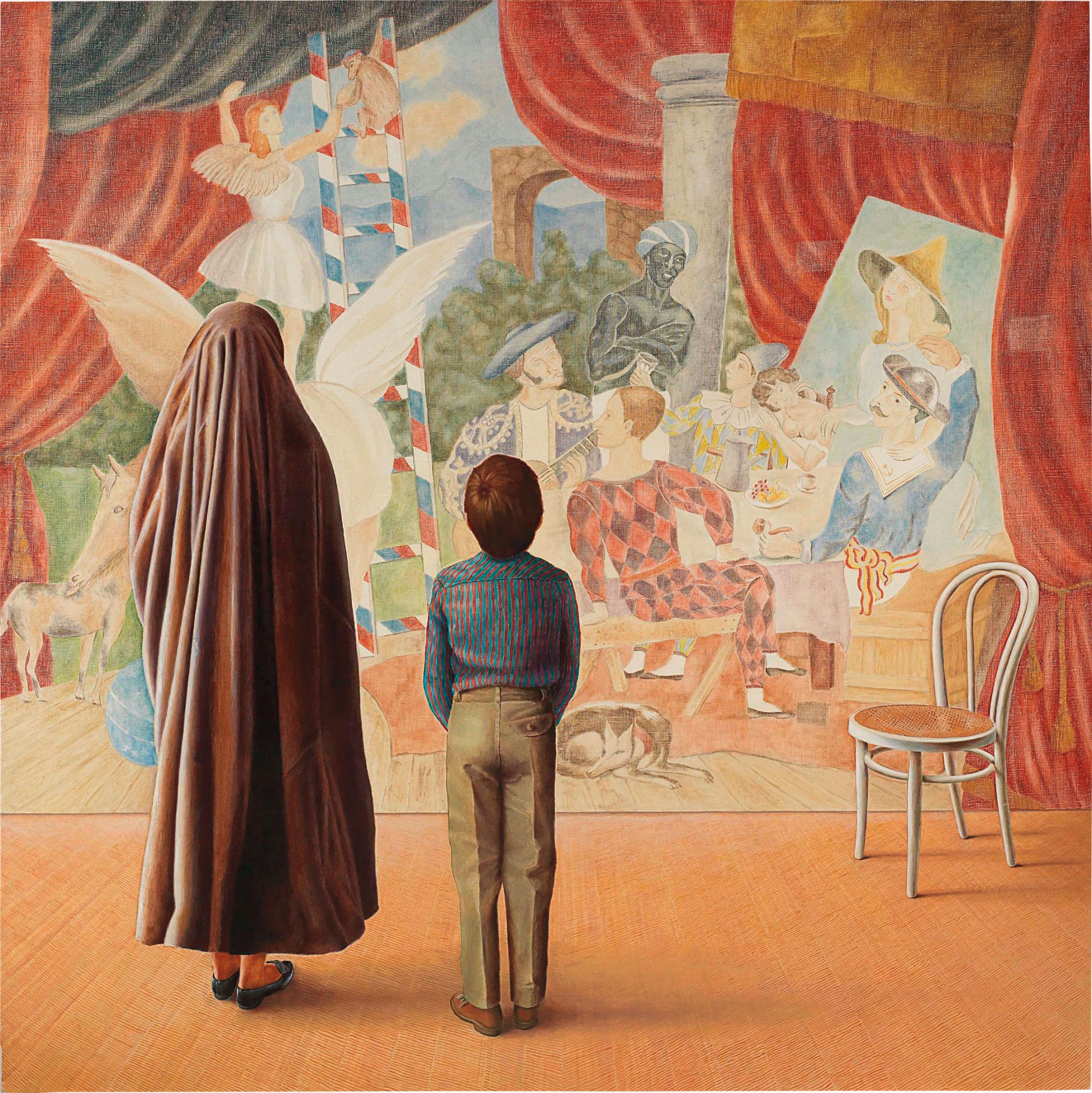
Y. Z. Kami
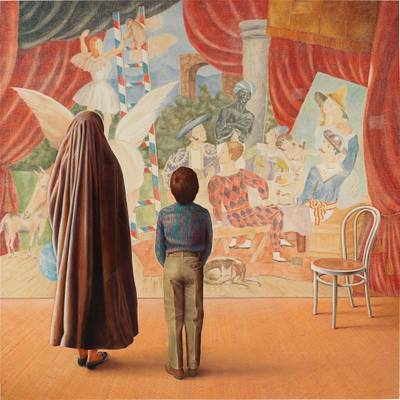
Nane and Kami in front of Picasso's Parade
His continued presence in major institutional and gallery exhibitions across New York, London, and beyond speaks to an artist whose relevance only deepens with time, whose quietude grows louder the more frantic the contemporary moment becomes. Kami was born in Tehran in 1956, into a culture saturated with a rich tradition of spiritual poetry, intricate calligraphy, and an aesthetic philosophy in which beauty and the divine are never far apart. He came of age in Iran before eventually making his way to Paris and then New York, where he has been based for decades. That journey between worlds, between the Persian sensibility of his formation and the Western modernism he encountered in his education and adopted city, did not produce a fractured identity but rather a singularly integrated one.
The tension between East and West in his work is not a tension at all, on closer inspection. It is a conversation, patient and generous, conducted across centuries of visual culture. Kami studied at the University of California, Berkeley, and later in Paris, absorbing influences from Byzantine icon painting, Sufi mysticism, Renaissance portraiture, and the meditative traditions of the East. These are not casual references but structural ones, built into the very architecture of how he makes a picture.
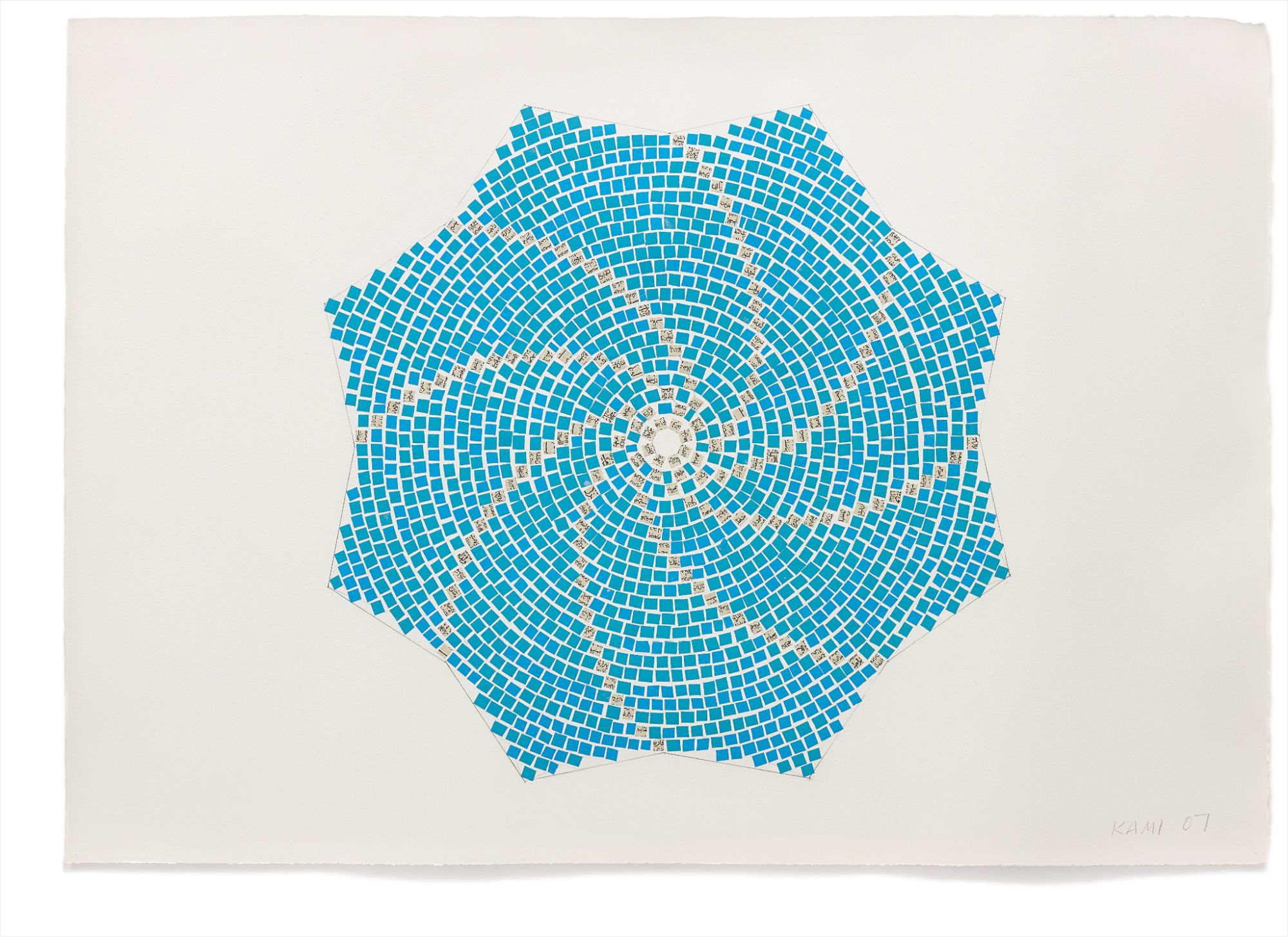
Y. Z. Kami
Endless Prayers
His early development was marked by a serious engagement with the history of the portrait as a form, asking what it means to render a face at a time when photography has seemingly made painting obsolete as a means of likeness. His answer, which he has spent decades elaborating, is that painting can reach something the camera cannot: the interior life, the soul, the ineffable quality of presence. The works that established Kami's international reputation are his monumental portraits, canvases that can rise to eight or ten feet, presenting a single face in close up with features slightly softened, slightly out of focus, as though seen in a moment just before or after waking. This deliberate blurring is not evasion but invitation.
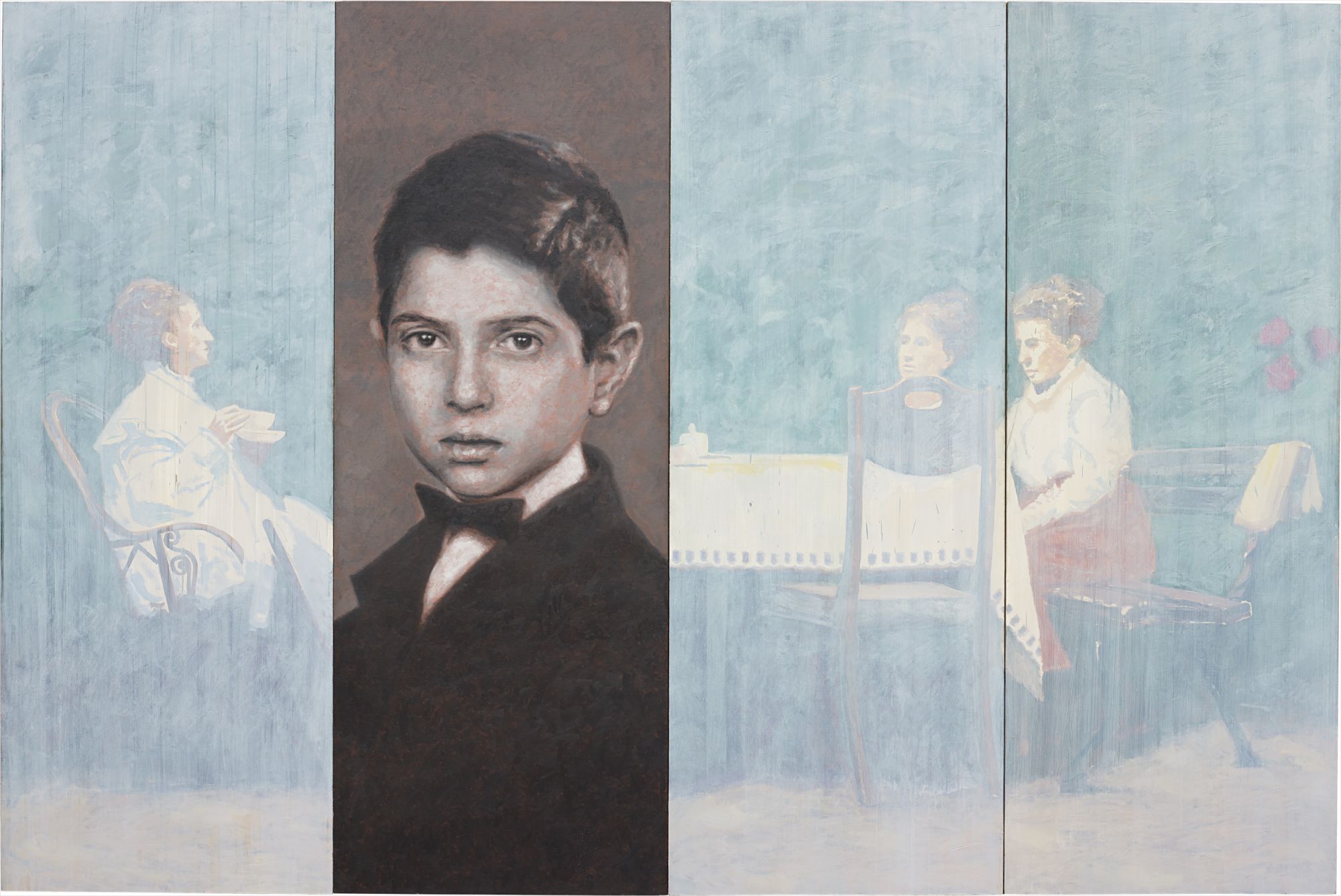
It removes the portrait from the realm of the documentary and places it somewhere closer to the visionary. The effect owes something to the long exposure photographs of the nineteenth century, something to the haze of memory, and something entirely to Kami's own spiritual and painterly sensibility. These are faces that radiate, that hold light rather than merely reflect it. Among the works that collectors and curators return to again and again is the deeply personal "Self Portrait as a Child," executed in oil and graphite on panel in four parts.
Y. Z. Kami
Self-Portrait as a Child
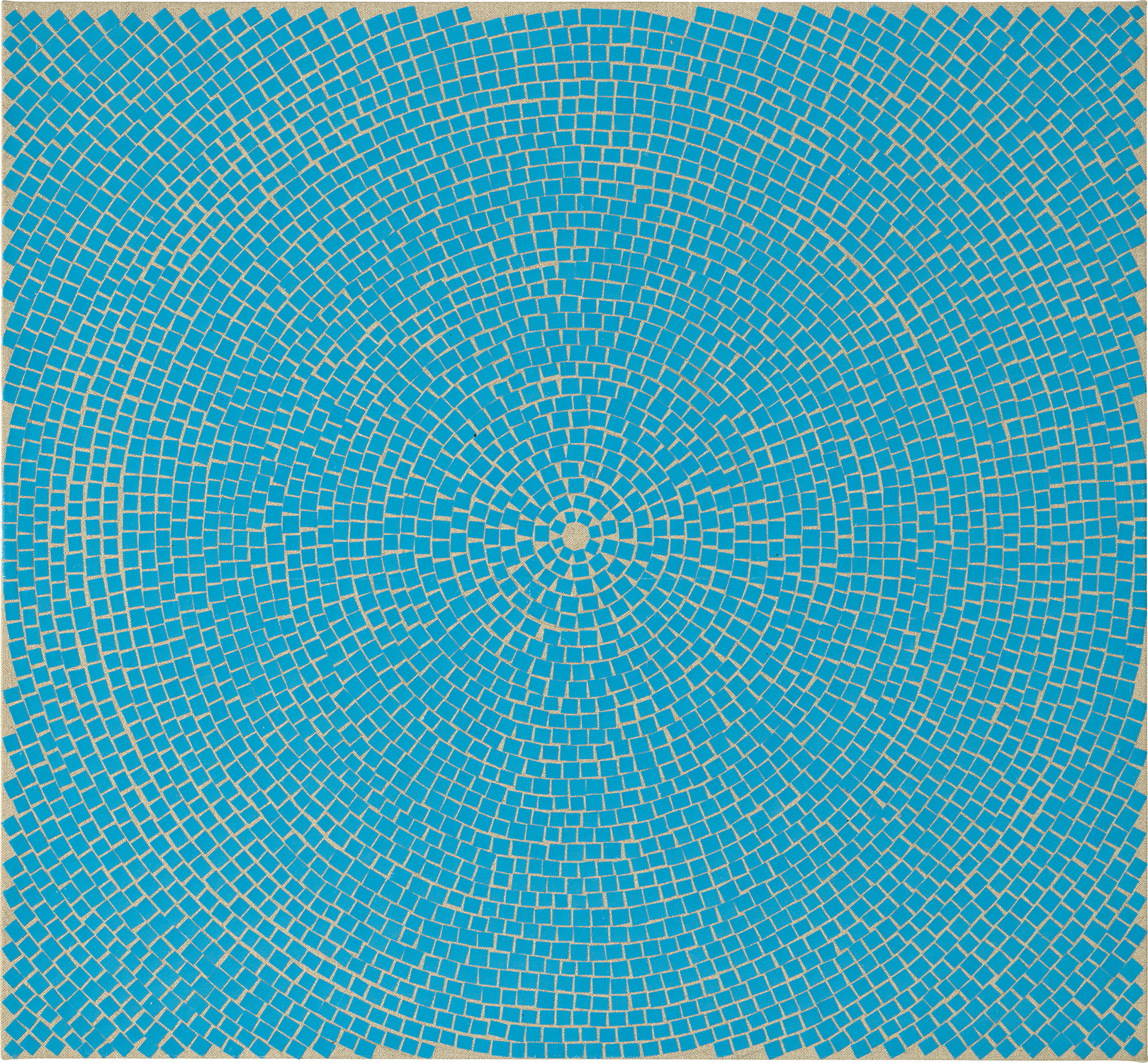
The multi panel structure gives the work a reliquary quality, as though the artist's own early selfhood is being preserved and honored with the reverence one might bring to sacred objects. "Nane and Kami in Front of Picasso's Parade" is another work of remarkable richness, placing the artist and a beloved figure before one of modernism's great theatrical masterpieces and finding in that encounter a meditation on art, memory, and inheritance. His "Endless Prayers" series, rendered in collage and pencil on paper, draws directly on the visual language of Islamic devotional practice, with repeating forms and calligraphic gestures that accumulate into something luminous and transcendent. "Blue Dome II," from 2009, brings architectural grandeur into his contemplative universe, the interior of a domed space becoming a kind of celestial field, a heaven the eye can enter.
From a collecting perspective, Kami occupies a position that is both singular and historically grounded. His work is held in significant public and private collections internationally, and his association with Gagosian, one of the world's most prestigious galleries, reflects the seriousness with which the market and the institution regard his practice. Collectors are drawn to the combination of intimacy and scale in his paintings, the sense that one is acquiring not merely a beautiful object but a portal, something that changes the room it inhabits and the consciousness of anyone who spends time with it. For those beginning to look at his work, the works on paper and the photographic pieces offer entry points that are deeply rewarding while also representing a more accessible range of his wide output.
Y. Z. Kami
Blue Dome II, 2009
In art historical terms, Kami belongs to a distinguished lineage of painters who have used the portrait to ask metaphysical questions. One thinks of Luc Tuymans, whose faces also carry a freight of silence and unease, though Kami's register is warmer, more devotional. There are affinities with the luminous surfaces of Gerhard Richter's photo paintings, with the spiritual ambition of Mark Rothko's late chapel works, and with the meditative portraiture of Chuck Close, though Kami's interests are ultimately more Eastern, more rooted in the idea that seeing a face is an act of prayer. He is an artist who bridges traditions not by blending them indiscriminately but by finding the places where they speak the same essential language.
What makes Y. Z. Kami matter so urgently now is precisely what has always made him matter: his refusal to be hurried. In an art world that prizes spectacle, disruption, and speed, his paintings insist on duration, on the slow accumulation of meaning that happens when you stay with something.
His work asks the viewer to be present in a way that few contemporary painters demand, and it rewards that presence extravagantly. For collectors and institutions building collections that speak not just to this moment but to the longer arc of human experience, Kami is an essential voice. To stand before one of his great portraits is to be reminded that painting, at its most serious and most beautiful, has always been about what it means to see another human being and, in doing so, to know something more about yourself.
Explore books about Y. Z. Kami