William Strang

William Strang, The Master Who Saw Everything
Artist Spotlight · The Collection Editorial
There is a particular pleasure in rediscovering an artist who was, in his own time, considered essential. William Strang occupied exactly that position in British art at the turn of the twentieth century, a printmaker and portraitist of such penetrating vision that his sitters included some of the most celebrated minds of the age. To look at his drypoint of George Bernard Shaw from 1907, or his etched portrait of Rudyard Kipling from 1898, is to understand immediately why Strang was sought after: he did not flatter, he revealed. And in that revelation, he created images that feel as urgent and alive today as they did when the needle first scored the copper plate.
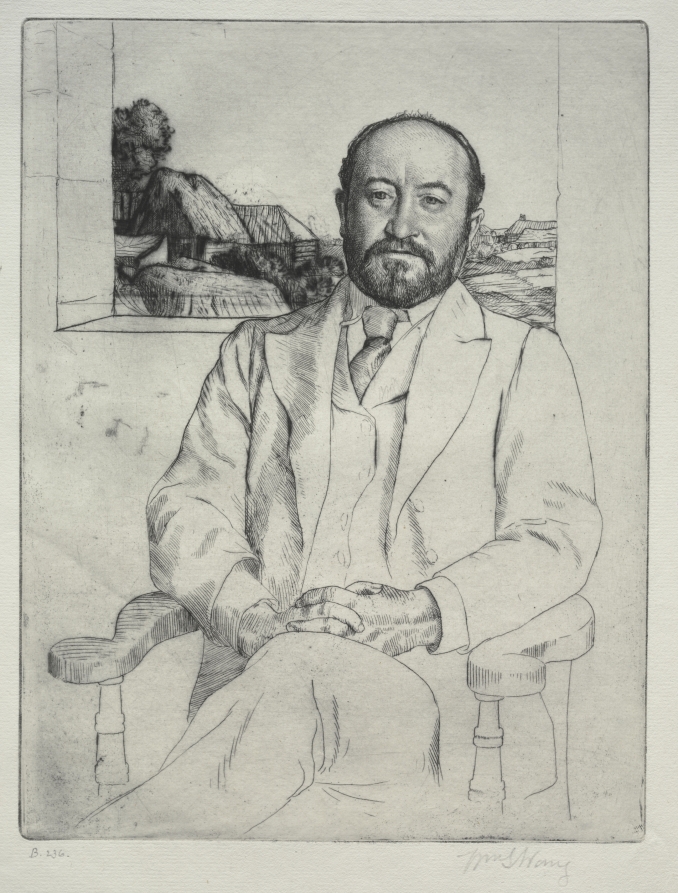
William Strang
C. J. Knowles, 1894
William Strang was born in Dumbarton, Scotland, in 1859, the son of a builder, and his early formation bears all the marks of a serious, industrious character shaped by the Scottish working landscape. He moved to London in 1875 to study at the Slade School of Fine Art, where he came under the direct influence of Alphonse Legros, the French artist who had settled in England and who would prove to be the single most decisive force in shaping Strang's technical and philosophical approach to art. Legros was a devotee of the etching revival then sweeping through European printmaking, and he instilled in his students a deep reverence for line, for the integrity of direct mark making, and for the expressive possibilities of intaglio processes. Strang absorbed these lessons completely and built upon them with an ambition that quickly distinguished him from his peers.
His early career was marked by an extraordinarily prolific engagement with etching, and by the mid 1880s he had already produced work of considerable power. His self portrait from 1885 is a remarkable document, the gaze direct and assessing, the line work confident without being showy, the whole image radiating the concentrated self possession of a young artist who knows precisely what he is doing. By this point Strang had joined the Royal Society of Painter Etchers and Engravers, and he was exhibiting regularly in London, building a reputation that would only deepen over the following decades. His printmaking practice expanded to encompass drypoint and mezzotint alongside etching, and he became known for the tonal richness he could coax from each medium.
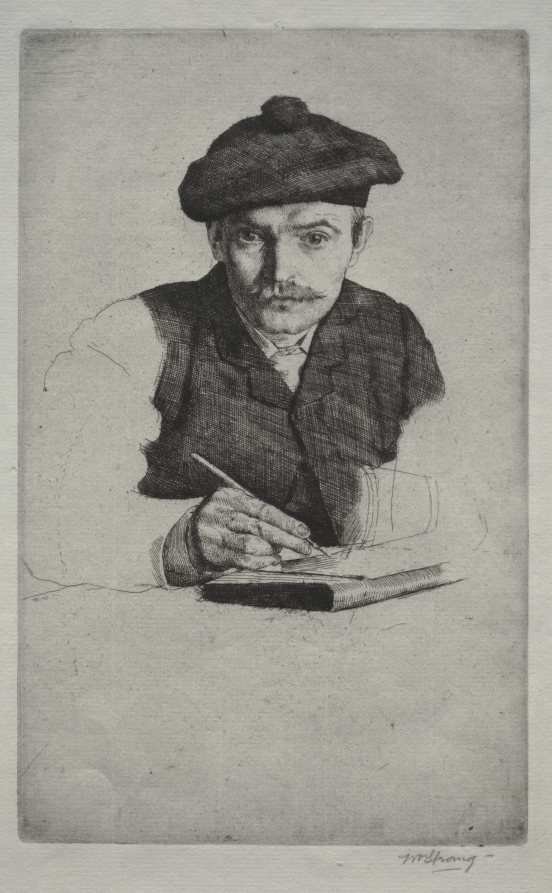
William Strang
Self-Portrait, 1885
Among the works that define his achievement, the portraits of literary and intellectual figures stand as a particular triumph. The drypoint of Rudyard Kipling, made in 1898 when Kipling was at the height of his fame, is a masterclass in psychological portraiture: the set of the jaw, the weight of the gaze, the sense of a formidable intelligence caught in a moment of stillness. The George Bernard Shaw drypoint of 1907 is equally arresting, capturing that famous wit and sharpness without reducing the sitter to caricature. Strang also turned his attention to figures within the art world itself, producing a memorable drypoint of Frederick Goulding in 1906 and a compelling portrait of Sir Charles Holroyd in 1909, works that speak to his deep embeddedness in the professional artistic culture of Edwardian London.
His portrait of the Right Honourable Joseph Austen Chamberlain from 1903 demonstrates his ease moving between artistic and political circles, producing images that carry genuine documentary weight. Beyond portraiture, Strang pursued a rich vein of subject matter that reveals the full breadth of his imagination. The Woodman from 1881 is one of his finest early achievements, an etching that brings a monumental dignity to a humble rural subject, the figure rendered with a sculptural solidity that recalls Millet while remaining entirely Strang's own voice. He also worked extensively in graphite, and works on paper such as the Reclining Nude demonstrate his command of drawing as a discipline in its own right, not merely preparation for printmaking but a fully realized expressive act.
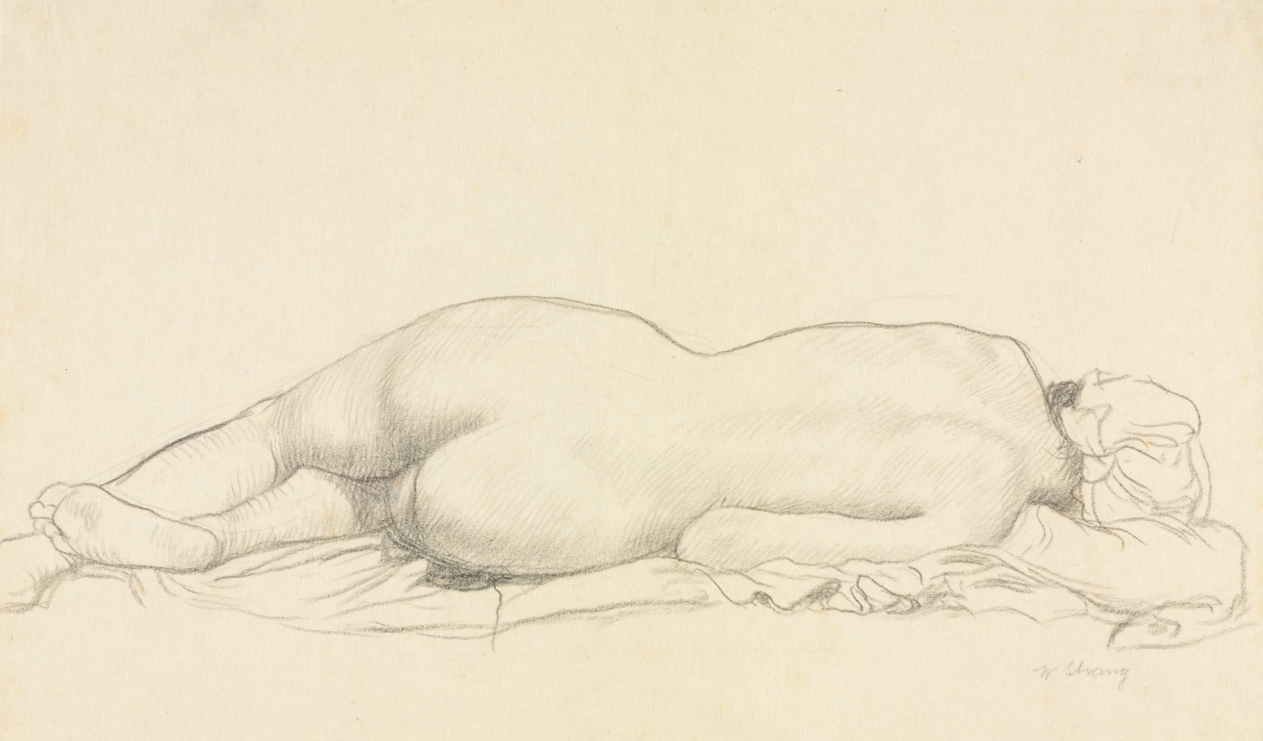
William Strang
Reclining Nude, 1874
Throughout his career he maintained a parallel practice in oil painting, receiving election as a full member of the Royal Academy in 1921, the year of his death, a recognition that felt both deserved and, to those who admired him, somewhat belated. For collectors, Strang represents an opportunity of genuine distinction. His prints appear with some regularity at auction and through specialist dealers in British works on paper, and they consistently reward close attention. The quality of impression matters enormously with intaglio work of this period, and Strang's finest proofs, pulled with care and often on papers he selected personally, have a presence that reproductions cannot convey.
Collectors drawn to the late Victorian and Edwardian printmaking tradition, and to the broader etching revival that encompassed figures such as Francis Seymour Haden, James McNeill Whistler, and Frank Short, will find in Strang a practitioner of comparable seriousness and considerably underappreciated depth. His portrait subjects also give his work an additional layer of historical interest: to own a Strang portrait of Kipling or Shaw is to own a primary document of cultural life at one of its most fertile moments. Understanding Strang within the larger map of British printmaking means placing him at a genuine crossroads. He inherited the rigorous continental tradition through Legros, absorbed the aesthetic ambitions of the etching revival that Whistler had done so much to energize, and brought to all of it a distinctly northern directness that owes something to Rembrandt, whom he deeply admired, and something to the Scottish moral seriousness of his origins.
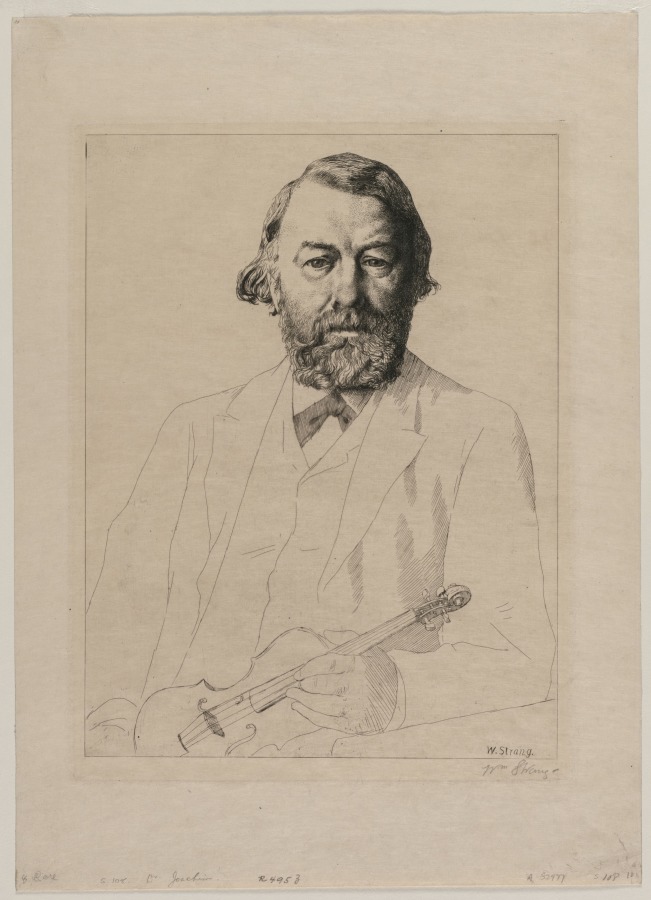
William Strang
Dr. Joachim, 1887
He was a friend and collaborator within a rich artistic network, and his work in portraiture places him in productive dialogue with John Singer Sargent and Walter Sickert, artists who were similarly obsessed with the problem of capturing a living presence on a flat surface. William Strang died in 1921, leaving behind a body of work that numbers in the hundreds of prints alongside paintings, drawings, and book illustrations, a legacy of sustained creative intelligence that deserves far more attention than it currently receives. The renewed interest in British art of the late nineteenth and early twentieth centuries, driven in part by major institutional exhibitions and by a broader reassessment of what that era produced, has created exactly the right moment to look again at Strang with fresh eyes. He was, by any serious measure, one of the finest printmakers these islands produced, and his portraits in particular are among the most penetrating images of their age.
To collect Strang is to collect with discernment, to choose depth over fashion, and to participate in the rediscovery of a truly essential voice.
Explore books about William Strang
William Strang: A Catalogue Raisonné of his Prints
David Goodall
William Strang: His Life and Art
James Greig
The Etchings of William Strang
David Goodall
Scottish Painters: William Strang
Caw, James L.
William Strang: A Critical Study
Campbell, Colin