William Pope.L
William Pope.L, America's Most Generous Provocateur
Artist Spotlight · The Collection Editorial
“Failure is underrated. I'm interested in the productive aspects of failure.”
William Pope.L, interview
In 2019, the Museum of Modern Art in New York presented 'Trinket,' a large scale installation by William Pope.L that filled the atrium with thousands of copies of The Wall Street Journal slowly composting in water. The work was visceral, patient, and deeply funny in the way that only the most serious art can be. It announced, to anyone who needed reminding, that Pope.
William Pope.L
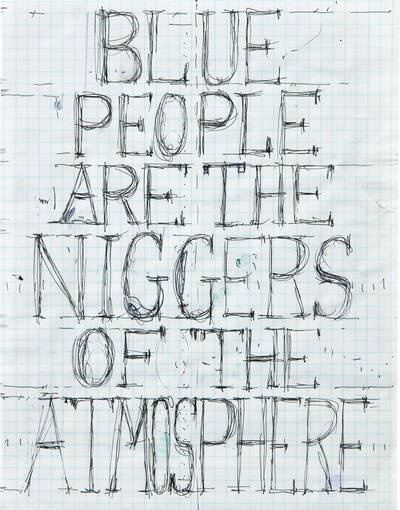
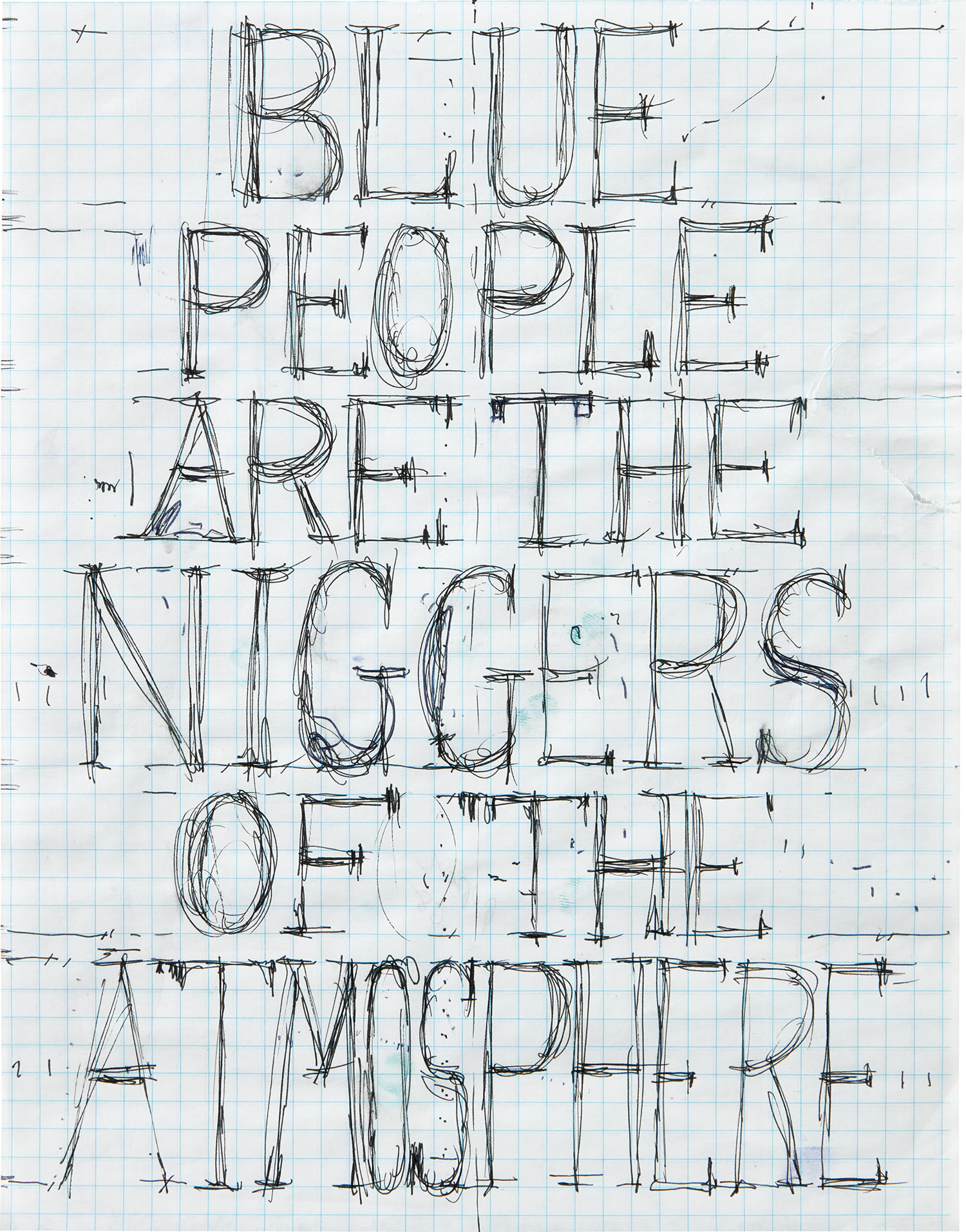
Blue People are the Niggers of the Atmosphere
L remains one of the essential voices in American contemporary art, an artist whose practice has only grown more urgent and more capacious with time. William Pope.L was born in Newark, New Jersey in 1955, and his formation as an artist is inseparable from the social and political landscape of that city and that era. Newark in the 1960s and 1970s was a place of profound tension and extraordinary cultural energy, scarred by the 1967 uprisings and shaped by a Black community asserting its political identity with fierce clarity.
Pope.L absorbed all of it. He went on to study at Pratt Institute in Brooklyn and later earned his MFA from Rutgers University, where he encountered the legacy of Allan Kaprow and the Happenings tradition. That lineage matters because it gave Pope.
William Pope.L
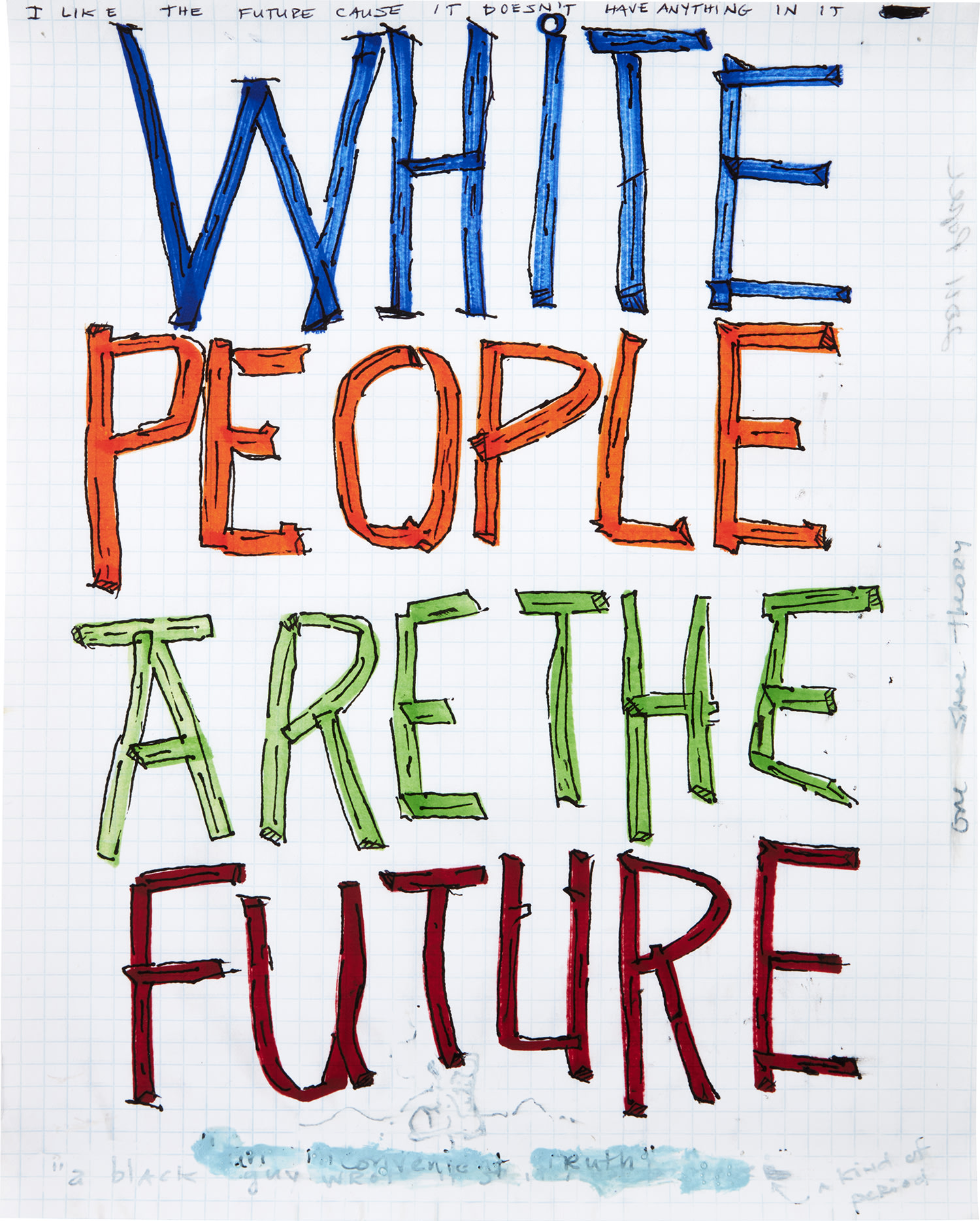
Skin Set Drawing: White People Are The Future
L a rigorous conceptual framework within which to pursue performance as a primary language, not as spectacle but as sustained, embodied inquiry. His artistic development through the 1980s and 1990s traces a path from the downtown New York performance scene into something entirely his own. Pope.L became a regular presence at Franklin Furnace Archive in Brooklyn, one of the great incubators of avant garde performance in America, and it was there that he began to develop the durational logic that defines his most celebrated work.
He also taught for many years at Bates College in Maine, and later at the University of Chicago, where his influence on younger generations of artists has been profound. Teaching, for Pope.L, is not separate from making. It is another form of the same generosity that runs through everything he does.
William Pope.L
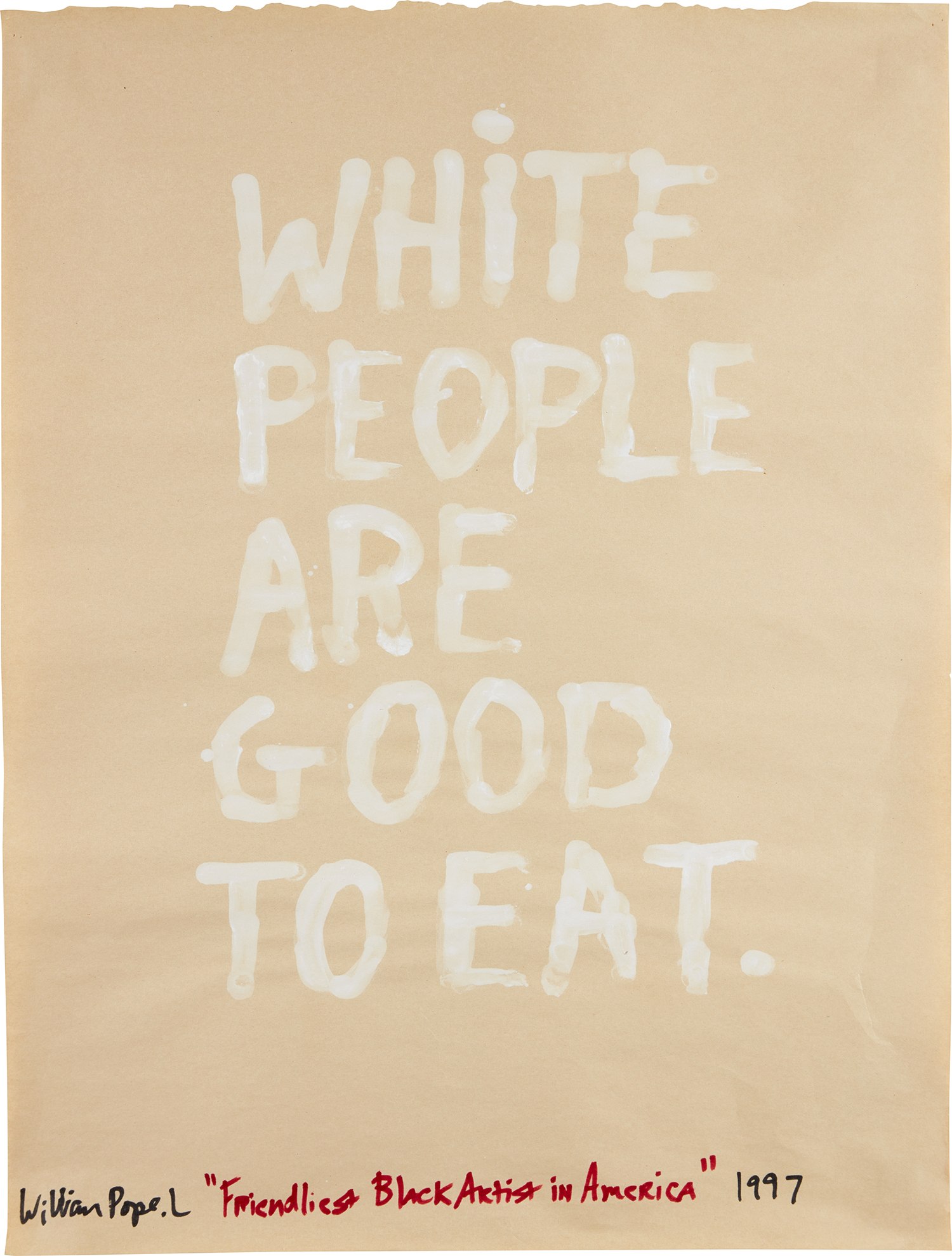
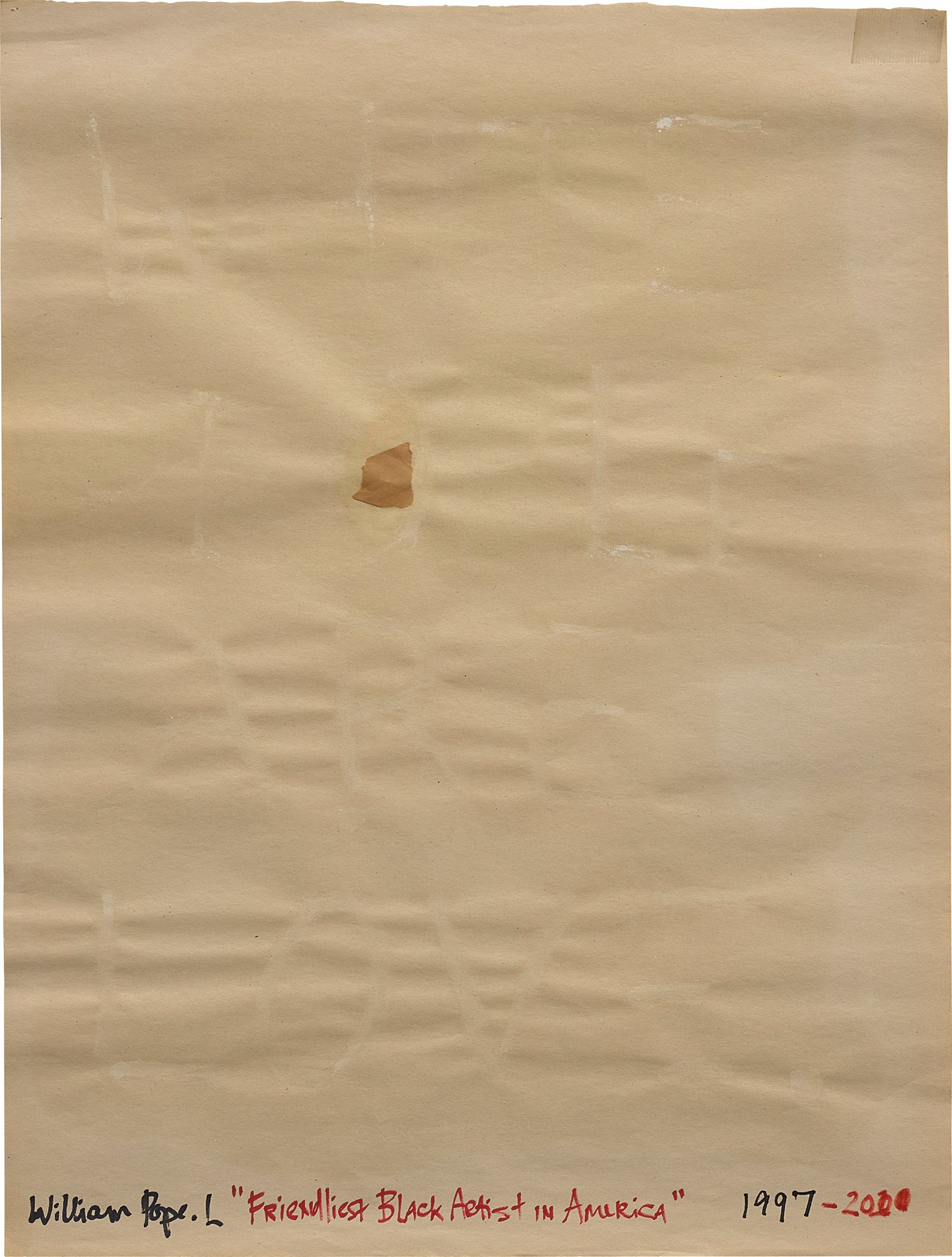
Friendliest Black Artist in America
The crawl performances, which Pope.L began in the early 1990s and has continued across decades, are the works for which he is most widely known, and they reward sustained attention. In pieces such as 'The Great White Way' (2001 to 2009), he crawled the entire length of Broadway in Manhattan over a series of staged sessions, wearing a Superman costume and carrying a skateboard. The image is indelible: a Black man in the most iconic American superhero costume, flattened against the pavement of the most famous street in the world, moving at the speed of pure persistence.
The crawls are not about suffering for its own sake. They are about revealing the structures that normally remain invisible, the way public space is organized, who it belongs to, who it excludes, and what the body must do to make those questions visible. The works available on The Collection offer a different and equally rewarding facet of Pope.L's practice.
William Pope.L
White People Are Love, 1997
His works on paper and his paintings carry the same conceptual intensity as the performances, delivered in a register that is more intimate and, in some ways, more confrontational. 'Friendliest Black Artist in America,' rendered in gouache and marker on brown wove paper, deploys the language of branding and self promotion with a deadpan wit that cuts in multiple directions at once. The title, which Pope.L has used as a kind of ongoing alter ego since the 1990s, reclaims stereotype through exaggeration and invites the viewer into an uncomfortable and productive relationship with their own assumptions.
'White People Are Love' (1997), a collage combining gouache with plastic and paper on paper, belongs to a series in which Pope.L systematically interrogates racial categories through the most banal and charged language imaginable. These are not slogans. They are philosophical propositions dressed up as absurdist wordplay.
'Skin Set Drawing: White People Are The Future' continues this investigation, printed as an archival pigment print on wove paper, and stands as a document of one of the most sustained and searching meditations on race in the history of American art. The 'Failure Drawing' series, including the work dated from 2005 executed in mixed media on tissue paper within the artist's own frame, reveals yet another dimension: a tenderness toward the fragile and the contingent that balances his more confrontational gestures. For collectors, Pope.L represents a remarkable opportunity to engage with an artist who has achieved canonical status without ever becoming comfortable or predictable.
His works on paper are among the most compelling examples of how conceptual practice can inhabit a relatively modest format without any loss of ambition. The 'Intimacy Project,' a signed and numbered edition published to benefit Franklin Furnace Archive, is a particularly resonant object for collectors interested in the intersection of artist community and institutional history. Pope.L's market has grown steadily as major institutions have deepened their commitment to his work, and the combination of critical recognition, institutional presence, and genuine rarity in the secondary market makes his works on paper especially worth pursuing.
Collectors drawn to artists such as Glenn Ligon, Adrian Piper, Kara Walker, and Theaster Gates will find in Pope.L a figure who in many ways preceded and shaped the conversations those artists continue today. To understand Pope.L's place in art history is to understand that he arrived before the institutional framework fully existed to receive him.
He was doing the work in downtown lofts and on city pavements while the art world was still learning how to talk about performance, race, and the body in the same sentence. His relationship to artists like Chris Burden and Vito Acconci is real but ultimately secondary to what he built on his own terms. Pope.L is not a footnote to anyone else's story.
He is an originator, and the generation of artists now making work about identity, endurance, and public space owes him a debt that is only beginning to be fully acknowledged. What makes William Pope.L matter today, perhaps more than ever, is his refusal to resolve the tensions he creates. His work does not offer consolation.
It offers honesty, and a kind of ferocious warmth that insists on the humanity of everyone in the room, including the viewer who is made uncomfortable. In a cultural moment that hungers for both provocation and connection, Pope.L provides both, with a rigor and a generosity that feel genuinely rare. To collect his work is to welcome that quality into your life permanently.
Explore books about William Pope.L
Twong: The Articulated Icicle
William Pope.L
The Friendliest Black Man in America: Selected Works
William Pope.L
William Pope.L: eMuseum
Various
William Pope.L: Claim
Laura Cottingham