William Kentridge

William Kentridge: Drawings That Move the World
Artist Spotlight · The Collection Editorial
“I am interested in a political art, that is to say an art of ambiguity, contradiction, uncompleted gestures, and uncertain endings.”
William Kentridge, artist's statement
In 2022, the Royal Academy of Arts in London mounted one of the most talked about survey exhibitions of the season, bringing together decades of William Kentridge's films, drawings, prints, and theatrical works under one roof. The show reminded a global audience what those who had been watching closely already knew: that Kentridge is among the most intellectually generous and formally inventive artists working anywhere in the world today. His work has appeared at Documenta, the Venice Biennale, and the Museum of Modern Art in New York, and yet each new encounter with it feels intimate, as though he made it specifically for you to find. Kentridge was born in Johannesburg in 1955, into a family of Jewish South African lawyers, many of whom were deeply committed to the anti apartheid movement.
William Kentridge
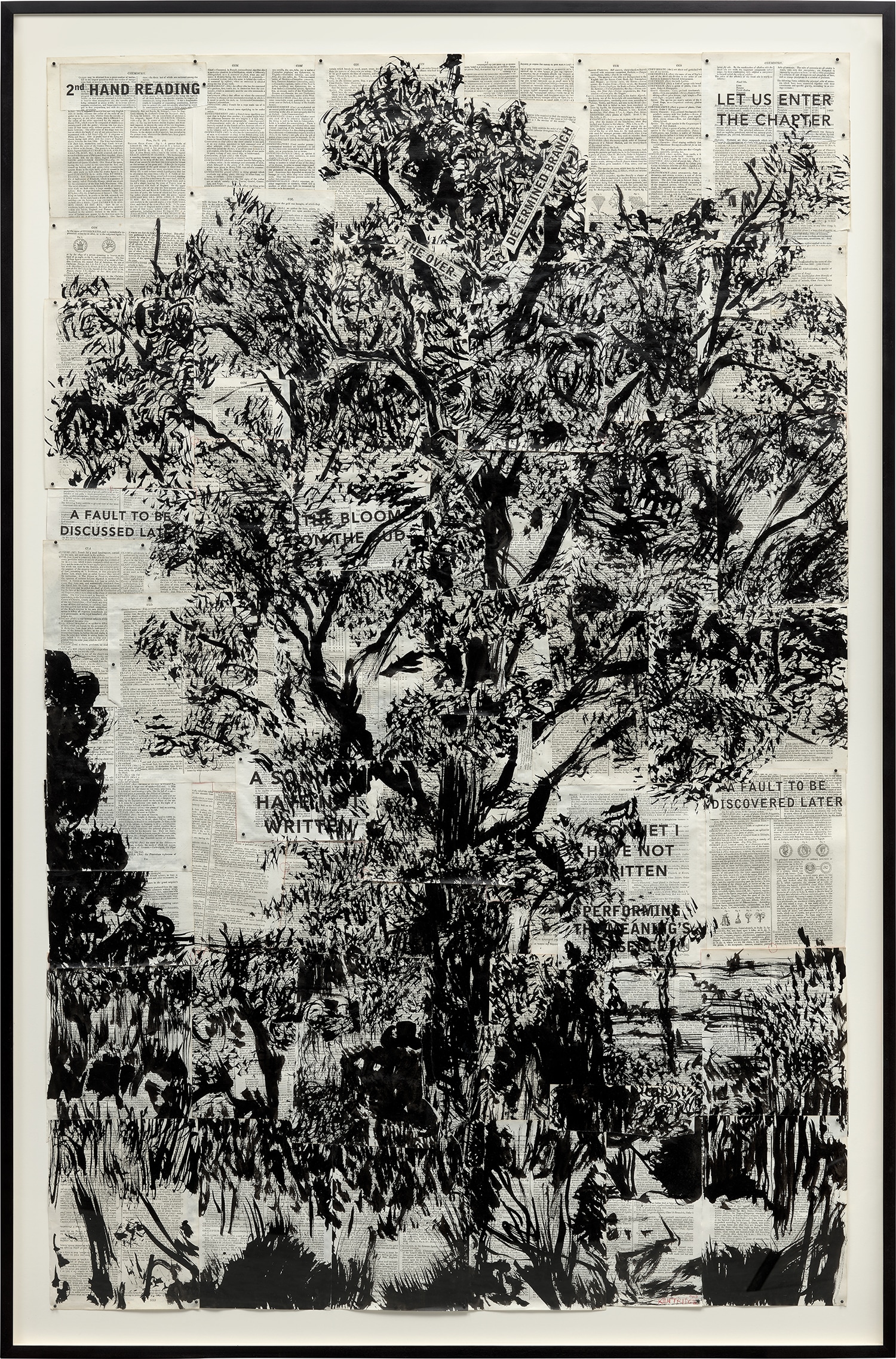
2nd Hand Reading, 2013
His father, Sir Sydney Kentridge, was a celebrated advocate who represented the family of Steve Biko at the inquest into Biko's death. This moral seriousness, this sense that public life demands personal reckoning, runs through everything William Kentridge has ever made. He studied politics and African studies at the University of the Witwatersrand before turning to fine art at the Johannesburg Art Foundation, and later studied mime and theatre at the École Internationale de Théâtre Jacques Lecoq in Paris, an experience that gave his visual practice its deeply performative, almost choreographic quality. His breakthrough came through a series of animated films he began developing in the late 1980s, works that would eventually form the celebrated Drawings for Projection series, which he continued to expand for over two decades.
These films were made using an ingenious and now legendary method: Kentridge would draw in charcoal and pastel on paper, film the drawing, erase and redraw, film again, and so on, so that each image carries the ghost of what came before. The erasures are never fully hidden. They accumulate as a kind of visual memory, a record of revision and reconsideration that mirrors the moral condition of a society trying to come to terms with its past. The films introduced his recurring protagonists, the industrialist Soho Eckstein and the dreamer Felix Teitlebaum, figures who allowed him to explore complicity, desire, power, and guilt in apartheid and post apartheid South Africa.
William Kentridge
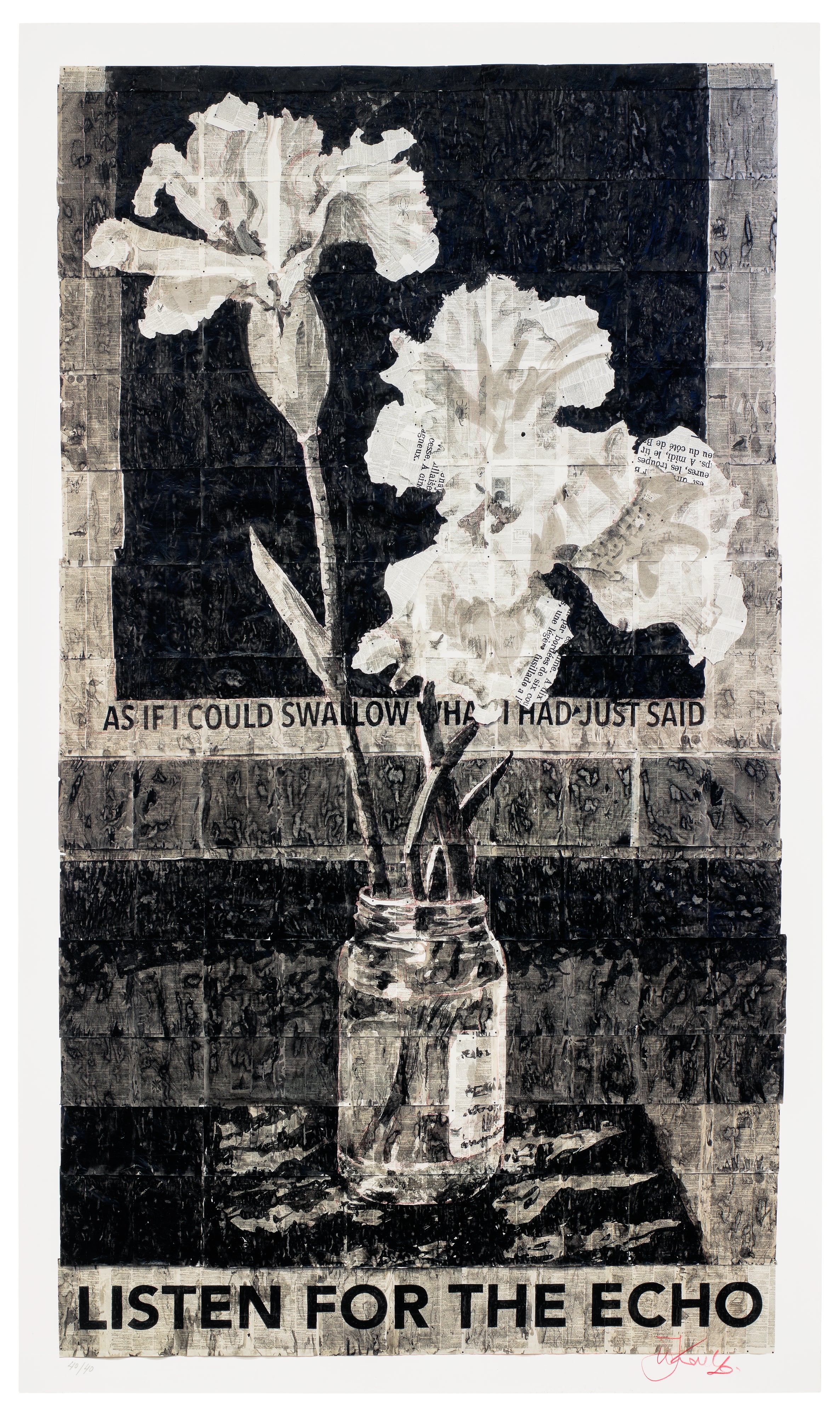
Listen for the Echo
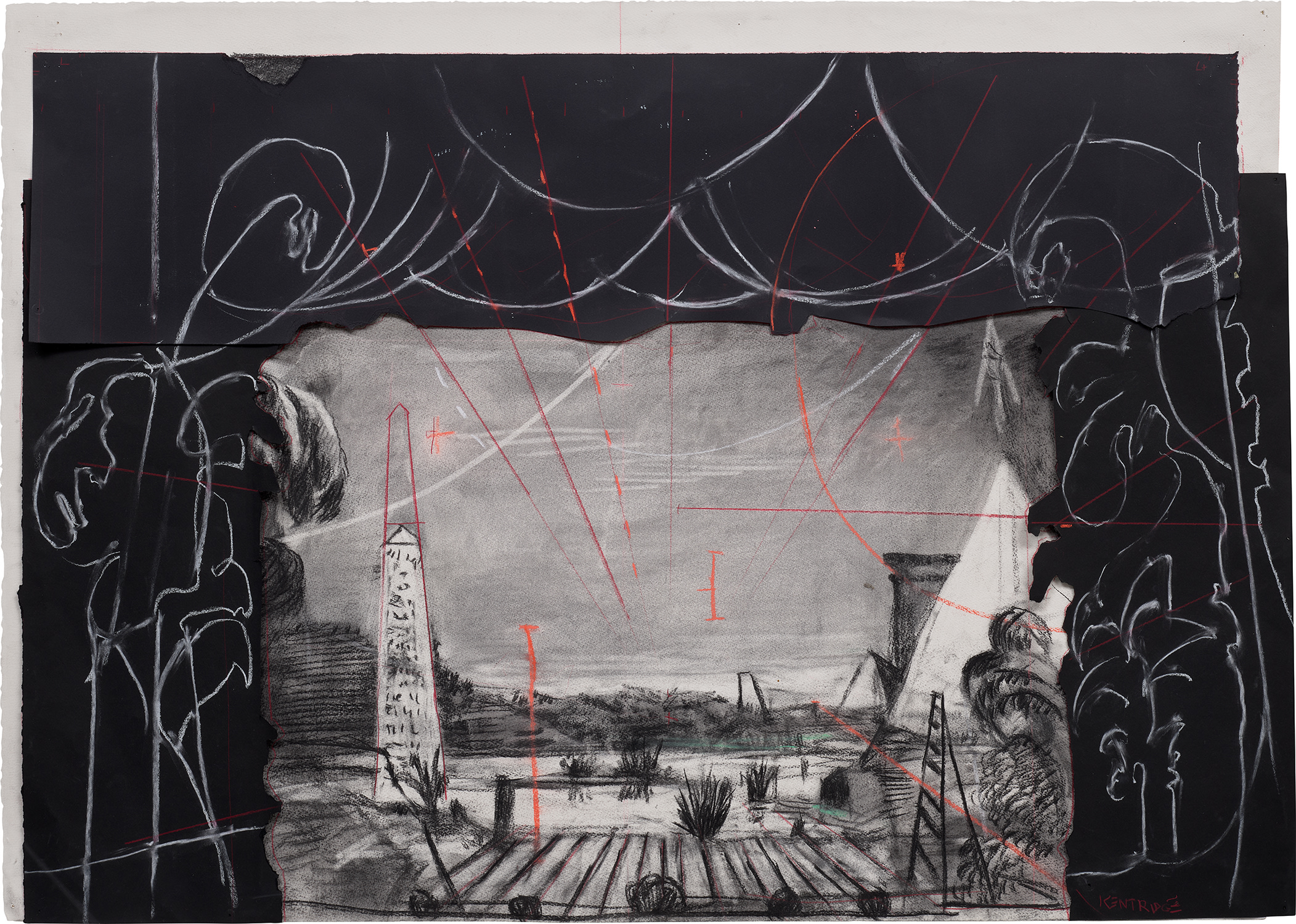
The works available through The Collection offer a remarkable window into the full range of his practice. Works such as "Mr and Mrs Eckstein" from 1991, rendered in charcoal and pastel on paper, show Kentridge at his most elemental, working with the most direct of materials to conjure an entire social world. "2nd Hand Reading" from 2013 demonstrates his love of found texts and collage, with India ink, graphite, and coloured pencil layered over pages from a Universal Technological Dictionary, pinned in place as though thought itself were being held down for examination. "Drawing from Preparing the Flute" from 2005 connects to his work in opera and theatre, a field in which he has designed and directed major productions including a celebrated staging of Shostakovich's "The Nose" for the Metropolitan Opera in New York.
“Every mark on the paper is a step in a journey, not just of the hand but of the mind trying to understand.”
William Kentridge, interview
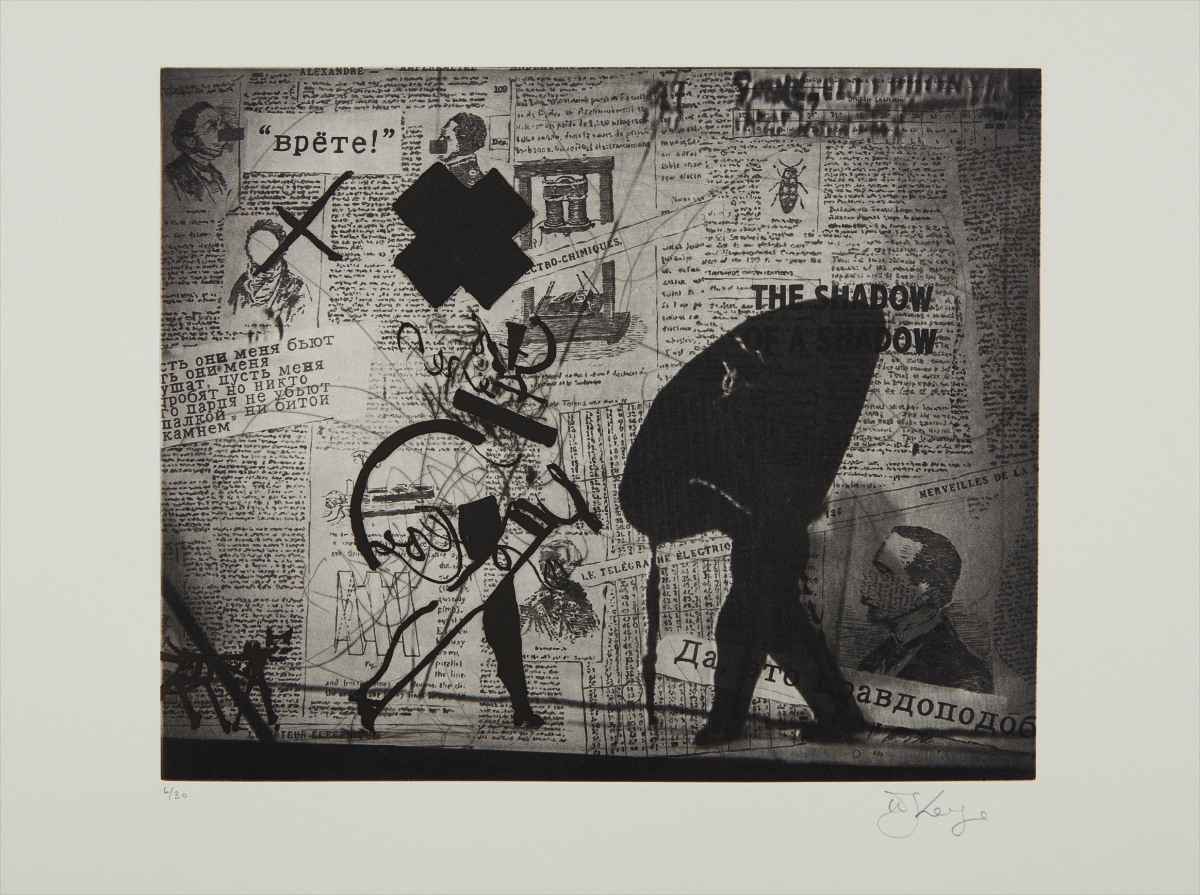
His prints, including works such as "Zeno at 4 A.M." and "Nose Projection with Walking Woman," reveal an artist who approaches etching and aquatint with the same restless intelligence he brings to drawing and film, treating the plate as another surface on which time and memory can be etched. For collectors, Kentridge's work rewards close attention and patient looking.
William Kentridge
Nose Projection with Walking Woman
His prints are produced in careful editions and represent one of the most accessible points of entry into a practice that commands serious prices at auction. Works on paper, including his charcoal and pastel drawings, have appeared at major auction houses and achieved prices reflecting the depth of his international institutional support. His bronzes, such as the arresting "Cat, from the Untitled (Procession Set)" from 1999, demonstrate that his sculptural thinking is as refined as his two dimensional work. Collectors are drawn not only to the formal beauty of individual objects but to the way each work functions as part of a larger conversation, one that spans decades and mediums and that grows richer the more of it you encounter.
Acquiring a Kentridge is acquiring a relationship with an ongoing body of thought. In art historical terms, Kentridge occupies a singular position. He is often discussed alongside artists who have used drawing and animation to address political trauma and historical memory, figures such as Kara Walker, whose silhouettes engage with American histories of race and violence in ways that rhyme with Kentridge's own excavations. His interest in theatre and the total artwork connects him to a tradition running from Brecht through Robert Wilson.
William Kentridge
Drawing from 'Preparing the Flute' (Stage with Black Curtain), 2005
His printmaking places him in conversation with a long lineage of politically engaged graphic artists. Yet he is irreducibly himself, rooted in the specific landscape and history of Johannesburg, and in a tradition of Central European Jewish intellectual life that arrived in South Africa and took new forms there. His work draws on literature, philosophy, opera, silent film, and the history of colonialism, weaving these threads into something that feels both urgently local and universally human. What makes Kentridge matter today, perhaps more than ever, is his insistence that art is a form of thinking, not merely a form of illustration.
His process is his argument. By showing the marks of erasure, by keeping the history of revision visible on the surface of the work, he refuses the comfortable fiction that we can simply move on from the past. He asks instead that we carry it with us, that we look at what we have erased and ask why. In an era of accelerating forgetting, his work is a sustained act of remembering.
He continues to produce, to direct, to draw, to lecture, and to inspire, operating from his studio in Johannesburg with a commitment to practice that is itself a kind of moral statement. For collectors who believe that art should ask something of its audience, William Kentridge is essential.
Explore books about William Kentridge
William Kentridge: Five Themes
Carolyn Christov-Bakargiev

William Kentridge
Lorna Ferguson
Thick Time
William Kentridge
William Kentridge: The Refusal of Time
Okwui Enwezor and others
William Kentridge: More Sweetly Play the Dance
Museum of Modern Art
William Kentridge: Fortuna
Carolyn Christov-Bakargiev

William Kentridge: Process and Product
Stephen Coppel