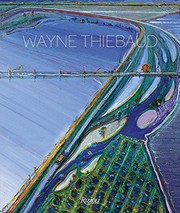
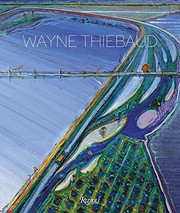
Wayne Thiebaud

Wayne Thiebaud: America's Most Delicious Visionary
Artist Spotlight · The Collection Editorial
“Painting is a way of trying to come to terms with life. I paint what I love and what I find beautiful.”
Wayne Thiebaud, interview with the Sacramento Bee
In 2021, the art world paused to mourn and celebrate one of its most beloved figures. Wayne Thiebaud, who passed away in December of that year at the extraordinary age of 101, left behind a body of work so joyful, so technically masterful, and so deeply American that its resonance only seems to grow with time. Major institutions including the Fine Arts Museums of San Francisco and the Whitney Museum of American Art have honored his legacy with retrospectives and tributes, and his work continues to command passionate attention at auction, where his paintings of pies, cakes, and California hillsides regularly achieve prices that reflect both their rarity and their irresistible charm. To encounter a Thiebaud is to feel, almost involuntarily, a surge of warmth.
Wayne Thiebaud
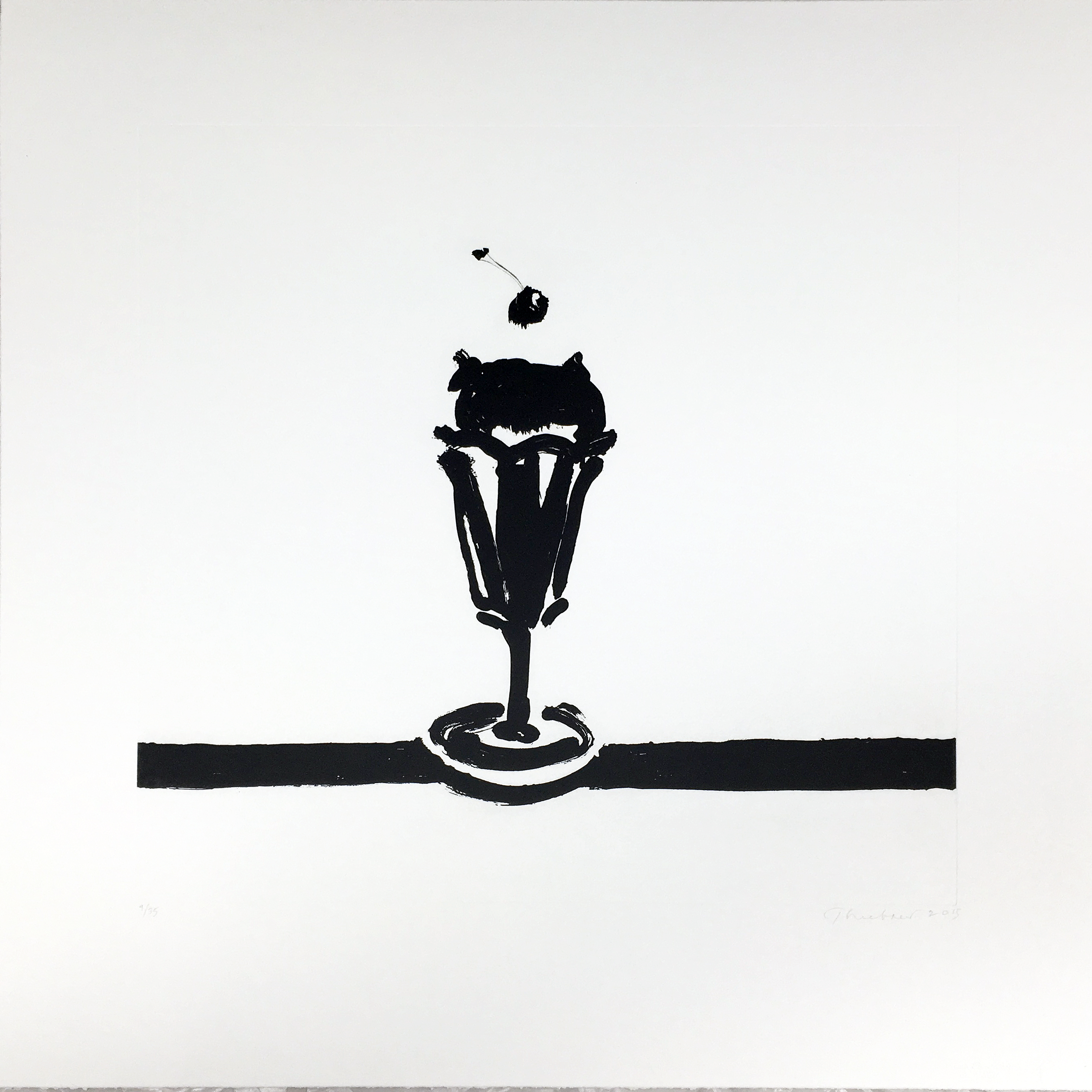
Tulip Sundae, 2015
Wayne Thiebaud was born on November 15, 1920, in Mesa, Arizona, and grew up largely in California, a place that would shape every dimension of his artistic imagination. His early years were marked by practical work rather than formal training. As a teenager he held jobs at a movie theater concession stand and later worked as a cartoonist and commercial illustrator, experiences that gave him an intimate familiarity with popular imagery, bold outlines, and the visual language of everyday American life. These were not detours from his artistic path.
They were the path itself, laying the groundwork for a practice that would find profound beauty in the most ordinary objects imaginable. Thiebaud studied at California State University, Sacramento, where he eventually became a beloved professor and spent decades shaping generations of painters. He also spent time in New York in the late 1950s, where he encountered the abstract expressionists then dominating the American art scene. Rather than being swept away by the prevailing tide, Thiebaud quietly held his ground, remaining committed to representation and to the specific pleasures of depicting the material world with paint.
Wayne Thiebaud
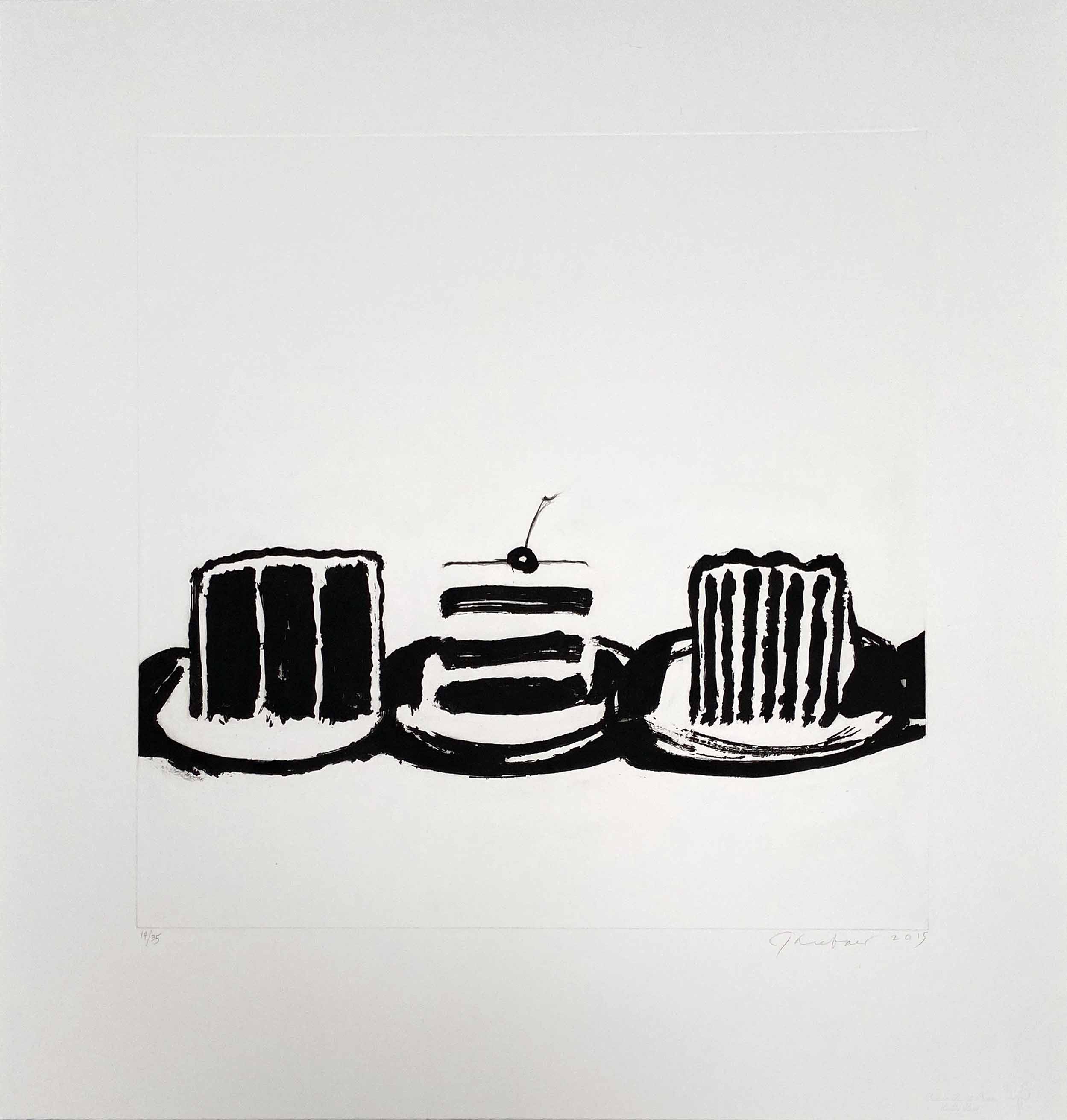
Cut Cakes, 2015
It was a stance that required both confidence and patience, and it paid off spectacularly. His first major gallery exhibition at the Allan Stone Gallery in New York in 1962 caused an immediate sensation, arriving at precisely the moment when pop art was capturing public imagination and critics were looking for a new figurative language. The works Thiebaud showed at Allan Stone that year, including rows of cakes, pies, and deli counters painted with thick, luminous pigment and surrounded by shadow in colors no one had quite used before, announced an utterly original sensibility. He was immediately grouped with pop artists like Andy Warhol and Roy Lichtenstein, a comparison that was understandable given his subject matter but ultimately too narrow.
“The world is full of interesting things to look at. The challenge is learning how to see them.”
Wayne Thiebaud
Where pop art often maintained an ironic distance from its sources, Thiebaud painted with genuine affection and a painterly rigor that owed as much to Morandi, Hopper, and Diebenkorn as to any commercial aesthetic. His brushwork was lush and deliberate, building up surfaces of extraordinary tactile richness, and his handling of light, particularly the way colored shadows pooled beneath a slice of pie or a glazed pastry, was simply unlike anything else in American painting. Among his most iconic works, the paintings of the early 1960s stand as a kind of founding testament. "Pie" from 1958, rendered in gouache, watercolor, wax crayon, and graphite, shows how early and how fully formed his vision was.
Wayne Thiebaud
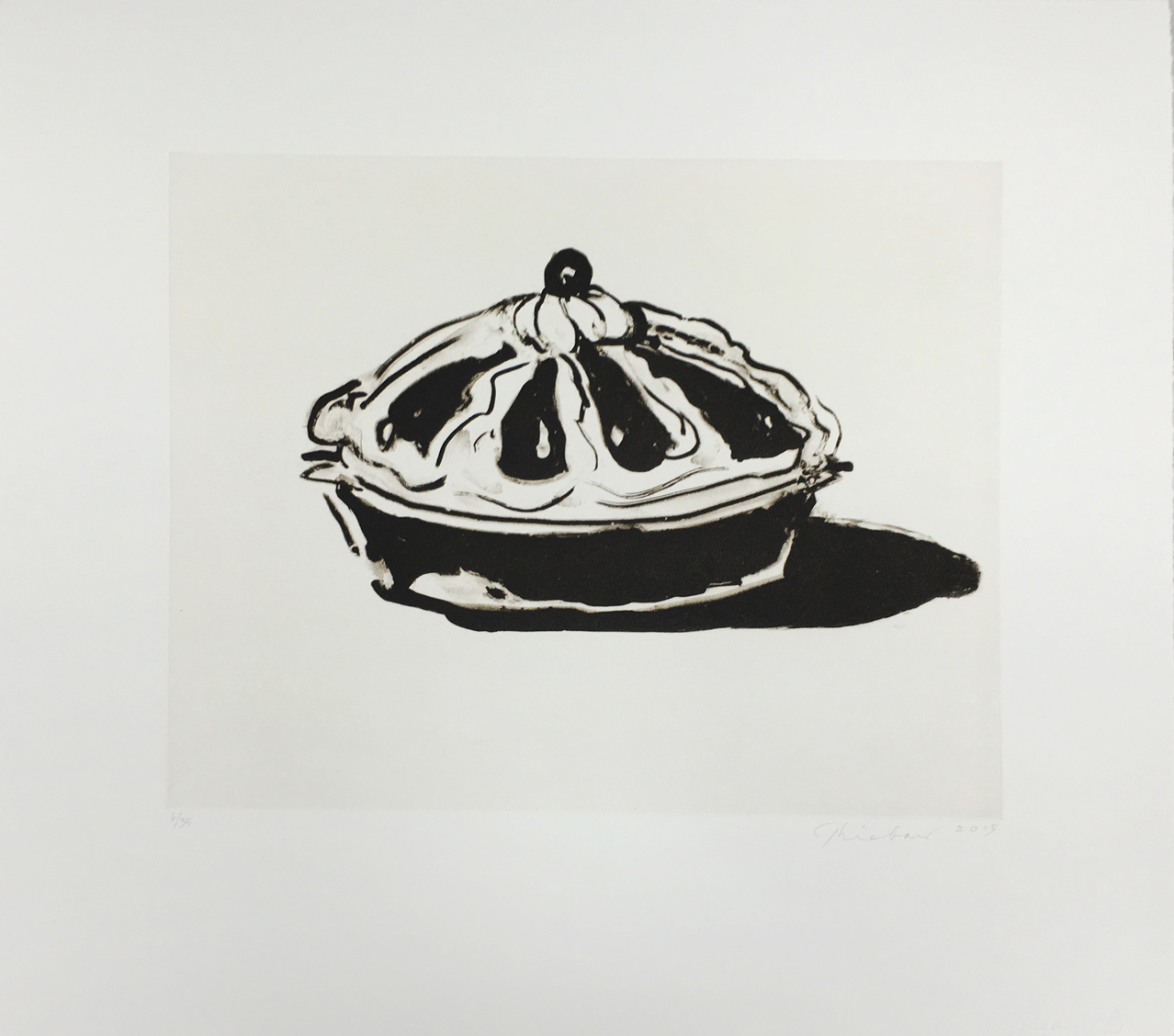
Crown Tart, 2015
"Cantaloupe" from 1962 demonstrates his ability to transform a single humble object into a subject of meditative intensity. His printmaking, which he pursued with equal seriousness throughout his career, produced works of comparable power. Pieces such as "Cut Cakes" and "Tulip Sundae" from 2015, both executed as sugar lift aquatints with drypoint, show the breadth of his technical command and his ability to translate his signature chromatic warmth into the more disciplined demands of the print studio. His drypoints, including the elegant study "Fish (Smelt), from Delights," reveal an artist whose eye for the poetic potential of ordinary subjects never dimmed.
Beginning in the 1970s and continuing through the rest of his long life, Thiebaud expanded his subject matter dramatically, turning to the vertiginous streets and hillsides of San Francisco with the same loving intensity he had brought to pie counters and candy displays. Works such as "Hillside Streets" from 1993 and "Middle Island" from 1997 show a painter grappling joyfully with the challenge of representing a landscape that seems to defy conventional perspective, with streets that plunge and rise at impossible angles, buildings stacked against each other in compositions of dizzying spatial complexity. These cityscapes are among the most formally ambitious works of his career and deserve to be seen alongside the best American landscape painting of the twentieth century. "Freeway Curve," rendered as a monotype, captures this same vertiginous energy with remarkable economy.
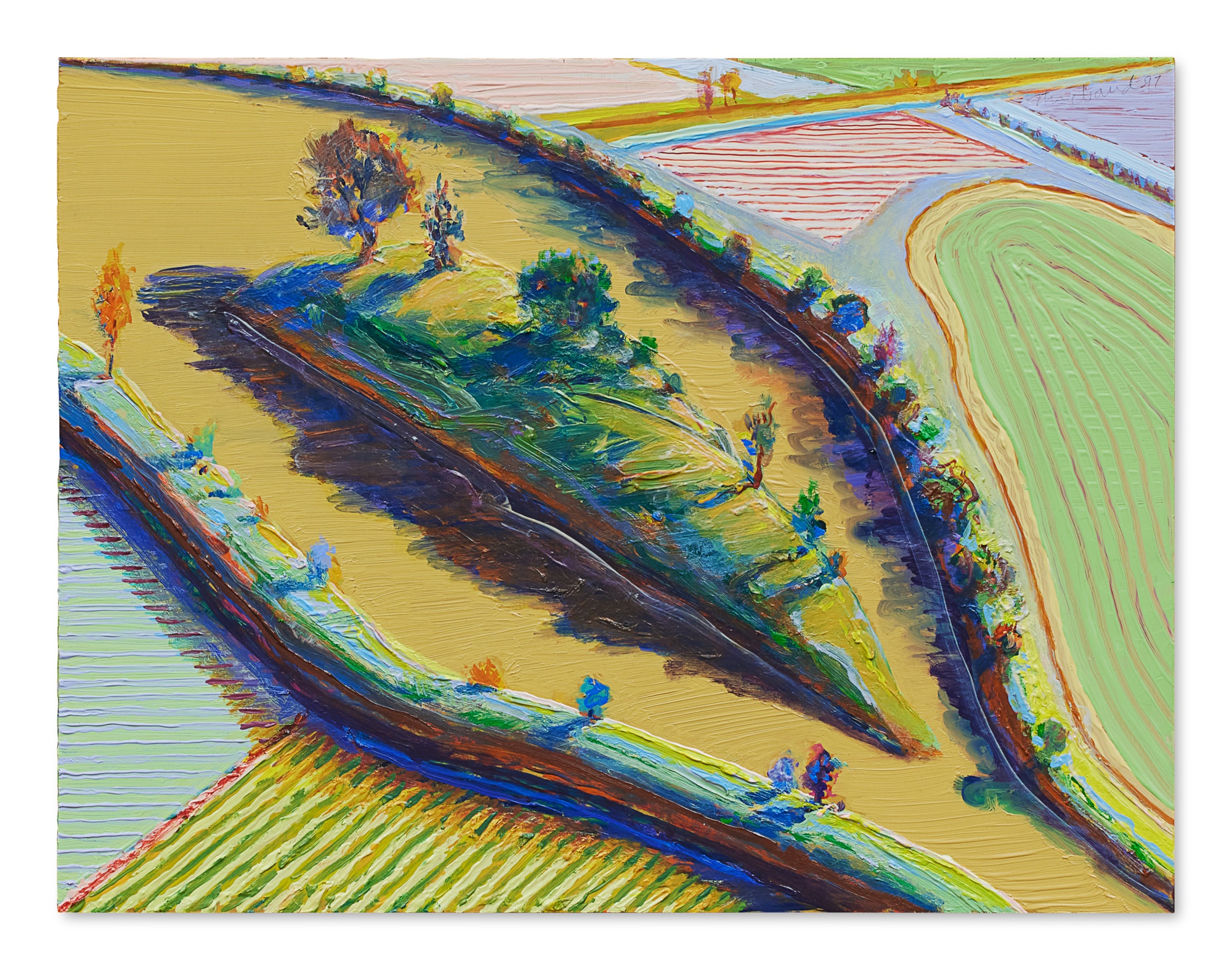
Wayne Thiebaud
Middle Island, 1997
For collectors, Thiebaud represents one of the most compelling and legible propositions in the American art market. His work spans an enormous range of media and scale, from intimate works on paper and prints to large scale paintings, which means there are meaningful entry points at many levels. His prints in particular offer extraordinary access to his vision at a fraction of the cost of his paintings, and they are works of genuine ambition rather than mere reproductions of his ideas. Collectors drawn to American realism, to the tradition of Edward Hopper and Richard Diebenkorn, and to artists who combine rigorous craft with warmth of feeling will find in Thiebaud a figure of enduring relevance.
His auction results over the past two decades have been consistently strong, with his iconic food paintings achieving results well into the millions of dollars at Christie's and Sotheby's. Thiebaud's place in art history is now secure and, it seems, still expanding. He was an artist who trusted his own eye and his own affections at a time when the art world rewarded conceptual daring above all else, and he was vindicated not by a single dramatic moment but by the slow accumulation of an extraordinary body of work. He reminds us that painting, at its best, is an act of attention and of love.
In treating a slice of lemon meringue pie or a curve of California freeway as worthy of the same careful looking we might give a Renaissance altarpiece, Thiebaud enlarged our sense of what is worth seeing. That is a gift that does not diminish.
Explore books about Wayne Thiebaud