W. Eugene Smith
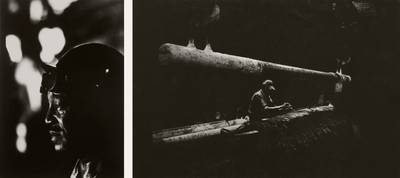
Artist Spotlight · The Collection Editorial
```json { "headline": "Eugene Smith: Humanity Rendered in Light", "body": "There is a photograph that stops time. A mother cradles her daughter in a steaming bath, their bodies intertwined in an embrace so tender it transcends documentation and becomes something closer to a pietà. Taken in Minamata, Japan in 1971, W. Eugene Smith's image of Ryoko Uemura bathing her daughter Tomoko, who had been profoundly disabled by industrial mercury poisoning, is among the most morally urgent and visually devastating photographs ever made.
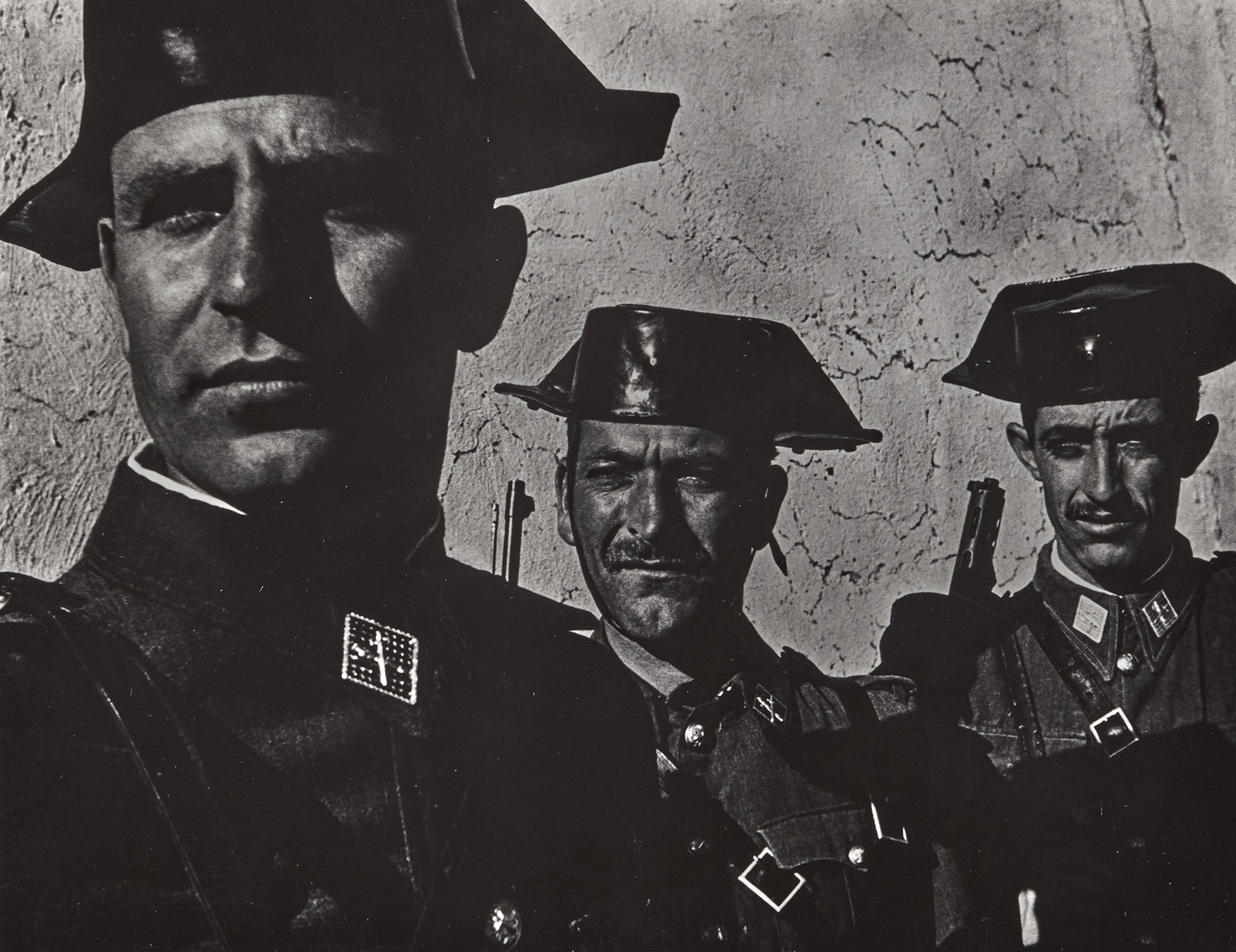
W. Eugene Smith
Guardia Civil
It is the kind of image that changes public policy, breaks open collective consciousness, and reminds us why photography, at its most committed, is one of the great art forms of our age. Decades after it was first published, the photograph continues to appear in museum retrospectives and critical surveys worldwide, most recently reasserting its power in ongoing discussions around the ethics of documentary image making and the enduring legacy of photojournalism as witness.", "William Eugene Smith was born on December 30, 1918, in Wichita, Kansas. His upbringing in the American heartland was formative and also marked by tragedy.
His father died by suicide during the Great Depression, an event that shaped Smith's deep moral seriousness and his lifelong conviction that images must carry weight, must mean something, must do work in the world. He began photographing as a teenager, covering local events for newspapers, and by the age of nineteen he had moved to New York and was working professionally. He briefly attended Notre Dame University on a photography scholarship before leaving to pursue his career full time, a decision that reflected both his urgency and his extraordinary early confidence.", "Smith's career accelerated rapidly through the 1930s and 1940s.
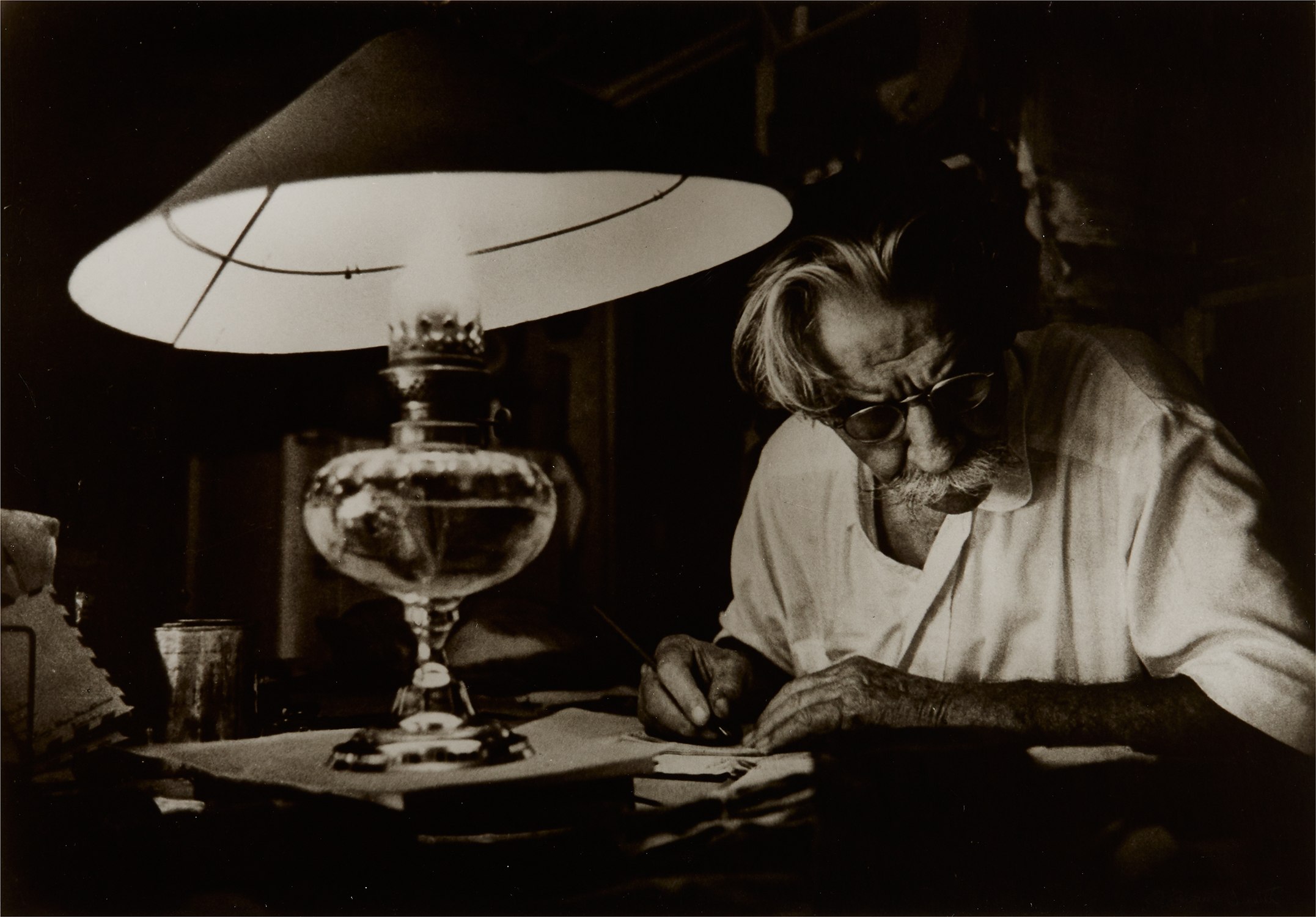
W. Eugene Smith
Albert Schweitzer from 'A Man of Mercy'
He worked for Newsweek and then became a staff photographer at Life magazine, the most important platform for photojournalism in the twentieth century. His World War II coverage, shot across the Pacific theater including Saipan, Guam, and Okinawa, brought him international recognition and also nearly killed him. In 1945 he was severely wounded by mortar fire on Okinawa, sustaining injuries so serious that his recovery took two years and required dozens of surgeries. His return to photography was announced in 1948 with a portrait of his two children walking hand in hand through a sun dappled forest into a clearing of light.
That image, Walk to Paradise Garden, became one of the most reproduced photographs of the twentieth century and served as the closing image of Edward Steichen's landmark exhibition The Family of Man at the Museum of Modern Art in 1955.", "What set Smith apart from his contemporaries was his absolute refusal to treat photographs as neutral records. He understood the image as an argument, an act of witness that carried the photographer's full moral and emotional investment. His photo essays for Life during the late 1940s and 1950s redefined what the form could do.
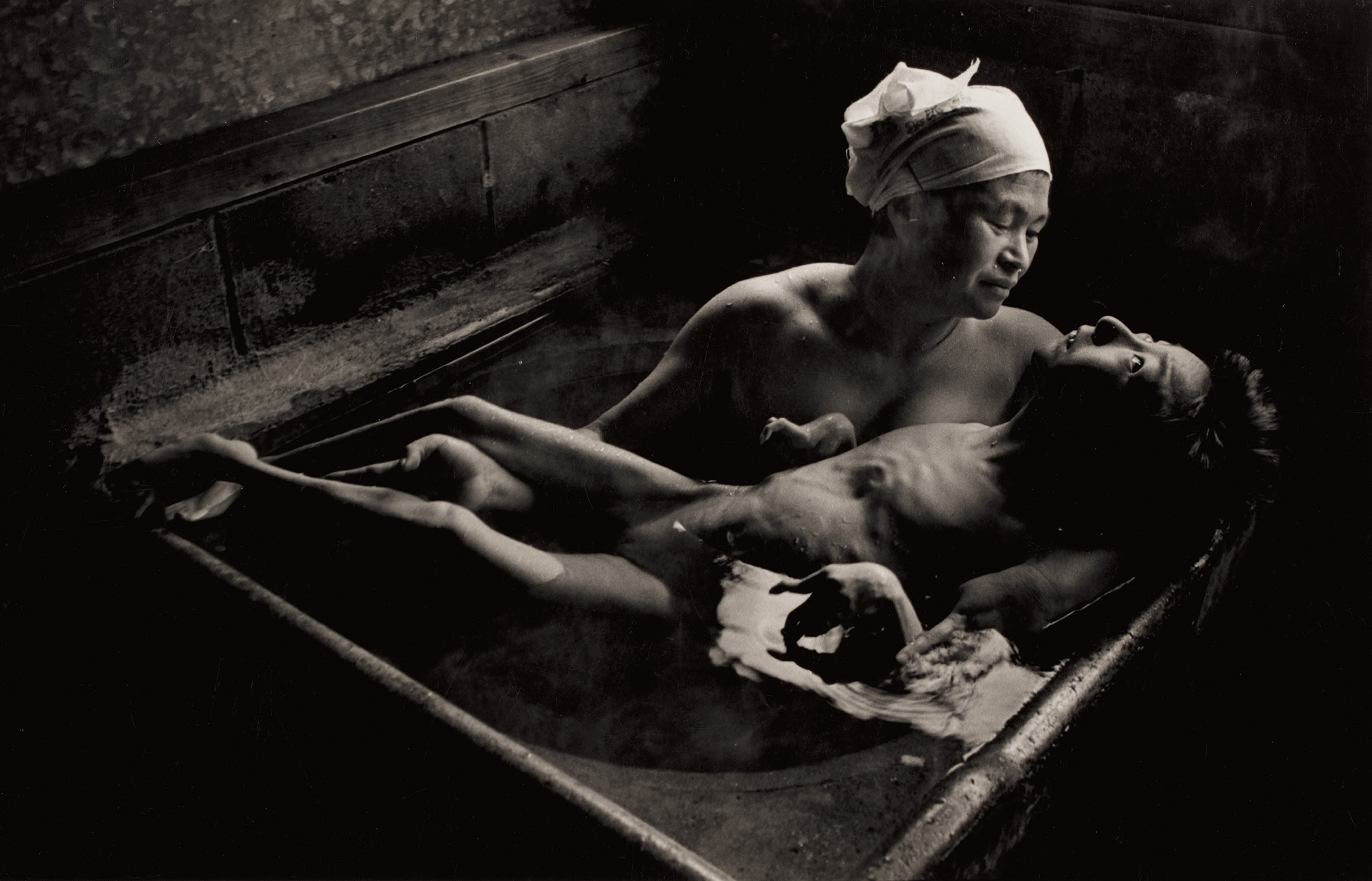
W. Eugene Smith
Tomoko Uemura Being Bathed by her Mother, Minamata
Country Doctor, published in 1948, followed a rural Colorado physician named Ernest Ceriani through exhausting days and nights of service, creating an intimate portrait of vocation and sacrifice that reads almost like a short film. Spanish Village, published in 1951 after months spent in the remote Extremaduran town of Deleitosa, captured the textures of life under Francoist Spain with a gravity and compositional beauty that drew comparisons to the paintings of Velázquez and Goya. These were not assignments Smith approached passively. He immersed himself completely, often living with his subjects for months, insisting on editorial control that brought him into repeated conflict with Life's editors.
", "The Pittsburgh project, undertaken between 1955 and 1958, represents perhaps the most ambitious single undertaking of his career. Originally commissioned to produce a modest visual survey of the city for a cultural publication marking its bicentennial, Smith instead spent years producing thousands of images across every stratum of Pittsburgh life. The resulting archive, never fully resolved in his lifetime into the definitive book he envisioned, encompasses steel workers wreathed in fire and smoke, quiet domestic interiors, the architecture of industry and poverty, and the strange sublime of a city built on labor. Works from this project, including Dance of the Flaming Coke and images of the steel workers at their furnaces, are among the most electrifying industrial photographs ever made.
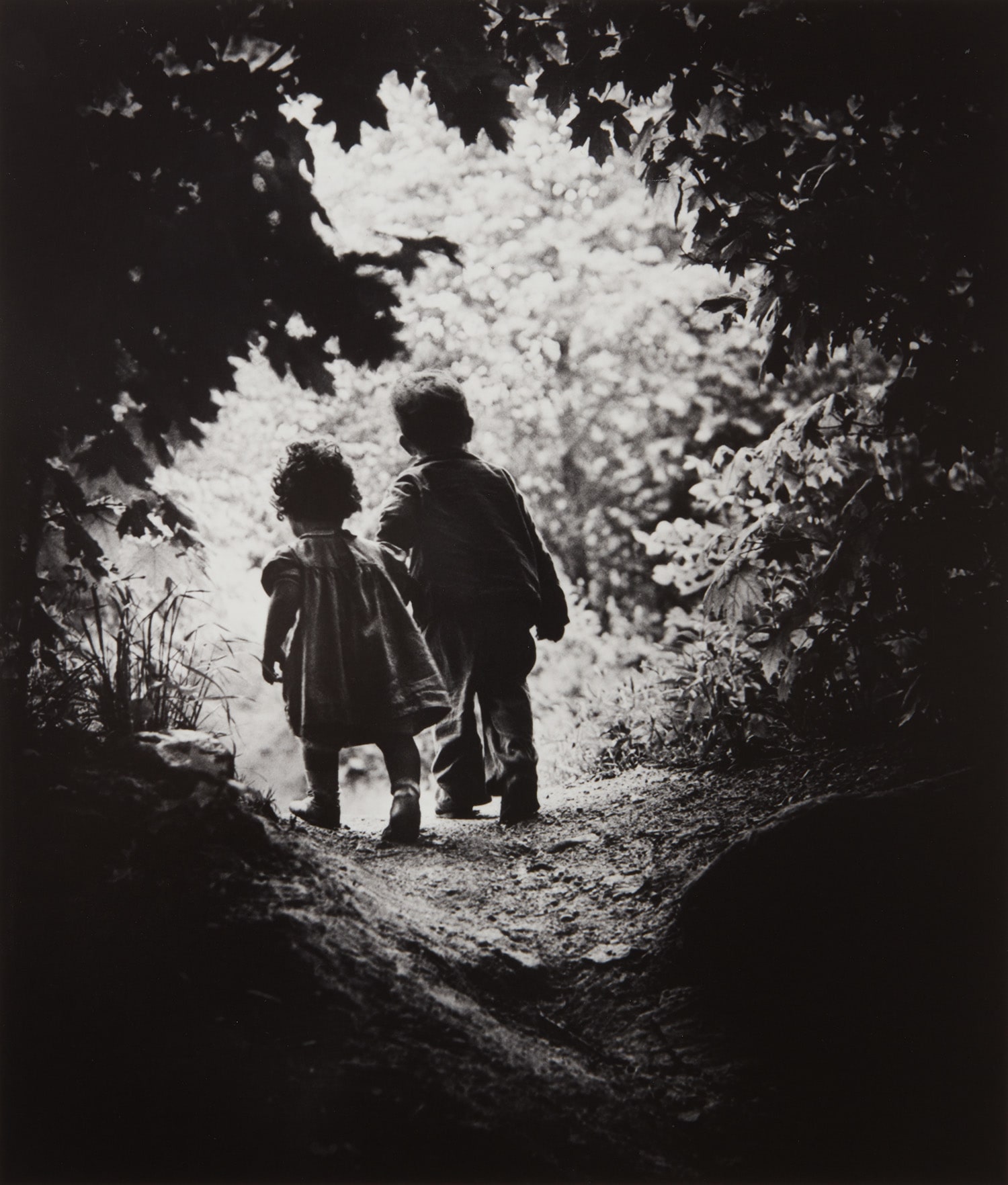
W. Eugene Smith
Walk to Paradise Garden
They circulate today in museum collections and at auction with considerable presence, commanding attention not only as historical documents but as fully realized works of fine art photography.", "For collectors, Smith's prints represent one of the most compelling intersections of art historical importance and market accessibility within the photographic medium. His gelatin silver prints, many made in his own darkroom to extraordinarily high standards, have a tonal richness and physical presence that reproductions cannot convey. Smith was known for his painstaking approach to printing, pushing his images in the darkroom toward his own vision rather than producing technically neutral renditions.
Vintage prints from major projects including Minamata, Spanish Village, and the Pittsburgh series carry the greatest historical and market weight, while later printed works offer collectors an opportunity to engage with his vision at a more accessible entry point. His most iconic image, the Tomoko Uemura bathing photograph, was eventually withdrawn from circulation at the request of Tomoko's family, which has only deepened its symbolic significance and the weight carried by any print that does reach the market.", "To understand Smith's place in art history it helps to consider him alongside figures such as Dorothea Lange, whose FSA documentation of the Depression shares his humanistic commitment, and Henri Cartier Bresson, whose influence on compositional thinking ran parallel to Smith's though their temperaments differed enormously. Where Cartier Bresson valued detachment and the decisive instant, Smith valued immersion and duration.
Robert Frank's The Americans, published in 1958, shared Smith's willingness to use the photograph as a subjective and even expressionistic instrument, and the two represent complementary visions of what American photography could become. Smith also belongs to a lineage that includes Sebastião Salgado and Mary Ellen Mark, both of whom acknowledged his influence on their long form documentary practice and their understanding of photography as a vehicle for social conscience.", "W. Eugene Smith died in Tucson, Arizona, in October 1978, at the age of fifty nine, his health long compromised by the injuries, the decades of hard living, and the chemical exposure he sustained while working undercover in Minamata.
He left behind an archive of extraordinary density and an approach to the medium that remains a touchstone. In an era when the ethics of documentary photography are debated with renewed intensity, Smith's work offers not a simple answer but a serious model: the photographer as witness who accepts the full burden of what it means to stand before suffering and render it visible. His photographs endure because they are beautiful in the way that truth, honestly confronted, can be beautiful. For collectors who believe that photography belongs in the same conversation as painting and sculpture, that it can carry the same philosophical and emotional freight, Smith is not merely a historical figure.
He is essential." , "quotes": [ { "quote": "I ask that I be allowed to make a significant contribution through my work. I wish my work to be a moment of revelation.", "source": "W.
Eugene Smith" }, { "quote": "Photography is a small voice, at best, but sometimes one photograph, or a group of them, can lure our senses into awareness.", "source": "W. Eugene Smith, Popular Photography, 1956" }, { "quote": "Each time I press the shutter release it is a supreme gesture of faith, a belief that what I am recording is of significance.", "source": "W.
Explore books about W. Eugene Smith
W. Eugene Smith: His Life and Photography
Jim Hughes
W. Eugene Smith: Master of Photojournalism
Glenn G. Willumson
W. Eugene Smith: Photographs 1934-1975
Vicki Goldberg
Minamata
W. Eugene Smith and Aileen M. Smith
Let Truth Be the Preset
Jim Hughes
W. Eugene Smith: The Camera as Conscience
Barbra Scott Library