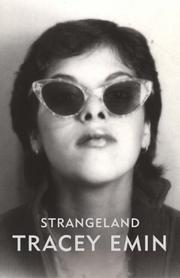
Tracey Emin

Tracey Emin: Life Lived as Living Art
Artist Spotlight · The Collection Editorial
“I need art like I need God. It's a place I go to where everything makes sense.”
Tracey Emin
In 2023, Tracey Emin opened a deeply personal exhibition at White Cube in London, presenting large scale paintings that bore witness to her ongoing battle with bladder cancer, diagnosed in 2021. Far from retreat, the work announced a defiant creative surge. The canvases were raw, luminous, and unmistakably alive, confirming what her most devoted collectors and admirers have always understood: that Emin transforms vulnerability into something close to transcendence. At sixty, she remains one of the most vital and emotionally alive artists working anywhere in the world.
Tracey Emin
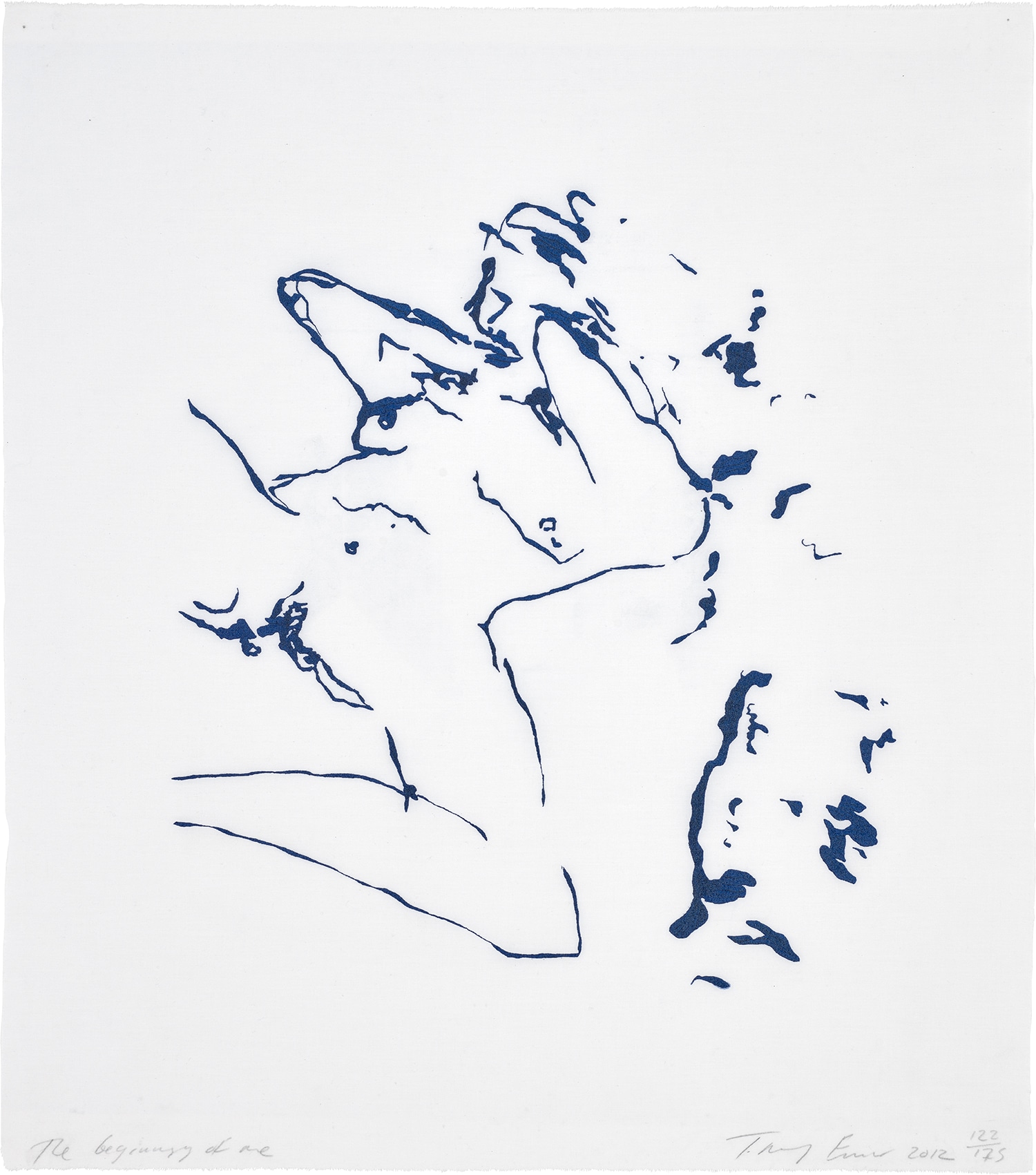
The Beginning of Me
Emin was born in 1963 in Croydon and raised largely in Margate, the faded seaside town on the Kent coast that would shape her sensibility as profoundly as any art school. Her childhood was turbulent and at times painfully difficult, marked by poverty, early trauma, and the particular loneliness of growing up at the margins of things. Yet Margate also gave her the sea, a love of light, and an understanding of beauty found in unexpected places. She has returned to the town repeatedly throughout her life, and her connection to it culminated in the opening of the Turner Contemporary gallery there in 2011, with which she has maintained a deep and abiding relationship.
Her formal training began at Maidstone College of Art and continued at the Royal College of Art in London, where she completed her MA in 1989. It was during the 1990s that she emerged as a genuinely original voice, finding her footing alongside a generation of artists who would collectively reshape British contemporary art. The Young British Artists movement, galvanised in part by Charles Saatchi's collecting and Damien Hirst's curatorial energy, provided a cultural moment in which Emin's confessional instincts found an audience ready for them. Her work was provocative not through shock alone but through an almost unbearable honesty that set her apart from many of her peers.
Tracey Emin
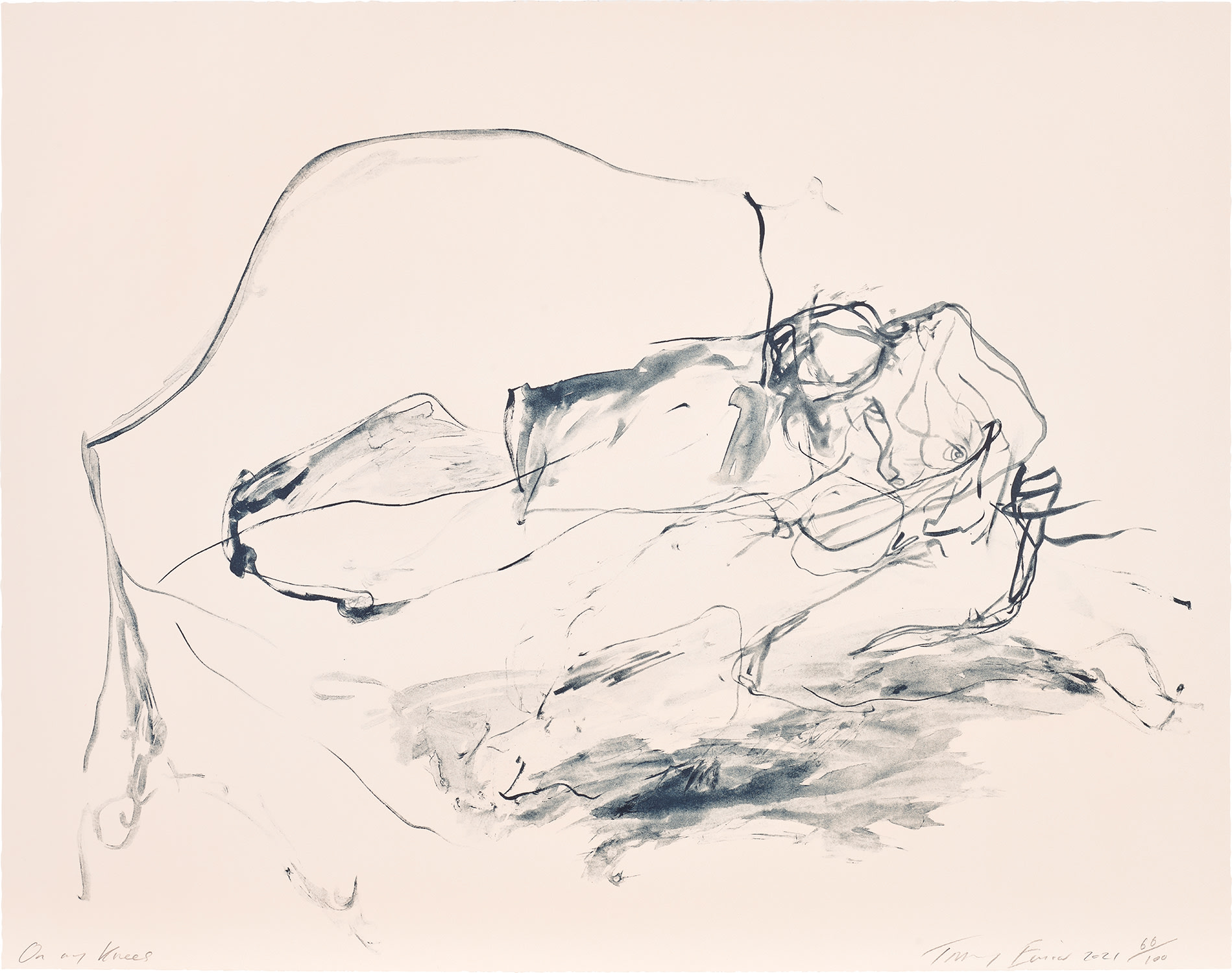
On My Knees, from Tate Modern 21 Years Print Portfolio
The work that brought her international notoriety was My Bed, first exhibited in 1998 and shortlisted for the Turner Prize in 1999. The installation presented her actual unmade bed, surrounded by the detritus of a period of severe emotional crisis: empty bottles, cigarette packets, underwear, and the intimate residue of a life temporarily falling apart. It was greeted with both outrage and adoration, and it crystallised something essential about Emin's practice. The everyday becomes sacred.
“My work is about telling the truth, and truth is something that has to be fought for.”
Tracey Emin, interview with The Guardian
The private becomes universal. The confession becomes a gift. My Bed was acquired by Charles Saatchi and later purchased at Christie's in 2014 by Count Christian Duerckheim for nearly three million pounds, cementing its status as one of the defining artworks of its era. Before My Bed, there was Everyone I Have Ever Slept With 1963 to 1995, a tent appliquéd with the names of every person she had shared a bed with, not only lovers but family members and close friends.
Tracey Emin
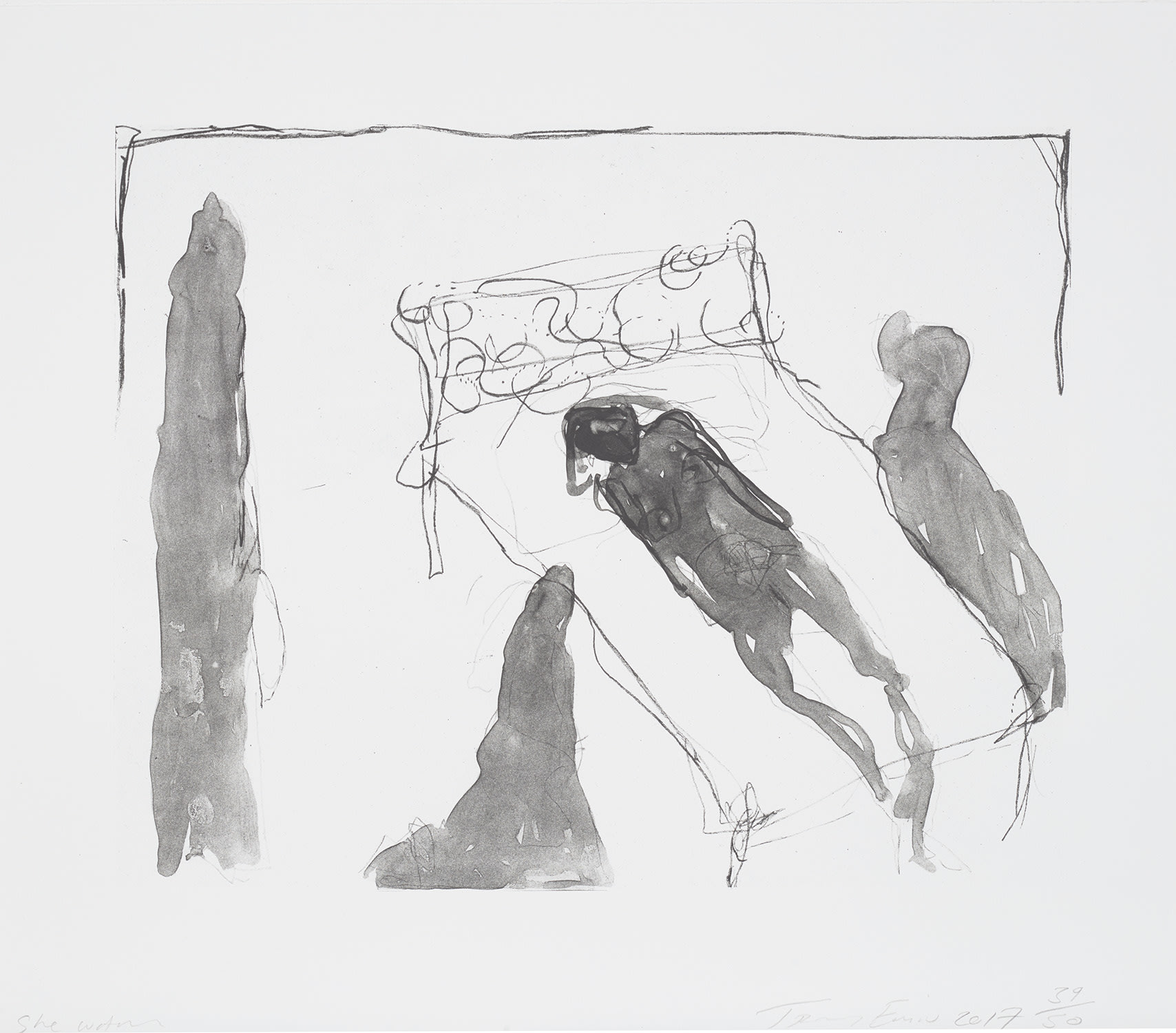
She Watched
Tragically destroyed in the Momart warehouse fire of 2004, it survives only in photographs and in the cultural memory of a generation. Her neon works, which began appearing in the 1990s and continue to this day, brought her handwriting into three dimensional space with phrases that oscillate between tenderness and anguish. Works such as I Promise to Love You and You Loved Me Like a Distant Star carry the weight of literature in just a few words. These neons have become among the most recognisable signatures in contemporary art and are held in major collections worldwide.
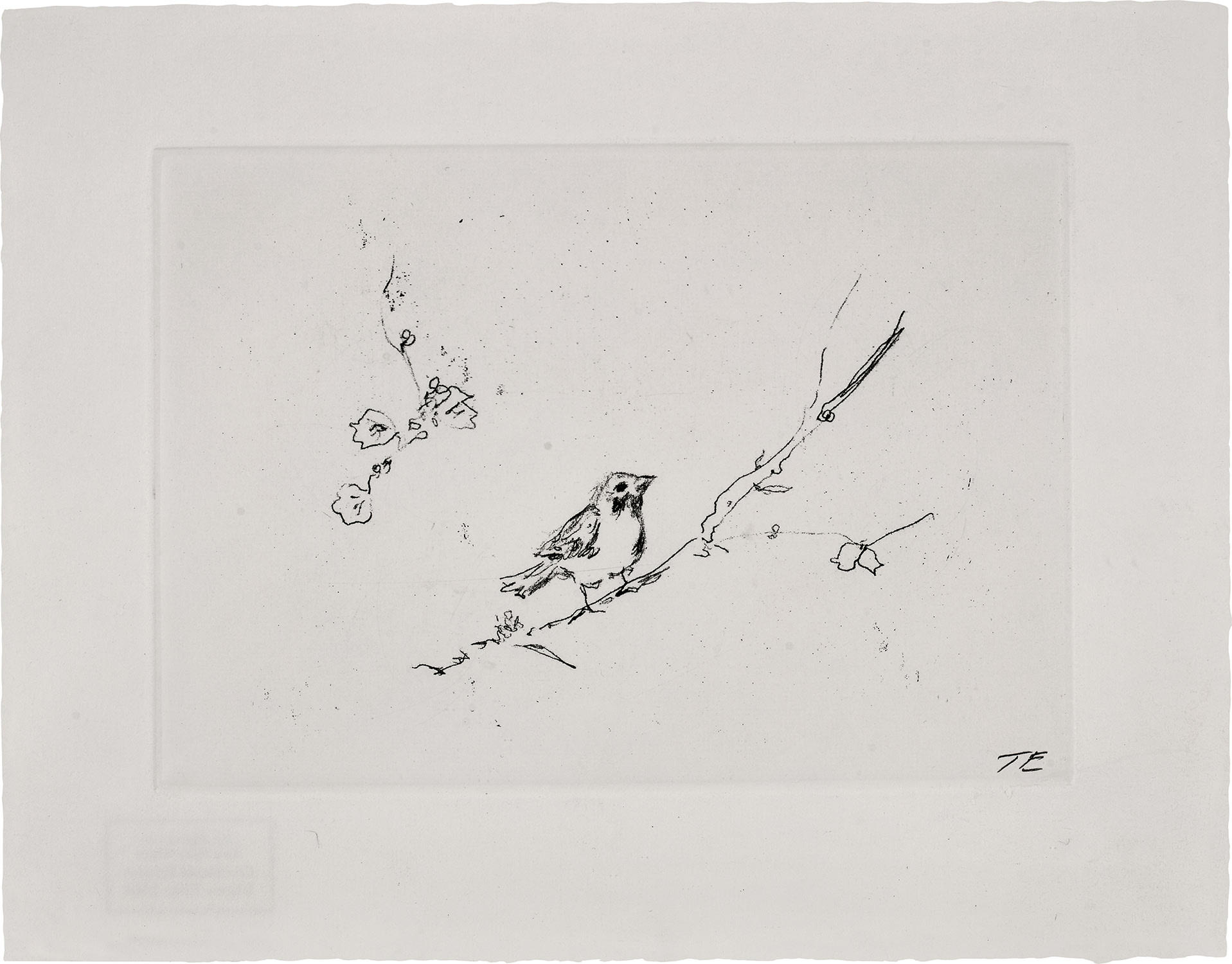
For collectors, Emin's works on paper and print editions offer a remarkable point of access to a practice that is deeply consistent across media. Her etchings, lithographs, and screenprints carry all the emotional directness of her larger installations. Works such as She Watched and Sam and Jay's Birds reveal a draughtswoman of genuine sensitivity, with a line that is at once trembling and assured. Her printmaking practice draws on a lineage that connects her to Edvard Munch and Egon Schiele, two artists with whom she shares a compulsion to make the interior world visible.
Tracey Emin
Sam and Jay's birds
Collectors who have followed her work across multiple decades find that the prints and works on paper reward sustained attention, offering fresh emotional resonance on each encounter. Emin sits within a lineage of artists who have made the self the central subject and material of their practice. Her work in painting connects to Neo Expressionist traditions, while her installations share territory with Louise Bourgeois, whose own excavation of memory and the body was a touchstone for Emin. She has spoken warmly of Francis Bacon, a fellow British artist whose distorted, anguished figures find an echo in her own figurative paintings.
Within the YBA generation, she stands as perhaps the most durably significant female voice, a position recognised by her appointment as a Royal Academician in 2007 and her representation of Britain at the Venice Biennale in 2007, one of the highest honours available to a British artist. Her market has shown consistent strength over many years. Her unique works command significant prices at auction, and her editions are collected across a wide spectrum of collectors from those building their first serious holdings to major institutional buyers. The appeal is not merely biographical or sensational, though those elements are undeniably present.
Collectors respond to Emin because she offers something rare: art that feels necessary. There is no sense of calculation or market positioning in her best work. It arrives from somewhere urgent and real, and it communicates directly across the distance between maker and viewer. Tracey Emin's legacy is already secure, yet she continues to expand and deepen it with each new body of work.
Her recent paintings made during illness are among the most compelling of her career, possessing a colour and a physical openness that suggest an artist who has moved through difficulty into something more spacious. She has spent decades arguing, through her work, that a woman's inner life is a legitimate and inexhaustible subject for serious art. She has won that argument completely. To collect Emin is to hold a piece of that history and to participate in one of the great ongoing conversations in contemporary art.
Explore books about Tracey Emin