Tony Cragg
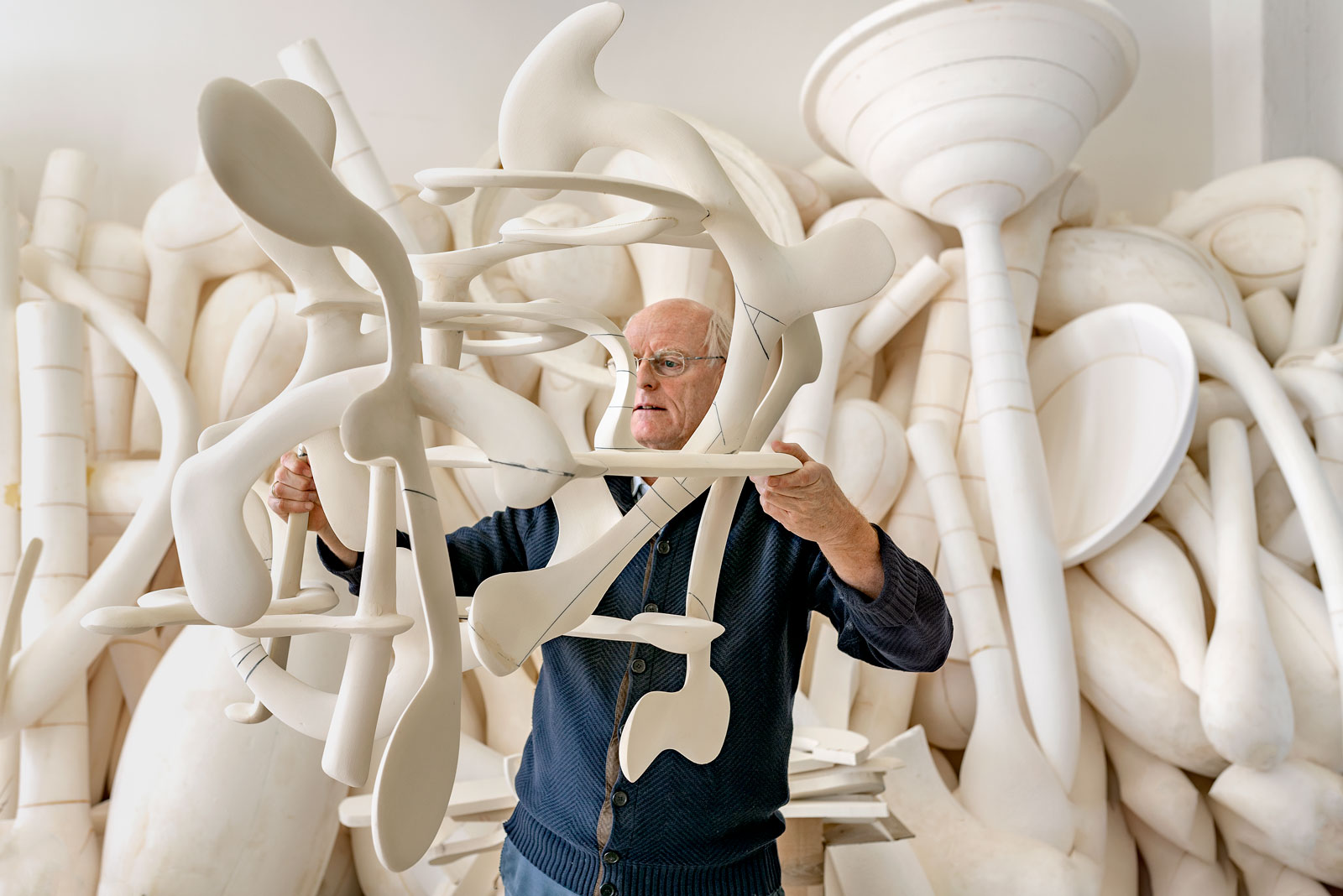
Tony Cragg, Sculptor of Living Matter
Artist Spotlight · The Collection Editorial
“I think sculpture is really about trying to make things that are as complex as the world.”
Tony Cragg, interview with Tate
In the autumn of 2023, the Kunstmuseum Wolfsburg presented a sweeping survey of Tony Cragg's work that drew visitors from across Europe and reaffirmed what serious collectors and museum curators have long understood: Cragg is among the most vital sculptors working anywhere in the world today. His pieces filled the galleries with an almost biological insistence, as though the bronze and steel and wood had arrived at their spiraling, biomorphic forms through some process of natural selection rather than human intention. The exhibition was a reminder that Cragg, now in his mid seventies, is not an artist coasting on reputation but one who continues to push his practice into genuinely new territory. Lisson Gallery, which has represented him for decades, has consistently brought his newest work to international art fairs and museum audiences alike, cementing his status as a cornerstone of the global contemporary sculpture conversation.
Tony Cragg
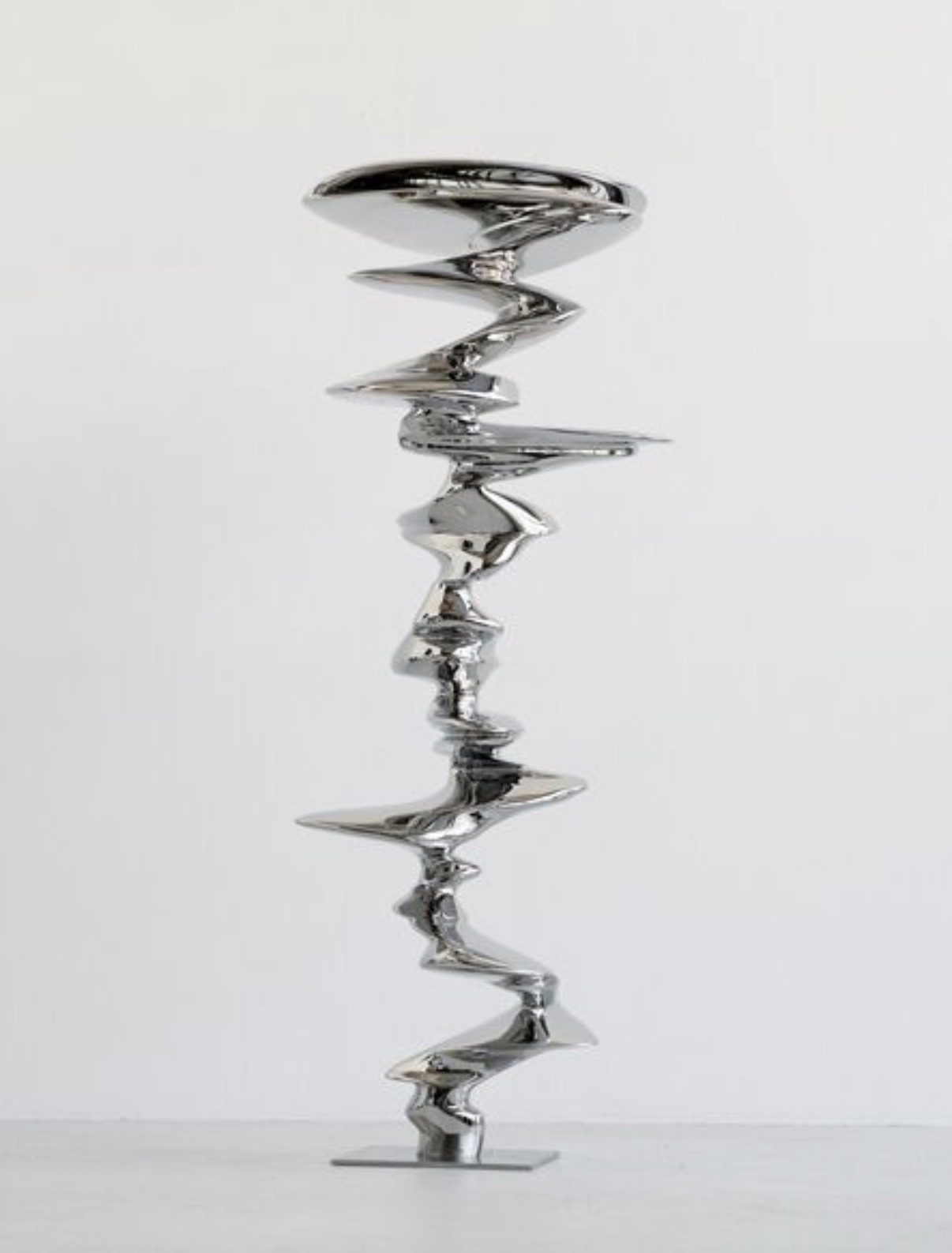
Elliptical Column, 2019
Anthony Douglas Cragg was born in Liverpool in 1949, a city whose postwar industrial landscape left a deep impression on his developing sensibility. He left school at sixteen to work as a laboratory technician at the Natural Rubber Producers Research Association, and that early immersion in materials science, in the physical properties of substances, the way matter behaves under pressure and over time, would prove foundational to everything he later made. He went on to study at Wimbledon College of Art and then at the Royal College of Art in London, graduating in 1977. Shortly after, he made a decision that shaped his entire career: he moved to Wuppertal, Germany, where he has lived and worked ever since, teaching at the Kunstakademie Düsseldorf and eventually serving as its rector.
The distance from the London art world gave him intellectual freedom and a productive remove from passing fashions. Cragg arrived on the international scene in the late 1970s and early 1980s with a body of work that was startling in its directness. He gathered discarded plastic objects, fragments of bottles and containers and packaging, and arranged them on gallery floors and walls in configurations that suggested maps, flags, human silhouettes, or simply the dense residue of consumer civilization. These early assemblages were conceptually sharp, asking urgent questions about the relationship between manufactured objects and the natural world, between the things we make and the things we discard.
Tony Cragg
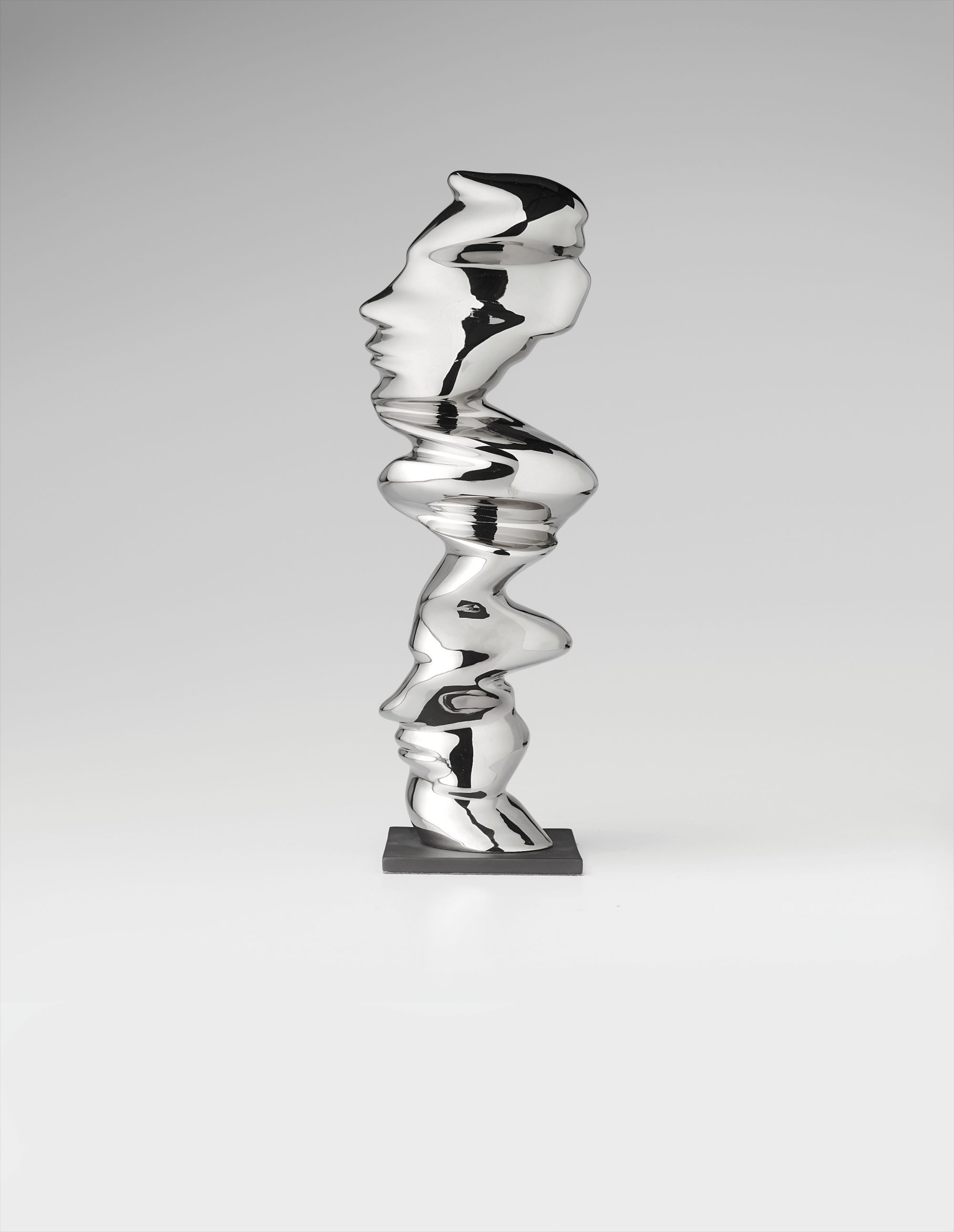
Point of View
When he won the Turner Prize in 1988, he was already recognized as a major figure, and the award brought his work to a broader public consciousness. His nomination and win helped define that generation of British sculptors who were rethinking what sculpture could be, what materials it could employ, and what social and philosophical territory it could occupy. Over the following decades Cragg developed his practice into something increasingly complex and formally ambitious. He moved from found materials into bronze, stainless steel, wood, stone, and ceramic, and his forms became more architecturally imposing and more intricately contoured.
“Materials are not passive. They have their own logic, their own history, and that is what I am working with.”
Tony Cragg, Kunstmuseum Wolfsburg catalogue
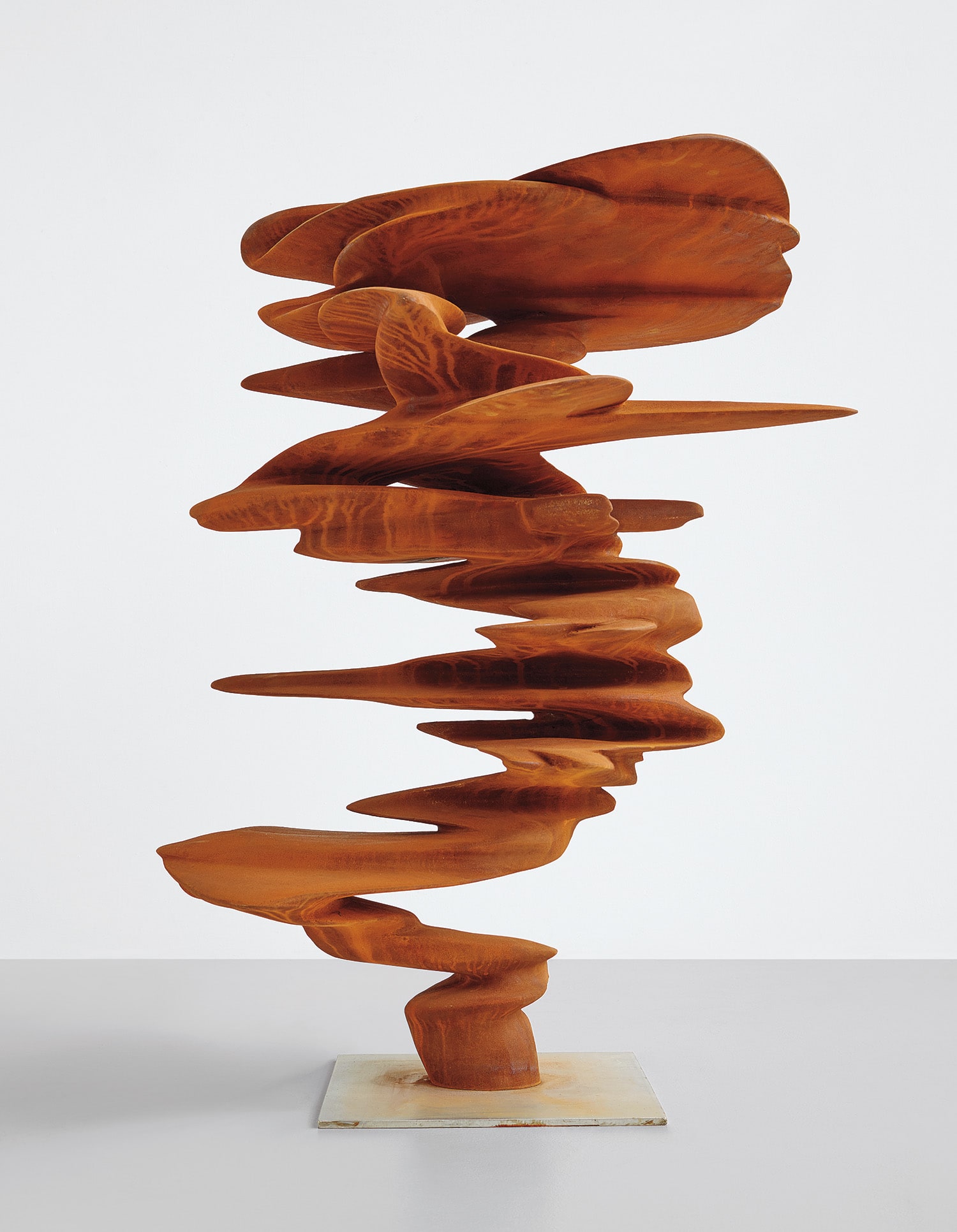
Works like "Elliptical Column," which exists in both a 2014 and a 2019 stainless steel edition, exemplify the mature Cragg: towering vertical forms whose surfaces appear to have been twisted and inflected by invisible forces, as though caught mid transformation between one state and another. "Antler" from 2015 carries the same quality, its branching, organic profiles evoking natural growth while remaining emphatically abstract. "Close Quarters" from 2006 in bronze and "Contradiction" from 2013 in bronze demonstrate his command of weight and volume, the way a Cragg sculpture seems simultaneously in motion and completely resolved. Each piece rewards extended looking; the forms reveal new profiles and internal rhythms as the viewer moves around them.
Tony Cragg
Antler, 2015
For collectors, a Cragg acquisition carries a particular kind of confidence. He is what the market rightly designates a blue chip sculptor, with a presence in major public collections including the Tate, the Museum of Modern Art in New York, the Centre Pompidou in Paris, and the Nationalgalerie in Berlin. His works appear regularly at the major international auction houses, where they consistently perform at and above estimate, with bronze editions and unique pieces both finding strong support from institutional and private buyers. The range of available works is genuinely broad.
Collectors beginning their engagement with Cragg might look to editioned works in porcelain or bronze, such as the elegant "Point of View" in porcelain with chrome glaze, or the "Palette, from For Joseph Beuys," a signed and numbered edition co published by Galerie Bernd Klüser in Munich and Edition Schellmann in New York, which speaks directly to Cragg's deep roots in the German art world and his respectful dialogue with Beuys's legacy. More ambitious collectors pursue the large scale unique bronze and stainless steel works, which command significant attention in any architectural context and have demonstrated sustained long term appreciation. Cragg occupies a distinctive position within the broader history of postwar and contemporary sculpture. His work is in conversation with the Arte Povera artists who also interrogated materials and process, with Richard Serra's monumental engagement with industrial substance, and with the British sculptors of his own generation including Bill Woodrow and Richard Deacon, who shared an interest in found objects and material transformation without ever converging on the same formal language.
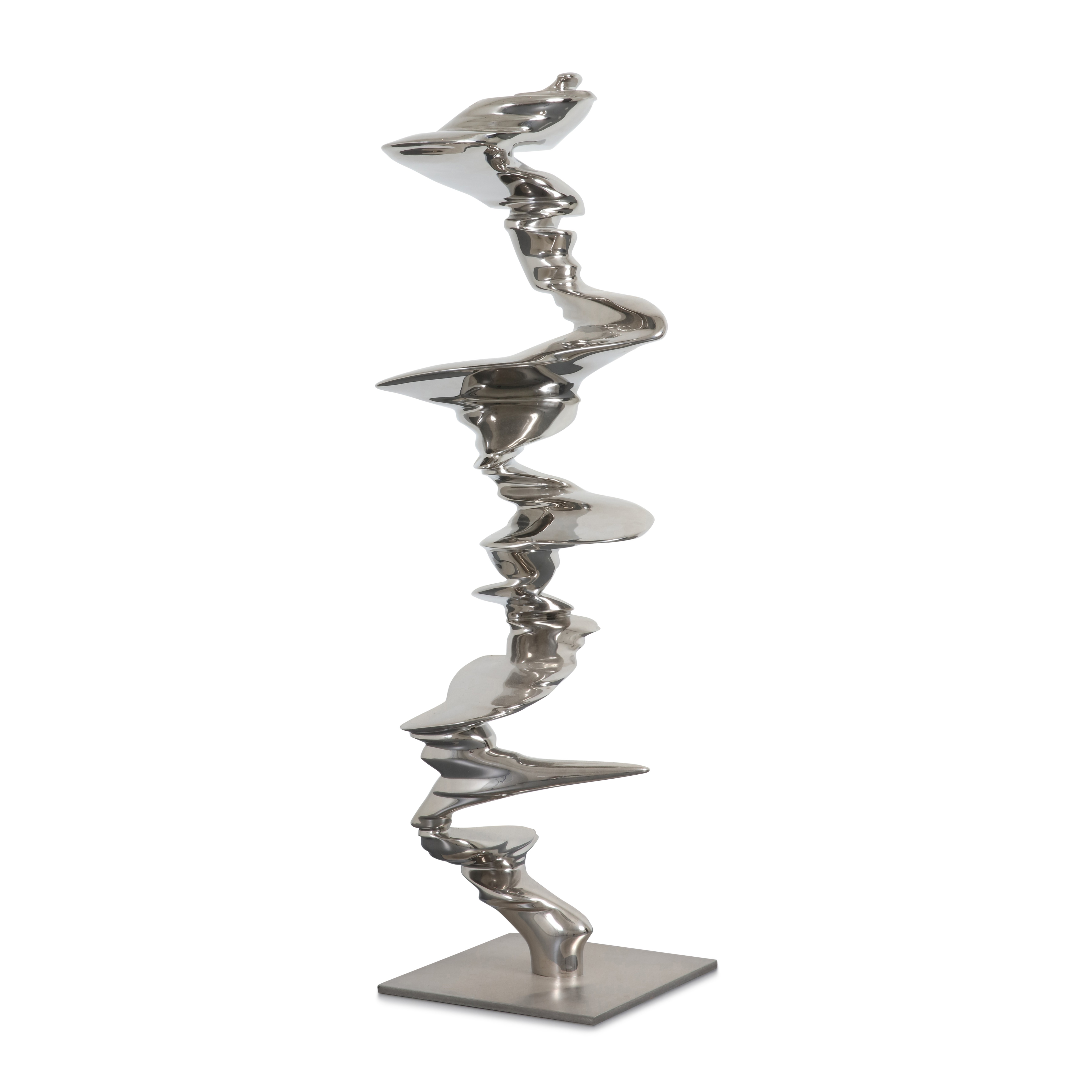
Tony Cragg
Elliptical Column, 2014
Yet Cragg remains genuinely singular. Where Serra imposes, Cragg suggests. Where Beuys reached for myth and shamanic resonance, Cragg stays with the empirical, with what matter actually does and what we can know through close attention to physical form. His dialogue with natural science, with evolution, geology, and cellular biology, gives his work an intellectual seriousness that operates independently of any single theoretical framework.
What makes Cragg matter so urgently today is the particular quality of optimism embedded in his practice. In a cultural moment saturated with anxiety about the natural world and humanity's relationship to materials and manufacture, Cragg offers not despair but curiosity. His sculptures insist that looking carefully at the forms of things, at the way organic and artificial structures mirror and complicate each other, is itself a form of ethical attention. "After We Have Gone" from 2014 carries that meditative quality in its very title, inviting reflection without melancholy, asking what endures and what transforms.
Cragg's career, from a Liverpool boy working with rubber compounds to one of the most celebrated sculptors in the world, is itself a kind of argument for the transformative power of sustained engagement with materials. For collectors who believe that great art deepens over time, who want work that holds the eye and the mind across years and decades, Tony Cragg is as reliable and as rewarding an investment of attention as the contemporary art world has to offer.
Explore books about Tony Cragg
Tony Cragg
Germano Celant
Tony Cragg: Sculptures and Drawings
Museum of Modern Art
Tony Cragg
Paul Moorhouse
Tony Cragg: Works 1977-1987
Kasper König
Tony Cragg
Lynne Cooke
Tony Cragg: New Forms
Museum Boymans-van Beuningen