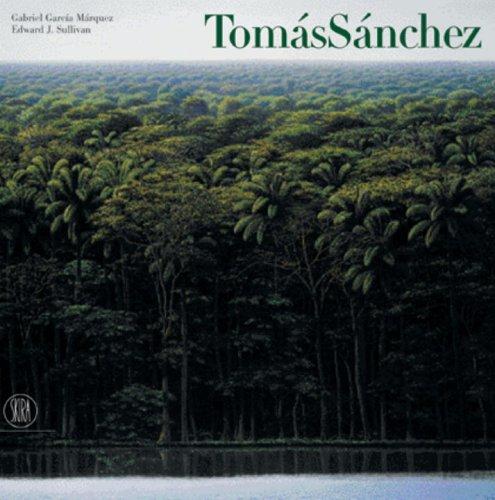
Tomás Sánchez
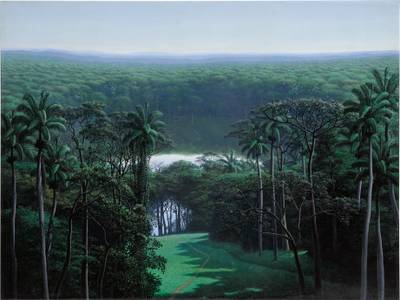
Tomás Sánchez: Where Stillness Becomes Sacred
Artist Spotlight · The Collection Editorial
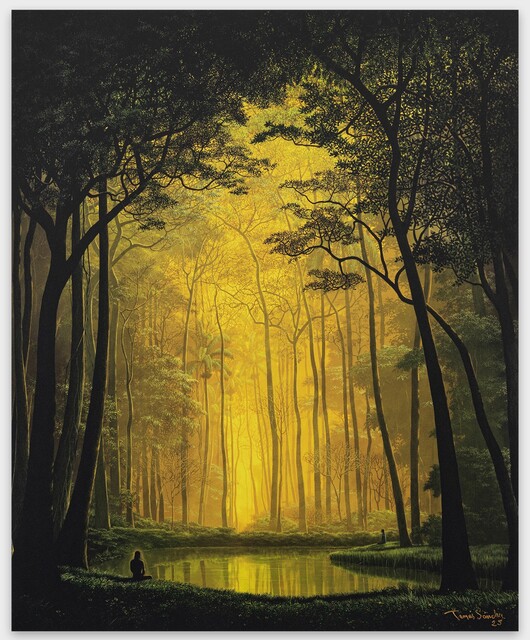
In 2025, Tomás Sánchez released a new body of work that includes "El testigo" and "Cascada Como Icono," UV pigment prints rendered on 410gsm Somerset Tub Sized Radiant White paper with a matte varnish seal, alongside a sculptural edition titled "Contemplar Al Meditador De La Isla," crafted from seven ply Grade A Canadian Maple Wood. These new works signal something significant: at 76 years old, one of Cuba's most internationally celebrated painters is not resting on a legacy but actively expanding it, moving fluidly between traditional painting, drawing, and editions that bring his luminous vision to new audiences. The arrival of these pieces on the market has renewed collector interest in a practice that has been quietly influential for decades, and that influence is now unmistakable. Sánchez was born in Cuba in 1948, coming of age in a country undergoing radical transformation.
Tomás Sánchez
El testigo, 2025
He studied at the San Alejandro Academy of Fine Arts in Havana, one of the oldest and most prestigious art institutions in Latin America, before completing his formation at the Instituto Superior de Arte, the landmark arts university established in Havana in 1976. It was during these formative years that Sánchez encountered the work of the Grupo Antillano movement and began to develop his own deeply personal visual language, one rooted not in political rhetoric but in something quieter and ultimately more enduring: the inner life of a person standing at the edge of water, listening. His early career placed him within the broader current of Cuban art at a moment when the island's painters were negotiating between realist traditions, surrealist influences arriving from Europe, and the urgent social themes of post revolutionary cultural life. Sánchez absorbed these pressures and redirected them inward.
Rather than making art about the world as a stage for human drama, he began making art about the world as a mirror for human consciousness. By the late 1970s and into the 1980s, his signature approach was taking shape: vast, meticulously rendered natural landscapes in which a solitary figure, almost always seated in meditation, occupies a small but spiritually charged position within an overwhelmingly beautiful natural world. "Orilla: Espejo de las Nubes," painted in acrylic on canvas in 1988, is one of the earliest works in the current platform selection and stands as a definitive example of his mature voice finding its full register. The title translates roughly to "Shore: Mirror of Clouds," and the painting delivers exactly that promise: a shoreline so still and so precisely observed that the sky and its reflection become indistinguishable, the boundary between heaven and earth dissolved by water.
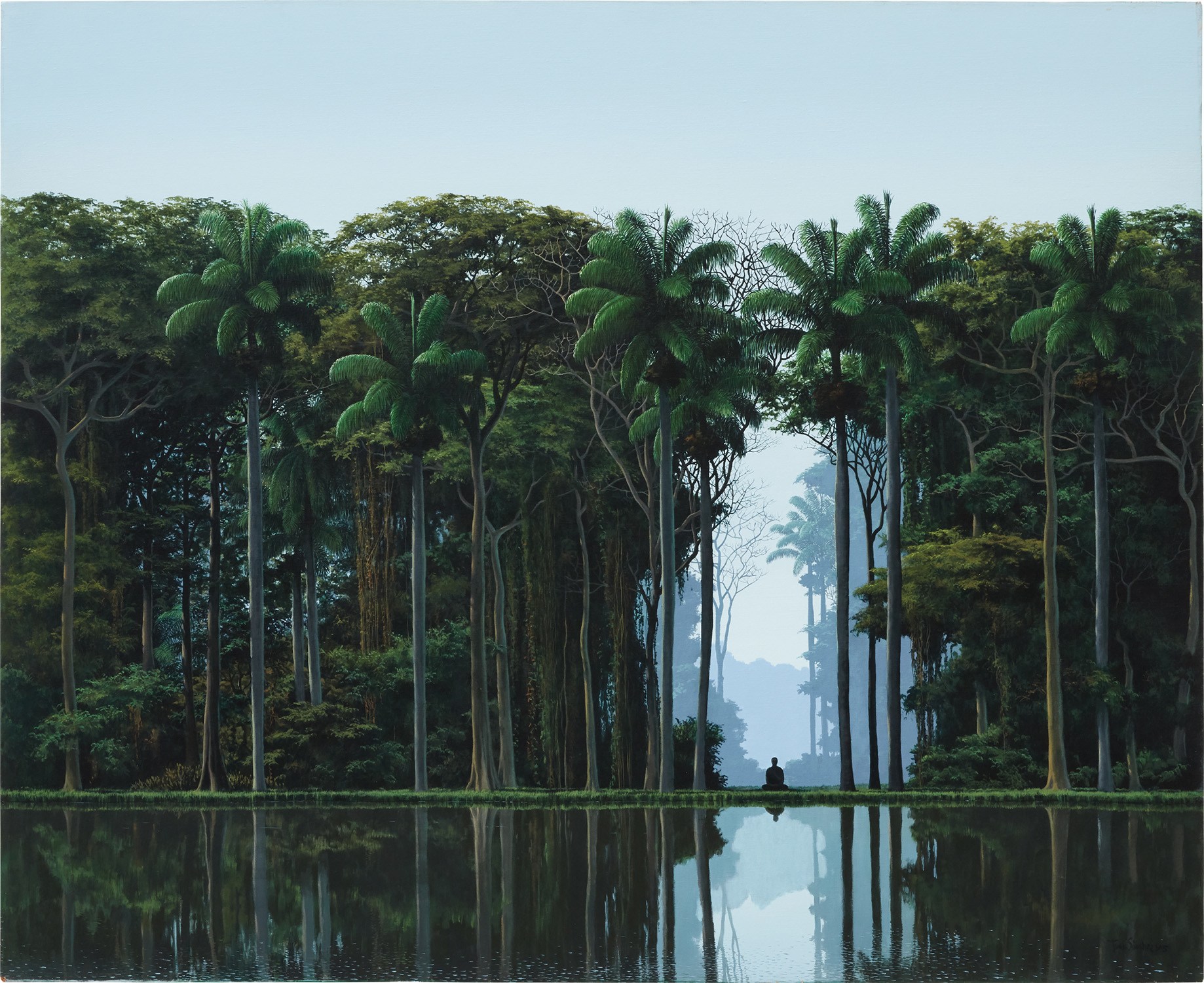
Tomás Sánchez
Meditador, 1995
Works like this one established Sánchez as a master of what might be called meditative hyperrealism, a mode of painting that deploys the technical exactitude of photorealism not in service of spectacle but in service of silence. The paintings from this period, including "El sonido de las aguas" (1993, oil on canvas), "Meditador" (1995, acrylic on canvas), and "Contemplador del contemplador" (1996, acrylic on canvas), represent the full flowering of this approach and remain among the most sought after works in his catalogue. What distinguishes Sánchez from his peers in the broader landscape of late twentieth century painting is the philosophical seriousness with which he treats nature as a subject. His work is not decorative, and it is not merely technical, though the technique is extraordinary.
The paintings are structured around a spiritual proposition: that attentiveness to the natural world is itself a form of enlightenment. The recurring figure of the meditator, small against forests and waterfalls and reflecting pools, is not dwarfed by nature so much as completed by it. "Encuentro con el meditador de la laguna" (1992, acrylic on canvas) and "Contemplador de cascada en la noche" (1996, acrylic on canvas) both demonstrate this dynamic with particular force, the human figure present not as protagonist but as witness, a role that gives the works their quiet authority. The 2018 work "Sonidos de cascada," executed in Conté crayon and acrylic on canvas, shows Sánchez experimenting with materials while maintaining absolute fidelity to his core vision.
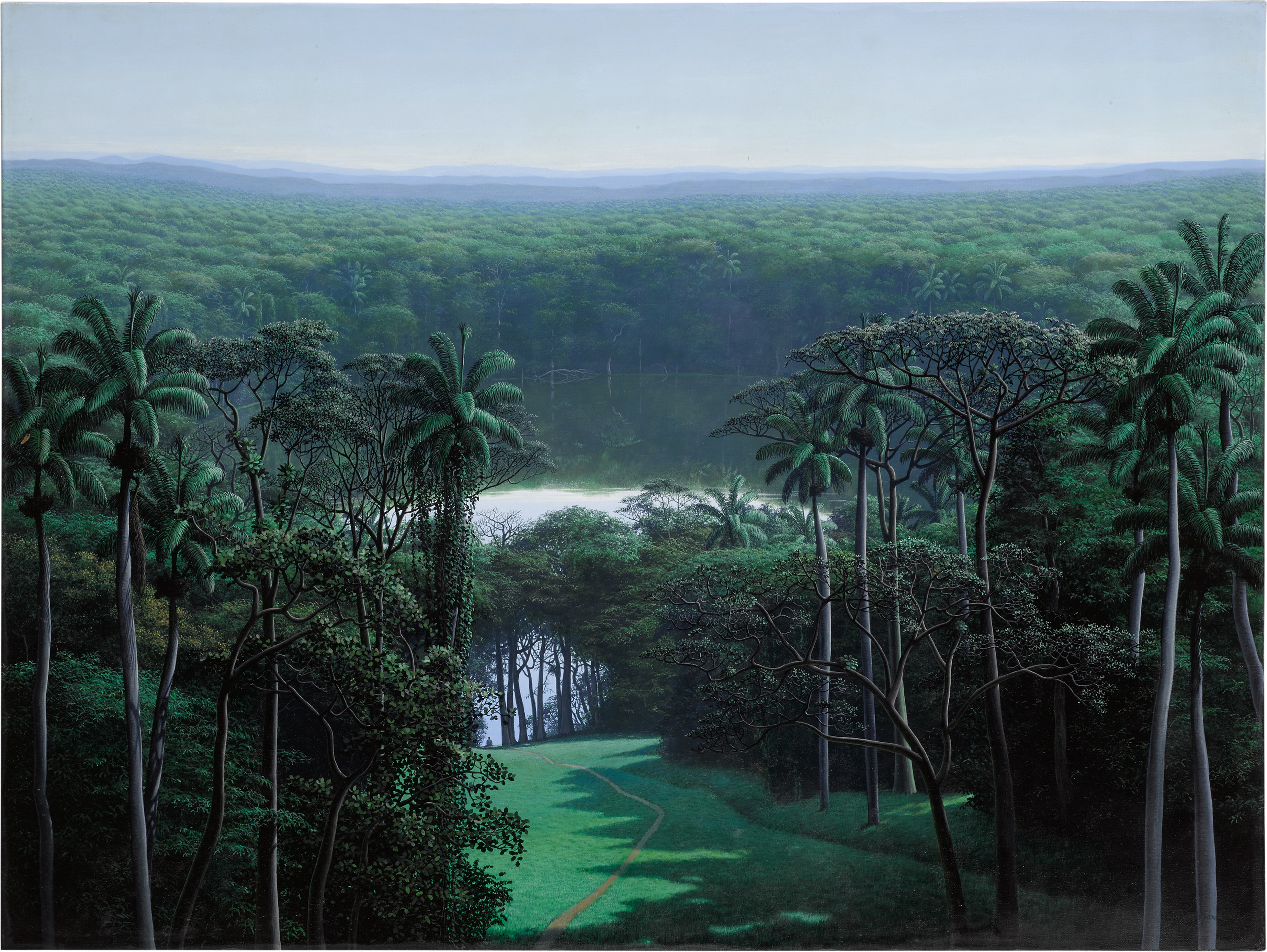
Tomás Sánchez
Encuentro con el meditador de la laguna, 1992
From a collecting perspective, the market for Sánchez has grown steadily and with genuine conviction. His works have been exhibited at major institutions across Latin America, the United States, and Europe, and private collectors across multiple continents have assembled significant holdings of his paintings. Blue chip status in the art market is typically conferred when an artist achieves consistent institutional recognition, strong secondary market performance, and a collector base that includes serious, long term participants, and Sánchez meets all three criteria. His paintings from the late 1980s through the late 1990s are considered his most historically significant and command attention whenever they appear at auction or in private sales.
For collectors approaching his work now, the 2025 editions offer an accessible and meaningful point of entry, while works on canvas from the early 1990s represent the kind of art historical touchstones that define a serious collection. Within the broader landscape of contemporary art, Sánchez occupies a position that is genuinely singular. He shares certain concerns with the American land artists of the 1970s, and his environmental consciousness resonates with painters like Vija Celmins in its commitment to patient, devoted observation of natural surfaces. His spiritual orientation connects him to a lineage that includes the nineteenth century luminists of the Hudson River School, artists like Frederic Edwin Church and Martin Johnson Heade who treated light in landscape as a form of transcendence.
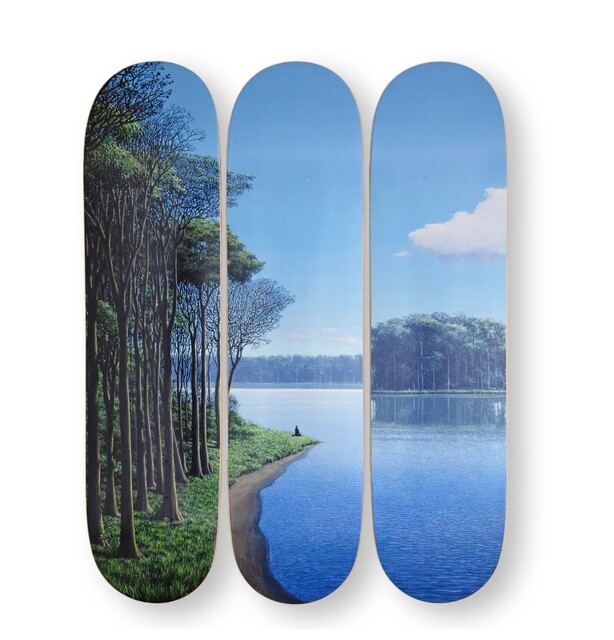
Tomás Sánchez
Contemplar Al Meditador De La Isla, 2025
Yet Sánchez is distinctly of his place and his time, rooted in the Caribbean, shaped by Cuban visual culture and by the specific quality of tropical light, which has no equivalent anywhere else in the world. The legacy of Tomás Sánchez is still being written, and that is precisely what makes him so compelling right now. He is a living artist whose historical importance is already secure, whose recent work demonstrates ongoing creative vitality, and whose central themes, ecological consciousness, the practice of stillness, the relationship between the human spirit and the natural world, feel not merely relevant but urgent in the present moment. To collect his work is to invest in a vision that has been consistent, uncompromising, and quietly radical for nearly five decades.
It is also simply to live with paintings that reward looking, paintings that ask you, with great patience and great beauty, to be still.
Explore books about Tomás Sánchez