Thomas Ruff
Thomas Ruff Sees Everything Anew
Artist Spotlight · The Collection Editorial
“I am not interested in photography as such. I am interested in images.”
Thomas Ruff, interview with ArtReview
In the spring of 2022, the Kunsthalle Düsseldorf mounted a survey that reminded a new generation of collectors and critics why Thomas Ruff remains one of the most intellectually alive photographers working anywhere in the world. The exhibition drew together works spanning four decades and demonstrated something that seasoned admirers of Ruff already know well: that each new body of work feels like the arrival of an entirely different artist, and yet the whole is unmistakably, thrillingly coherent. Ruff does not simply take photographs. He interrogates the very conditions under which images are made, circulated, believed, and forgotten.
Thomas Ruff
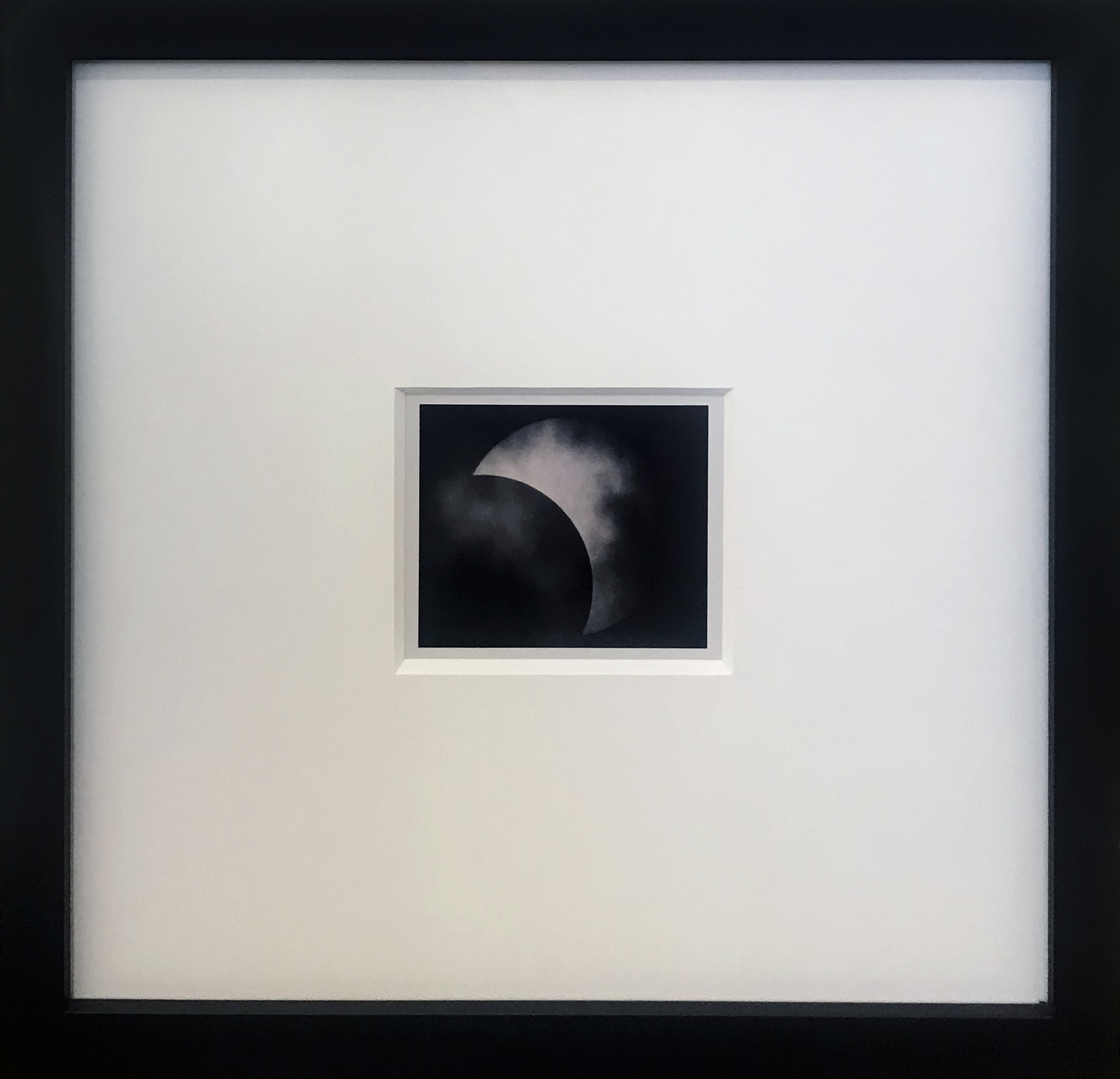
Eclipse, 2004
Ruff was born in Zell am Harmersbach in the Black Forest region of Germany in 1958, and he came of age in a country still actively reckoning with its recent past and the role that images had played in it. He studied at the Kunstakademie Düsseldorf from 1977, entering the legendary class of Bernd and Hilla Becher, the photographers whose deadpan, systematic documentation of industrial structures would give rise to an entire school of serious conceptual photography. His classmates included Andreas Gursky, Candida Höfer, and Axel Hütte, a cohort that would come to define the Düsseldorf School of Photography and reshape the international art world's understanding of what the medium could achieve. The formation Ruff received there was rigorous, philosophical, and deeply rooted in questions of objectivity, seriality, and the archive.
From the beginning, Ruff worked in series, approaching each subject with the methodical patience of a scientist conducting experiments. His early Portraits, begun in the early 1980s and exhibited to considerable attention at the German Pavilion during the 1990 Venice Biennale, presented large format frontal photographs of young men and women against neutral backgrounds. The images were deliberately emptied of psychological warmth or narrative intimacy. Shot with the neutral affect of a passport photograph but blown up to monumental scale, the Portraits forced viewers to confront the gap between looking and knowing, between resemblance and understanding.
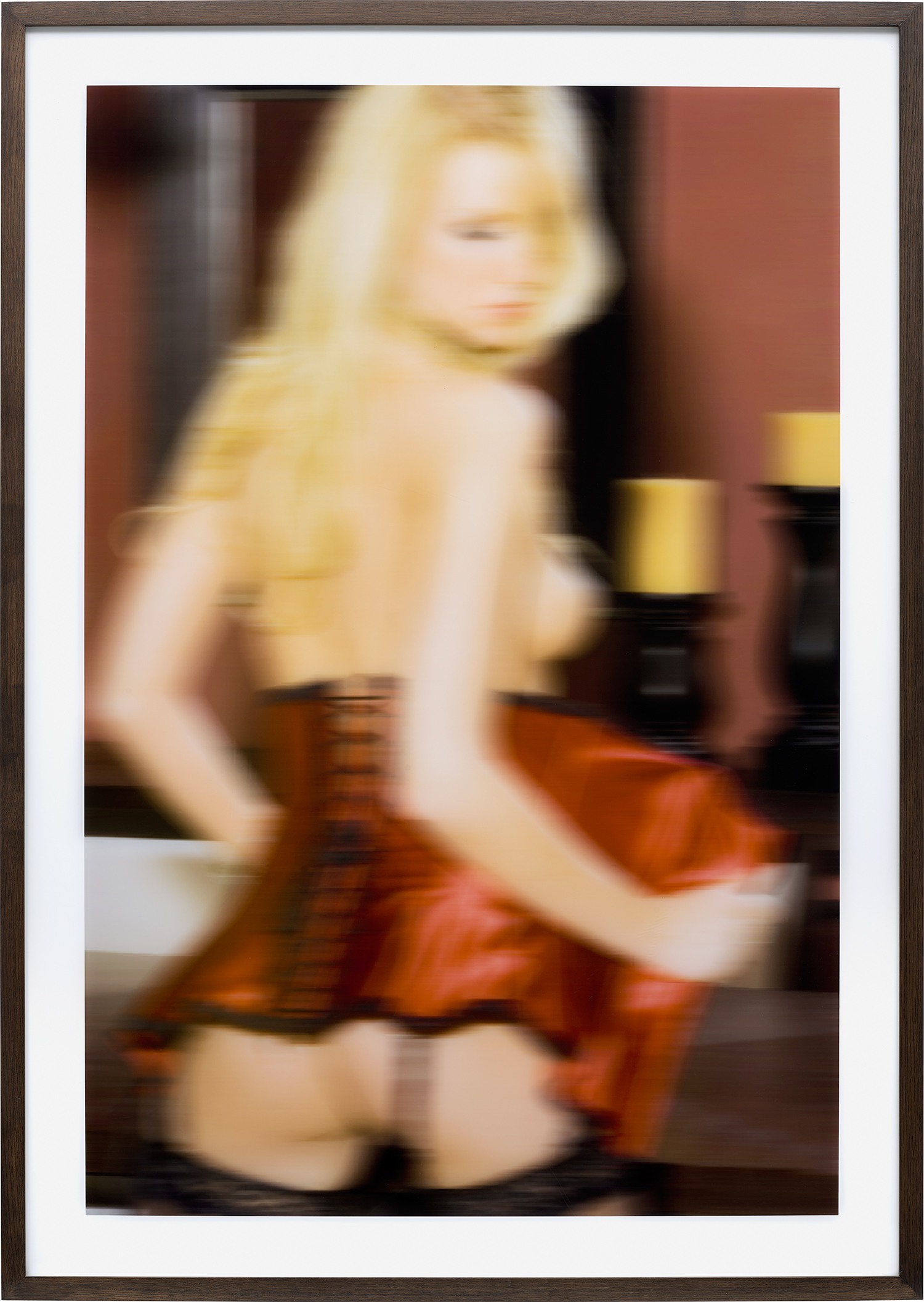
Thomas Ruff
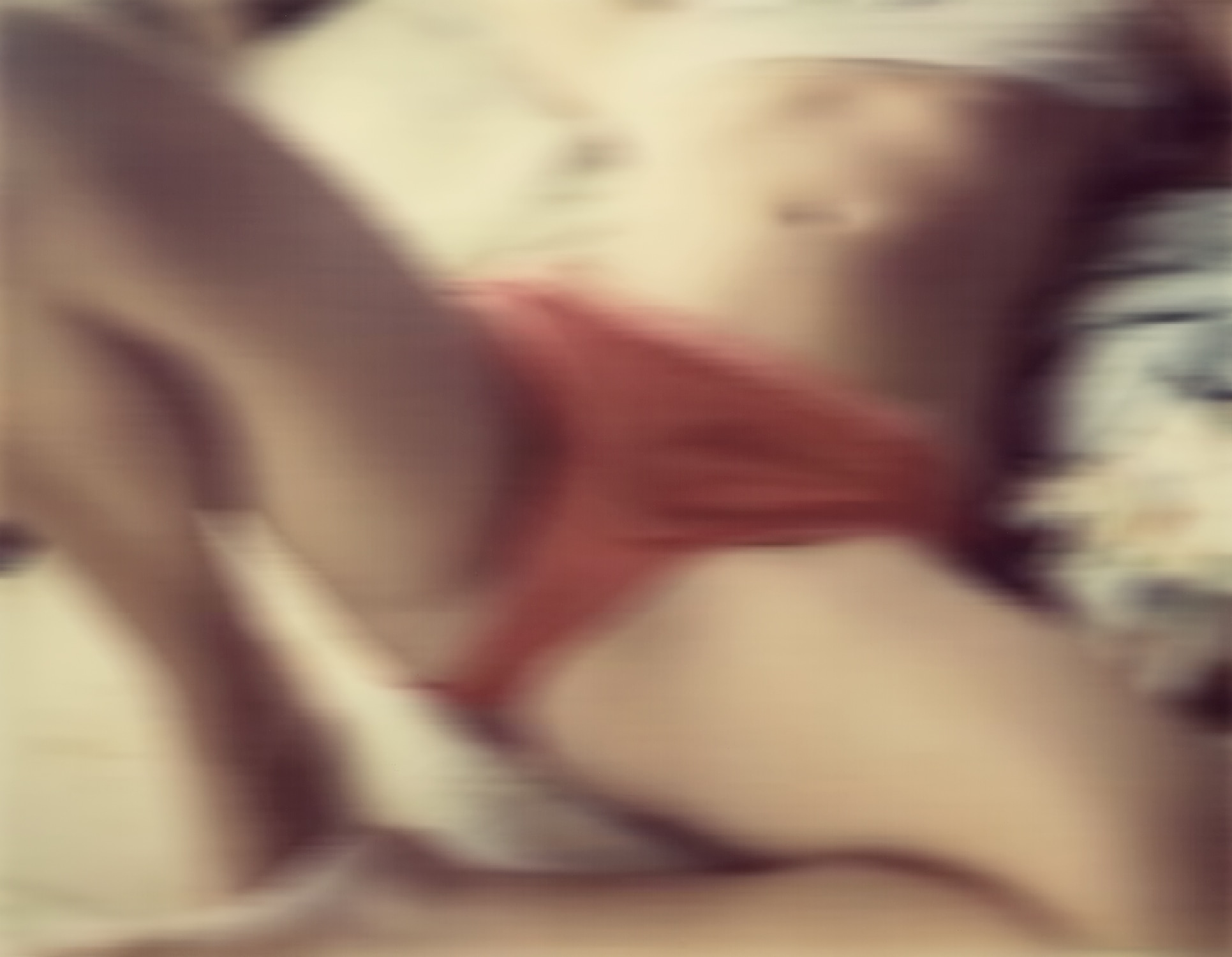
nudes il 07, 2012
They established the central concern that would animate everything Ruff made thereafter: what does an image actually tell us, and what does it merely appear to tell us. The Sterne series, produced in collaboration with the European Southern Observatory and exhibiting celestial photographs taken through telescopes, pushed this inquiry into cosmic territory. Works such as Sterne 16H 08M / 25° are chromogenic prints of extraordinary scale and luminous precision, face mounted to Plexiglas so that the darkness of space seems to exist behind the surface of the image rather than on it. Ruff did not take these photographs himself in any conventional sense.
“Every picture is a construction. There is no such thing as an objective photograph.”
Thomas Ruff, Kunsthalle Düsseldorf catalogue
He sourced them from the observatory's archive and reprinted them at a scale and with a quality that transformed scientific data into something vertiginous and sublime. The series raised questions that would preoccupy Ruff throughout his career: what is authorship, what is originality, and what happens when an image changes hands and context. The jpeg series, launched in the early 2000s, represents one of his most celebrated and prescient moves. Ruff downloaded images from the internet and then massively enlarged them, allowing the compression artifacts of the jpeg format to bloom into large abstract pixels.
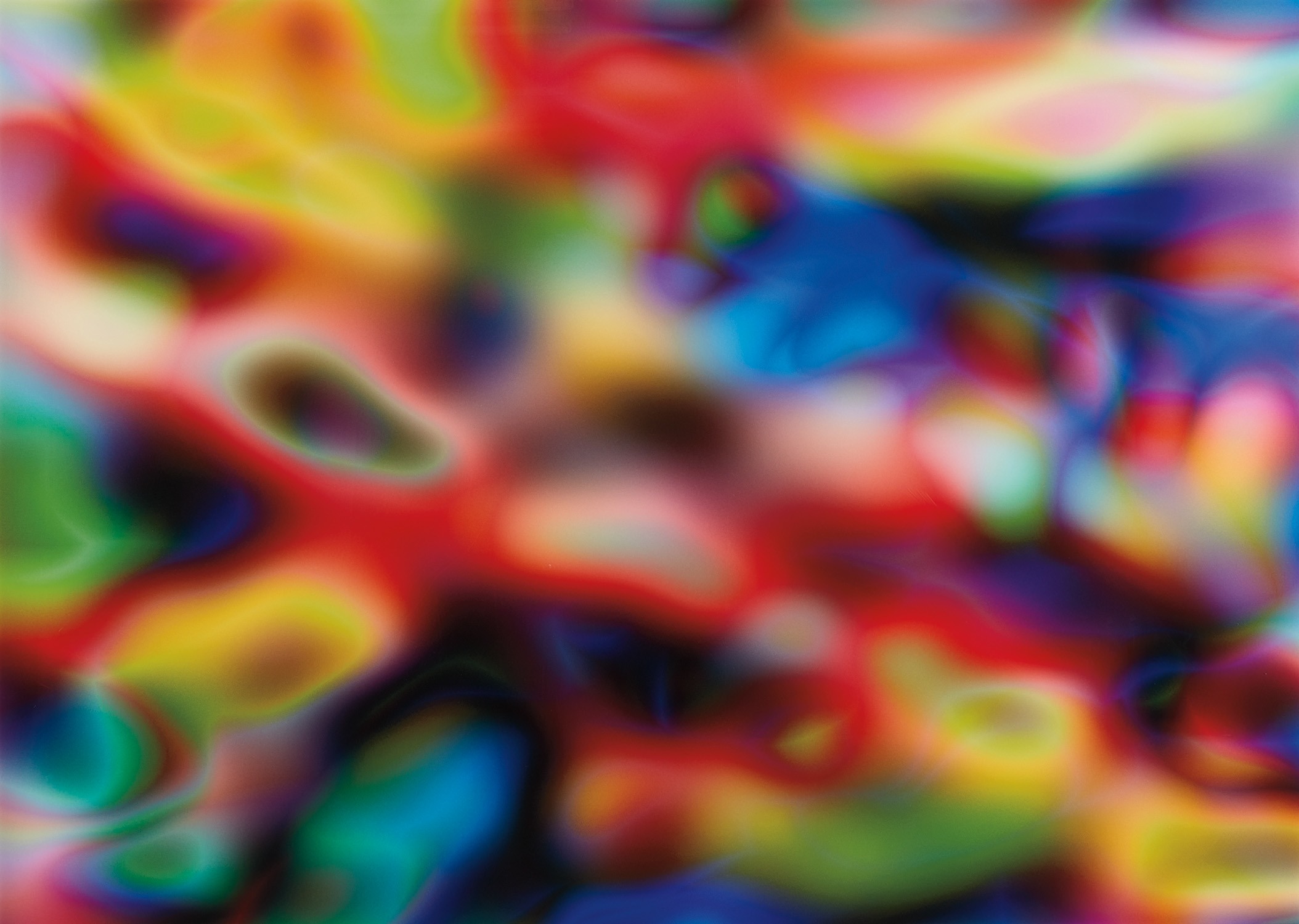
Thomas Ruff
Substrat 15 I
Works like jpeg li01 and jpeg pp02 are both documentary and painterly, both forensic and lyrical. At a moment when the internet was transforming how images were consumed and trusted, Ruff was already making visible the hidden architecture of digital representation. His jpeg works anticipated debates about fakery, resolution, and the politics of imagery that would become urgent cultural conversations a decade later. The ma.
r.s. series extended this logic into NASA's archive of Mars imagery, bringing the alien surface of another planet into the gallery with the same cool, probing intelligence. The nudes series, begun in the late 1990s and continuing into the 2010s, is perhaps his most provocative body of work and also among his most formally beautiful.
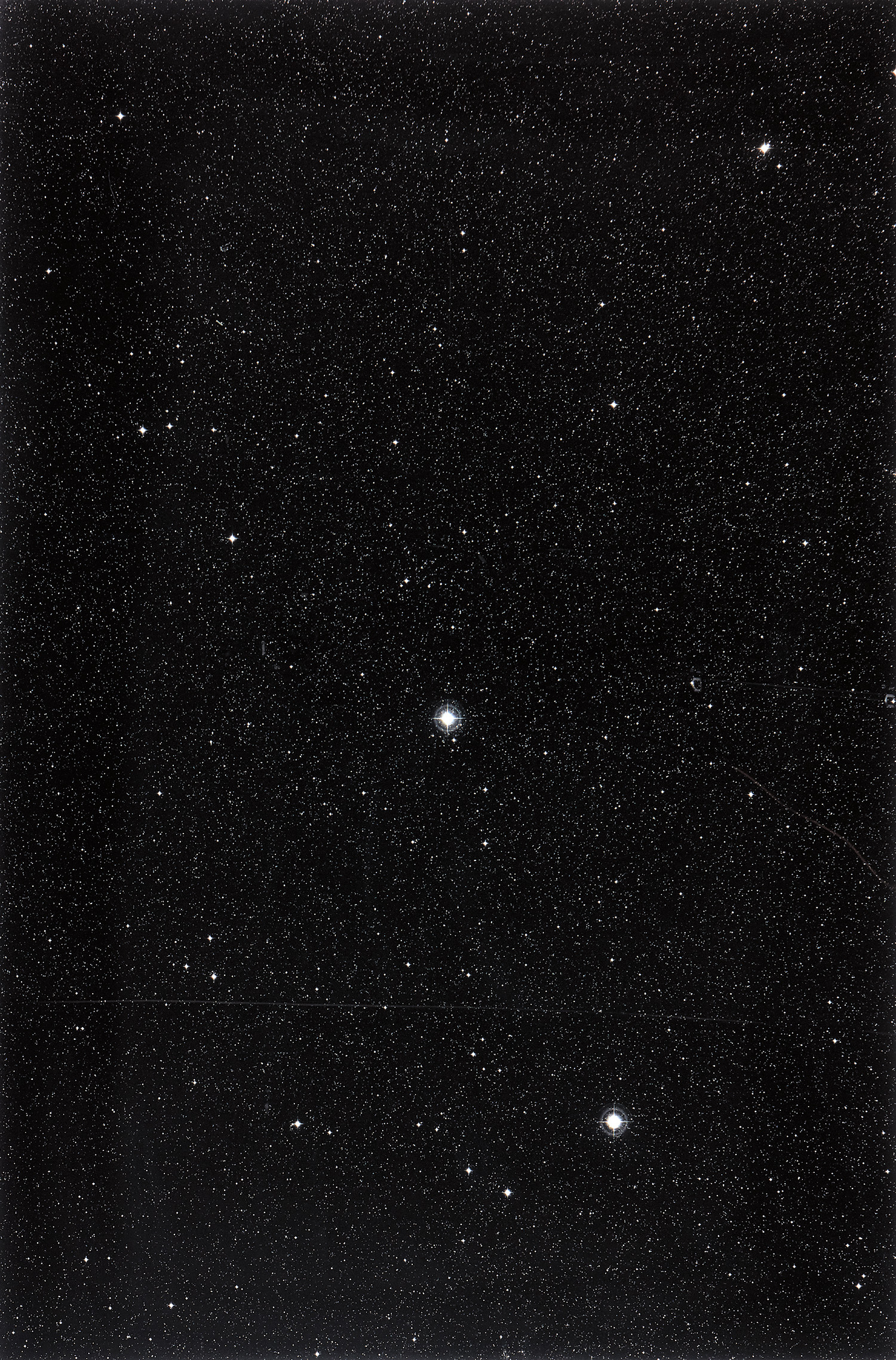
Thomas Ruff
Sterne 16H 08M /-25°
Ruff sourced images from pornographic websites and then applied photographic filters and techniques that dissolved the explicit content into something atmospheric and abstract. Works like nudes il 07 exist in a strange zone between visibility and concealment. The human body becomes a kind of painterly blur, a rumor of flesh, and the images ask serious questions about desire, the gaze, censorship, and the moral assumptions that audiences bring to looking. The series drew controversy but also serious critical appreciation, and it remains central to any understanding of Ruff's contribution to contemporary art.
From a collecting perspective, Thomas Ruff offers something genuinely rare: a body of work that is both visually spectacular and intellectually robust, capable of commanding a room and sustaining years of thought. His prints have been offered at Christie's, Sotheby's, and Phillips with consistent strength, and the large format Plexiglas mounted works in particular tend to perform very well at auction, reflecting the appetite among serious collectors for photography that operates at the scale and ambition of painting. The Maschinen series, a suite of digital pigment prints on Hahnemühle photo rag paper documenting industrial machinery with almost tender formalism, offers collectors a point of entry that connects Ruff's work directly to the Becher legacy while demonstrating his own irreducibly individual vision. The complete sets and editioned suites that appear periodically at auction carry particular interest among institutional buyers and private collectors who appreciate the conceptual coherence of encountering a series whole.
Ruff belongs to a tradition that includes not only his Düsseldorf peers but also reaches back to conceptual photographers like Ed Ruscha and the Pictures Generation artists such as Cindy Sherman and Richard Prince, all of whom interrogated the found image and the conditions of photographic truth. He is also deeply in conversation with painters. The jpeg and Substrat works in particular read as a kind of dialogue with abstract painting, and collectors who hold works by Gerhard Richter or Wade Guyton often find that a Ruff sits beside them with a natural intellectual companionship. His work has been shown at the Museum of Modern Art in New York, the Tate Modern in London, the Centre Pompidou in Paris, and the Stedelijk Museum in Amsterdam, among many other major institutions, giving it a provenance and a critical context that collectors rightly value.
What makes Thomas Ruff genuinely indispensable to the story of art in our time is his absolute refusal to be satisfied by any single answer to the questions he poses. Every series he has made represents a fresh starting point, a willingness to discard what has already been praised and begin again with a new set of problems. He has shown that photography is not a style but a set of philosophical tools, and that those tools can be used to examine everything from the human face to the surface of Mars, from the architecture of desire to the hidden geometry of digital code. To collect Ruff is to invite into your life one of the most searching minds that contemporary photography has produced, and to join a conversation about images that has never felt more necessary.
Explore books about Thomas Ruff