Tammi Campbell
Tammi Campbell Wraps Memory in Light
Artist Spotlight · The Collection Editorial
Something quietly radical is happening in Tammi Campbell's studio. In 2024, Campbell released a cluster of works that announce themselves with disarming wit and visual intelligence, using the most ordinary materials imaginable, bubble wrap, packing tape, plexiglas, to reframe some of art history's most canonical gestures. The timing feels exactly right. At a moment when the art world is hungrily reassessing whose contributions have been centered and whose have been deferred, Campbell arrives with work that is simultaneously playful and deeply considered, personal and universal, rooted in tradition while cheerfully refusing its hierarchies.
Tammi Campbell
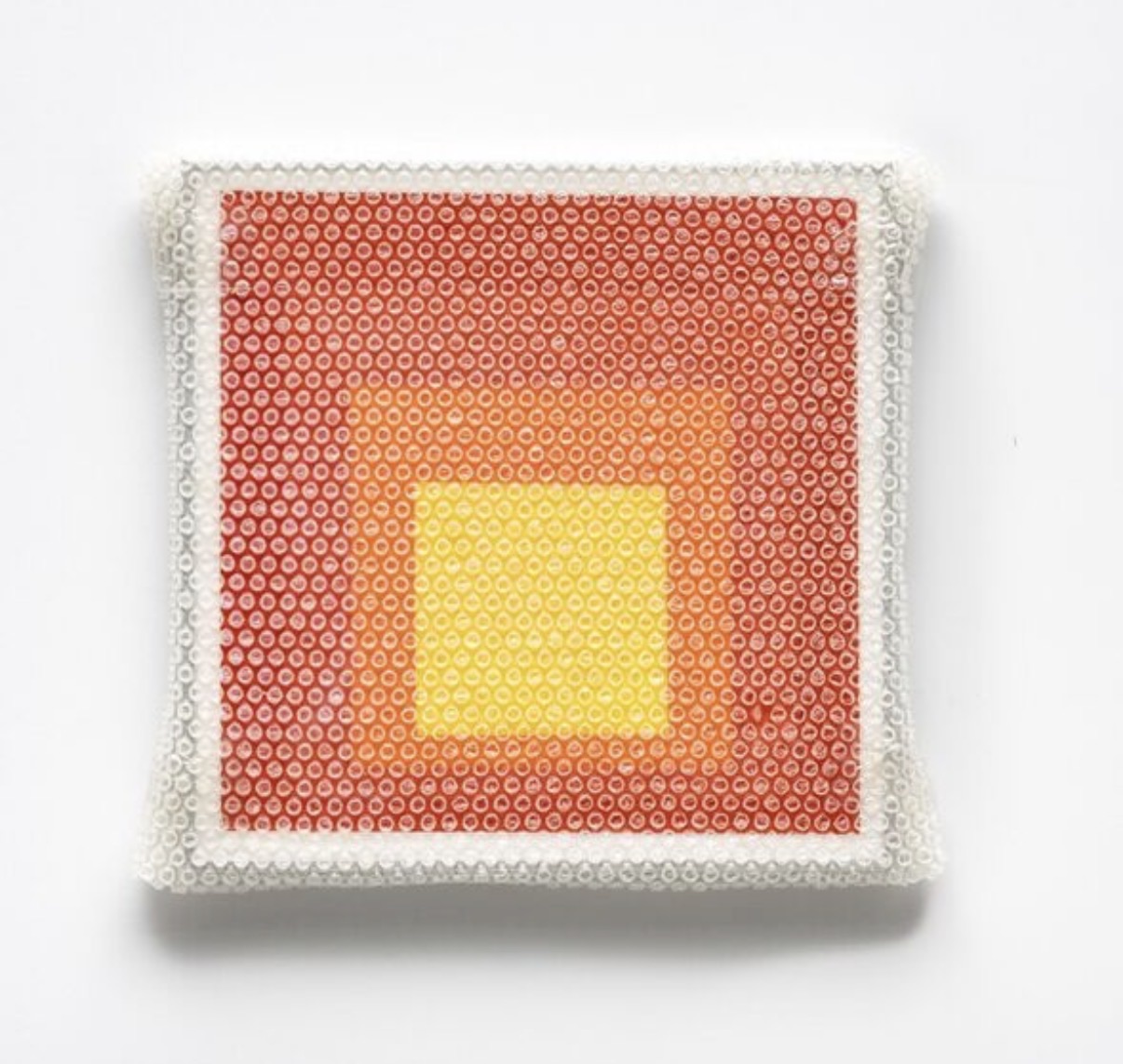
Homage to the Square, Wrapped with Bubblewrap and Tape, 2024
Tammi Campbell was born in 1960 in the United States, coming of age during a period of profound cultural transformation that would leave its mark on everything she would later make. The social upheavals of the 1960s and 1970s, the ongoing negotiations around Black identity, visibility, and belonging in American life, formed the atmosphere in which her artistic sensibility took shape. Like many artists of her generation, Campbell absorbed the contradictions of that era, the simultaneous expansion of possibility and the persistence of exclusion, and found in art a space where those contradictions could be held, examined, and sometimes lovingly dismantled. Campbell's practice developed across painting, assemblage, and mixed media, a range that reflects both her formal curiosity and her conviction that no single material or method can contain the full weight of what she wants to say.
Working with found objects, textiles, and cultural artifacts alongside paint and traditional supports, she builds compositions that are layered in the most literal sense. Physical layers of material accumulate meaning the way memory does, through accretion, through repetition, through the unexpected survival of things that were never meant to last. Her engagement with domesticity and heritage is not nostalgic. It is forensic and affectionate in equal measure, an excavation carried out with care.
Tammi Campbell
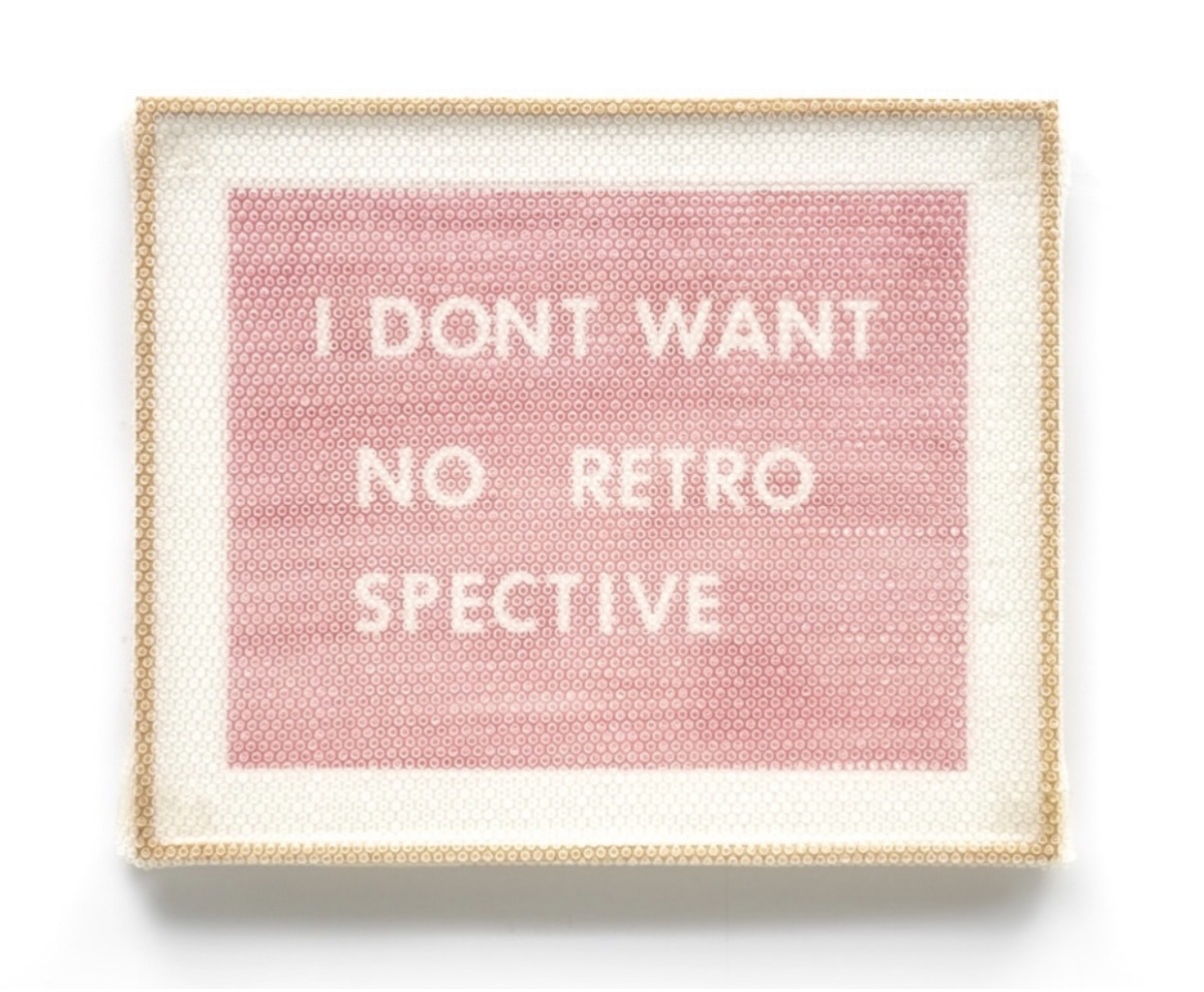
I DON'T WANT NO RETROSPECTIVE, 2024
The 2024 works available through The Collection give a vivid sense of where Campbell's thinking currently sits. "Homage to the Square, Wrapped with Bubblewrap and Tape" deploys Josef Albers's legendary series as a foundation and then proceeds to wrap it as if for shipping, as if it were precious cargo in transit between one era and another. The gesture is funny and it is also entirely serious. Albers spent decades asking what color does to color, what a square does to a square.
Campbell asks what happens when the canon becomes an object in the world, subject to the same indignities and protections as anything else we value enough to move carefully from place to place. The metal frame completes the proposition, making the painting simultaneously a painting and a statement about paintings. "I DON'T WANT NO RETROSPECTIVE" is perhaps the most immediately arresting of the recent works. The title, rendered with the directness of a declaration, sits in productive tension with the very medium of the piece, pastel on paper enclosed in bubble wrap and packing tape, sealed behind plexiglas in a wood frame.
Tammi Campbell
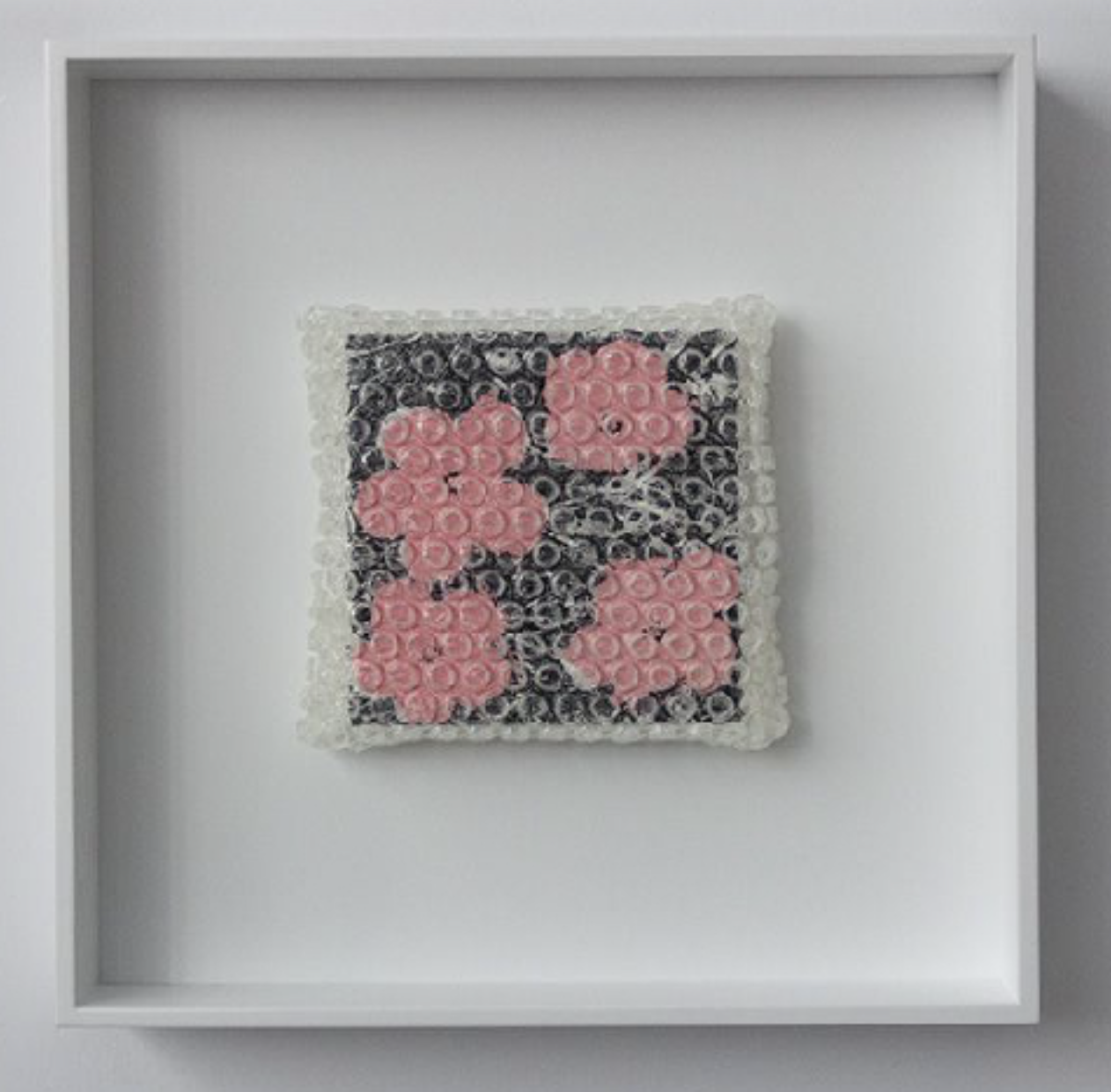
Flowers with Bubblewrap and Packing Tape, 2024
There is something both defiant and tender here. The retrospective, that institutional coronation, is refused even as the work insists on its own preservation, its own right to be handled carefully and seen fully. The double negative in the title carries echoes of vernacular speech, the grammar of emphasis rather than cancellation, and that linguistic specificity feels entirely deliberate. Campbell is not ambivalent about her relationship to institutions.
She is precise about it. "Flowers with Bubblewrap and Packing Tape" completes the suite with a gesture toward beauty that is also a gesture toward the fragility of beautiful things. Flowers have served as subject matter across centuries of Western painting, from Dutch still life to Impressionism to the expansive floral canvases of artists like Alma Thomas, whose luminous abstractions remain a touchstone for thinking about color, joy, and the particular position of the Black woman artist in American culture. Campbell's flowers, rendered in acrylic on linen and then wrapped in the same protective materials as the other works, sit in that long lineage while marking their own coordinates within it.
The bubble wrap is not irony. It is acknowledgment that beauty requires protection, that the things we love are always also things we stand to lose. For collectors, Campbell's work presents an opportunity that is both timely and substantial. The 2024 works are formally cohesive, operating as a thematic body that gains resonance when considered together, while remaining individually powerful.
Her multidisciplinary approach places her in productive conversation with artists who have used assemblage and found materials to interrogate cultural memory, figures such as Betye Saar, Faith Ringgold, and David Hammons, each of whom transformed everyday objects into instruments of historical reckoning. Campbell shares with these artists a commitment to the idea that the materials of ordinary life carry meaning that fine art materials alone cannot access. Collectors drawn to that lineage, and to the larger conversation about expanding the canon to reflect the full breadth of American artistic achievement, will find in Campbell a practice that is mature, resolved, and still very much unfolding. What Campbell ultimately offers is a way of seeing that is generous without being sentimental, critical without being cold.
Her work asks the viewer to consider what gets preserved and what gets discarded, what earns the protection of the frame and the institution and what must protect itself through other means. In wrapping the art historical object, she is also, quietly, insisting on its continued relevance, not as monument but as living material, still in transit, still arriving. That is a significant thing to say in 2024, and Campbell says it with remarkable economy and grace. The art world is paying attention, and it should be.