Takashi Murakami

Takashi Murakami Blooms Beyond All Borders
Artist Spotlight · The Collection Editorial
“I have a feeling that the concept of art in Japan has always been flat, which translates globally now.”
Takashi Murakami
In the spring of 2022, the Gagosian in Los Angeles unveiled a sprawling presentation of new paintings by Takashi Murakami that stopped visitors in their tracks. The works pulsed with his signature flowers, Buddhist iconography, and a chromatic energy that felt simultaneously ancient and urgently alive. That exhibition was yet another reminder that Murakami, now well into his sixth decade, shows no signs of slowing down. If anything, he is accelerating, threading his practice through new collaborations, new media, and an ever deepening engagement with Japanese cultural history that rewards attention at every scale.
Takashi Murakami
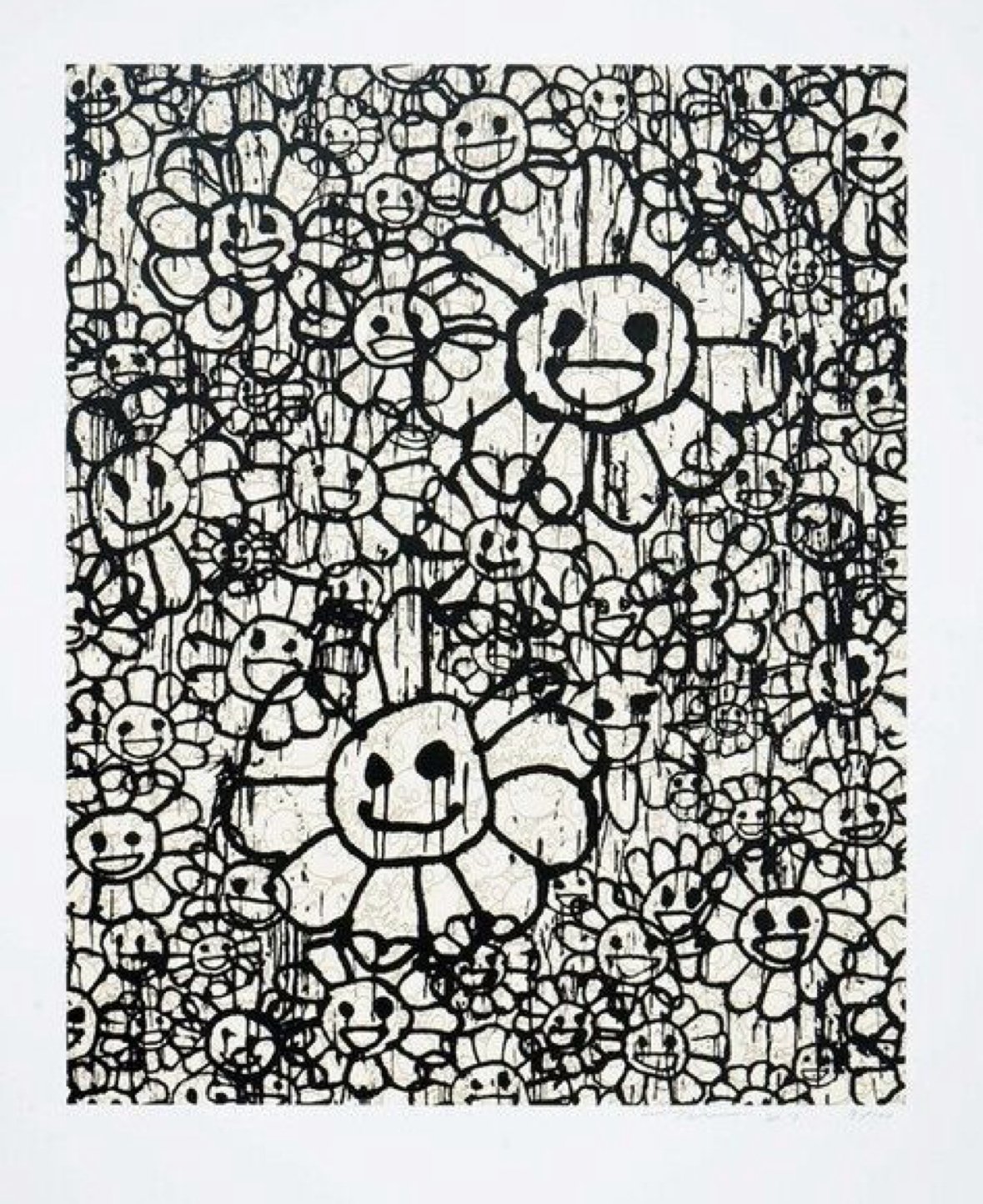
Flowers A Beige, 2017
Murakami was born in Tokyo in 1962, and his early formation was shaped by twin obsessions that might seem incompatible but proved generative beyond measure. As a young man he trained rigorously in Nihonga, the traditional Japanese painting style rooted in classical techniques and materials. He pursued this path all the way through his doctoral studies at the Tokyo University of the Arts, where he earned his PhD in 1993. At the same time, he was immersed in anime, manga, and the dense visual culture of postwar Japan, the otaku universe of obsessive fandom and hyperdetailed illustration that filled newsstands and television screens around him.
The tension between these two worlds became the engine of everything that followed. His breakthrough came in the mid 1990s when he articulated what he called Superflat, a theory and aesthetic programme that identified a particular flatness in Japanese visual culture stretching from Edo period woodblock prints through to contemporary animation. Superflat was not merely an artistic style but a critical argument: that the distinctions between high art and commercial imagery, between fine art and popular culture, had already collapsed in Japan long before Western postmodernism arrived at similar conclusions. He formalized this thinking in a landmark 2001 exhibition at the Museum of Contemporary Art in Los Angeles, titled Superflat, which he curated and which introduced international audiences to a generation of Japanese artists working in this register.
Takashi Murakami
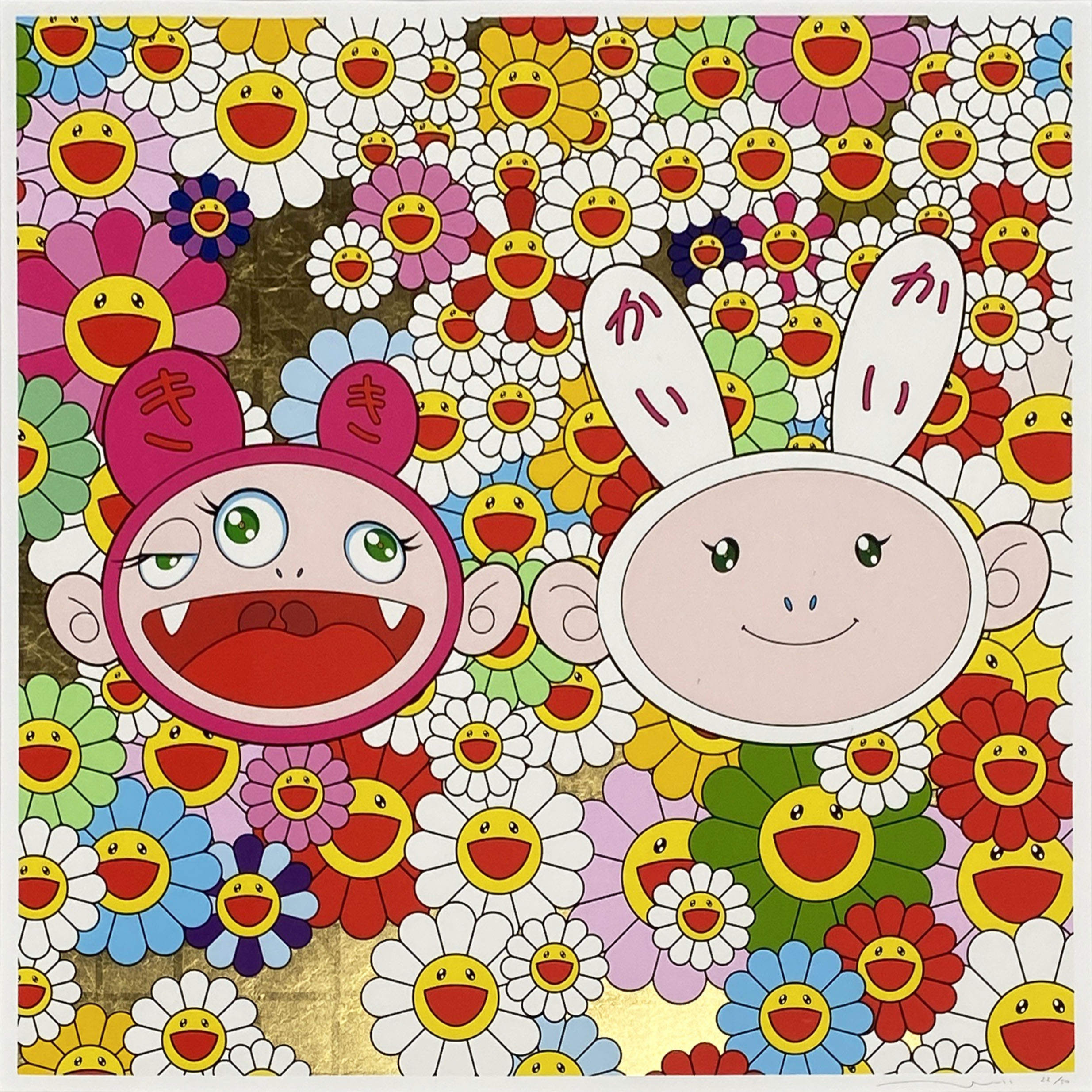
Kai Kai Kiki Lots of Fun
It was a declaration and an arrival simultaneously. The works that flowed from this period established his global reputation. His smiling, wide eyed flower characters, first developed in the late 1990s, became icons of a certain cultural moment while retaining a genuine ambivalence that keeps them interesting. Pieces like And Then and Then and Then and Then and Then, an offset lithograph first produced in 2006, present these flowers at monumental scale with a decorative density that references both classical Japanese screens and the relentless pleasure seeking of consumer culture.
“My job is to create a universe, a complete world, not just individual pieces.”
Takashi Murakami
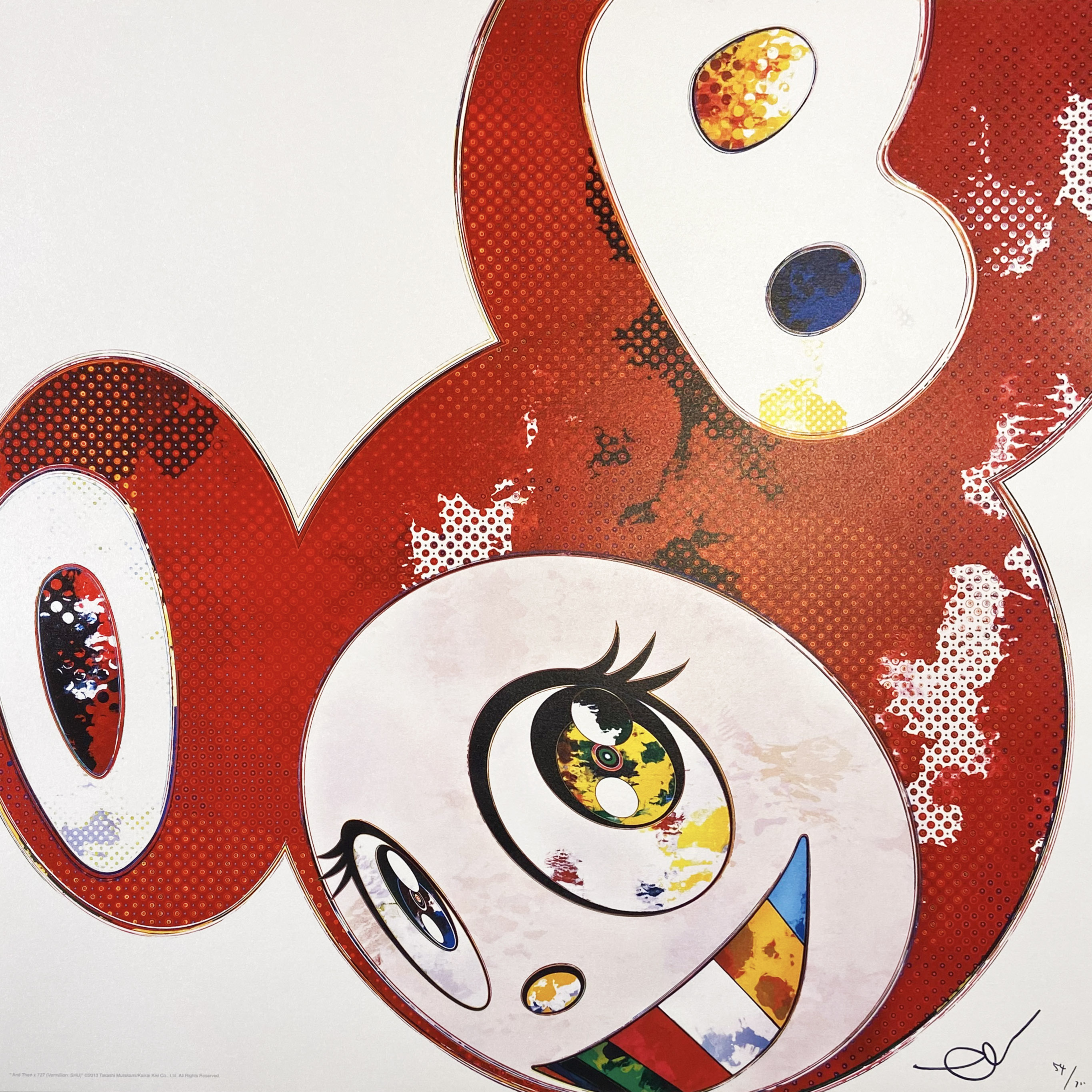
The And Then series in its many iterations, including the striking vermillion Shu variant from 2013, demonstrates how Murakami uses repetition not as a mechanical gesture but as a meditative one, echoing Buddhist traditions of repetitive devotional practice. There Is Nothing Eternal in this World, That Is Why You Are Beautiful from 2013, with its cold stamp and high gloss varnishing on circular paper, layers this philosophical awareness directly into the physical object, making the work shimmer with impermanence even as it insists on beauty. His collaboration with Kanye West on the cover artwork for Graduation in 2007 brought him to an audience measured in the tens of millions. His partnership with Louis Vuitton, developed with Nicolas Ghesquière's predecessor Marc Jacobs beginning in the early 2000s, produced one of the most discussed luxury collaborations of the century and raised urgent questions about the boundaries of art, commerce, and authorship that remain generative today.
Takashi Murakami
And Then x 727 (Vermillion: SHU), 2013
Murakami never retreated from these questions. He leaned into them, arguing that in Japan there had never been the same post Enlightenment distinction between the fine and applied arts that haunted the Western conversation. He was not selling out; he was pointing out a category error. Collectors are drawn to Murakami's work for reasons that encompass both pleasure and intellectual seriousness, a rare combination.
His prints and editions offer a genuine point of entry into a body of work that at its finest touches on mortality, on the legacy of Hiroshima, on the anxieties of postwar Japanese identity, and on the universal human need for beauty in the face of loss. Works on paper such as Flowers on the Island Closest to Heaven from 2018, executed with platinum leaf on wove paper, demonstrate his consistent commitment to material quality and craft even within the edition market. Red Demon Blue Demon with 48 Arhats from 2013 shows a different dimension of his practice, rooted in classical Buddhist iconography and medieval Japanese painting, and reminds collectors that beneath the smile and the merchandise there is a deeply learned artist in dialogue with centuries of tradition. At auction, his most significant canvases have achieved prices well into the millions, while his editions remain among the most actively traded works by any living artist on the secondary market.
Takashi Murakami
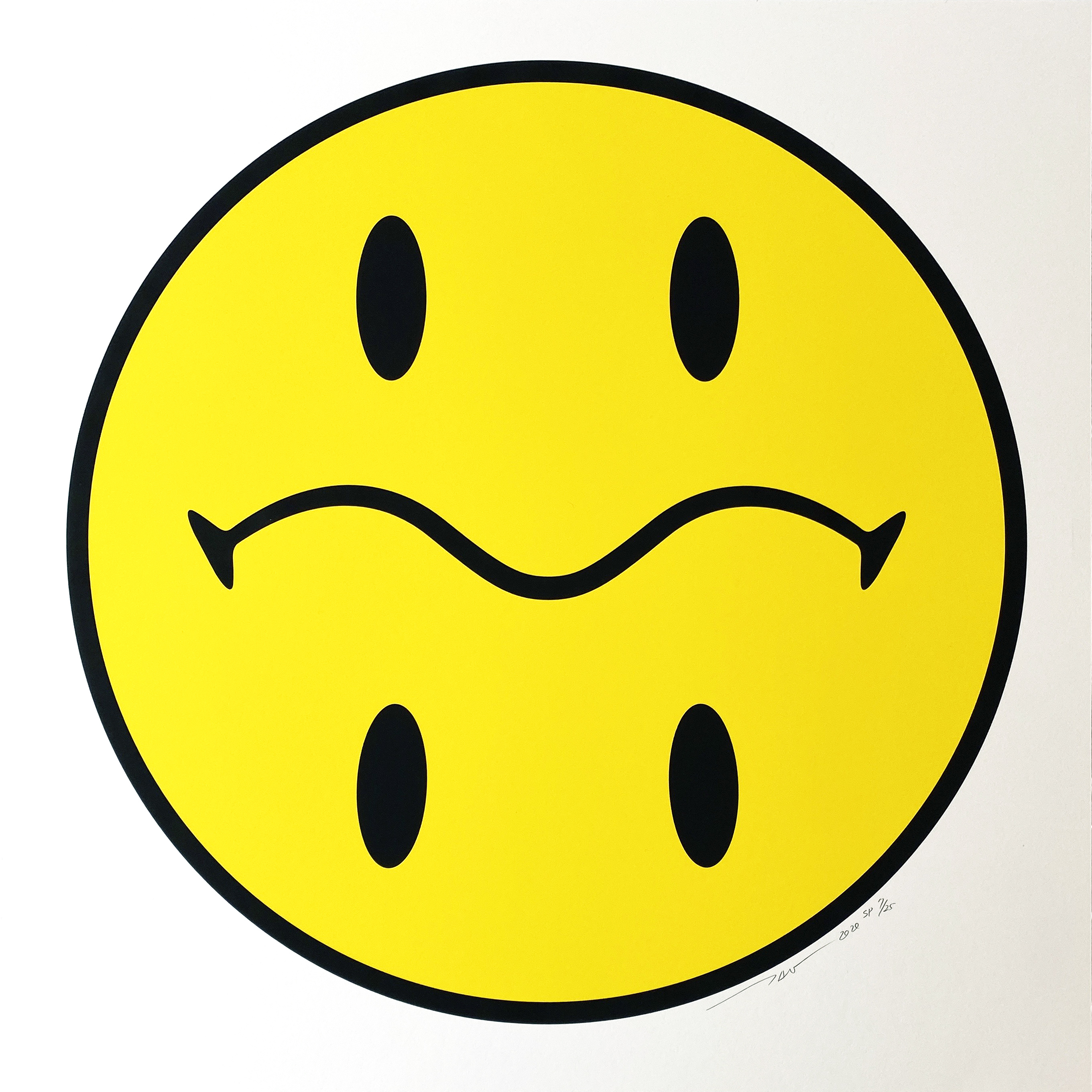
Tonari Smiley, 2020
In terms of artistic lineage, Murakami sits at a genuinely unusual intersection. His debts to Andy Warhol are evident and acknowledged: the studio system he operates through his company Kaikai Kiki, the embrace of commercial imagery, the cultivation of celebrity. But his roots in Nihonga connect him to Rinpa school masters such as Ogata Korin, while his engagement with Buddhist iconography places him in a lineage stretching back through Japanese temple painting. Among his contemporaries, collectors who respond to Murakami often find similar pleasures in the work of KAWS, Jeff Koons, and Yoshitomo Nara, the latter a fellow Japanese artist who emerged in related cultural circumstances and who shares Murakami's ability to hold sentiment and critique in productive tension.
What makes Murakami essential to any serious account of contemporary art is precisely his refusal to be contained. He is a painter, a sculptor, a filmmaker, a theorist, a curator, and a cultural entrepreneur, and he brings the same ferocious energy to each of these roles. His 2013 retrospective at the Château de Versailles placed his work in conversation with the apex of European court culture, an encounter that was both audacious and, on reflection, entirely logical. Beauty, spectacle, power, and the anxiety of mortality are his great themes, and they have never been more present in the culture than they are right now.
To collect Murakami is to hold a piece of one of the most sustained and serious engagements with contemporary life that any artist has undertaken in the past thirty years.
Explore books about Takashi Murakami

Takashi Murakami
Yoshitaka Murakami

Takashi Murakami: Superflat
Takashi Murakami
Murakami Takashi Genga-ten
Various
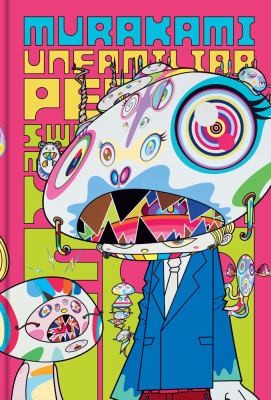
Takashi Murakami: The Superflat Movement
Alexandra Munroe

Takashi Murakami: Jellyfish Eyes Official Visual Book
Takashi Murakami
Takashi Murakami: A Little Boy
Takashi Murakami
Takashi Murakami: Gagosian Gallery
Various
Takashi Murakami Prints
Takashi Murakami