Stephen Truax
Stephen Truax Finds Beauty Between Two Worlds
Artist Spotlight · The Collection Editorial
There is a particular kind of attention required to stand before a painting by Stephen Truax. The American contemporary artist has built a practice around the space where images threaten to dissolve, where a figure or a landscape hovers at the edge of recognition before yielding, gracefully, to the pull of pure surface. His work rewards patience, and in an art world that often prizes immediate impact, that patience feels quietly radical. Collectors and curators who have encountered Truax's paintings and drawings frequently describe the same experience: a slow unfolding, a sense that the painting is giving itself up in stages.
Stephen Truax
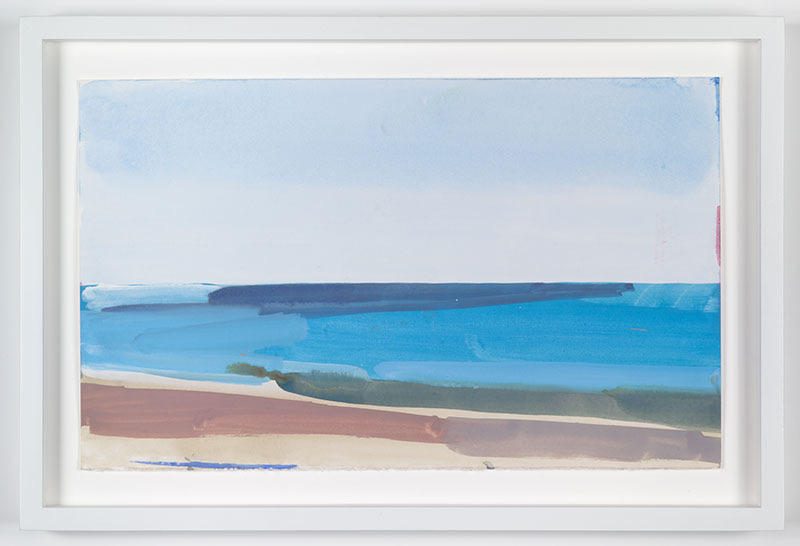
Oceanfront Property (Floriday Day 3), 2018
Truax works across painting, drawing, and mixed media, and his command of gouache on paper in particular has earned him serious attention from those who track emerging and mid career American painters. Works like "Oceanfront Property (Floriday Day 3)," made in 2018, reveal an artist who understands the peculiar emotional grammar of American leisure, coastal light, and the way memory softens the edges of lived experience. The title itself, with its affectionate misspelling of Florida tucked inside, suggests an artist attuned to the poetics of the everyday, to the way language and image can hold sentiment without sentimentality. While much of Truax's biography remains closely held, his work speaks clearly to a set of formative influences rooted deeply in American visual culture.
The tradition of American landscape painting runs through his compositions like an undertow, surfacing in his interest in specific places and the emotional weight they carry. Abstract Expressionism, that great twentieth century rupture in how Americans understood the act of painting, is equally present, not as nostalgia but as a living inheritance. Truax does not merely reference these movements; he metabolizes them, finding in their tensions a productive friction that energizes his own mark making. His development as an artist reflects a sustained engagement with process based art practices, a lineage that stretches from the experimental studios of the postwar period through to the material investigations of artists like Robert Ryman and Agnes Martin, whose insistence on the painting as a physical event rather than a window onto the world clearly resonates with Truax's sensibility.
Stephen Truax
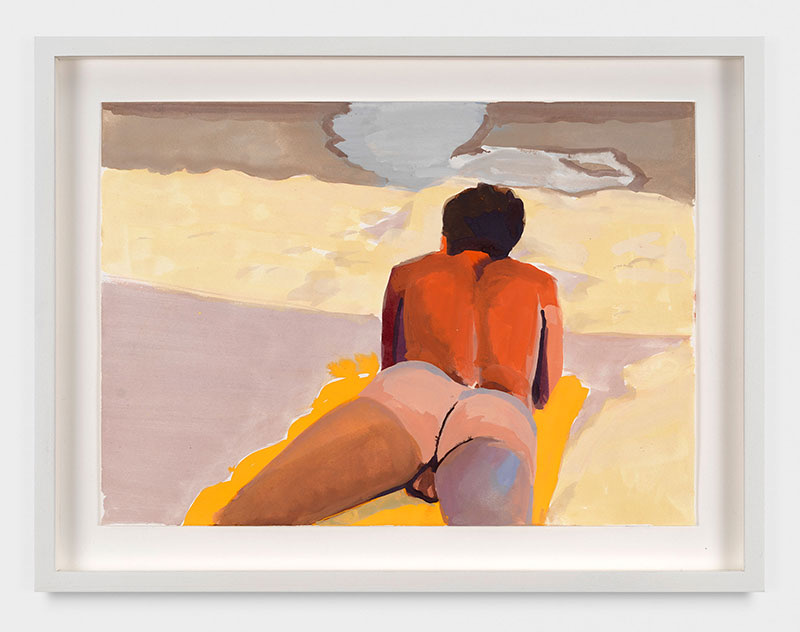
Thomas on a Yellow Towel, 2022
What distinguishes Truax, however, is his refusal to abandon representation entirely. His surfaces are layered and gestural, built up and scraped back, but within them figures persist. A body on a yellow towel. A stretch of beach.
These residues of the recognizable world give his abstractions a human warmth that purely process based work can sometimes lack. "Thomas on a Yellow Towel," completed in 2022 and rendered in gouache on paper, is among the most compelling works in Truax's recent output. The intimacy of the subject, a figure at rest, named and therefore known, speaks to an artist interested in the relationship between specificity and universality. Gouache, with its matte opacity and its resistance to the atmospheric blending possible in oil or watercolor, suits Truax's intentions perfectly.
Stephen Truax
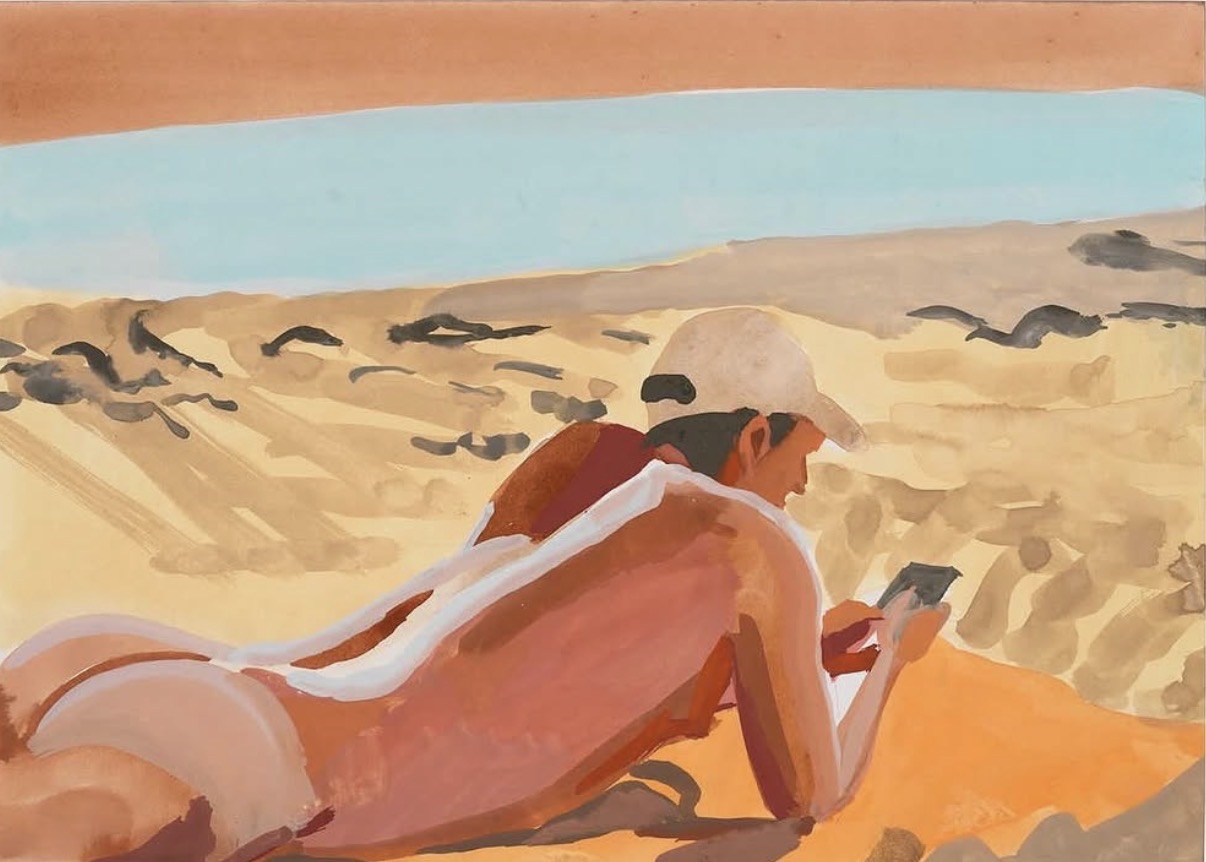
Beach Day, 2020
The medium forces decisions. It rewards directness. In Truax's hands, it produces surfaces of considerable sophistication, passages where color and mark coexist in a kind of productive argument. His 2020 acrylic on canvas "Beach Day" extends these concerns into a larger format, demonstrating that his sensibility scales with assurance.
For collectors, Truax represents an opportunity of a kind that appears with relative infrequency: an artist whose work is already demonstrably accomplished and whose trajectory points consistently upward. His practice sits within a broader conversation about what painting can do in the twenty first century, a conversation that includes artists grappling with similar questions of representation, abstraction, and material culture. Collectors drawn to the looser figuration of painters working in the tradition of gestural American painting will find in Truax a sensibility that is deeply conversant with that tradition while remaining unmistakably his own. Works on paper, particularly the gouaches, offer an accessible point of entry without sacrificing the depth and seriousness that define his larger paintings.
Contextually, Truax's work invites comparison with a generation of American painters who have reinvigorated interest in process, surface, and the figure's relationship to abstraction. His interest in coastal and quotidian American life echoes, at a certain distance, the affectionate documentation of American leisure found in the work of artists like Alex Katz, while his commitment to gestural mark making and layered surfaces aligns him with a lineage of painters for whom the act of painting is itself a subject. This dual inheritance, the representational and the abstract, places Truax in rich and distinguished company without reducing him to a derivative of either tradition. What Truax is building, work by patient work, is a body of art that takes seriously the challenge of seeing.
His paintings ask us to slow down, to accept ambiguity, to find meaning in the friction between what an image nearly shows us and what it ultimately withholds. In a cultural moment characterized by speed and surface, that invitation feels not merely valuable but necessary. For collectors who understand that the most rewarding relationships with art unfold over years rather than moments, Stephen Truax is an artist whose time is very much now.