Shiro Kuramata
Shiro Kuramata: Poetry Made Permanent in Form
Artist Spotlight · The Collection Editorial
“I have always been attracted to things that don't exist.”
Shiro Kuramata
There is a moment, standing before a Shiro Kuramata piece for the first time, when the eye genuinely struggles to process what it is seeing. Is the 'How High the Moon' armchair solid or permeable? Is 'Miss Blanche' a functional object or a painting suspended in three dimensions? This quality of productive bewilderment, this sense that the ordinary rules governing matter and purpose have been quietly suspended, is precisely why Kuramata remains one of the most arresting figures in postwar design and why museum curators, collectors, and cultural institutions continue to return to his work with fresh urgency.
Shiro Kuramata
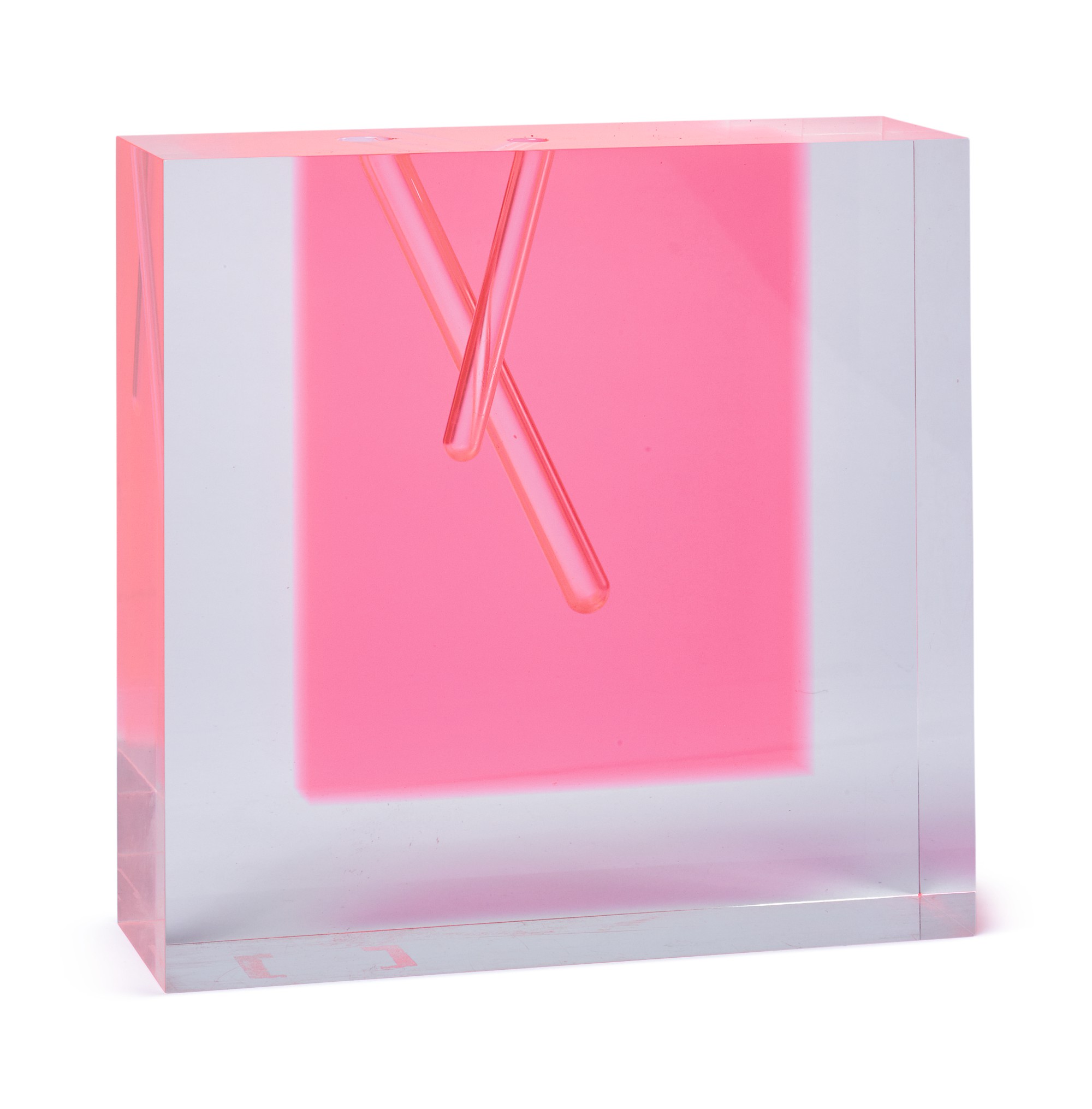
Flower Vase #2
The retrospective attention his pieces have received at institutions including the Vitra Design Museum and the Museum of Arts and Design in New York has only deepened appreciation for a practice that was, from the very beginning, operating on a different frequency from everything around it. Shiro Kuramata was born in Tokyo in 1934, a city and a nation that would undergo extraordinary transformation during his formative years. He trained first in woodworking at the Tokyo Municipal Polytechnic High School and later studied living space design at the Kuwasawa Design School, graduating in 1956. His early professional life was spent working for the Matsuya department store's interior design department, an experience that grounded him in the commercial realities of space and function even as his imagination was already reaching toward something far less constrained.
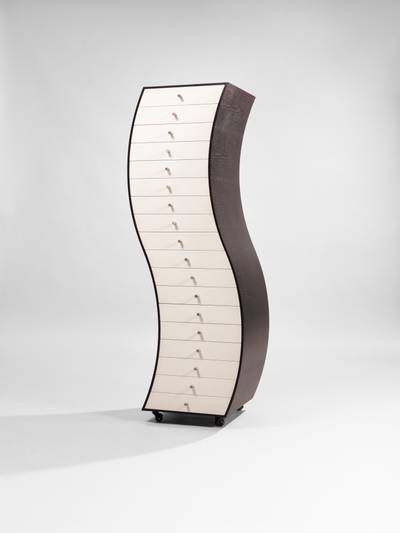
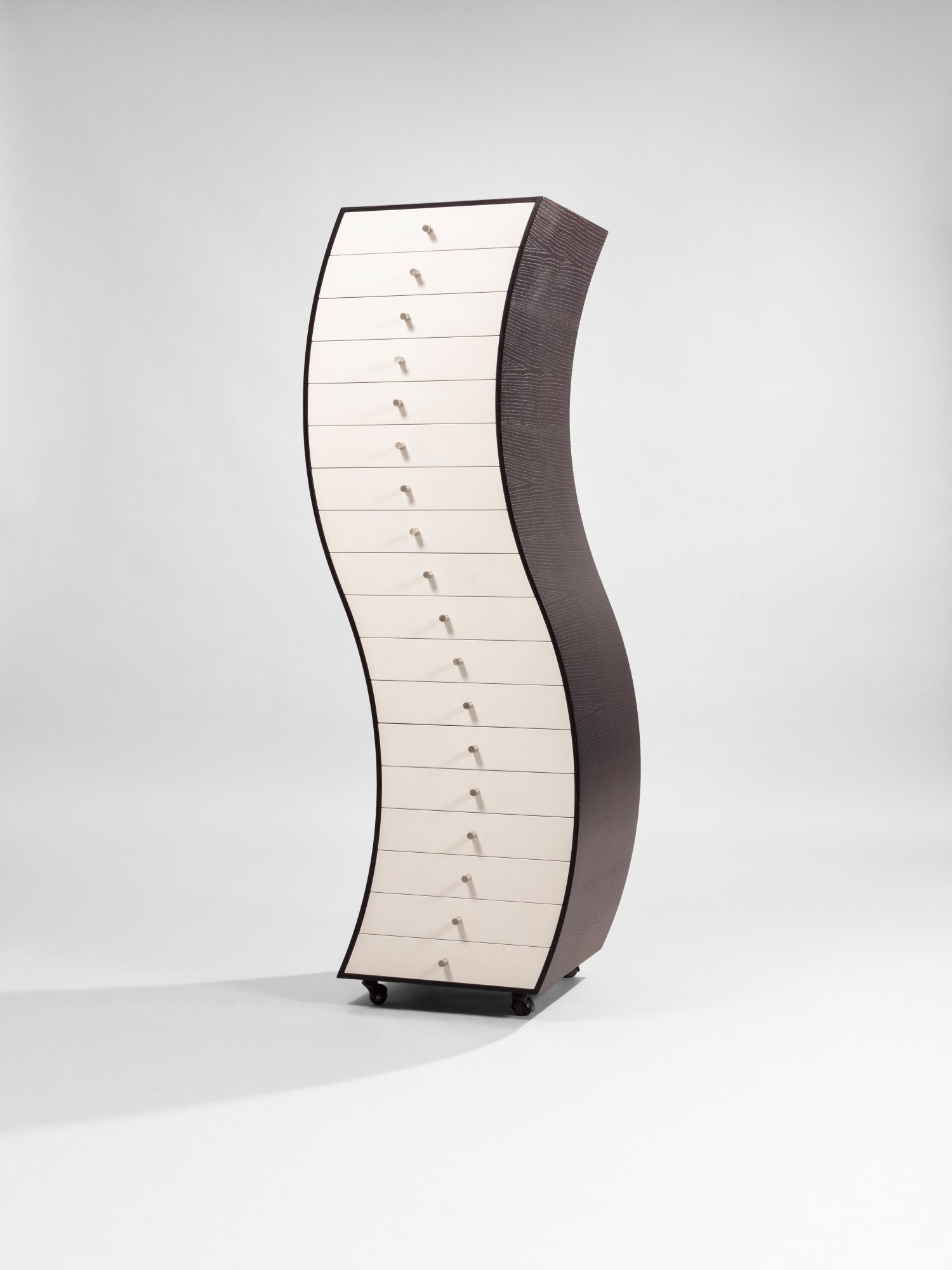
Tokyo in the postwar decades was a place of radical reinvention, absorbing Western modernism, Metabolist architecture, and the formal experiments of international design culture while remaining deeply rooted in Japanese spatial philosophy, and Kuramata absorbed all of it. He established his own studio, Kuramata Design Office, in Tokyo in 1965, and the work that followed over the next two and a half decades would prove to be among the most consistently surprising output of any designer working anywhere in the world. His early furniture experiments played with the drawer as a sculptural and conceptual unit, stacking and offsetting storage forms in ways that rendered the familiar delightfully strange. His 'Furniture in Irregular Forms' series from the early 1970s, which included works like the 'Commode Furniture in Irregular Forms,' constructed from tinted ash, lacquered ash, and brushed steel on wheels, used the chest of drawers as a vehicle for pure formal investigation.
Shiro Kuramata
Commode Furniture in irregular forms side 1
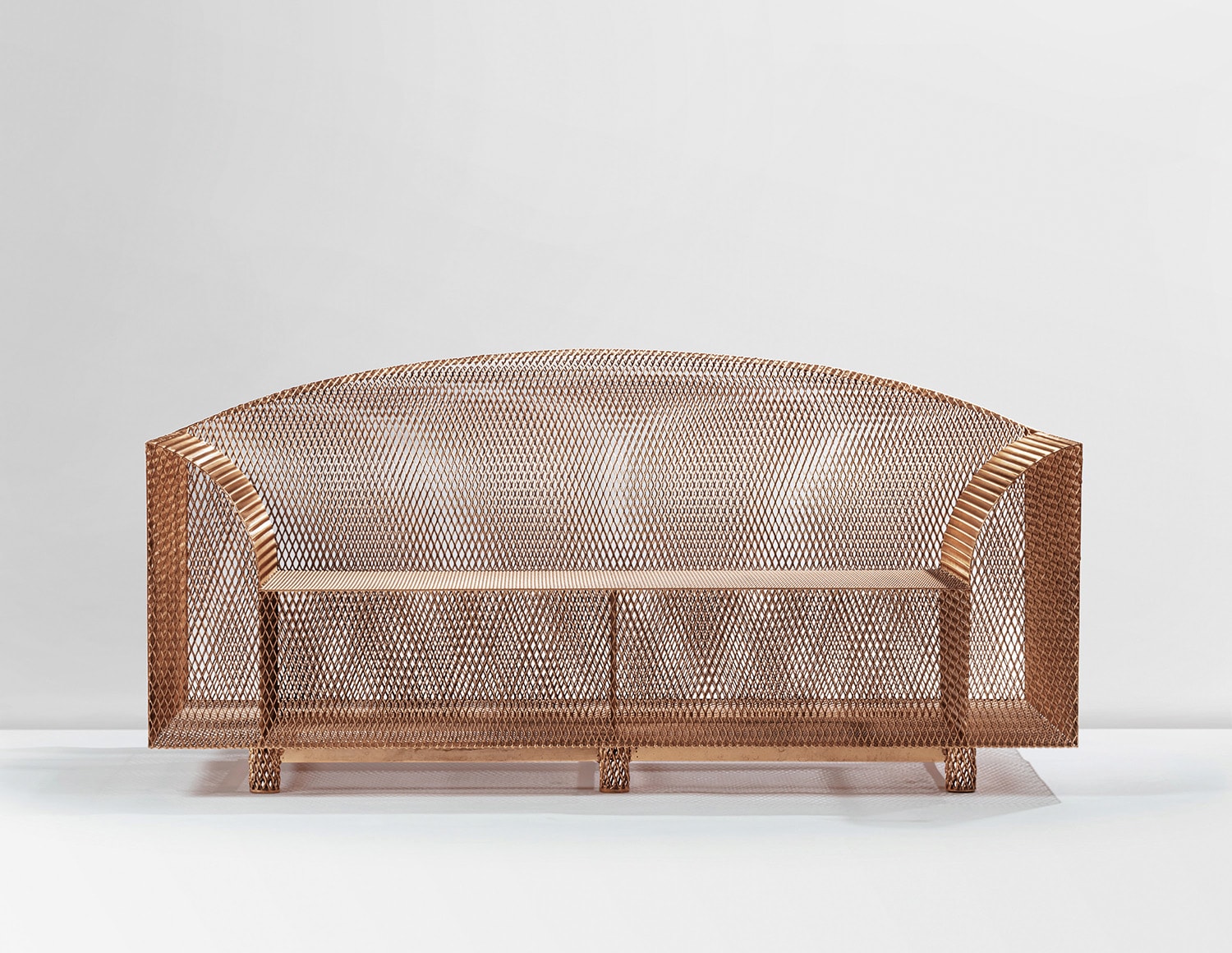
These pieces are not merely eccentric furniture; they are arguments about perception, about the way we unconsciously assign logic and hierarchy to the objects we live alongside. The 1980s brought what many consider the apex of Kuramata's achievement. In 1986 he designed 'How High the Moon,' the armchair that bears its name with perfect justification, a form made entirely from expanded steel mesh, a material associated with industrial fencing and construction, transformed here into something that seems almost to dematerialize in certain lights. The mesh allows the eye to pass through the chair's volume, making it simultaneously present and absent, heavy and weightless.
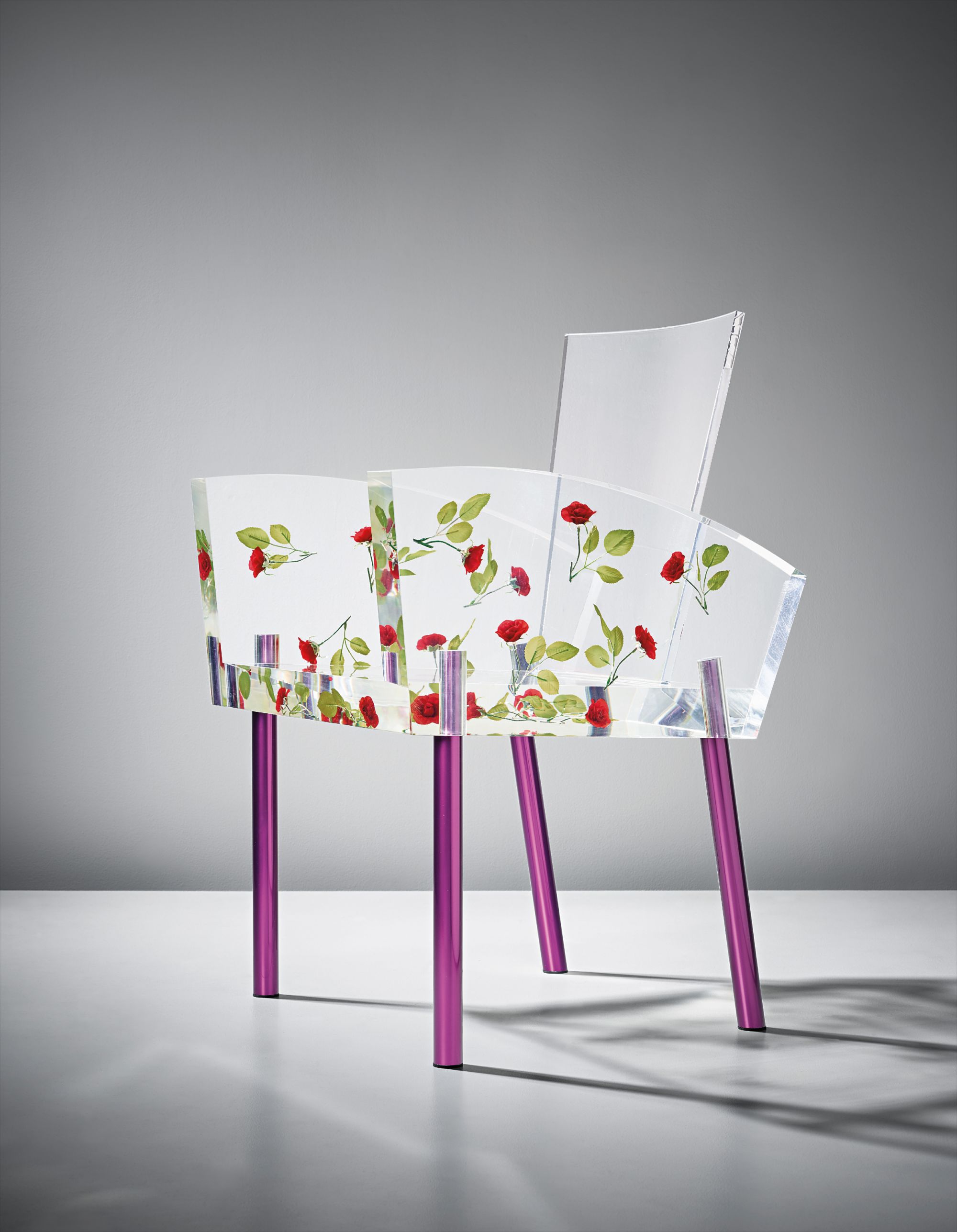
Two years later came 'Miss Blanche,' perhaps the single most discussed object in his body of work, an armchair in which artificial red roses appear to float suspended within a cast block of clear acrylic resin, the legs formed from anodised tubular aluminium. The piece takes its name from Blanche DuBois in Tennessee Williams's 'A Streetcar Named Desire,' a reference to fragile beauty and romantic illusion that Kuramata wore without irony. These two chairs alone would secure his place in the history of twentieth century design, but they represent only a fraction of what he produced. His 'Glass Chair,' also among the works available through The Collection, demonstrates yet another dimension of his investigation into transparency and structural logic.
Shiro Kuramata
'How High the Moon' two-seater sofa
Constructed entirely from plate glass, it has the quality of a proof, a demonstration that a chair can be made from the least chair like material imaginable while remaining entirely, serenely functional. The 'Flower Vase No. 2' shows the same sensibility applied to an even more intimate scale, elevating a domestic object into a meditation on containment and display. Across all of these works, what unifies them is a refusal to accept that utility and transcendence are separate categories.
For Kuramata, the everyday object was always a potential site of the poetic. From a collecting perspective, Kuramata's work occupies a fascinating and genuinely rare position. His career was relatively short and his output, while prolific in ideas, was limited in terms of edition sizes and surviving examples, which means that significant pieces appear at auction and through specialist dealers with the gravity of genuine events. Works by Kuramata have appeared at Christie's, Phillips, and Wright auction house in Chicago, which has long been one of the most serious venues for design at the highest level.
Shiro Kuramata
'Miss Blanche' chair
Collectors drawn to his work tend to be those who think across categories, who are as comfortable with Arte Povera as they are with Ettore Sottsass or the Memphis Group, of which Kuramata was an important participant. His friendship and collaboration with Sottsass, and his involvement with Memphis from its founding in 1981, placed him at the center of one of the most culturally significant design movements of the late twentieth century, while his Japanese formation meant he always brought something to that conversation that was entirely his own. The artists and designers with whom Kuramata shares the most meaningful dialogue include Isamu Noguchi, whose insistence on the sculptural dimension of functional objects Kuramata clearly absorbed, and Ron Arad, whose own investigations into industrial materials and unexpected form run parallel to Kuramata's concerns. Within Japanese design culture, his influence on figures including Tokujin Yoshioka is direct and acknowledged.
But perhaps the most honest comparison is to Constantin Brancusi, not in terms of visual vocabulary but in terms of philosophical ambition: the belief that an object refined to its essential formal truth becomes something more than the sum of its materials and function, becomes, in the fullest sense, art. Shiro Kuramata died in Tokyo in February 1991, at only fifty six years of age, leaving behind a body of work that continues to feel contemporary in the most genuine sense of that word. Not fashionable, not revived, but actually present, actually alive to the questions that preoccupy makers and thinkers today around materiality, transience, and the emotional life of objects. His work reminds us that the most ambitious design does not decorate our lives but genuinely expands them, offering moments of encounter with beauty so precisely conceived that it reads as inevitability.
To live with a Kuramata is to be in daily conversation with one of the most searching and generous imaginations of the twentieth century.
Explore books about Shiro Kuramata
Shiro Kuramata
Shiro Kuramata
Shiro Kuramata: Furniture and Interiors
Modo Editore
Kuramata: Master of Design
Andrea Branzi
Shiro Kuramata 1965-1991
Vitra Design Museum
The Complete Works of Shiro Kuramata
Japan Interior Design Association