Shara Hughes
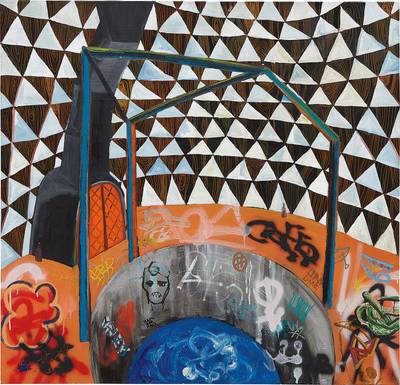
Shara Hughes Paints the World Anew
Artist Spotlight · The Collection Editorial
In 2022, the Whitney Museum of American Art included Shara Hughes in its prestigious Biennial, one of the most closely watched surveys of contemporary American art. Her large scale landscape paintings stopped visitors in their tracks, drawing them into worlds that felt simultaneously familiar and utterly invented. That moment confirmed what collectors and curators had been quietly celebrating for years: Hughes is one of the most compelling painters working in America today, a visionary who has genuinely expanded what landscape painting can mean and do. Hughes was born in 1981 and grew up in Atlanta, Georgia, a city with a rich creative culture that sits somewhat outside the traditional art world centers of New York and Los Angeles.
Shara Hughes
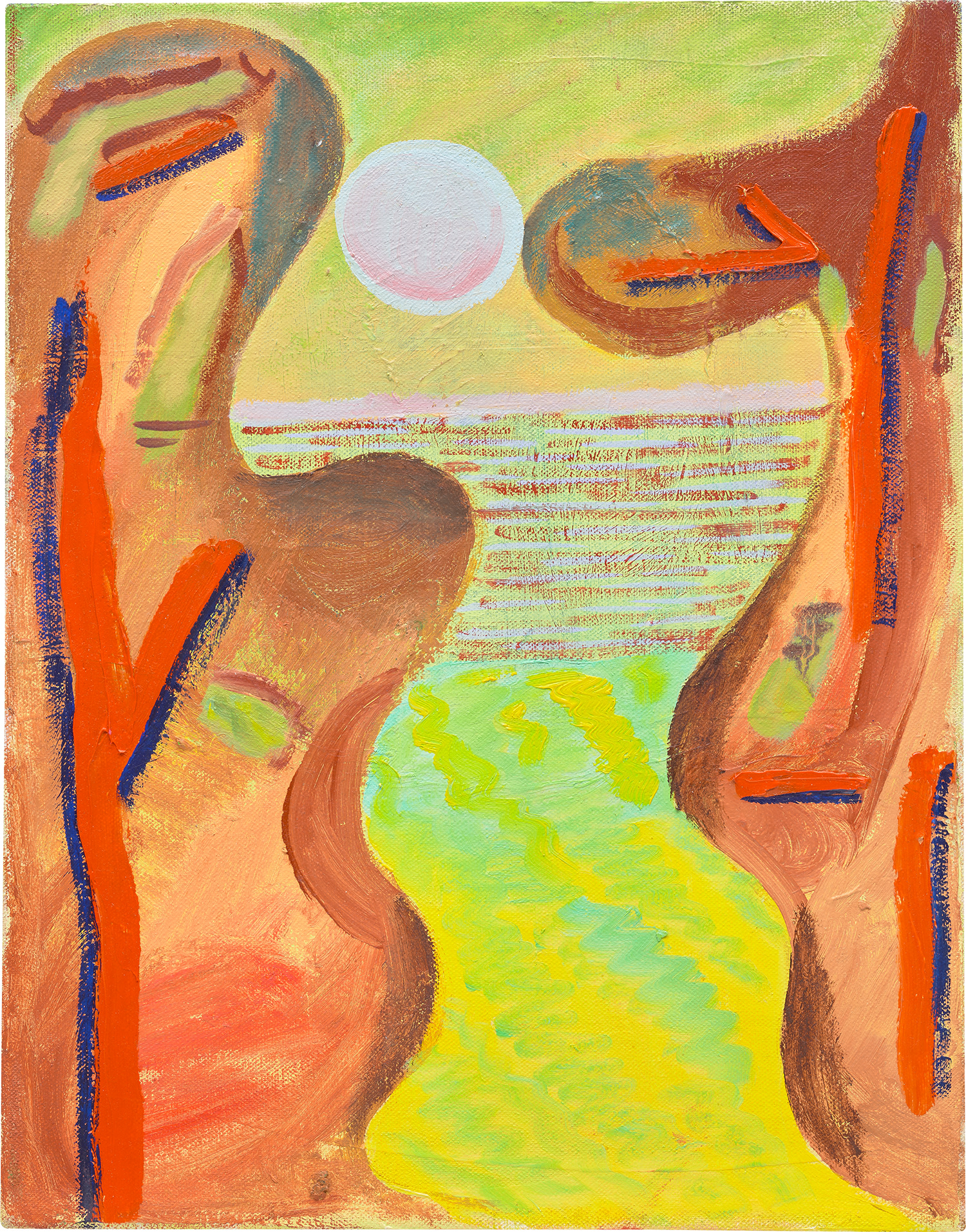
Fits Just Right, 2016
She studied at the Rhode Island School of Design and later at the School of the Art Institute of Chicago, two institutions known for encouraging artists to develop strong individual voices. That rigorous formation gave Hughes a deep command of painting's technical possibilities, but what she carried out of those years was something harder to teach: an absolute confidence in following her own instincts, no matter how strange or unexpected the result. Her early work already showed the restless energy and chromatic ambition that would define her mature practice. Hughes was never interested in straightforward representation or in the kind of plein air tradition that has dominated landscape painting since the nineteenth century.
Instead, she began layering observation with memory and pure invention, allowing a remembered hillside or a glimpsed stretch of coastline to mutate into something far more emotionally charged. She built her canvases through accumulation, adding oil, acrylic, enamel, and pencil in combinations that gave her surfaces a palpable physical presence, almost like geological strata compressed into a single plane. By the mid 2000s, Hughes had settled into a practice centered on what might best be described as psychological landscapes. These are not places you can visit or find on a map, yet they carry the unmistakable feeling of somewhere real, somewhere experienced deeply.
Shara Hughes
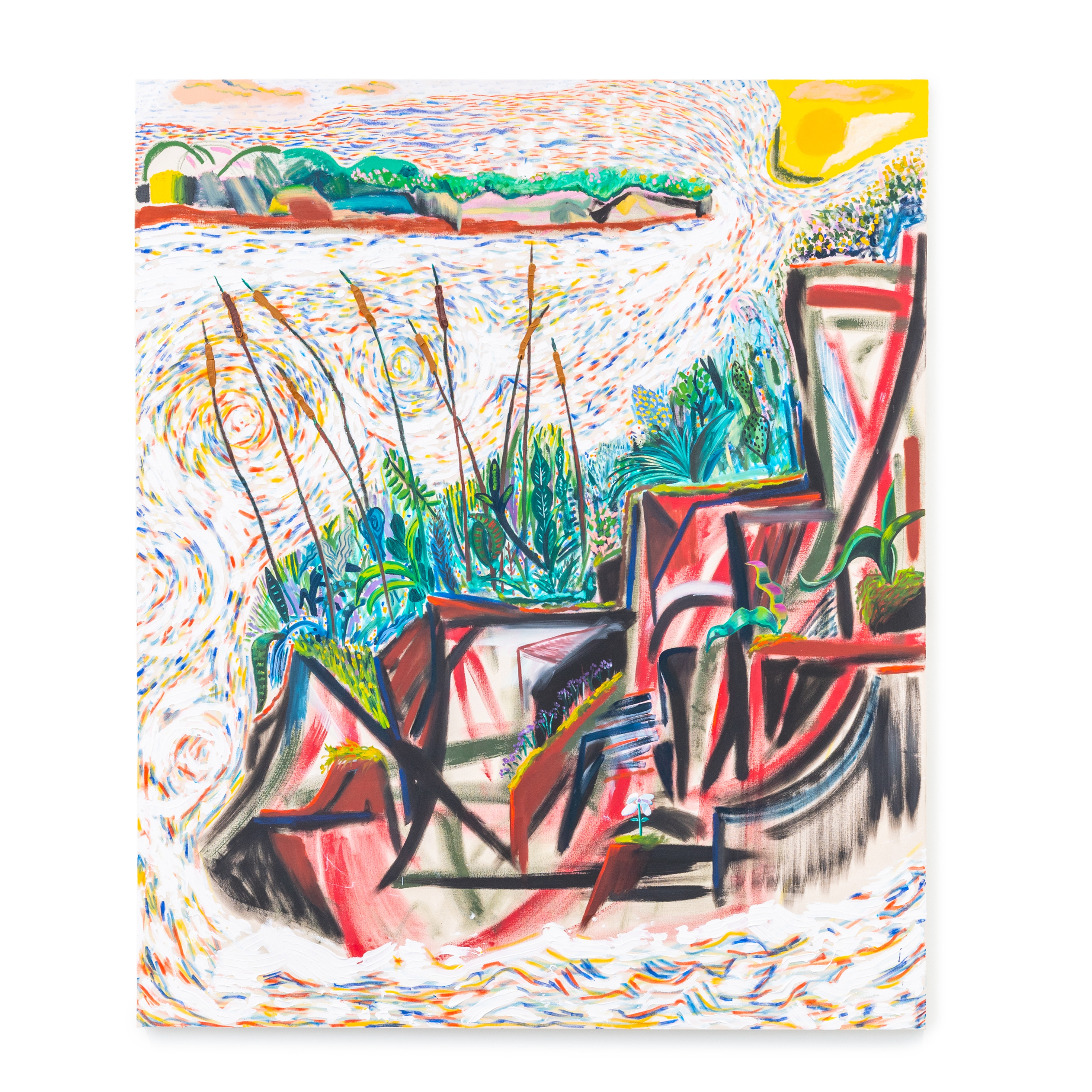
Stairway to Heaven 通往天堂的階梯
A work like "Enter Goldfish" from 2007, made with oil, acrylic, enamel, paint pens, and plastic paper, announced a distinctive sensibility: playful and rigorous at once, combining the visual energy of folk art, the color intensity of Fauvism, and the structural freedom of Abstract Expressionism. The result was entirely her own. As her reputation grew through gallery shows in New York, collectors began to recognize that her paintings offered something genuinely rare, which is the ability to make you feel emotionally located in a place that does not exist. The works from the mid 2010s represent a particularly fertile period.
"Wavy Navy" from 2015 showcases her mastery of color as emotional weather, the deep blues and undulating forms creating a sense of being held inside a tide. "Fits Just Right" from 2016 and "Bad News Beach" from the same year demonstrate her growing confidence with scale and composition, each canvas organized around bold, almost theatrical contrasts of light and shadow that give the work a cinematic quality. "Pleasure House" and "The Not Dark Dark Spots," both from 2017, push further still, introducing dye alongside oil to create surfaces that seem to glow from within, as if light were being emitted rather than reflected. These paintings do not simply depict landscapes; they perform them, enacting the feeling of being inside weather, inside a season, inside a particular quality of afternoon light.
Shara Hughes
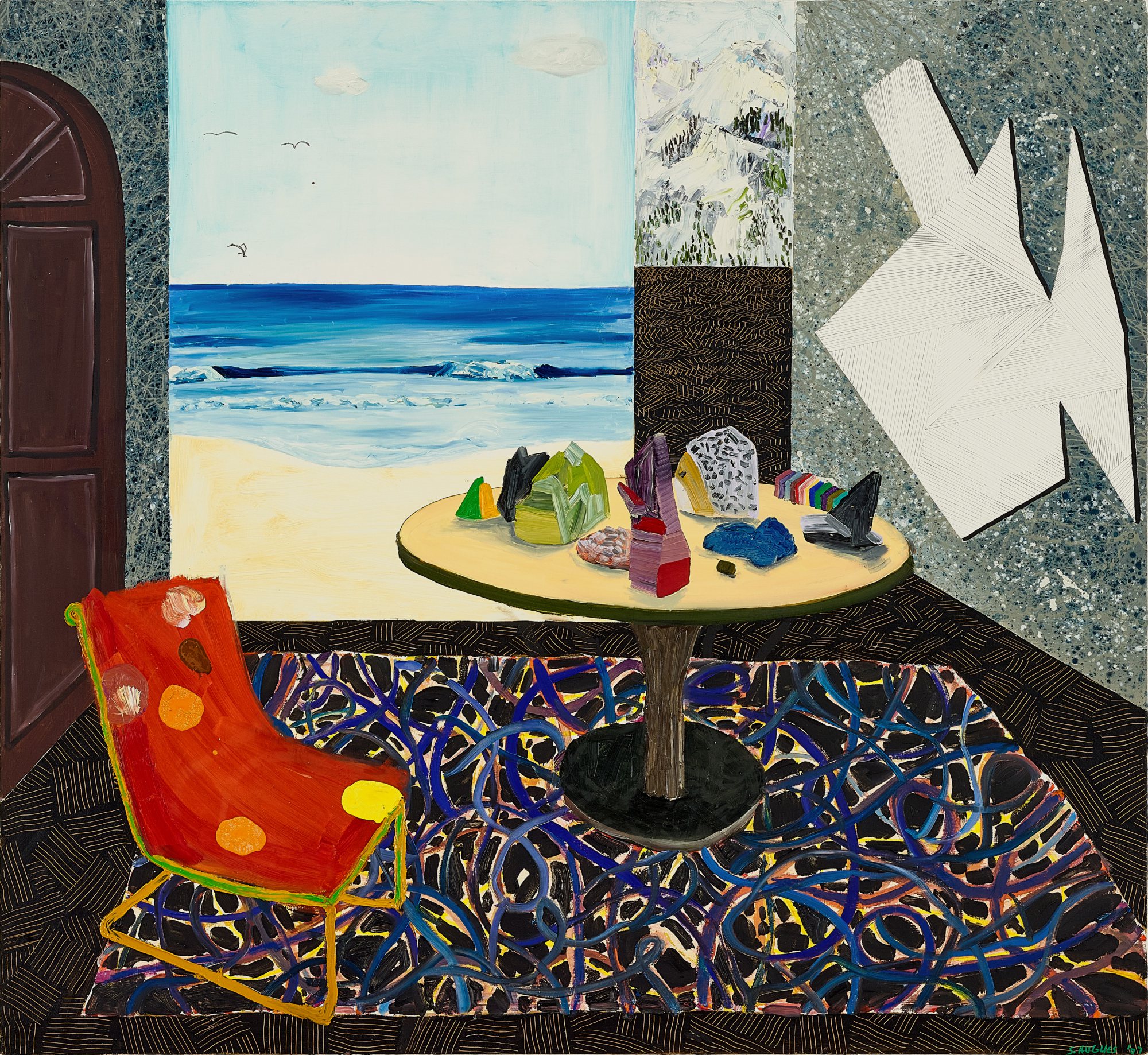
Rock Collection 岩石收藏
Hughes works with Reena Spaulings Fine Art in New York and has shown with international galleries that have introduced her work to collectors across Europe and Asia. The bilingual titles of certain works, including "Stairway to Heaven" and "Rock Collection," which carry both English and Traditional Chinese text, speak to the genuinely international appetite her paintings have generated. Her prints, including the "Full Moon Cove" monotype made with oil based inks on wove paper, have also attracted significant collector interest, offering an entry point into her world for those drawn to works on paper. The monotype format suits her sensibility beautifully, allowing for the controlled accident and luminous color that define her best work on canvas.
From a collecting perspective, Hughes occupies an enviable position in the current market. She is established enough to have a clear track record and institutional validation, with work held in major museum collections and shown at venues including the Metropolitan Museum of Art. Yet she is also still in mid career, which means the full arc of her development remains ahead. Collectors who have followed her since the early 2010s have seen significant appreciation, and works from the key periods of 2015 to 2017 are now regarded as benchmark examples of her practice.
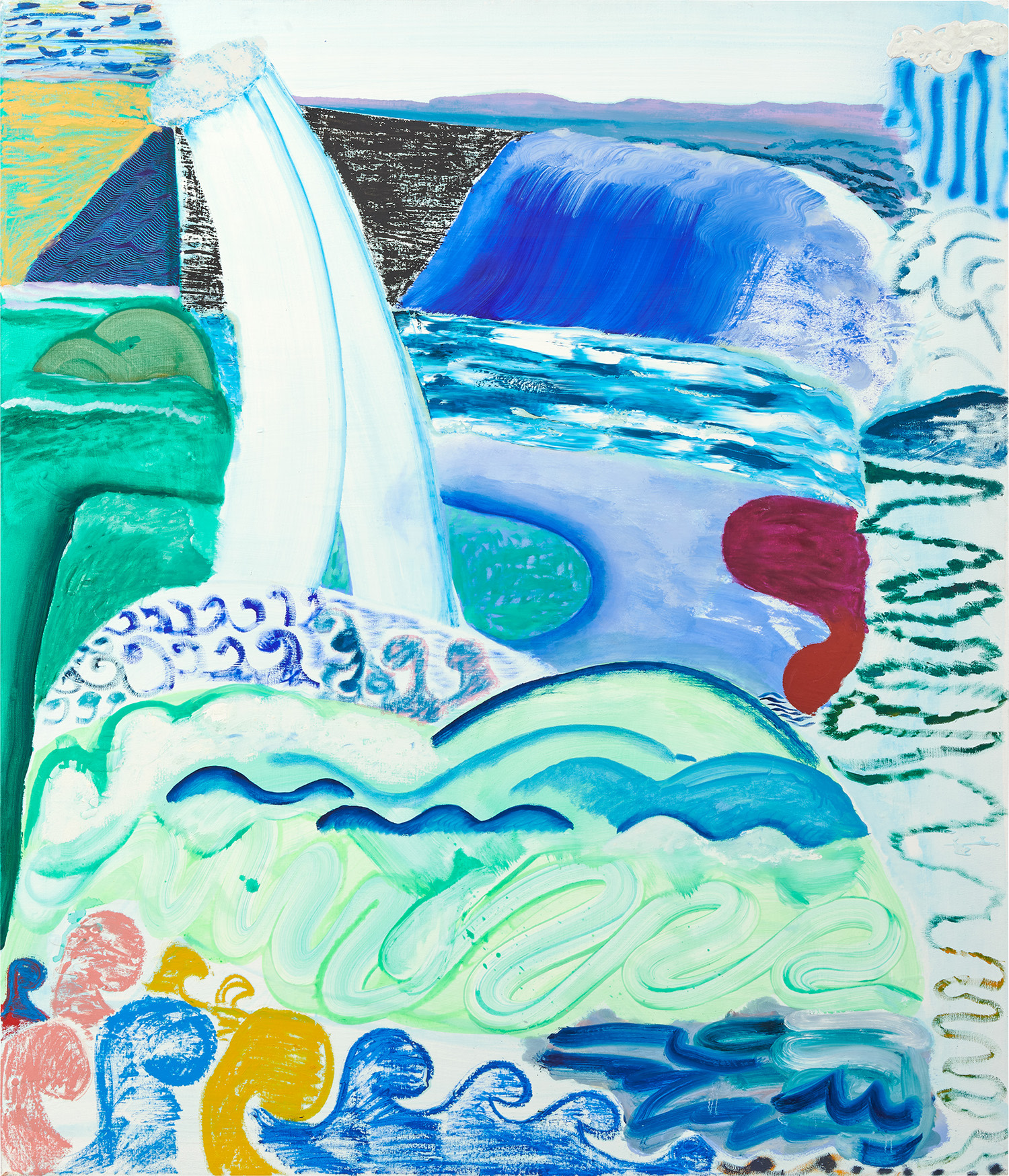
Shara Hughes
Wavy Navy, 2015
Those approaching her work for the first time would do well to look closely at the mixed media canvases, where her willingness to combine unexpected materials produces surfaces of extraordinary richness. In the context of art history, Hughes belongs to a lineage of painters who have treated landscape not as document but as inner life. Philip Guston's late paintings come to mind in their combination of cartoonish directness and genuine emotional weight. There is also something of the electric color sense of Raoul Dufy and the spatial freedom of early David Hockney in her work, along with echoes of folk painting traditions that treat the natural world as a stage for feeling rather than a subject to be accurately recorded.
Among her contemporaries, she sits alongside painters who are similarly invested in pushing figuration toward abstraction, artists working in the productive space between what is seen and what is felt. What makes Hughes matter in the longer view is her insistence on painting as a form of freedom. At a moment when contemporary art can feel burdened by theory or driven by spectacle, her canvases are unapologetically about the pleasure and power of paint itself, about what happens when a gifted artist trusts color and form to carry genuine human experience. The landscapes she invents are invitations, asking viewers to bring their own memories and emotions and find them reflected back in entirely unexpected forms.
That generosity, combined with her formidable technical skill and restless inventiveness, is why her work continues to find devoted collectors and new admirers with every passing year.
Explore books about Shara Hughes
