Sandy Skoglund
Sandy Skoglund's Wonderfully Strange, Radiant Worlds
Artist Spotlight · The Collection Editorial
“I wanted to make something that was both beautiful and disturbing at the same time.”
Sandy Skoglund, interview
There is a moment, standing before a Sandy Skoglund photograph, when the ordinary world quietly dissolves. The living room is still a living room, the bedroom still a bedroom, but something has shifted irrevocably: goldfish drift through the air above sleeping figures, foxes tumble through a diner at midnight, cats cascade across a grey domestic interior like a fever dream made solid. Skoglund has spent more than four decades constructing these impossible scenes by hand, one object at a time, and the cumulative effect of her career is nothing short of extraordinary. Her work continues to entrance new audiences and serious collectors alike, with major institutional holdings and a sustained presence at auction that confirms her place among the most distinctive voices in American art of the late twentieth and early twenty first centuries.
Sandy Skoglund
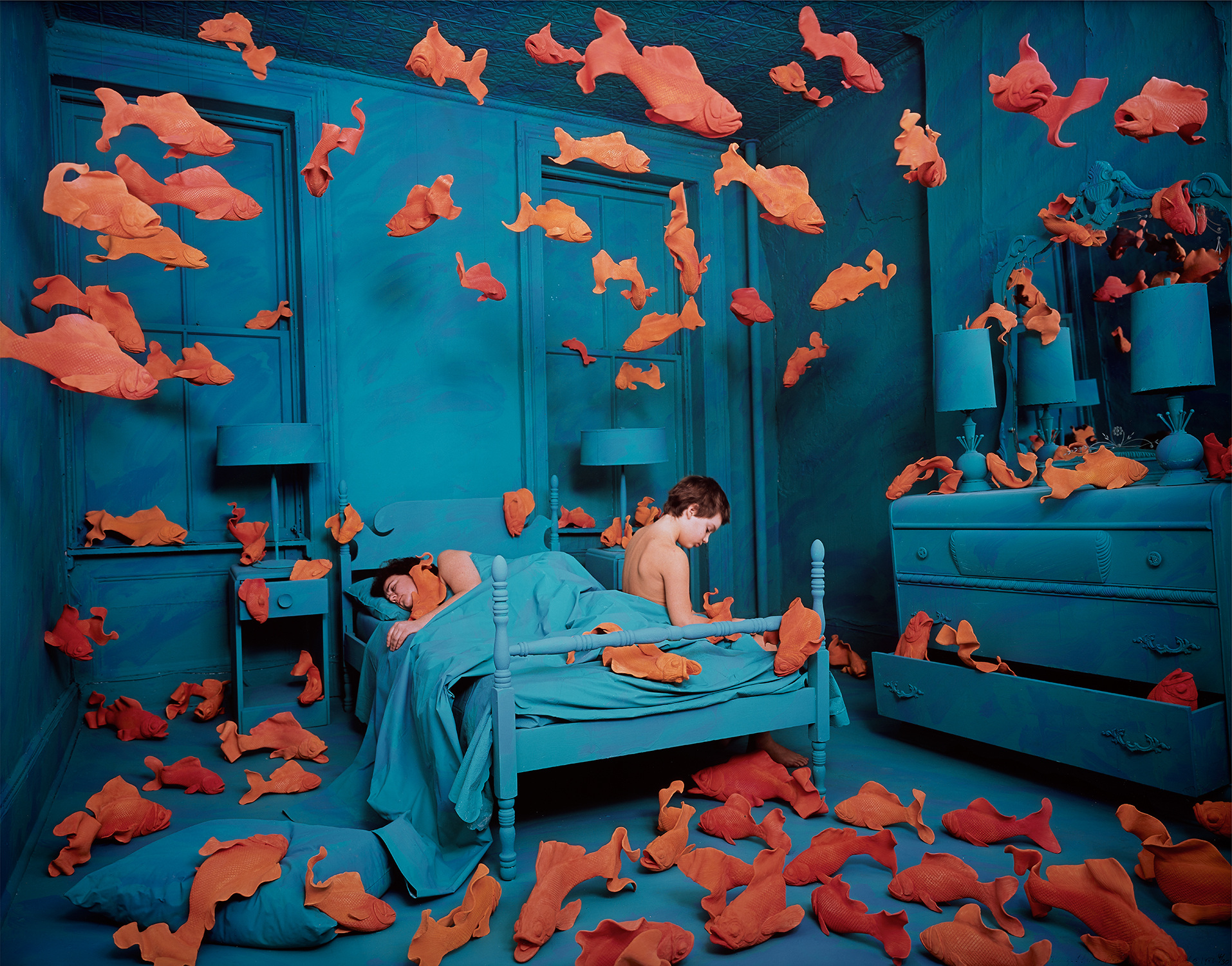
Revenge of the Goldfish and 'Blaze' Sculpture
Sandy Skoglund was born in 1946 and grew up in the postwar American landscape that would come to define so much of her visual imagination, a world of tract houses, supermarket abundance, and the particular kind of domestic quietude that conceals as much as it reveals. She studied at the Université d'Aix Marseille in France before earning her BA from Mount Holyoke College and then an MFA from the University of Iowa, where she encountered the ideas around conceptual art and installation practice that were reshaping the boundaries of what art could be. Her early work in the 1970s included more strictly conceptual and food based pieces, some of which appear in the platform's holdings, including the intimate and revealing early work Cubed Carrots and Kernels of Corn from 1978, which offers a glimpse into the systematic, almost scientific approach to everyday objects that would soon evolve into something far more theatrical. The breakthrough came in the early 1980s when Skoglund began constructing elaborate, room sized installations populated by hand sculpted objects, often dozens or even hundreds of identical figures, which she would then photograph as finished works.
The photograph was never simply a document of the installation. It was the work itself, a precisely lit, carefully composed image that transformed the three dimensional scene into something with the uncanny flatness of a dream. Radioactive Cats, completed in 1980, was among the first of these major tableaux, and it announced her intentions with complete confidence: sickly green cats swarm a grey kitchen where an elderly couple sit oblivious, their indifference as strange and disquieting as the invasion surrounding them. The work brought together sculpture, installation, and photography in a way that had no real precedent and very few successors who have managed it with equivalent skill.
Sandy Skoglund
Gathering Paradise
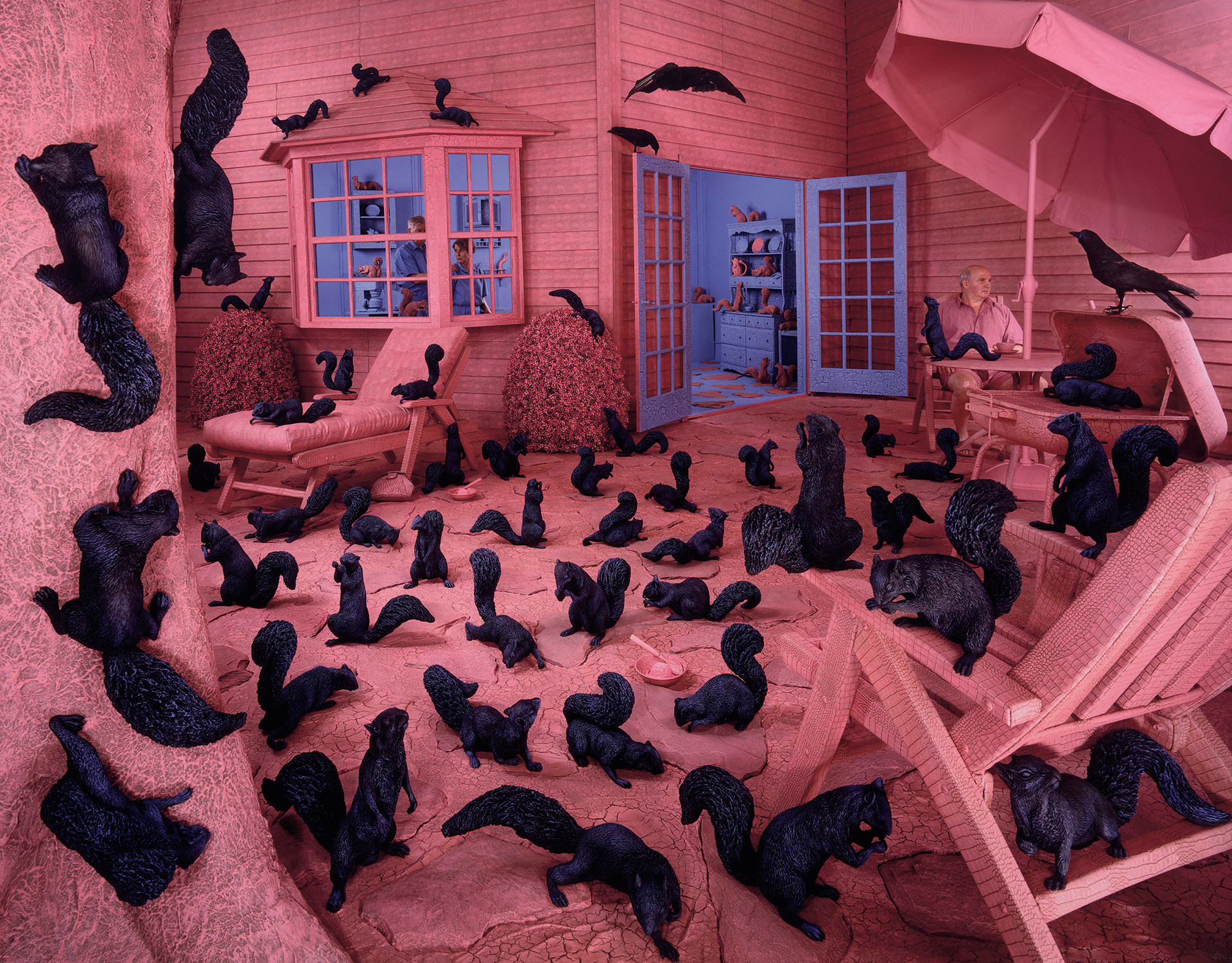
The works that followed through the 1980s and into the 1990s cemented her reputation. Revenge of the Goldfish, from 1981, remains among her most celebrated images: orange fish drift through a blue saturated bedroom where figures lie sleeping, the scene suffused with a kind of submerged, aquatic unreality. The Collection's holdings include a particularly significant example of this work accompanied by a polyester resin sculpture of the orange fish known as Blaze, mounted on a bronze base, which offers collectors the rare opportunity to hold a material piece of the installation itself alongside the photograph. Fox Games, from 1989, brought the same logic into a diner setting, foxes rendered in vivid orange erupting through every surface while human figures react or fail to react in ways that feel simultaneously absurd and psychologically precise.
These works were shown at institutions including the Castelli Graphics gallery in New York, which helped bring her to wider critical attention during a period when photography as a fine art medium was still fighting for full acceptance within the mainstream art world. What draws collectors to Skoglund's work is not simply its visual drama, though that drama is considerable. It is the extraordinary density of labor embedded in each image. Every fish, every cat, every fox was sculpted by Skoglund herself over months or years of preparation, and that handmade quality gives the photographs a warmth and material presence that purely photographic works rarely achieve.
Sandy Skoglund
Maybe Babies
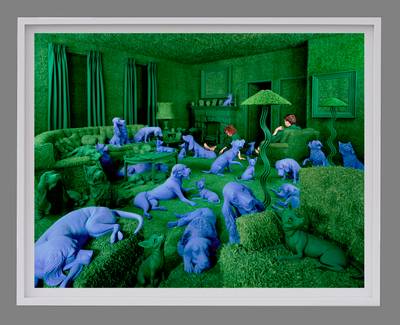
Her prints have appeared consistently at major auction houses, with strong results for key works like Fox Games and Revenge of the Goldfish, and the accompanying sculptures, when available, command significant premiums. Collectors who acquire a Skoglund photograph paired with one of her sculptures are acquiring two distinct art forms fused into a single vision, which is a genuinely rare thing. Works from the 1980s in dye destruction or dye transfer processes carry particular historical weight and are increasingly sought after as examples of a specific photographic moment. Later archival pigment prints, including works like Fresh Hybrid and Gathering Paradise represented in the platform's holdings, show her continuing to evolve her palette and her preoccupations into the twenty first century with undiminished energy.
Skoglund's work exists in productive conversation with a number of other artists who explored the tension between the everyday and the surreal, the domestic and the uncanny. Cindy Sherman was her near contemporary in using the photographic tableau to stage complex psychological narratives, while artists like Yinka Shonibare and Carrie Mae Weems have similarly used elaborately constructed scenes to investigate social and cultural dynamics. Jeff Koons explored the aesthetics of consumer abundance with some of the same knowingness, though from a very different political and emotional angle. Skoglund's particular fusion of installation and photography places her in a unique position, and art historians increasingly frame her early tableaux as foundational works in a lineage that runs through much of the most ambitious staged photography of the past forty years.
Sandy Skoglund
Selected Images from True Fiction Two
What remains most remarkable about Sandy Skoglund's legacy is its generosity. Her images give themselves freely, the visual pleasure immediate and overwhelming, and only gradually does the viewer become aware of the layers of anxiety, critique, and tenderness operating beneath the spectacular surface. She spent her career asking what it means to live inside consumer culture, inside the domestic arrangements we inherit rather than choose, inside a world that manufactures sameness on an industrial scale. Her answer was to make that sameness strange again, to populate the familiar rooms of American life with creatures and colors that should not be there, until the rooms themselves become newly visible.
That is a gift to anyone willing to look, and it is a gift that endures.
Explore books about Sandy Skoglund