Sam Taylor-Johnson
Sam Taylor-Johnson: Vulnerability Transformed Into Vision
Artist Spotlight · The Collection Editorial
“I am interested in the extremes of human emotion and how people deal with those extremes.”
Sam Taylor-Johnson, interview with the Guardian
When the Tate Modern acquired key works from Sam Taylor Johnson's video practice and her photographs continued commanding serious attention at auction houses from Christie's to Phillips, it confirmed what the art world had long understood: this is an artist whose work has never stopped mattering. Taylor Johnson occupies a rare position in contemporary British art, equally celebrated by institutions and deeply cherished by private collectors who respond to the profound emotional intelligence embedded in every image she makes. Her continued presence in major collections worldwide, alongside a filmmaking career that has brought her work to the broadest possible audience, makes this a compelling moment to consider the full arc of what she has built. Born in Croydon in 1967, Sam Taylor Johnson grew up in circumstances that gave her an early and intimate understanding of instability and resilience.
Sam Taylor-Johnson
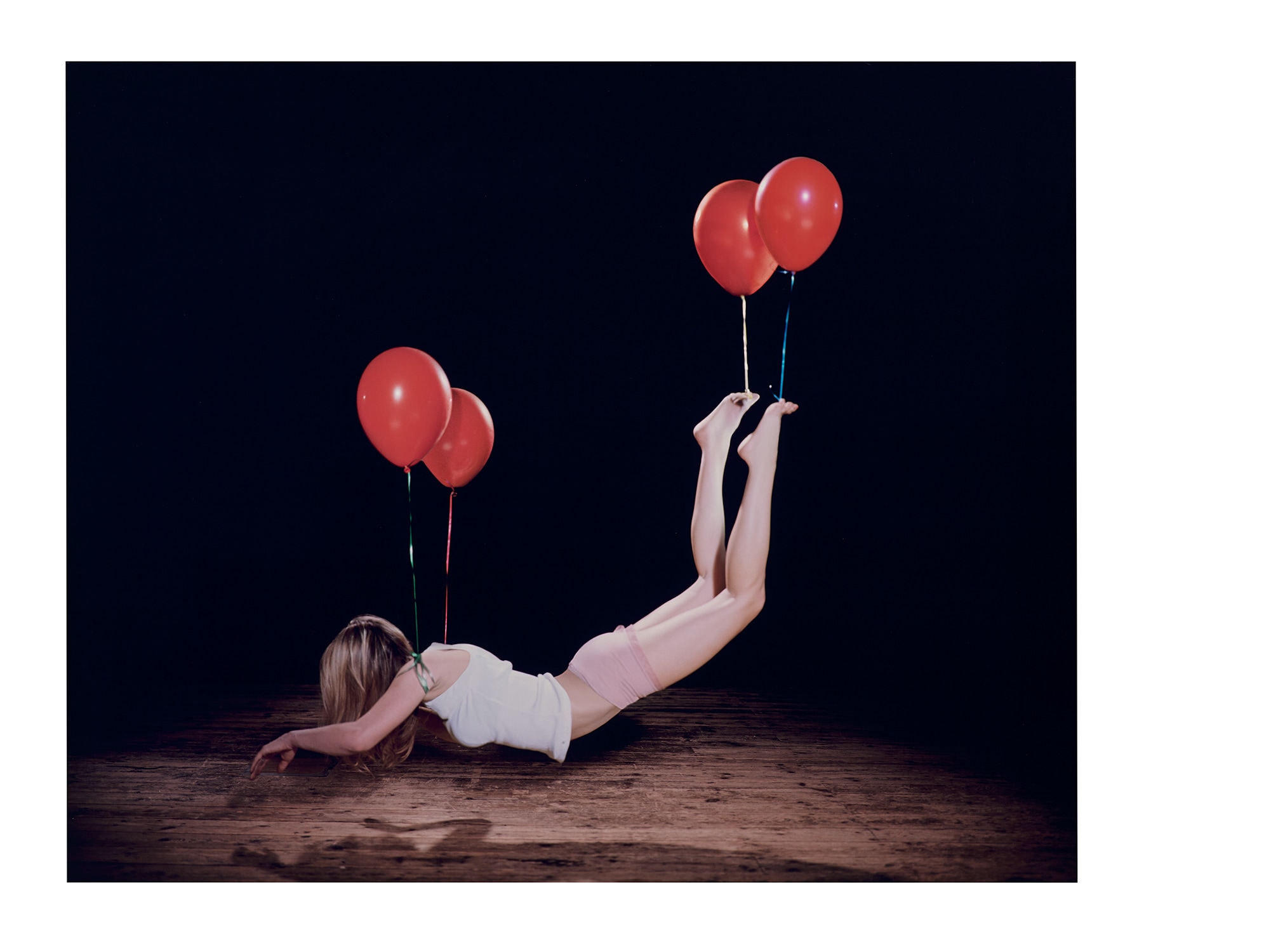
Escape Artist (Red)
She studied at Goldsmiths College in London, graduating in 1990 at one of the most electrically charged moments in British art history. Goldsmiths in that period was the incubator for what would become the Young British Artists movement, and Taylor Johnson found herself among a cohort that included Damien Hirst, Tracey Emin, and Gary Hume. The environment demanded boldness and rewarded conceptual ambition, and she absorbed both lessons entirely. Her early work announced an artist thinking seriously about the body, time, and the theater of human feeling.
The panoramic photographic series 'Five Revolutionary Seconds,' developed across the mid to late 1990s, used a rotating camera to capture 180 degree domestic and social scenes, presenting them as wide curved prints that placed the viewer inside an unfolding moment. Works like 'Five Revolutionary Seconds V' (1996) and 'Five Revolutionary Seconds XII' (1998) invited the eye to travel across a scene the way memory does, nonlinearly and with varying emotional weight on different details. These were not simply formal experiments. They were propositions about how we inhabit shared space and how much we miss even when we are present.
Sam Taylor-Johnson
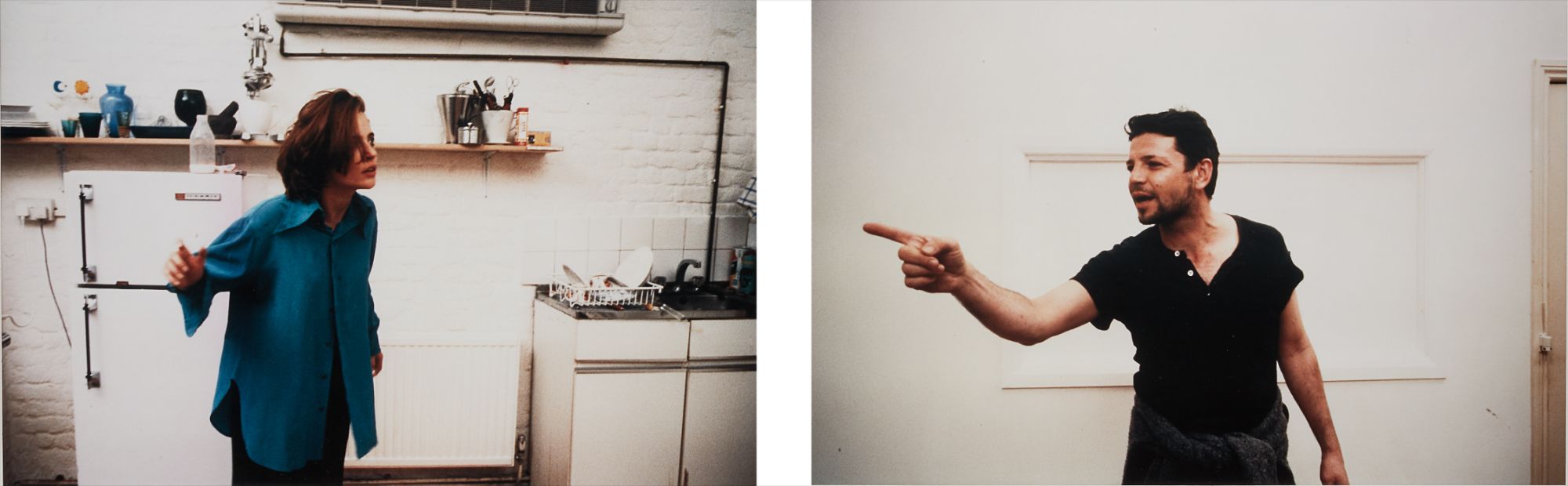
Travesty of a Mockery (diptych)
The video works deepened this inquiry into time and the body in ways that remain genuinely startling. 'A Little Death' from 2002 uses time lapse to document the decomposition of a hare alongside a peach, compressing weeks into minutes. The work draws directly on the tradition of vanitas painting, those Dutch and Flemish meditations on mortality that filled European collections for centuries, but it refuses the consolation that painting's stillness can offer. Here the transformation is relentless and literal.
“Vulnerability is something I find very beautiful. It is where the truth lies.”
Sam Taylor-Johnson
It is among the most discussed works of its generation, cited alongside the video practice of artists like Bill Viola and Gary Hill while remaining entirely and unmistakably its own thing. Around the same time, Taylor Johnson was also creating 'Crying Men,' a series of large scale chromogenic photographs depicting some of Hollywood's most celebrated male actors weeping without narrative context. Subjects including Ray Winstone, Paul Newman, and Laurence Fishburne appear stripped of the protective roles that stardom typically provides. The series is both an act of profound tenderness and a quiet subversion of how masculinity and public image are constructed.
Sam Taylor-Johnson
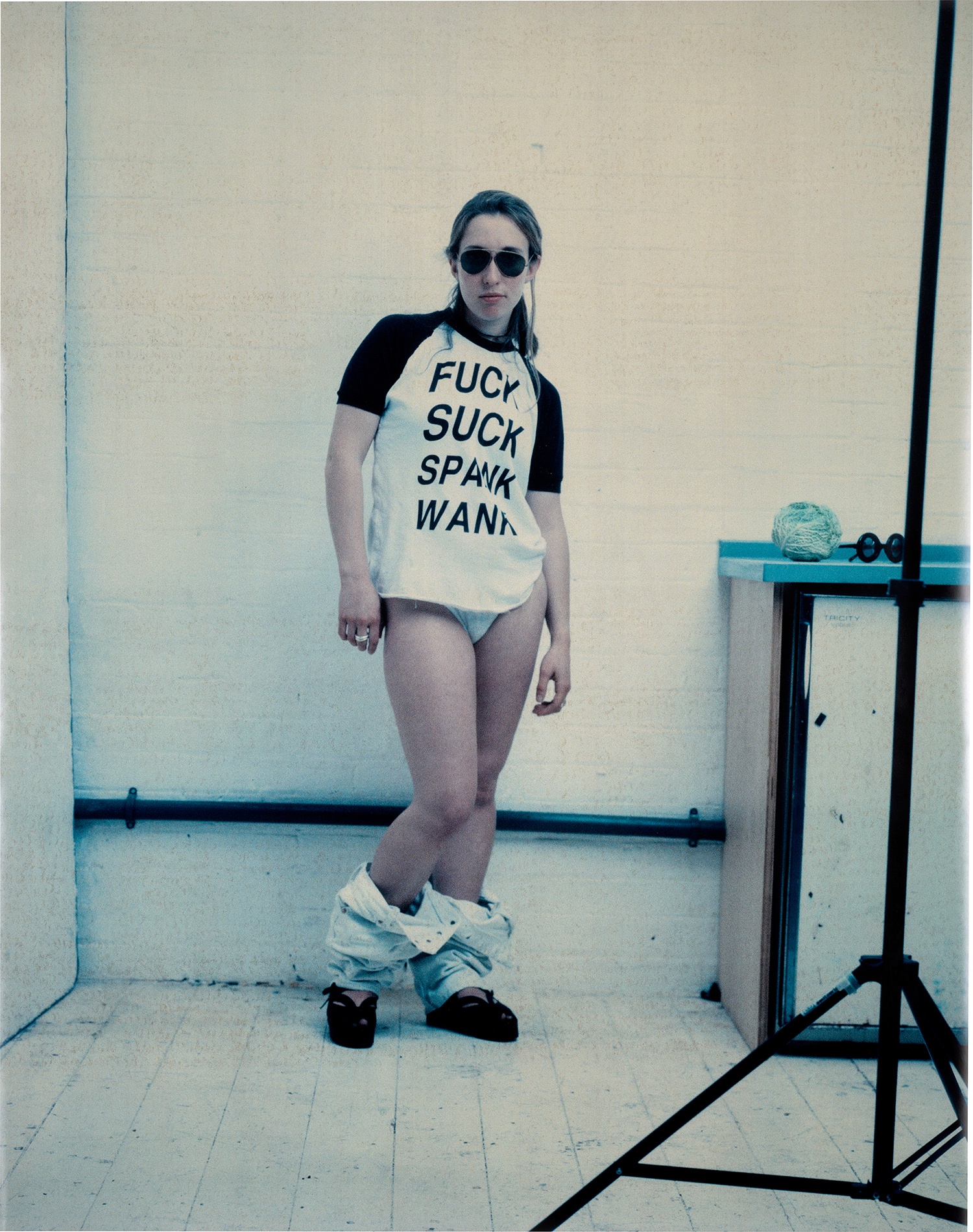
Fuck, Suck, Spank, Wank
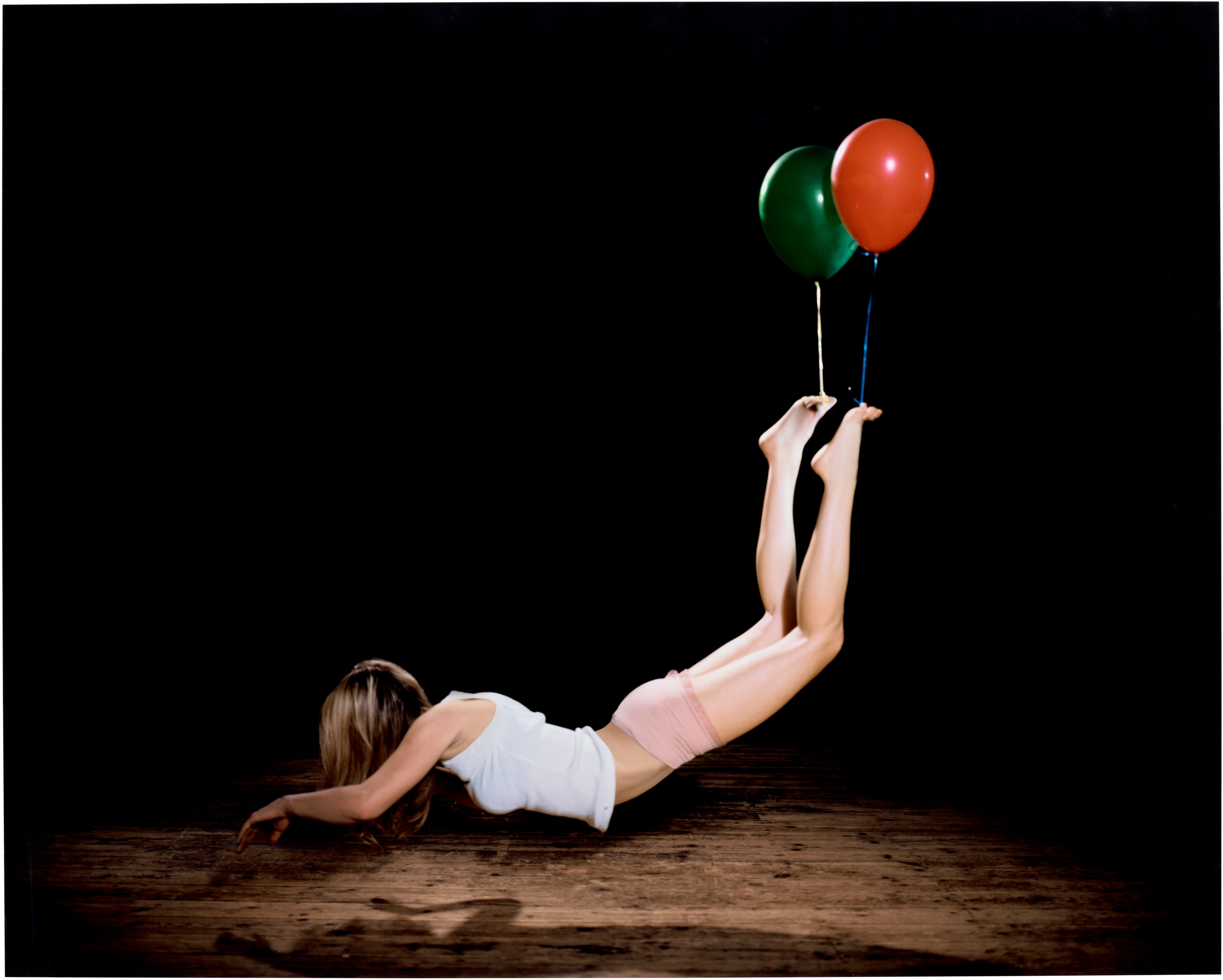
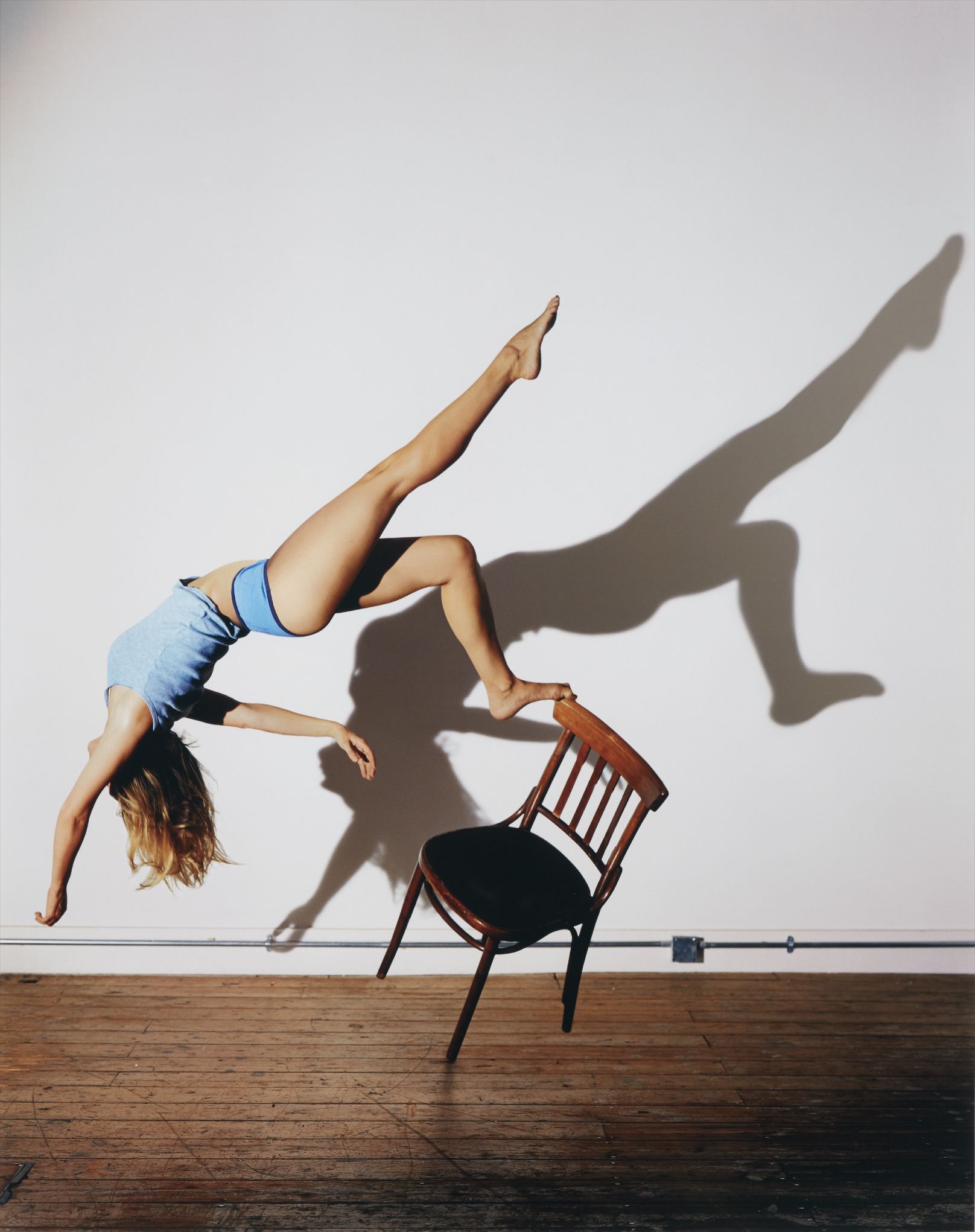
The breadth of her photographic work is genuinely remarkable when considered as a whole. 'Fuck, Suck, Spank, Wank' from 1993, a large chromogenic print, arrived early in her career as a provocation that was also, on closer inspection, a meditation on language and the body and the gap between words and acts. 'Bram Stoker's Chair II' operates in an entirely different register, elegiac and literary, referencing the physical traces left by a writer whose imagination produced one of culture's most enduring myths. The 'Escape Artist' photographs, including both the green and red and the red variants, demonstrate her continuing interest in the suspended moment, figures caught between one state and another, neither fully here nor fully elsewhere.
Across all of these works, what unites them is a quality of sustained attention, the sense that the artist has looked at her subject with complete seriousness and asked us to do the same. For collectors, Taylor Johnson's work presents a genuinely strong proposition at multiple points of the market. Her chromogenic prints, particularly those from the 1990s and early 2000s, represent the core of her photographic practice and appear regularly at the major London and New York sales rooms. Works from the 'Crying Men' series and the 'Five Revolutionary Seconds' panoramas are among the most sought after, combining art historical legibility with immediate emotional power.
Sam Taylor-Johnson
Bram Stoker’s Chair II
Edition sizes vary across her output, and condition is paramount given the sensitivity of chromogenic materials to light, so working with knowledgeable advisors and galleries is essential. Her representation through major galleries has ensured consistent documentation and provenance, which matters considerably at this level of the market. Collectors who have built around her work often find it in dialogue with peers including Wolfgang Tillmans, Rineke Dijkstra, and Nan Goldin, artists who share her commitment to the photograph as a space of genuine human encounter rather than mere documentation. Taylor Johnson's significance within art history extends well beyond her YBA associations, though that context remains important.
She emerged alongside artists who collectively redefined what British art could be and where it could sit in the global conversation, and she has consistently outpaced easy categorization within that grouping. Her work is in serious dialogue with the entire tradition of artists who have used the body as primary material, from Cindy Sherman's explorations of identity and performance to Marina Abramovic's confrontations with physical and emotional endurance. At the same time, her deep engagement with cinema, both as a maker of films including her 2009 debut 'Nowhere Boy,' the biographical portrait of John Lennon's adolescence, and as an artist who thinks through film history in works like 'XV Seconds (after Scorsese),' gives her practice a cultural range that few artists of her generation can match. What endures most powerfully about Sam Taylor Johnson's work is its absolute refusal to look away.
Whether she is documenting decay or tears or bodies suspended in ambiguous space, she brings to her subjects a quality of respect and attention that transforms the difficult into something luminous. This is an artist who has spent more than three decades making images that ask us to feel more precisely, to understand the people and moments in front of us with greater care. For collectors and institutions, and for anyone who believes that art should expand rather than diminish our capacity for empathy, her practice represents one of the most enduring achievements in contemporary photography and moving image. The works available through The Collection offer a meaningful entry point into this extraordinary body of work, and the opportunity to live with them daily is one that serious collectors will recognize as genuinely rare.
Explore books about Sam Taylor-Johnson
Sam Taylor-Johnson
Iwona Blazwick
Sam Taylor-Johnson: A Retrospective
Francesco Bonami
Sam Taylor-Johnson: Hysteria
Various Authors
Sam Taylor-Johnson: Brontosaurus
Various Authors
Sam Taylor-Johnson: Still Life
Various Authors