Sam Falls
Sam Falls Lets the World Paint Itself
Artist Spotlight · The Collection Editorial
There is a particular kind of patience required to make art the way Sam Falls makes art. Not the patience of the meticulous craftsman measuring twice and cutting once, but something closer to the patience of a gardener who plants a seed and then steps back, trusting the season. In recent years, as Falls has expanded his presence across major institutional and gallery contexts internationally, from shows in Los Angeles to presentations in Europe and beyond, that trust has been rewarded handsomely. The art world has caught up to what his most devoted collectors understood years ago: that Falls is doing something genuinely rare, coaxing images and objects into existence through collaboration with the natural world itself.
Sam Falls
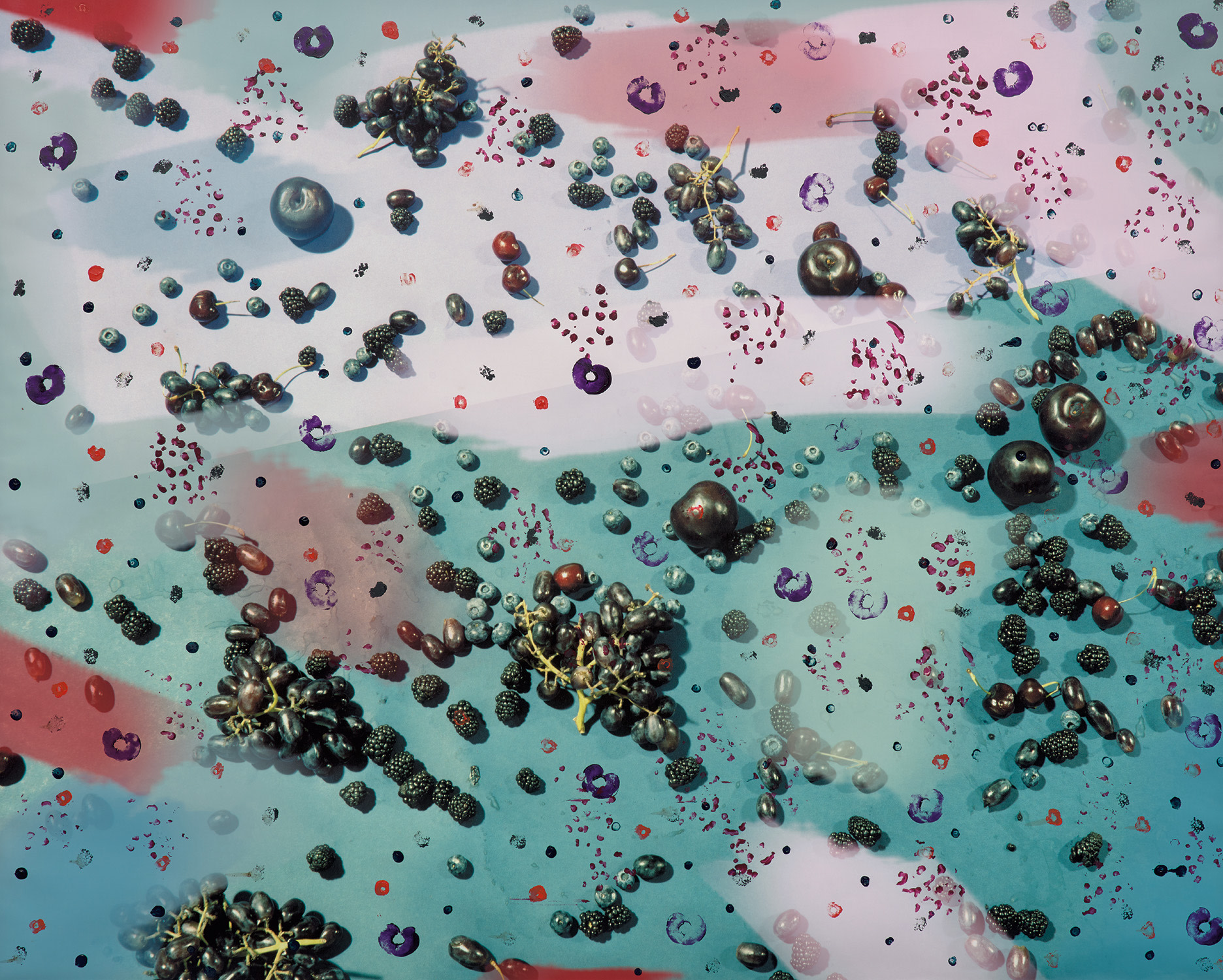
Blackberries, Blueberries, Cherries, Plums, Raspberries, Red Flame Grapes
Falls was born in 1984 and grew up in the United States during a moment when the boundaries between artistic disciplines were being redrawn with increasing urgency. The generation of artists who came of age in the 1980s and 1990s had inherited a legacy of conceptualism, minimalism, and process art, all movements that questioned what a painting could be and who or what could make one. Falls absorbed these influences and took them somewhere more sensory, more elemental, and ultimately more lyrical. His training and early development situated him within a Los Angeles context that has long celebrated the interplay between light, material, and environment, a tradition stretching back through the Light and Space movement and beyond.
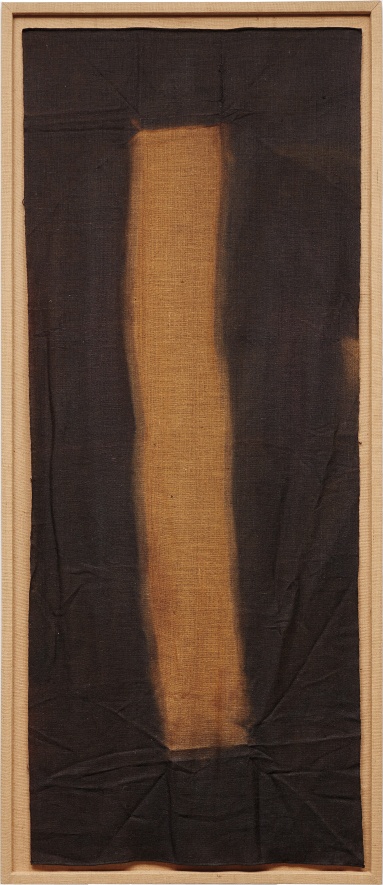
The foundation of Falls's practice is disarmingly simple to describe and endlessly complex in its results. He places fabric, canvas, or paper outdoors and exposes it to the elements, sunlight, rain, wind, and the physical presence of plants, fruits, and other organic matter, allowing the world to inscribe itself directly onto the surface. The resulting works are photograms in the oldest and most honest sense of the word, images made by light acting on a light sensitive material, except that Falls has expanded the vocabulary of that process to encompass painting and sculpture simultaneously. A piece of pre dyed burlap left to the mercy of the California sun becomes a record of time passing, a document of weather, season, and place that no camera could replicate.
Sam Falls
pre-dyed burlap, 2013
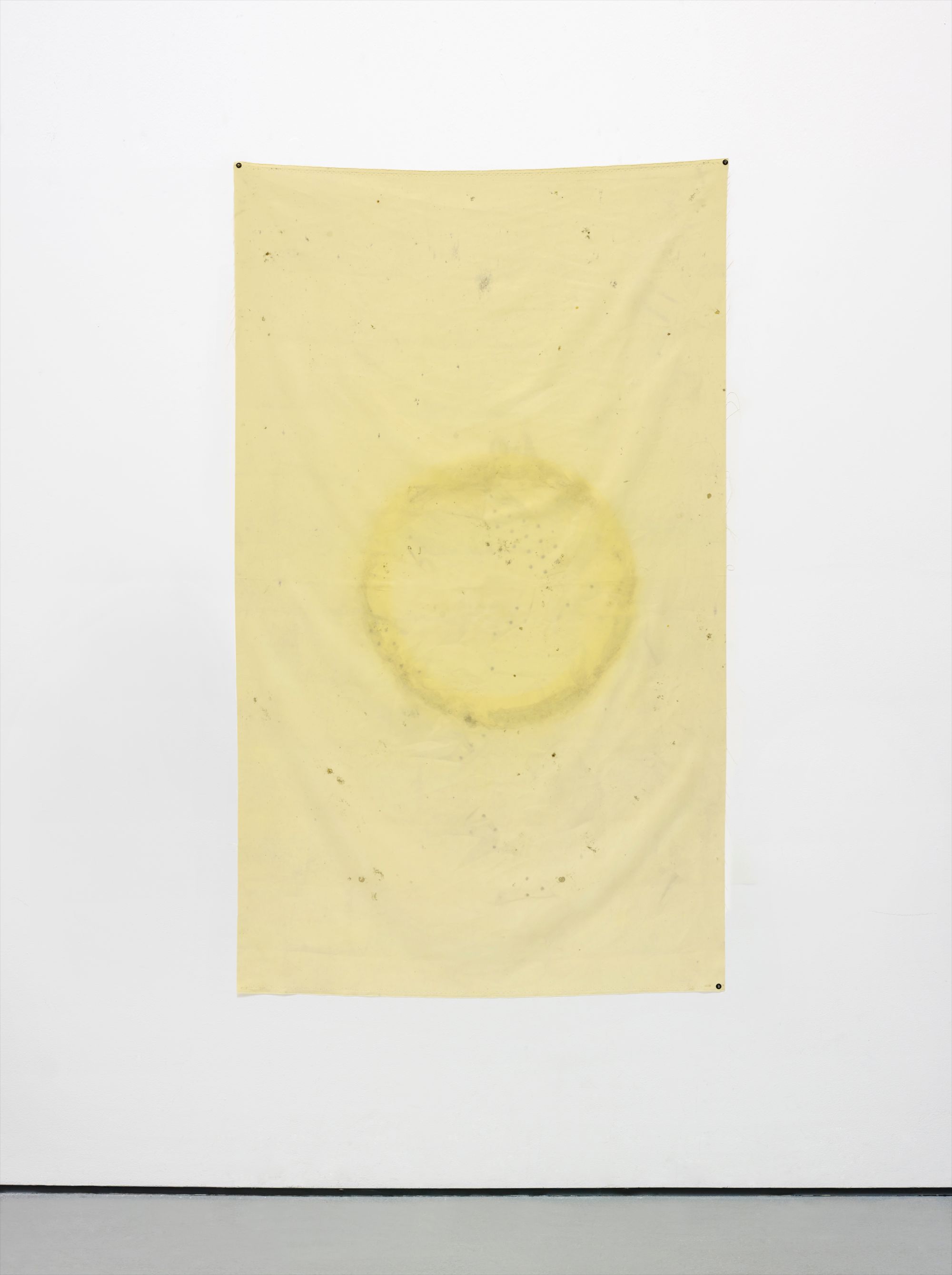
His works from the early 2010s, including pieces made from pre dyed polyester and cotton secured with metal grommets, established him as an artist of serious formal ambition. These are not accidental works. The grommets anchor the fabric with sculptural intentionality, and the choice of pre dyed material means Falls is working with color that already carries a history before the sun begins its slow transformation. Works from 2012 and 2013 in particular demonstrate a rigorous commitment to the idea that a painting need not be painted by a human hand to carry human meaning.
They feel archaeological, like evidence of something that happened rather than something that was composed, and that distinction is what gives them their particular emotional weight. The fruit works represent another dimension of the practice entirely, and they have become among the most recognized and beloved images associated with Falls. Pieces such as his archival pigment prints incorporating blueberries, cherries, plums, raspberries, bananas, kiwis, and grapes bring the natural world into an almost celebratory register. Falls places actual fruit directly onto photographic surfaces, allowing the juice, skin, and fiber of the produce to leave its mark, then sometimes returns to the surface with applied acrylic paint, building a dialogue between the indexical and the intentional.
Sam Falls
polyester and metal grommets
The result is something that feels simultaneously scientific and joyful, a still life made by the subjects themselves. These works invite comparison to the great traditions of still life painting while cheerfully refusing to behave like paintings at all. For collectors, the appeal of Falls's work operates on several levels at once. There is the conceptual richness, the genuine art historical positioning within the lineage of process art and photographic experimentation that connects his practice to figures such as Sigmar Polke, Wolfgang Tillmans, and the legacy of artists like Robert Rauschenberg who blurred the line between image and object.
There is also the sheer physical beauty of the works, the way light plays across a sun faded surface, the unexpected chromatic complexity that emerges from organic processes. Works on ikat fabric stretched over wooden stretchers from 2013 demonstrate how falls can take a material with its own cultural history, ikat weaving carries centuries of craft tradition, and introduce it into a conversation about contemporary image making. Collectors who acquire Falls are participating in an ongoing dialogue about what a photograph is, what a painting is, and what happens when you trust the world to answer those questions for you. In terms of art historical context, Falls belongs to a lineage of artists who have understood nature as a collaborator rather than a subject.
Sam Falls
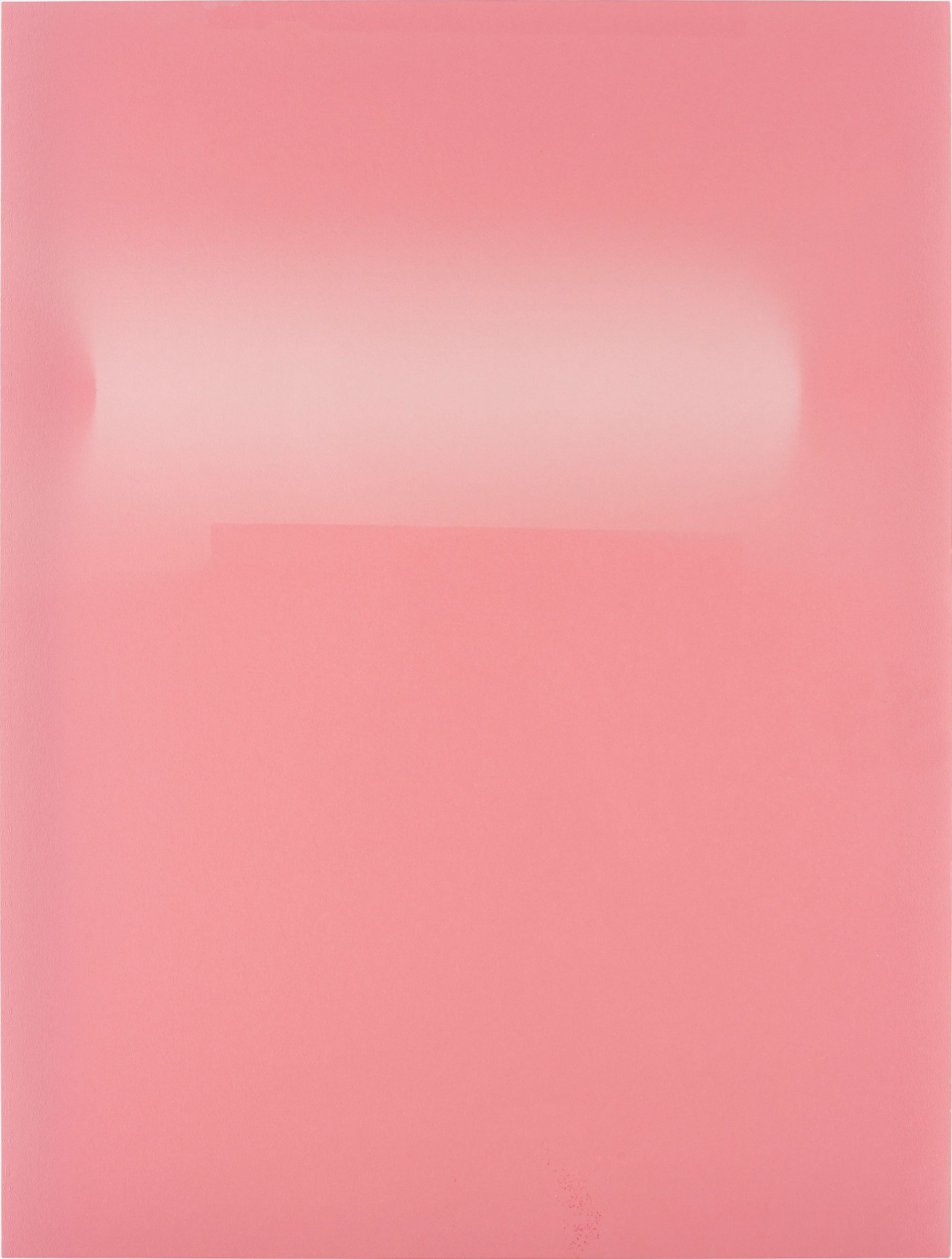
paper
The cameraless photography experiments of Man Ray and László Moholy Nagy haunt the edges of his practice, as does the environmental attentiveness of artists like Andy Goldsworthy and the material investigations of Arte Povera. His institutional recognition reflects this serious positioning: the Museum of Contemporary Art Los Angeles and the ICA Miami are not institutions that engage lightly with emerging or mid career artists, and Falls has earned his place in those contexts through the sustained coherence and ambition of his vision. Gallery presentations internationally have further cemented his reputation as an artist whose work travels well, which is to say an artist whose ideas are strong enough to hold up in any context. What makes Falls genuinely important right now, in this particular cultural moment, is how urgently his work speaks to questions we are all living with.
At a time when the relationship between human activity and the natural world has never felt more fraught or more consequential, Falls has spent his career making art that insists on a collaborative relationship with nature, one built on observation, patience, and respect for processes that exceed human control. His works are not polemical about this, they are simply beautiful, and their beauty carries the argument more effectively than any manifesto could. To stand before a Sam Falls work is to feel the passage of time, the specific quality of a particular kind of light, the weight of fruit in your hand. That is no small thing.
That is, in fact, exactly what art is for.