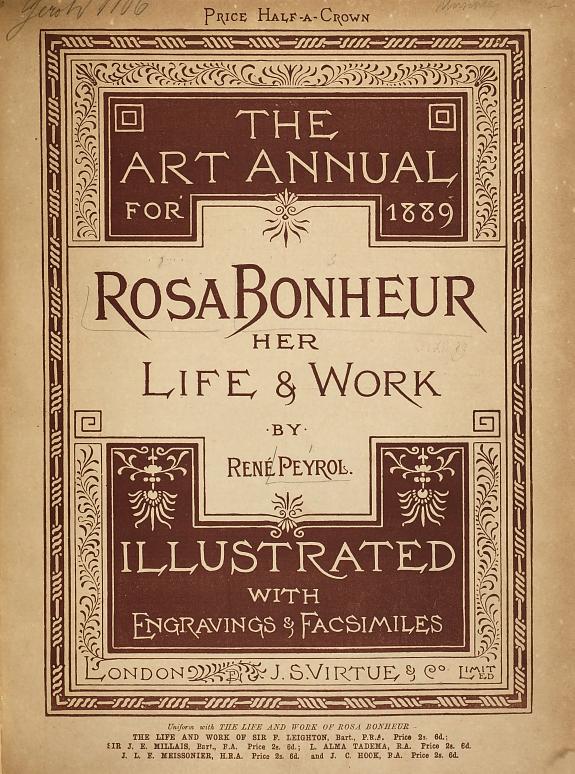
Rosa Bonheur
Rosa Bonheur, Nature's Most Devoted Witness
Artist Spotlight · The Collection Editorial
“Why would I not be proud to be a woman? My father always told me that women's mission was a noble one.”
Rosa Bonheur
There is a moment, standing before Rosa Bonheur's monumental painting The Horse Fair at the Metropolitan Museum of Art in New York, when the scale of her ambition becomes fully legible. The canvas, stretching nearly five meters wide, pulses with the muscular energy of Percherons being led through a Parisian marketplace, their coats gleaming, their hooves churning the dust of the Boulevard de l'Hôpital. Bonheur spent two years preparing this work, attending the horse market at Salpêtrière twice a week, sketching obsessively, dressing in men's clothing because she required a police permit to do so legally. When the painting was exhibited at the Paris Salon of 1853, it stopped the art world in its tracks.
Rosa Bonheur
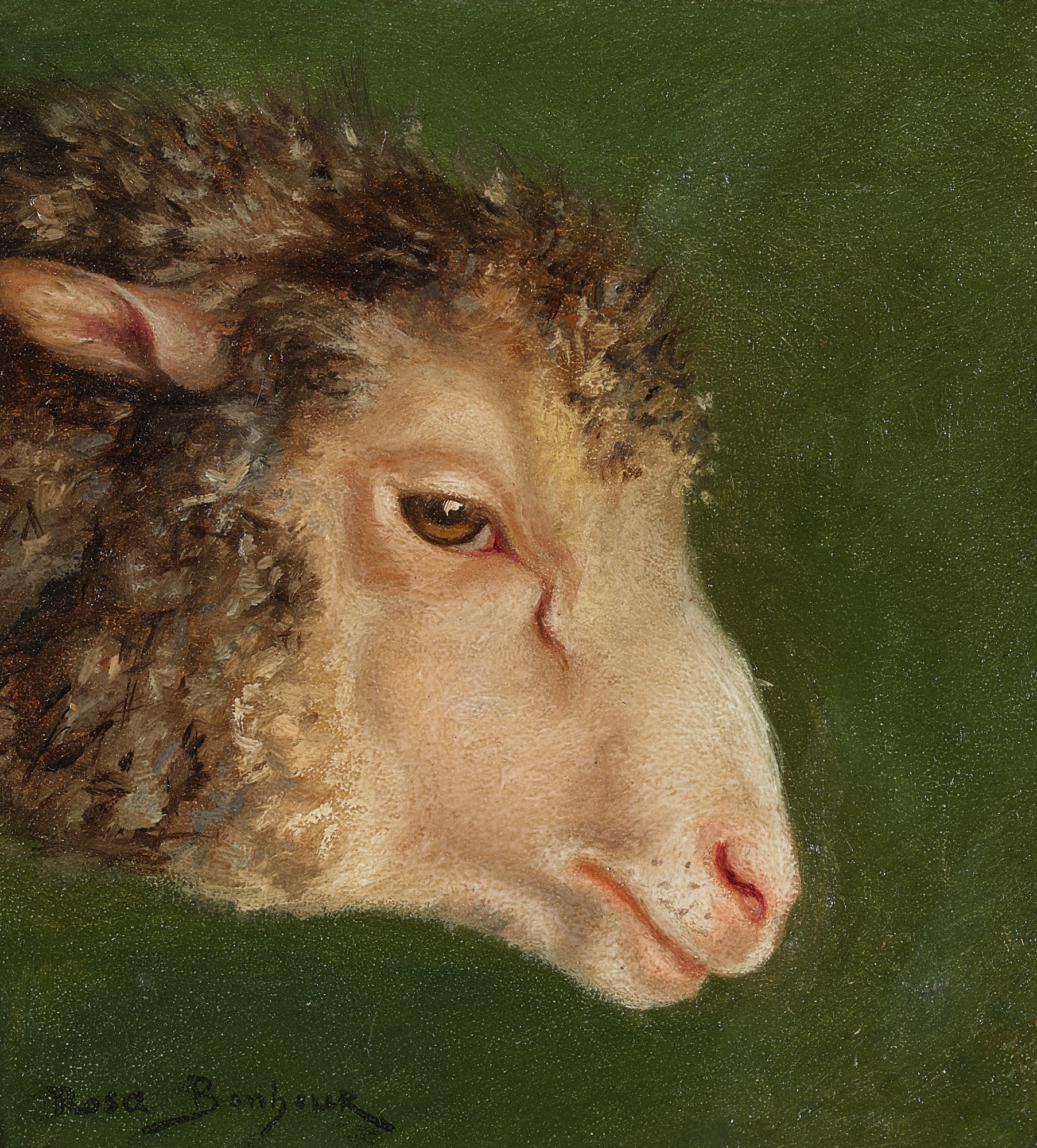
Head of an Ewe
It remains, more than 170 years later, one of the most commanding paintings of the nineteenth century. Rosa Bonheur was born in Bordeaux in 1822 into a family that treated creativity as a basic condition of life. Her father, Raymond Bonheur, was a landscape and portrait painter and a committed Saint Simonian, a social movement that advocated for the equality of women and believed in the spiritual power of art. This progressive household shaped Rosa profoundly.
When the family relocated to Paris, she began formal training under her father's guidance, spending long hours at the Louvre copying the Dutch and Flemish masters, whose precise attention to animal anatomy and pastoral light would leave a permanent mark on her vision. From adolescence, she made regular visits to the slaughterhouses and livestock markets of Paris, sketchbook in hand, building an encyclopedic understanding of animal form that no other painter of her era could match. Her artistic development was rapid and purposeful. By the time she exhibited at the Salon in the early 1840s, she was already working in a mode that combined scientific rigor with genuine feeling for her subjects.
Rosa Bonheur
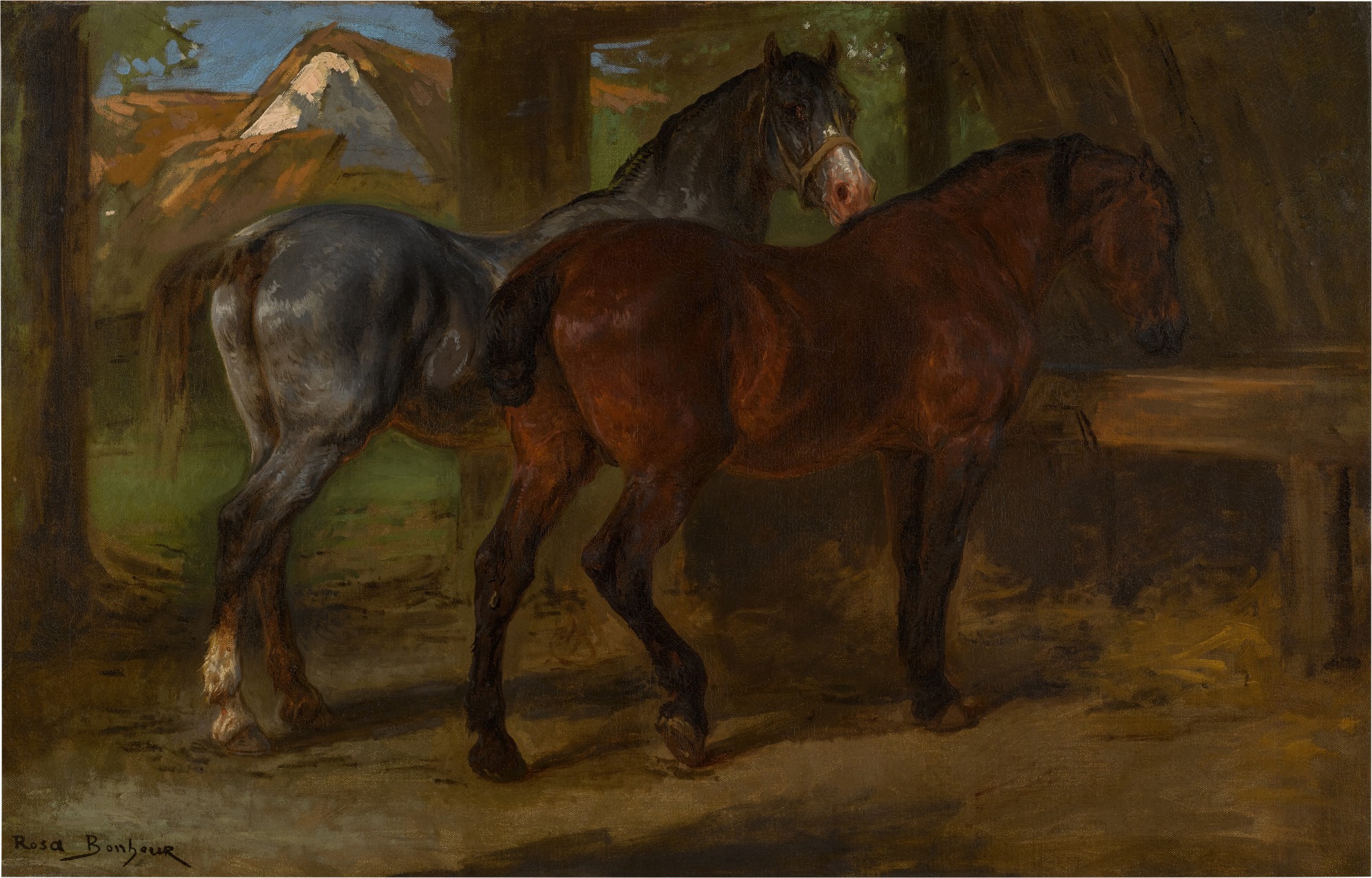
Two Horses in a Stable, 1885
She kept a private menagerie at her studio, including sheep, goats, horses, deer, and eventually lions, believing that sustained proximity to living animals was the only honest foundation for painting them. This was not mere eccentricity but a philosophical commitment: Bonheur believed the natural world deserved the same respect and careful attention that history painters lavished on mythology and military conquest. Her breakthrough came with Plowing in the Nivernais, exhibited at the Salon of 1849, a vast, serene depiction of oxen working the land that earned her a first class medal and confirmed her as one of the defining painters of her generation. The works available through The Collection reveal the full compass of her practice, from intimate studies to ambitious finished compositions.
“I have no patience with women who ask permission to think.”
Rosa Bonheur
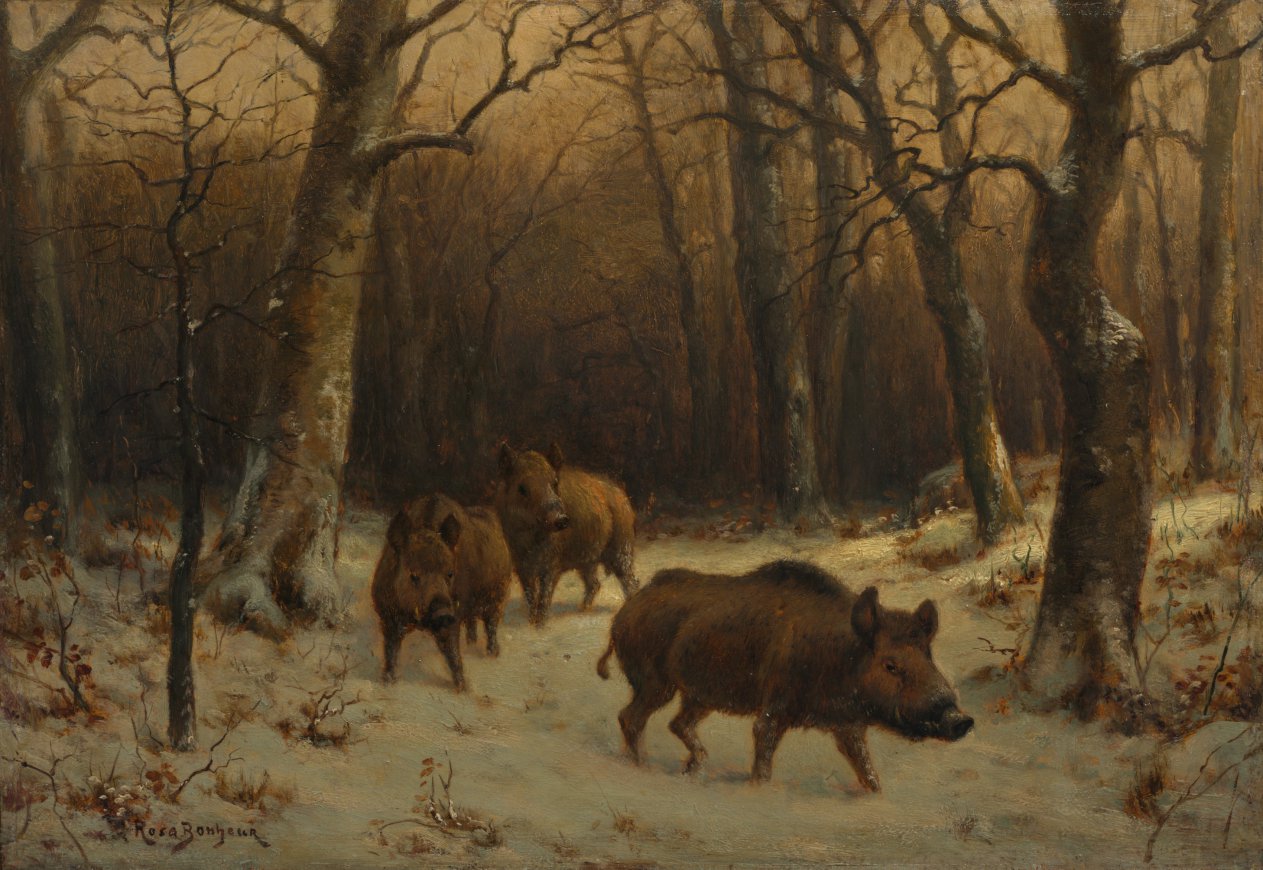
Head of an Ewe, rendered in oil on canvas, demonstrates the quality that made her irreplaceable: a capacity to find dignity and individuality in a single animal face, to paint wool as a texture alive with light rather than a decorative surface. Wild Boars in the Snow, dated 1872 and painted on wood panel, shows her command of atmosphere, the cold grey weight of a winter forest rendered with a directness that anticipates the naturalist impulse of the following decades. Return from the Horse Fair, a watercolor and gouache over graphite from 1873, offers a looser, more lyrical approach, the medium allowing the energy of horses in motion to breathe across the page in ways that oil sometimes constrains. Two Horses in a Stable from 1885 is a quiet, intimate work, two animals sharing warmth and proximity, observed with the patience of someone who had spent decades in the company of creatures she genuinely loved.
Rosa Bonheur
Wild Boars in the Snow, 1872
For collectors, Bonheur's work presents a remarkable opportunity. She was extraordinarily prolific, working in oil, watercolor, gouache, and drawing throughout a career that spanned six decades, which means that works in a range of scales and price points appear at auction with satisfying regularity. Her larger oil paintings command significant attention when they come to market, but her works on paper, including watercolor and gouache studies of animals in landscapes, offer collectors a chance to acquire something deeply characteristic of her vision at a more accessible level. What to look for is the specificity of her animal observation: the tilt of a horn, the flex of a fetlock, the particular way light falls across a coat in cold air.
Bonheur never painted a generic animal. Each creature in her work was encountered, studied, and known. Within the broader history of nineteenth century painting, Bonheur occupies a fascinating position at the intersection of Realism and the Animalier tradition. The Animalier sculptors and painters, including Antoine Louis Barye and Constant Troyon, shared her commitment to the careful observation of animal subjects, though Bonheur brought to that tradition an ambition of scale and a political self consciousness that set her apart.
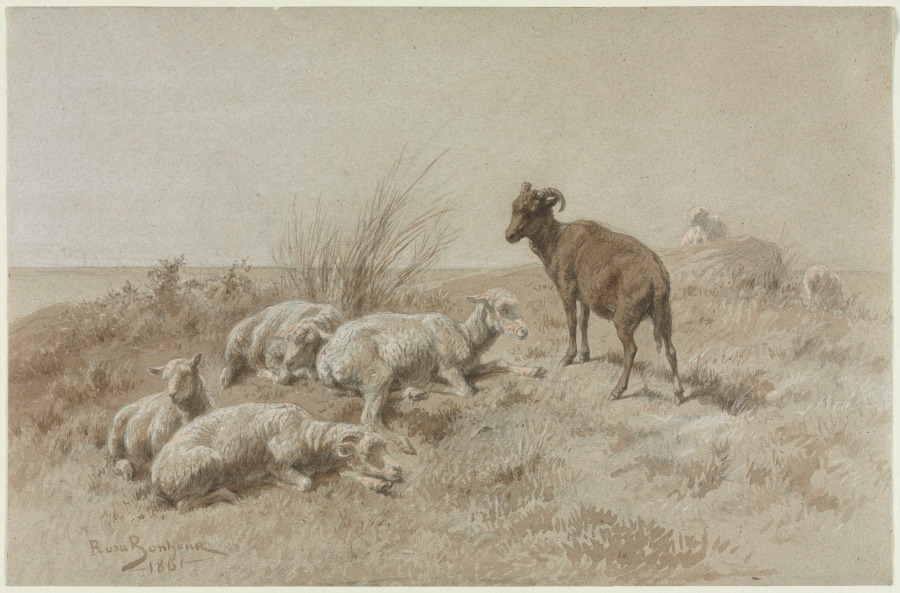
Rosa Bonheur
Sheep, 1861
Her refusal to paint animals as mere symbols of human power, as beasts of burden or trophies, aligns her work in spirit with the Realist project of Courbet and Millet, even as her technique retained an elegance and finish that appealed to academic audiences. She was awarded the Légion d'honneur in 1865, the first woman artist to receive it, presented by Empress Eugénie, who reportedly said that genius has no sex. What makes Rosa Bonheur matter today, with a force that feels newly urgent, is precisely what her contemporaries sometimes struggled to categorize. She lived openly with the women she loved, she refused the social constraints placed on women artists of her era, and she insisted that the animal world was a subject worthy of the highest artistic seriousness.
In an era when the boundaries between human and nonhuman life are being reconsidered across philosophy, science, and culture, her body of work reads not as charming Victoriana but as a sustained argument for attention and empathy. The animals in her paintings are not background. They are the whole point. To spend time with her work is to understand that looking carefully and looking lovingly are not opposites, and that an artist who devoted her life to that understanding left the world genuinely richer for it.
Explore books about Rosa Bonheur