Roger Reutimann
Roger Reutimann Paints the Depths of Being
Artist Spotlight · The Collection Editorial
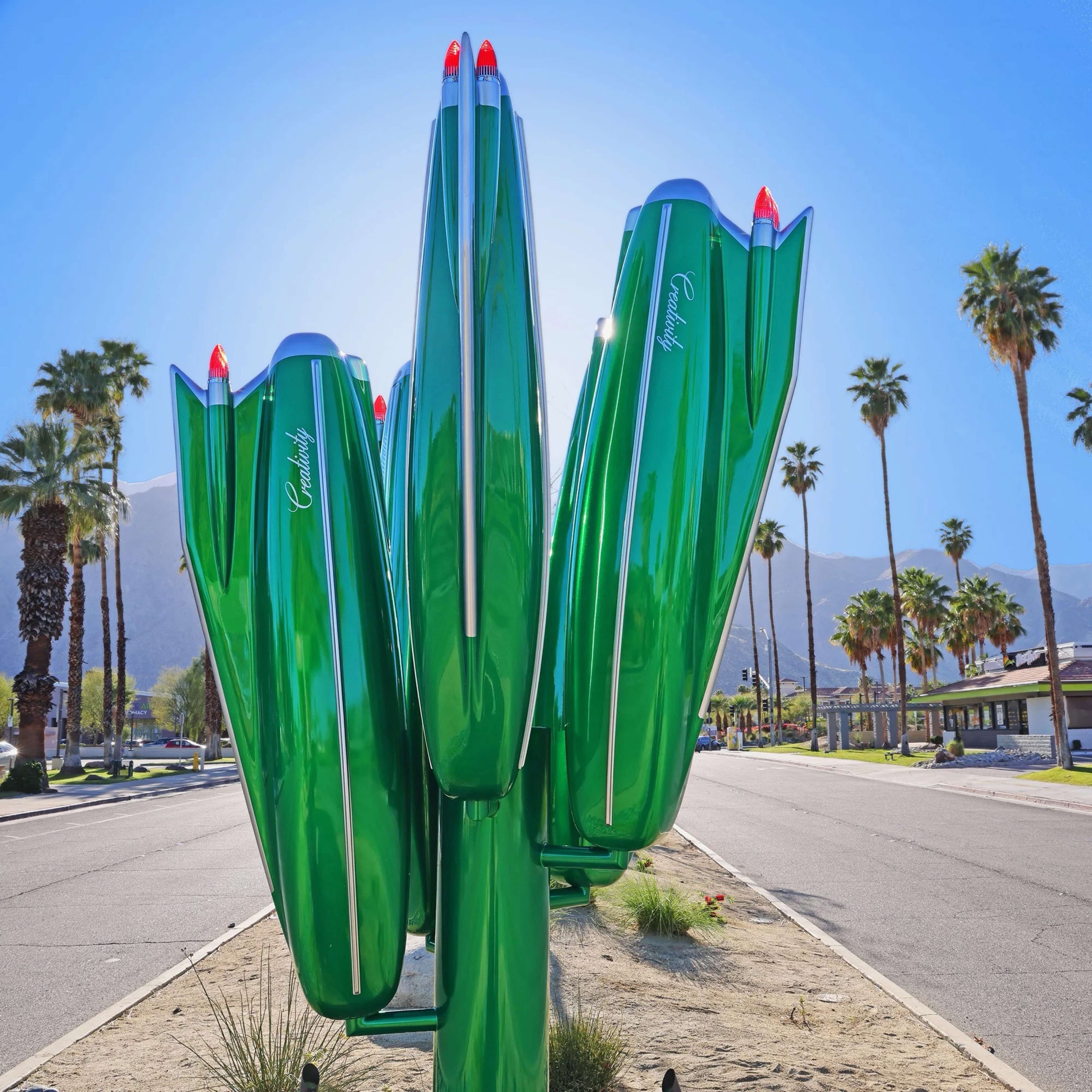
Something is stirring in the world of American figurative painting, and Roger Reutimann finds himself at the center of it. His 2024 work "Cadillactus," a painted steel sculpture that fuses the swagger of American automotive culture with the prickling geometry of desert flora, signals an artist in full creative bloom, unafraid to push his practice into new material territory. The piece is a confident declaration from a painter who has spent decades refining a visual language built on emotional honesty, formal rigor, and an abiding curiosity about what it means to be human. Reutimann is not an artist who shouts for attention.
Roger Reutimann
Cadillactus, 2024
He earns it, slowly and surely, through work that rewards sustained looking. Born in 1960, Reutimann came of age during one of the most turbulent and generative periods in American cultural life. The postwar optimism of his early childhood gave way to the social upheaval of the late 1960s and 1970s, and then to the explosive artistic energies of the 1980s New York scene. These overlapping cultural waves left a visible impression on his sensibility.
He developed an early attunement to the expressive possibilities of the human figure, drawn to the way a painted face or a gestural body could carry the weight of memory, loss, desire, and resilience. The classical traditions of Western figurative painting, from the psychological intensity of Rembrandt to the raw physicality of Chaim Soutine, were never far from his mind as he built his foundational understanding of what paint could do. Reutimann's development as an artist reflects a sustained negotiation between inherited traditions and the demands of contemporary experience. His practice spans painting, drawing, and mixed media, and across all of these forms he has maintained a commitment to representational work that does not shy away from complexity.
His painterly expressiveness sits comfortably alongside careful compositional structure, and this productive tension gives his work its particular charge. He is neither a pure gestural abstractionist nor a cool photorealist. He occupies a space in between, where the marks on the canvas feel alive with the speed of thinking but are always anchored to a recognizable world of faces, figures, and forms. This position places him squarely within the Neo Expressionist lineage while remaining distinctly his own.
The thematic concerns at the heart of Reutimann's work are nothing less than the great preoccupations of humanistic inquiry: memory, identity, and the condition of being alive in a particular time and place. His portraits and figurative compositions carry within them a sense of psychological depth that invites the viewer to linger. There is often a feeling of something just out of reach, a recollection beginning to surface or a truth still forming, and this quality gives his images their emotional resonance. "Cadillactus," while departing from canvas into painted steel, carries these same concerns in a new register.
The Cadillac, that quintessential symbol of American aspiration and mobility, is transformed by its hybridization with the cactus, a plant of extraordinary endurance and hidden beauty, into something that asks questions about the American self and what survives the passage of time. For collectors approaching Reutimann's work, the appeal is both aesthetic and intellectual. His canvases reward the kind of living with a work that defines a serious collecting practice. The surface qualities of his paintings, the way paint is layered and worked, the interplay of gestural passages with more deliberate marks, offer continuous discoveries the longer one spends in their presence.
Collectors who have gravitated toward the broader Neo Expressionist tradition, toward artists such as Julian Schnabel, Eric Fischl, or Susan Rothenberg, will find in Reutimann a figure who engages the same questions with equal seriousness and a voice that is genuinely his own. His willingness to work across media, including his recent forays into painted steel, also speaks to a practice that is still actively evolving, which is an important signal for collectors thinking about the long arc of an artistic career. Within the broader landscape of American art, Reutimann occupies a meaningful position in a generation of painters who refused to abandon the figure even as abstraction dominated critical conversation for much of the late twentieth century. The return of figurative painting to the center of the market and the museum world in recent years has brought renewed attention to artists like Reutimann who maintained their commitment through leaner critical periods.
His work can be understood in conversation with the expressive figuration of Leon Golub, the psychological portraiture of Alice Neel, and the mythologizing figuration of Neo Expressionism more broadly. At the same time, his humanistic concerns align him with a tradition that stretches back through American social realism to the great figurative painters of Europe. What makes Reutimann matter today is precisely his insistence on the human at a moment when that insistence feels increasingly urgent. In an art world that has embraced technology, spectacle, and institutional critique as organizing principles, his patient attention to the face, the figure, and the remembered moment offers something rare and necessary.
His work asks viewers to slow down, to look carefully, and to recognize something of their own experience in the painted surface before them. That is not a small thing. As his practice continues to develop, with works like "Cadillactus" pointing toward new formal possibilities, Reutimann stands as an artist whose deepest contributions may still be ahead of him. The collectors and institutions that recognize this now will be among those who shaped the story of American painting in the early twenty first century.