Robert Motherwell
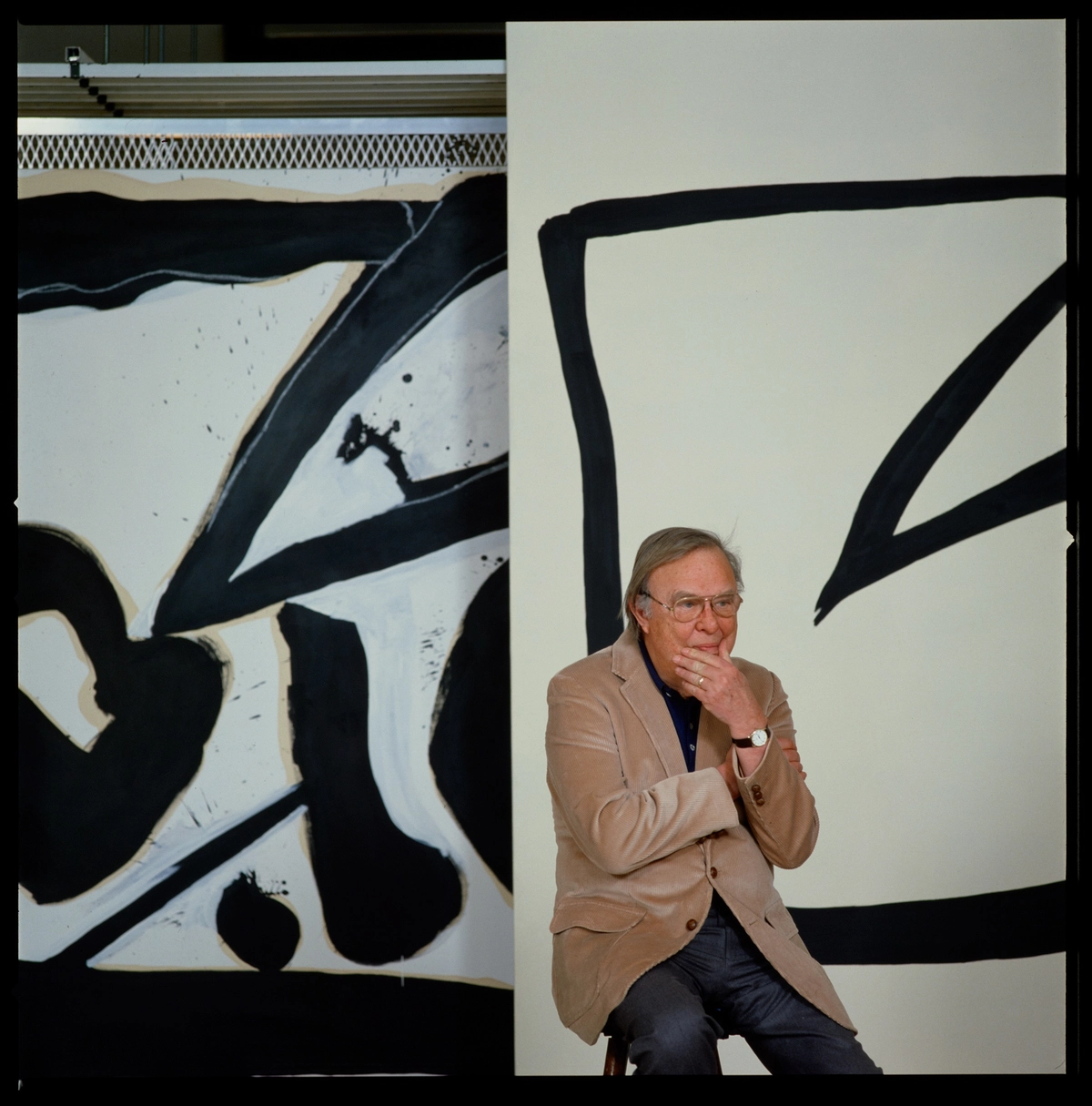
Robert Motherwell: The Poet Who Painted Feeling
Artist Spotlight · The Collection Editorial
“A painting is a thought made visible, and what I think about is feeling.”
In the spring of 2023, the Modern Art Museum of Fort Worth mounted a quietly revelatory survey of works on paper by Robert Motherwell, reminding a new generation of collectors and curators just how expansive and emotionally alive his practice truly was. The exhibition gathered lithographs, collages, gouaches, and etchings that revealed the full range of a man who approached every sheet of paper as a philosopher approaches a problem: with total commitment, rigorous inquiry, and a willingness to be surprised. For those who encountered Motherwell only through his monumental canvases, the show was a revelation. For those who already loved him, it was a homecoming.
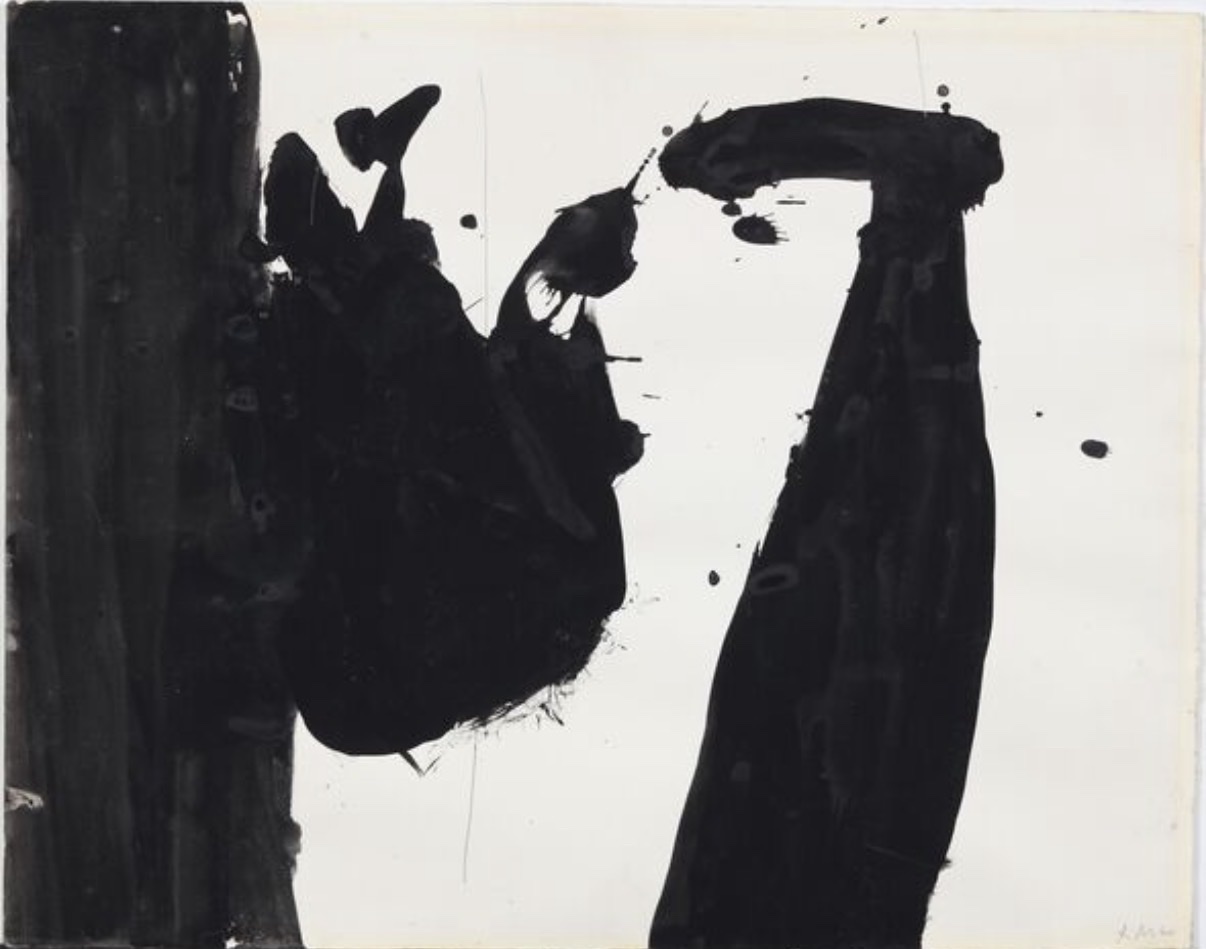
Robert Motherwell
In Black + White, 1960
Robert Motherwell was born in 1915 in Aberdeen, Washington, into a family that valued education and ambition. His father was a bank president, and the household was comfortable but not particularly bohemian. From an early age, Motherwell showed an unusual appetite for ideas, and he pursued that appetite formally at Stanford University, where he studied philosophy. It was philosophy, not painting, that gave him his first language, and that language never left him.
The questions that preoccupied him at Stanford, questions about consciousness, expression, and the nature of meaning, would animate his canvases for the rest of his life. His turn toward art was gradual but decisive. He studied briefly at the California School of Fine Arts and then made his way to New York, where the intellectual climate of the early 1940s was crackling with possibility. Under the mentorship of the Surrealist painter Kurt Seligmann, Motherwell was introduced to the European emigre community that had gathered in Manhattan to escape the war.
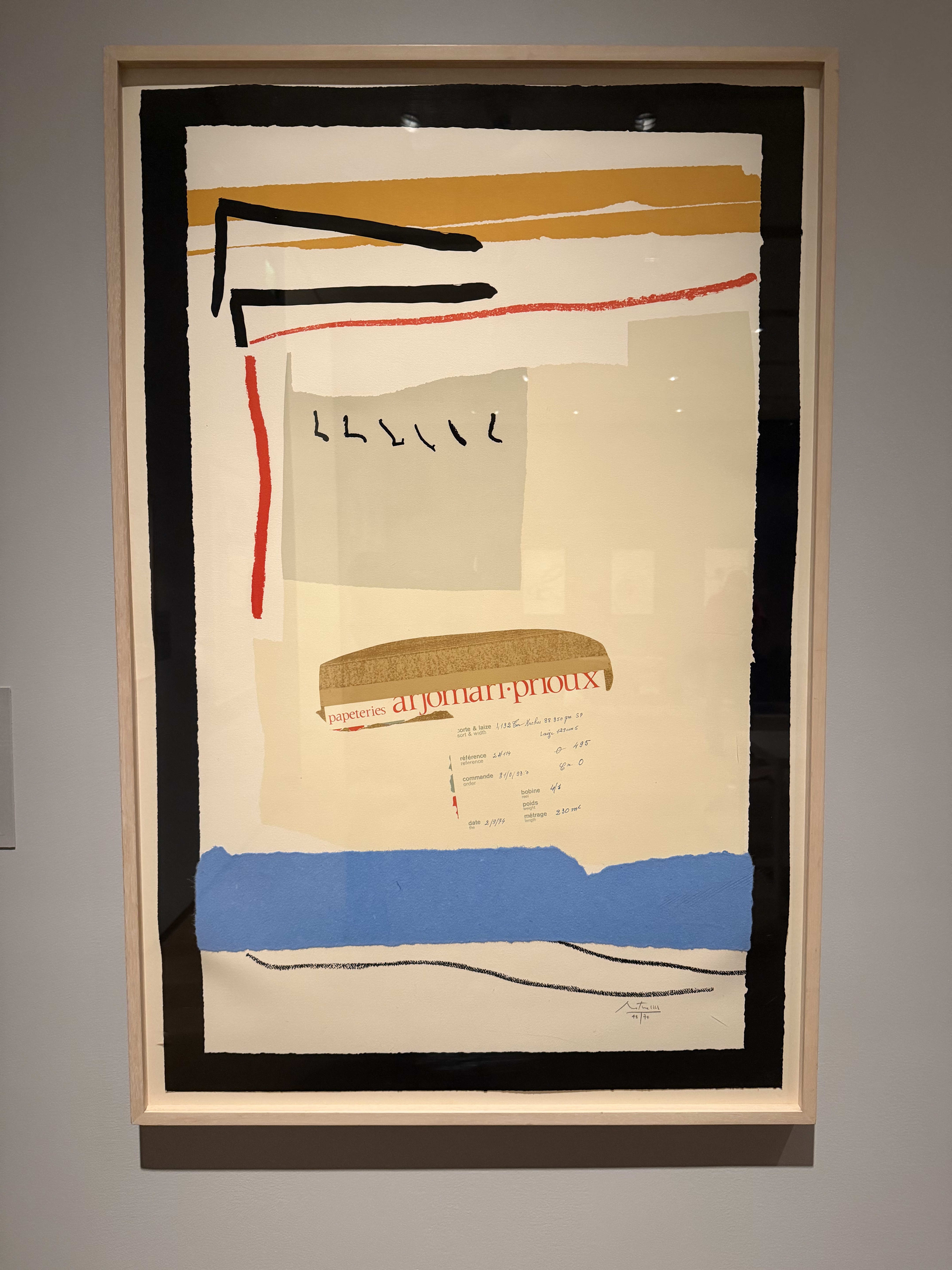
Robert Motherwell
America - La France Variations III, 1984
He befriended figures including Andre Breton, Marcel Duchamp, and Max Ernst, absorbing their ideas about automatism and the unconscious with the same rigor he had once applied to Kantian ethics. He also grew close to Matta, the Chilean Surrealist painter, who encouraged him to paint freely and intuitively. These friendships shaped everything that followed. What made Motherwell singular among the Abstract Expressionists was his refusal to separate thinking from feeling.
“Every intelligent painter carries the whole culture of modern painting in his head.”
Robert Motherwell
While contemporaries like Franz Kline or Mark Rothko worked from a place of raw emotional urgency, Motherwell brought an almost scholarly self awareness to his practice. He was a prolific writer and editor, most famously responsible for editing and translating Robert Goldwater and Marco Treves's "Artists on Art" and for founding the Documents of Modern Art series, which introduced many European modernist texts to American readers. He believed that artists had an obligation to understand the tradition they were working within, and he honored that obligation throughout his career. Yet none of this intellectualism made his paintings cold.
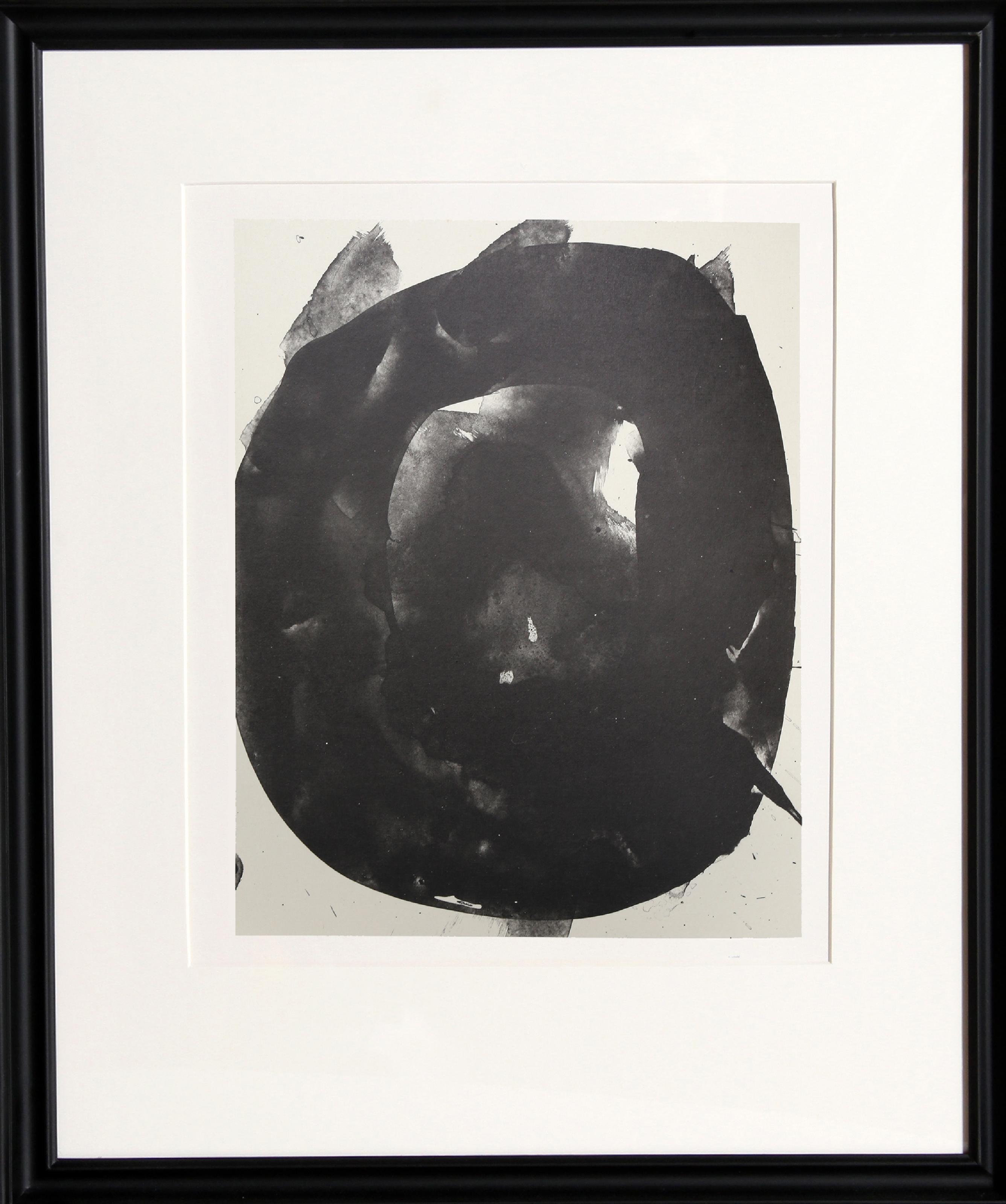
Robert Motherwell
Three Poems: Nocturne V
If anything, it gave them a peculiar tenderness, the warmth of someone who has thought deeply about why beauty matters. His signature achievement is the series known as the Elegy to the Spanish Republic, a cycle of paintings begun around 1948 and continued, with extraordinary devotion, until near the end of his life. The elegies, with their great black ovoid forms pressing against vertical bars on fields of white or cream, are among the most recognizable images in postwar American art. They draw on Motherwell's grief over the fall of Republican Spain to Franco's forces, a political catastrophe that he experienced as a symbol of everything fascism destroyed: freedom, culture, the life of the mind.
“I would rather have my pictures live in the world than hang in a museum.”
The forms are not illustrative; they do not depict anything literally. But they carry weight in the way that music carries weight, through rhythm, proportion, and the raw authority of black against white. Over more than a hundred individual paintings in the series, Motherwell never exhausted the subject. Each elegy feels both inevitable and new.
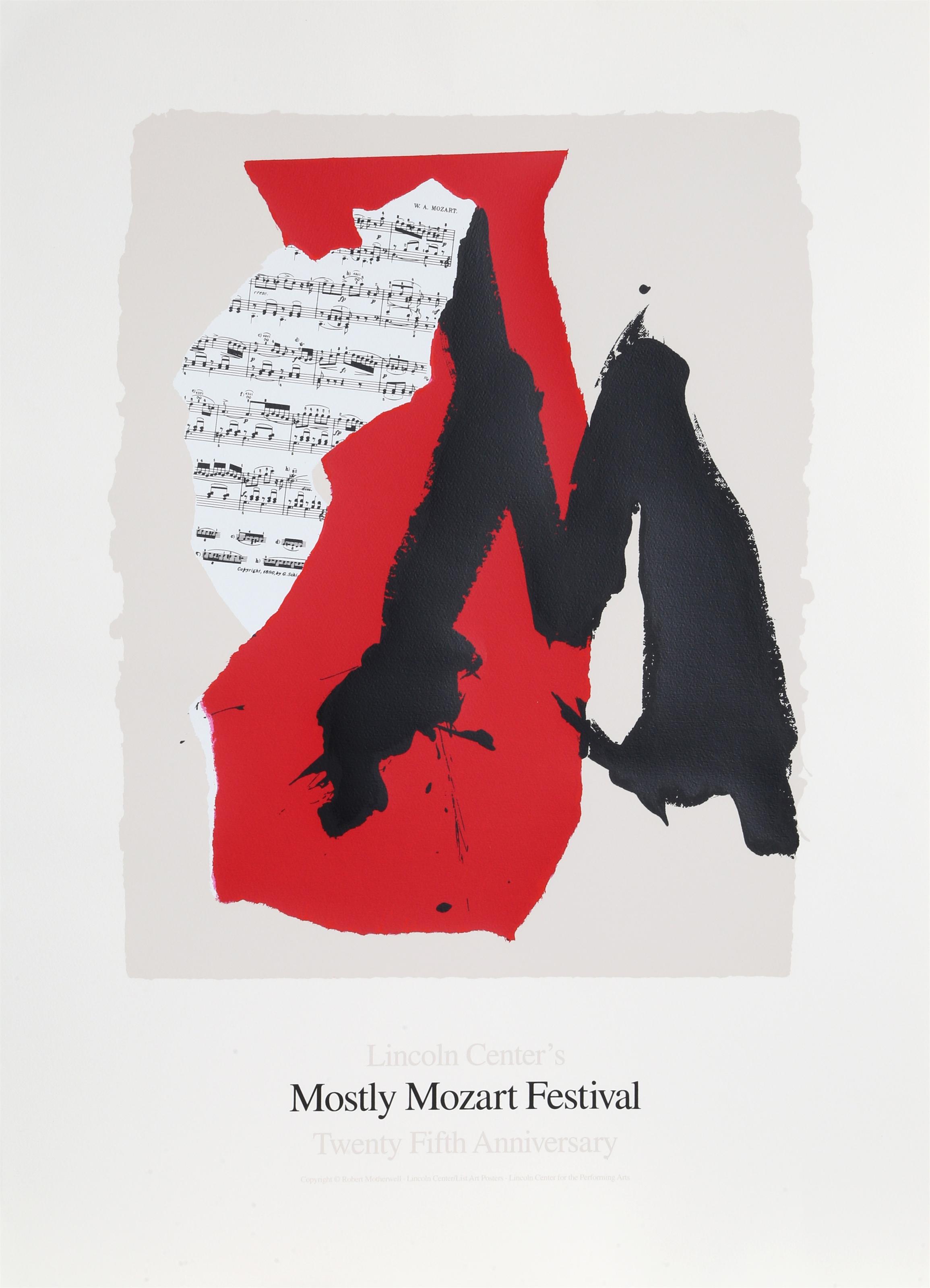
Robert Motherwell
Lincoln Center Mostly Mozart, 25th Anniversary
Beyond the elegies, Motherwell's practice was restlessly inventive. His Open series, begun in 1967, moved in an entirely different direction, toward spare, luminous fields of color interrupted only by the suggestion of a window drawn in charcoal. Works like "Open No. 25: In Blue with Variations" from 1968 have the stillness of a meditation, vast expanses of acrylic that seem to breathe.
His collages, some made as early as the 1940s and continuing throughout his career, demonstrate an equally free and joyful sensibility. Works like "Souvenir de Californie" from 1953, combining oil, casein, pasted papers, and charcoal, show how naturally he moved between high and low materials, between the gestural and the geometric. His printmaking practice was similarly ambitious, producing editions of considerable beauty and complexity, including the richly colored lithographs of the "America La France Variations" series from 1984. For collectors, Motherwell offers a rare combination of historical importance and genuine aesthetic pleasure.
His works appear regularly at the major auction houses, with prints and works on paper providing excellent entry points for those building a collection. The lithographs, screenprints, and etchings produced throughout his career are not mere multiples; they were projects to which he gave serious creative attention, working closely with master printers at workshops including Tyler Graphics and Gemini G.E.L.
Works such as "Lines for St. Gallen," "Red Open with White Line," and the Mozart and Newport Opera posters demonstrate the range available within his printed oeuvre, from intimate to monumental, from austere to exuberant. Collectors who look carefully at Motherwell's works on paper often find that they are acquiring something richer and more personal than the monumental canvases suggest on their own. Motherwell belongs to the generation that also gave us de Kooning, Pollock, Kline, and Rothko, and his work is properly understood in that constellation.
But he also has strong affinities with the European modernists he loved so deeply, with Matisse's command of color and scale, with Picasso's willingness to range across styles and materials, and with the Spanish painters and poets, Federico Garcia Lorca above all, whose spirit haunts the Elegy series. Collectors who appreciate Cy Twombly's literary sensibility, or Joan Miro's ability to balance spontaneity with formal rigor, will find much to love in Motherwell. Robert Motherwell died in Provincetown, Massachusetts, in 1991, but his influence has never diminished. Retrospectives at the Albright Knox Art Gallery, the Museum of Modern Art, and institutions across Europe have continued to cement his place in the canon.
More than that, his insistence that abstraction could carry moral and political content, that a painting could grieve and still be beautiful, feels urgently relevant in the present moment. To collect Motherwell is to invest not only in one of the defining voices of American modernism but in the enduring idea that art, made with intelligence and passion, can speak to what matters most.
Explore books about Robert Motherwell
Robert Motherwell and the New York School: Modernism's Painter
Stephanie Terenzio
The Collected Writings of Robert Motherwell
Stephanie Terenzio

Robert Motherwell
Frank O'Hara
Robert Motherwell: Surrealism to Abstraction
Bonnie Clearwater
Robert Motherwell: Elegy to the Spanish Republic
Multiple Contributors