Piet Mondrian
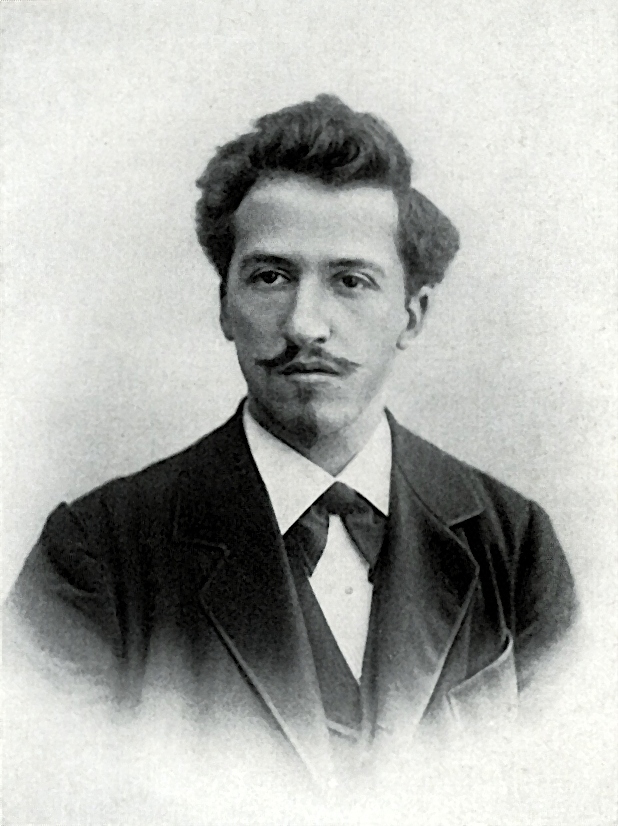
Mondrian: The Grid That Freed Us All
Artist Spotlight · The Collection Editorial
“The position of the artist is humble. He is essentially a channel.”
Piet Mondrian
In 2022, the Kunstmuseum Den Haag mounted what became one of the most talked about retrospectives of the decade, gathering Mondrian's work across six decades and reminding a new generation why this quiet, deeply spiritual Dutch painter fundamentally rewired how human beings see the world. The exhibition drew record attendance and sparked a wave of renewed critical writing, with scholars and collectors alike returning to the radical simplicity of his grids and asking, again, how one man arrived at something so elemental and so permanent. Mondrian is one of those rare artists whose influence has never dimmed, whose imagery is immediately recognizable to people who have never set foot in a museum, and whose ideas continue to shape architecture, fashion, graphic design, and contemporary painting in equal measure. To encounter his work fresh is to feel the quiet shock of inevitability, as if the painting had always existed and he merely uncovered it.
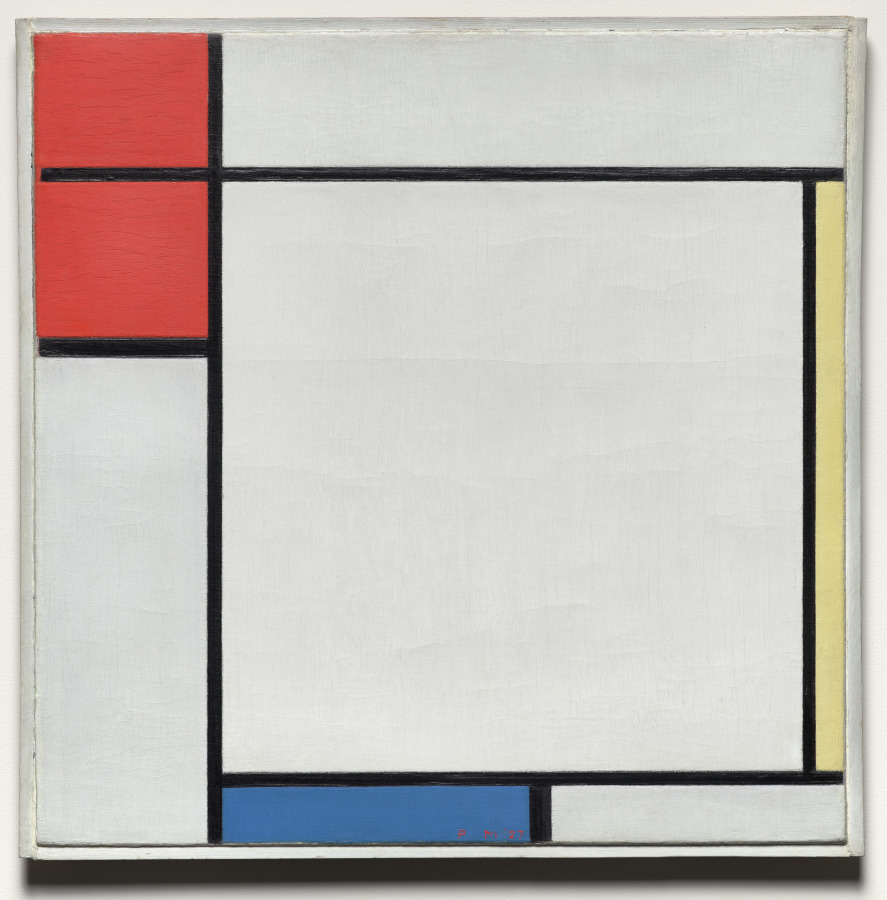
Piet Mondrian
Composition with Red, Yellow, and Blue, 1927
Pieter Cornelis Mondriaan was born on March 7, 1872, in Amersfoort, in the central Netherlands, into a devoutly Calvinist family. His father, a headmaster and amateur draughtsman, introduced him to drawing early, and his uncle, the Hague School painter Frits Mondriaan, offered a more direct path toward a professional artistic life. He trained at the Rijksakademie van beeldende kunsten in Amsterdam, completing his studies in 1897, and spent his early years working as a schoolteacher and painter of the Dutch landscape tradition. These early years are sometimes overlooked in the rush to celebrate his mature abstractions, but they are essential to understanding the full arc of his genius.
The early work is a revelation in its own right. Paintings such as Field with Young Trees in the Foreground from 1902 and Field with Oak Trees at Dusk from 1907 show a painter of genuine sensitivity to light and atmosphere, working fluently within the naturalist tradition of his Dutch predecessors. His Still Life with Mirrors, Containers, Honesty and Fruit from 1905 and the luminous Landscape at Loosduinen from the same year demonstrate his command of tone, texture, and quiet observation. Even his botanical studies, including the tender Chrysanthemum of 1906, reveal an eye tuned to underlying structure, to the geometry latent in organic form.
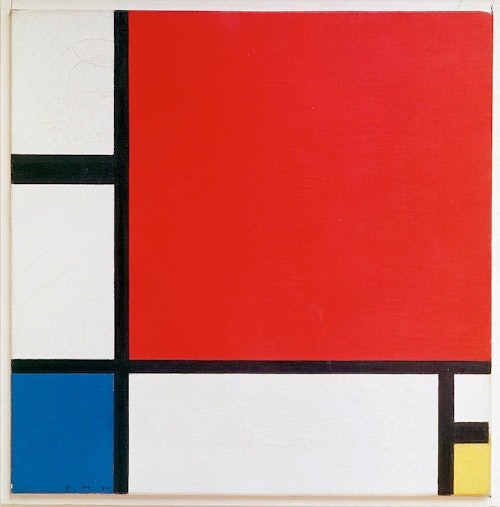
Piet Mondrian
Composition with Red, Blue, and Yellow, 1930
These are not the works of an artist marking time before his real career begins. They are beautiful paintings that show us a mind already searching beneath the surface of appearances. The great transformation came in stages. Mondrian discovered Theosophy around 1908 and became a devoted student of its philosophy, which held that the material world was a veil over deeper spiritual truths.
“Art is not made for anybody and is, at the same time, for everybody.”
Piet Mondrian
This profoundly shaped his ambition: he wanted to paint not things but the reality behind things. His encounter with Cubism during his years in Paris, beginning in 1911, gave him the formal tools to pursue that ambition. Working through Cubist fragmentation and Futurist energy, he developed his own systematic approach he would eventually call Neoplasticism, stripping away representation entirely in favor of horizontal and vertical lines, the primary colors of red, yellow, and blue, and the neutrals of black, white, and gray. By the early 1920s, he had arrived at one of the most distinctive and consequential visual vocabularies in the history of art.
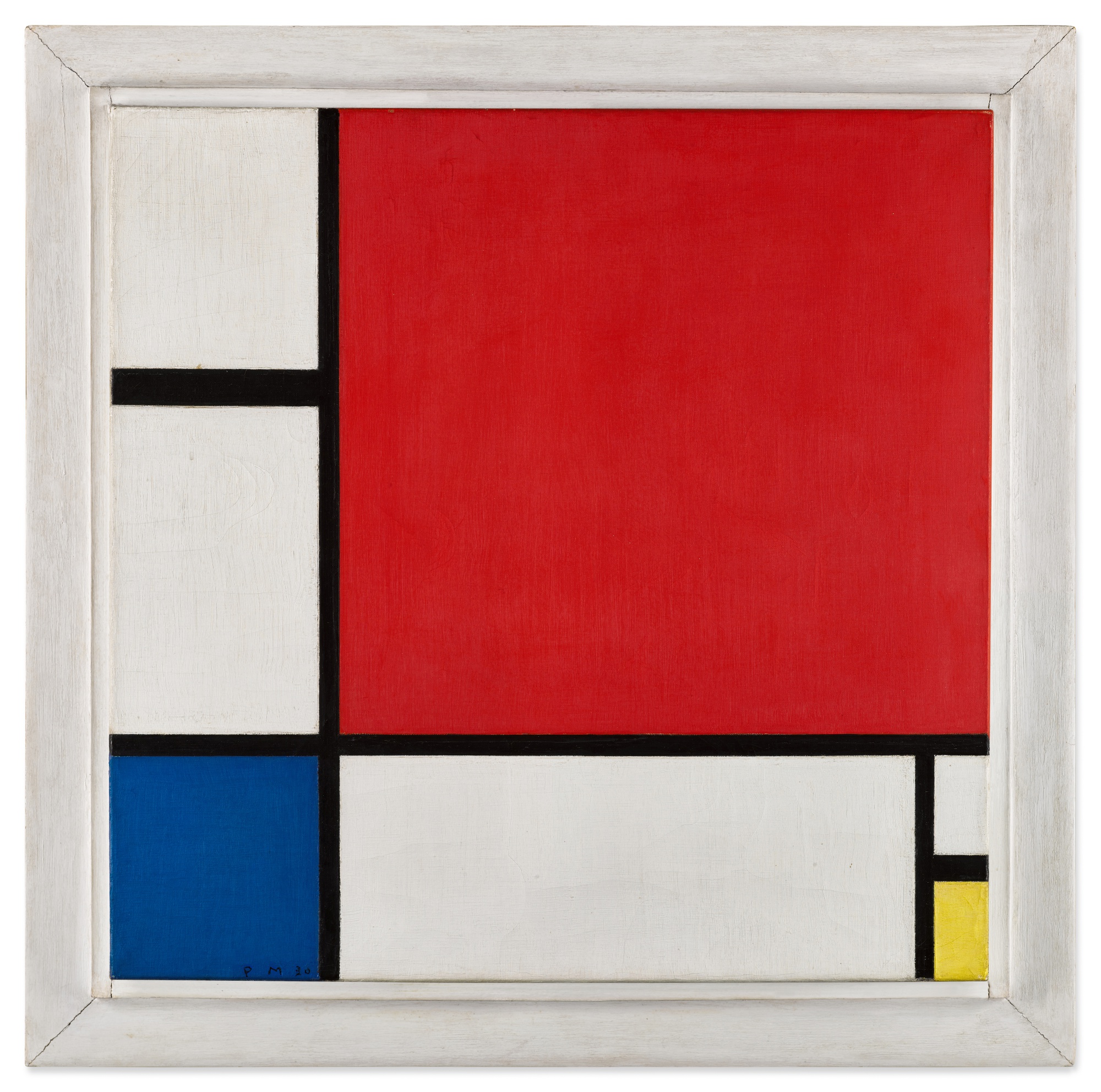
Piet Mondrian
Composition No. II, 1930
The Composition paintings of the 1920s and 1930s represent the summit of that achievement. Composition with Red, Yellow, and Blue from 1927 and Composition with Red, Blue, and Yellow from 1930 are among the most studied and admired paintings of the twentieth century, works in which the relationship between form and space, between color and structure, creates a tension that feels both mathematical and deeply felt. Composition No. II from 1930, presented in its artist's frame, and Composition in White, Red, and Yellow from 1936 extend that investigation across different proportions and color weights, demonstrating how inexhaustibly generative his visual system proved to be.
Each painting is unique within a framework of apparent sameness, and that paradox is part of their enduring fascination. He was not producing variations on a theme so much as pursuing an infinite set of possible harmonies within a self imposed discipline. For collectors, Mondrian presents one of the most compelling propositions in the entire canon of modern art. His works appear at auction with relative infrequency, and when they do, they command extraordinary attention.
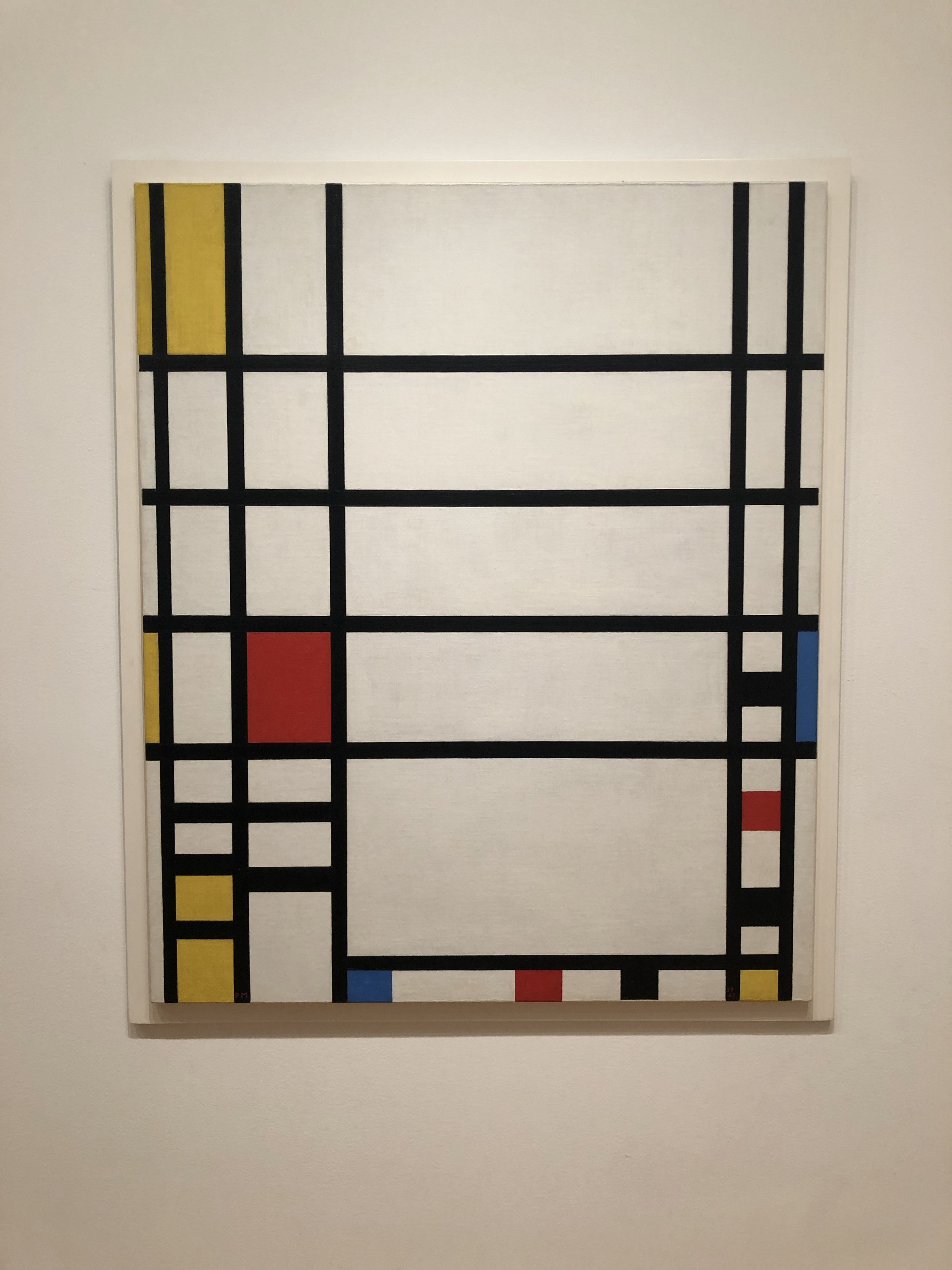
Piet Mondrian
Composition in White, Red, and Yellow, 1936
In 2022, a prime Composition sold at Christie's for well over $50 million, confirming his position among the most sought after modernists in the market. Beyond the major Compositions, collectors have found rich territory in his earlier naturalist paintings, which offer a more accessible entry point while carrying the full weight of art historical significance. Works on paper, including drawings and watercolors from his Dutch period, demonstrate the breadth of his technical gifts and often carry intimate qualities that the more monumental canvases do not. For anyone building a serious collection of modern art, understanding Mondrian is not optional: he is one of the load bearing walls of the entire structure.
Mondrian belongs to a constellation of artists who collectively invented abstraction, and understanding him in that company deepens appreciation of what he achieved individually. His colleague and sometime rival Theo van Doesburg, with whom he cofounded the De Stijl movement in 1917, shared his commitment to geometric purism but differed fatally on the question of the diagonal, which Mondrian refused to admit into his work. Kandinsky was pursuing spiritual abstraction from a different direction at roughly the same time, as were Kazimir Malevich and the Russian Suprematists. But Mondrian's system was arguably the most rigorous, the most fully theorized, and ultimately the most influential on the design and visual culture of the century that followed.
He died in New York on February 1, 1944, having spent his final years in the city he loved, dancing to boogie woogie music at downtown clubs and completing Broadway Boogie Woogie, a late masterwork that showed his visual language could still evolve and surprise. He had fled Europe ahead of the German advance, living first in London and then emigrating to New York in 1940, where he found a creative community and a city that matched his restless energy. His legacy is everywhere: in the Bauhaus, in Swiss graphic design, in the color block dresses Yves Saint Laurent showed in 1965, in the glass facades of modernist architecture, in the grid of every digital interface. But it is most powerfully alive in the paintings themselves, which continue to reward looking with something that feels less like aesthetic pleasure than genuine illumination.
Explore books about Piet Mondrian
Piet Mondrian: Life and Work
Harry Holtzman and Martin S. James
Mondrian: The Art of Destruction
Carel Blotkamp
Piet Mondrian 1872-1944
Michel Seuphor
The New Art-The New Life: The Collected Writings of Piet Mondrian
Piet Mondrian
Mondrian: Abstraction and Beyond
Karen Wilkin
Piet Mondrian: The Complete Works
Angelica Zander Rudenstine
Mondrian: Evolution
Paul Overy
Piet Mondrian
Michel Seuphor