Pierre Puvis de Chavannes

Pierre Puvis de Chavannes, Dreamer of Serene Worlds
Artist Spotlight · The Collection Editorial
“A mural painting should be a kind of vision, a poem in color, a silent music for the eyes.”
Pierre Puvis de Chavannes
Stand before the grand staircase of the Musée de Picardie in Amiens, or pause in the reading room of the Boston Public Library, and you will feel it immediately: a hush, a slowing of the pulse, a sense that time has agreed to suspend itself. These are the walls that Pierre Puvis de Chavannes painted, and they remain among the most quietly commanding presences in Western art. In recent years, renewed scholarly attention has drawn a new generation of curators and collectors toward his work, recognizing in his luminous, pale palettes and monumental stillness something that speaks with startling directness to contemporary sensibilities shaped by minimalism, conceptual restraint, and a longing for beauty that does not perform. Puvis de Chavannes was born in Lyon in 1824 into a family of comfortable bourgeois means, his father a mining engineer whose professional world could hardly have predicted the rarefied artistic universe his son would inhabit.
Pierre Puvis de Chavannes
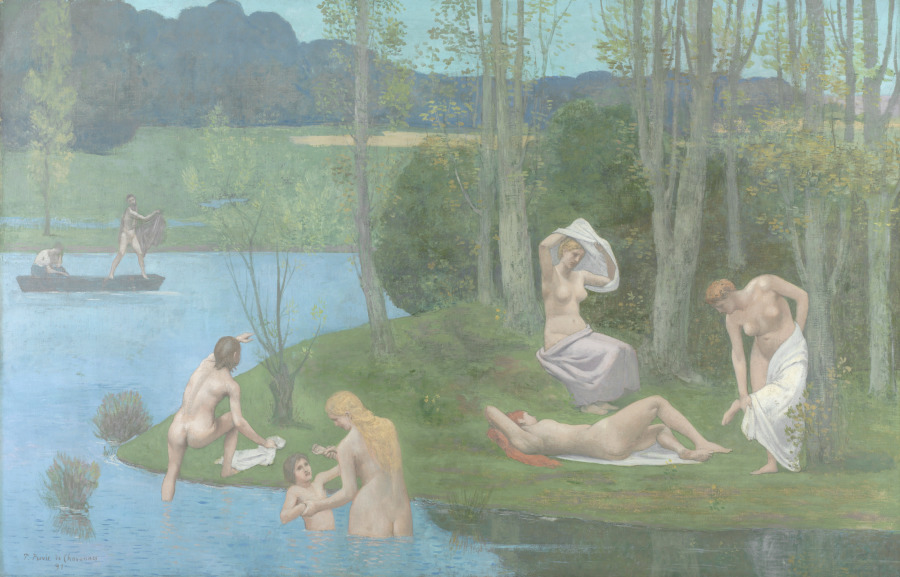
Summer, 1891
He studied briefly under Eugène Delacroix and later under Thomas Couture, two artists whose influence he absorbed and then quietly set aside in favor of something more entirely his own. A formative journey to Italy in the late 1840s proved decisive: the frescoes of the Italian Renaissance, their flat planes of color and grave, unhurried figures, lodged themselves in his imagination and never left. He returned to Paris not as an imitator of the Italians but as an artist who had understood their deepest lesson, that monumental painting must breathe. His early career was marked by determined persistence in the face of a skeptical Salon.
His large allegorical compositions, submitted repeatedly through the 1850s and into the 1860s, were met with puzzlement and occasional rejection. Critics found his figures too archaic, his colors too bleached, his narratives too elusive. Yet Puvis pressed forward, developing with each successive canvas a pictorial language of increasing refinement and originality. Works like The War and Peace, exhibited in the early 1860s and eventually acquired for the Musée de Picardie in Amiens, marked a turning point.
Pierre Puvis de Chavannes
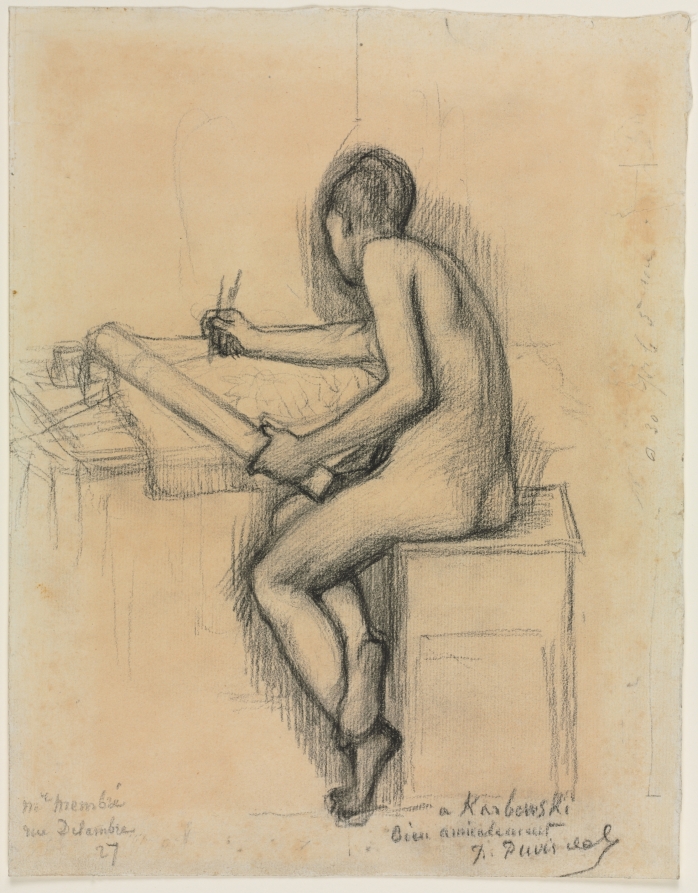
Study of a Seated Nude Female Model Drawing, 1883
Here was an artist working at a scale and with an ambition that demanded serious reckoning, and the French state, whatever its initial hesitation, began to take notice. The mural commissions that followed would define his reputation for generations. The Panthéon in Paris, the Sorbonne, the Hôtel de Ville, the staircase of the Musée des Beaux Arts in Lyon, and most famously the Boston Public Library, where he completed his great cycle on the history of the written word in the 1890s: these are spaces transformed by his hand into environments of contemplative grandeur. His method was remarkable in its own right.
Working on canvas in his studio and then affixing the completed panels to their architectural settings, he achieved the matte, powdery surface of true fresco without the unforgiving demands of the medium itself. The result is a quality of light that seems to emanate from within the painting rather than from any external source, as if his figures inhabit a world lit by its own calm conviction. The works available through The Collection offer a privileged window into the less publicly visible dimension of his practice: the studio drawings and preparatory studies that underpin his monumental achievements. Summer, the 1891 oil on fabric, distills his vision of a golden, unhurried world into a single radiant image.
Pierre Puvis de Chavannes
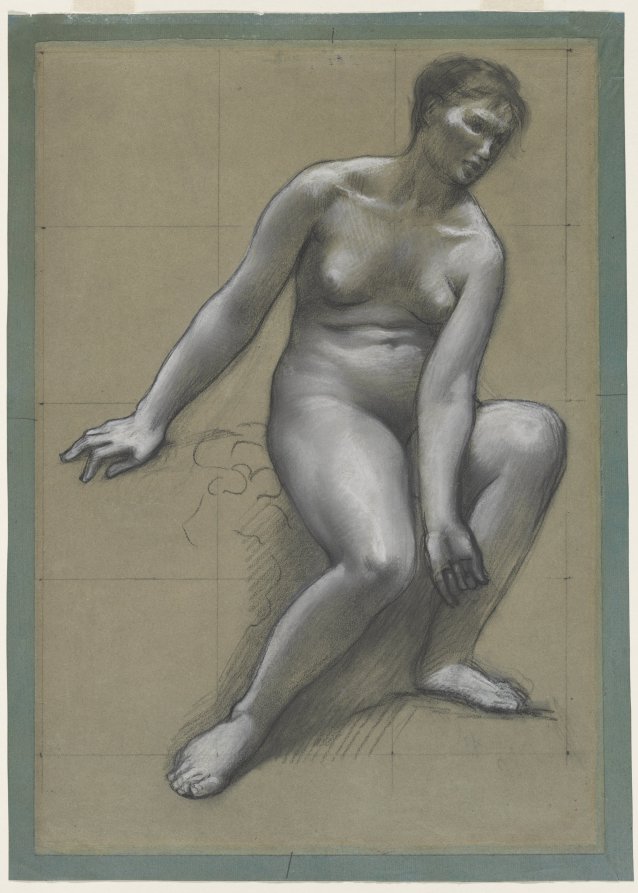
Study for the Mother in The Fisherman's Family, 1870
The black chalk studies, including the Study of a Seated Nude Female Model Drawing from 1883 and the Study for the Mother in The Fisherman's Family from 1870, reveal a draughtsman of tremendous sensitivity, one who observed the human body with patience and tenderness and squared his compositions with a methodical care that speaks to his deep seriousness of purpose. The Study for the Frieze of Sainte Geneviève demonstrates how his preparatory work was not merely mechanical but already fully inhabited by the mood and light of the intended final work. His red chalk Male Nude of 1891 and the charcoal Study for The War from 1861 span three decades and show an artist whose fundamental commitments remained consistent even as his handling grew more assured. For collectors, works on paper by Puvis de Chavannes occupy a particularly compelling position.
His finished murals are, by their nature, immovable and institutionally held. The drawings are therefore the primary means by which a private collection can engage with his working intelligence, the place where one can see the hand, the revision, the searching line that precedes the finished grandeur. These sheets have appeared at auction at Sotheby's, Christie's, and Drouot with some regularity, and discerning collectors have long understood their value both as autonomous works of beauty and as documents of one of the most significant decorative and mural programs of the nineteenth century. The market for such works remains quietly strong, sustained by museums, scholars, and a growing community of collectors who prize intimacy and intellectual depth over spectacle.
Pierre Puvis de Chavannes
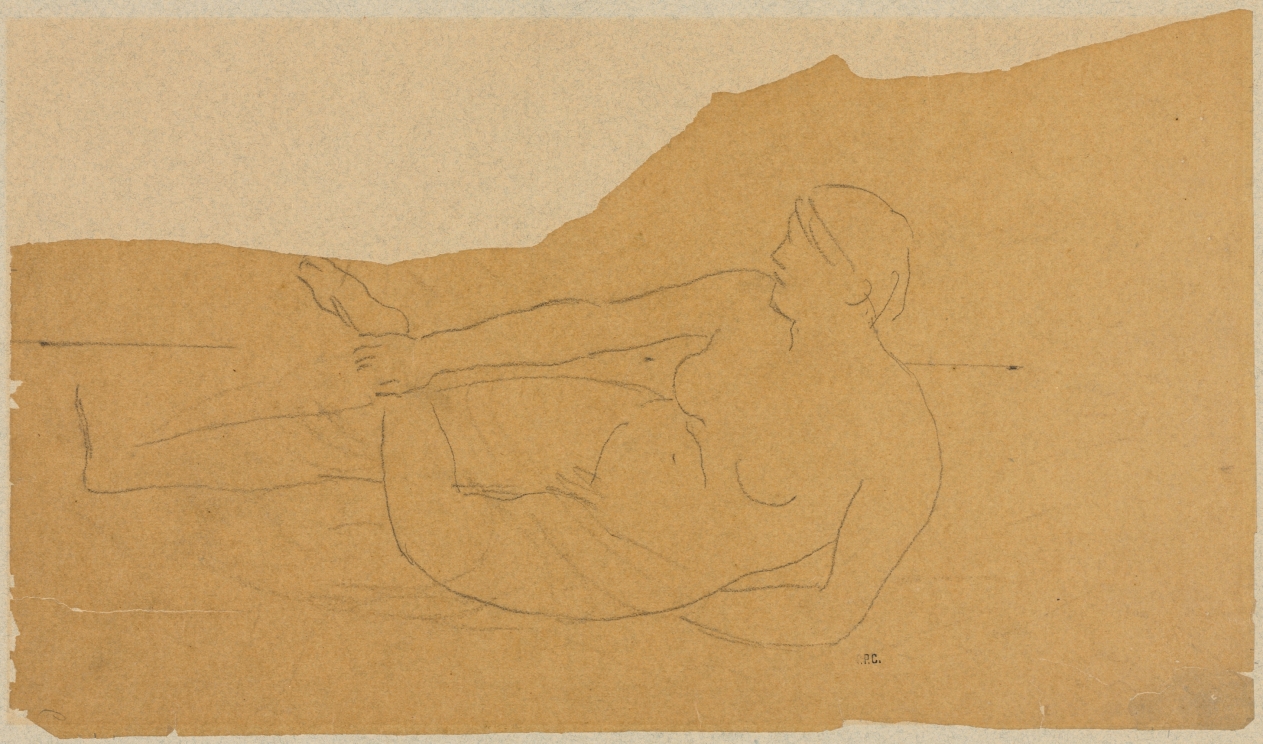
Female Nude, 1891
To understand Puvis fully it helps to place him in the company of artists who shared his instinct for a certain elevated, dreamlike classicism. The Symbolist movement claimed him as a forefather, and it is easy to see why: his allegories are never literal, his figures never merely illustrative. Gustave Moreau inhabited a similar territory of myth and reverie, though with a more jeweled, operatic intensity. The younger generation of Post Impressionists revered him openly.
Paul Gauguin studied his flattened planes and simplified color with close attention before departing for Polynesia. Georges Seurat looked to him as a model of monumental composition. Paul Cézanne, not given to easy admiration, expressed genuine respect. The Nabis, Maurice Denis chief among them, traced much of their decorative ambition back to his example.
To collect Puvis is to hold a key to a remarkable network of influence that runs through the final decades of the nineteenth century and well into the twentieth. His legacy today is one of steady, deepening appreciation. A world grown tired of irony and noise finds in his work something genuinely restorative: figures who exist in relation to landscape and to one another with a grace that feels not nostalgic but necessary. He died in Paris in 1898, just at the moment his influence was cresting among the generation that would remake Western art.
The great walls he painted still hold their silence, still slow the visitor's step, still insist that beauty and gravity are not opposites but companions. To discover him now, through the intimacy of a chalk study or the quiet poetry of a preparatory canvas, is to encounter an artist whose time, in the most meaningful sense, has never passed.
Explore books about Pierre Puvis de Chavannes
Puvis de Chavannes
Aman-Jean, Edmond
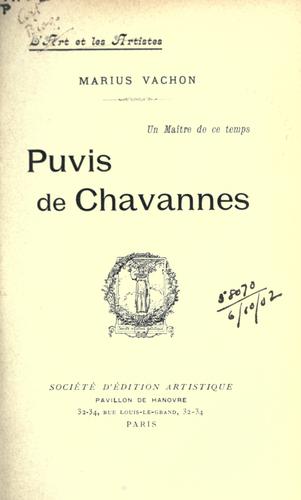
Puvis de Chavannes
Vachon, Marius
Pierre Puvis de Chavannes: A Retrospective Exhibition
Lacambre, Genevieve

Puvis de Chavannes
Herding, Klaus

The Art of Puvis de Chavannes
Dunstan, Bernard
Pierre Puvis de Chavannes: His Life and Works
Cogniat, Raymond
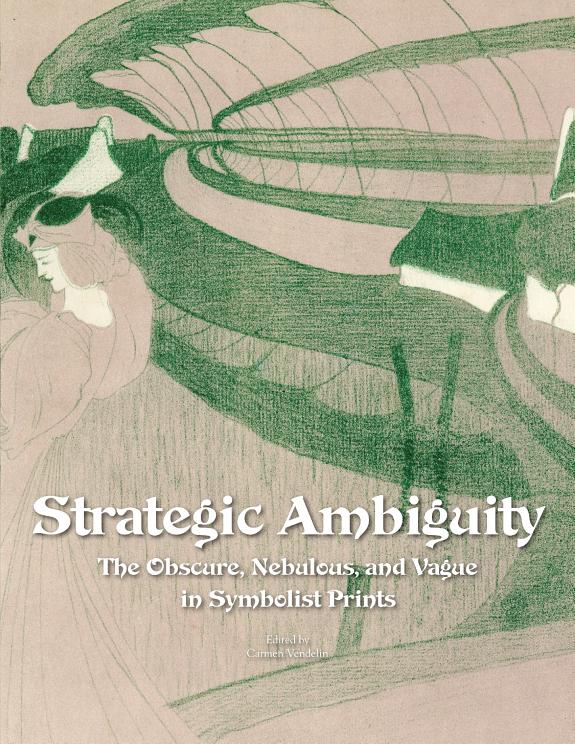
Puvis de Chavannes and the Modern Tradition
Eisenman, Stephen F.