Pierre Jeanneret
Pierre Jeanneret: Architecture Lived From the Inside
Artist Spotlight · The Collection Editorial
When a set of teak office chairs attributed to Pierre Jeanneret crossed the auction block at Wright in Chicago in recent years, bidders from Paris, New York, and Tokyo competed with an urgency that would have surprised almost anyone unfamiliar with the quiet revolution Jeanneret set in motion half a century ago. The lots far exceeded their estimates, as they so often do now, because collectors had come to understand something that the broader design world was still catching up to: these objects are not merely furniture. They are philosophy made tangible, democratic idealism pressed into grain and cane, the residue of one of the twentieth century's most extraordinary urban experiments. Jeanneret's market has matured from a specialist curiosity into a global phenomenon, and his pieces now command serious attention in the rooms where the best design is discussed and acquired.
Pierre Jeanneret
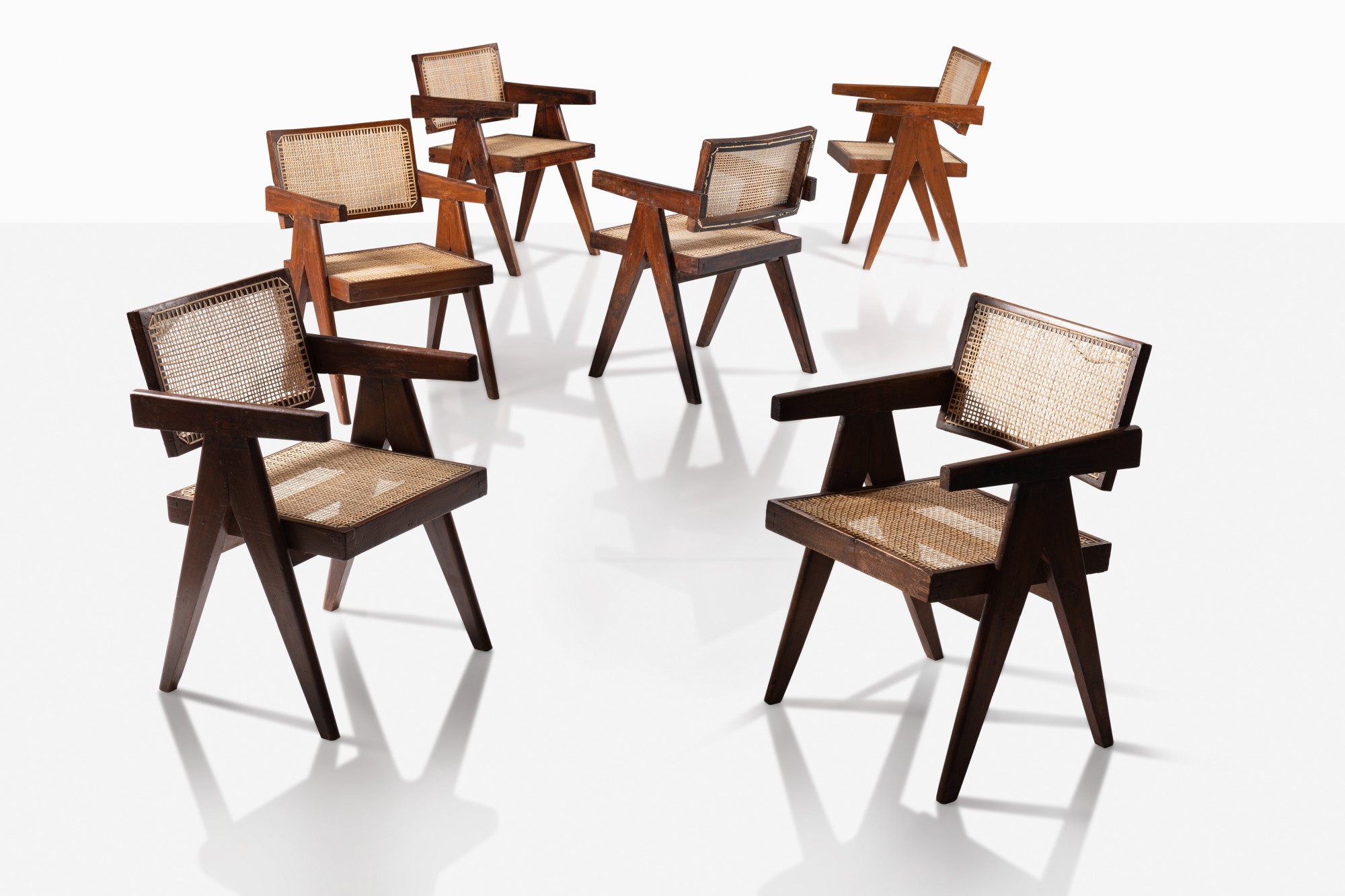
Six chaises PJ-SI-28-B , dites office chairs
Pierre Jeanneret was born in Geneva in 1896 into a cultured Swiss bourgeois family with an exceptional genetic inheritance. His cousin, born Charles Édouard Jeanneret and later known to the world as Le Corbusier, was already beginning to sketch the outlines of a career that would reshape modern architecture. The two men were close in age and temperament, sharing a belief that design and architecture were inseparable from social purpose. Pierre studied at the École des Beaux Arts in Geneva before moving to Paris, where he entered Le Corbusier's studio on the Rue de Sèvres in 1922.
That partnership would last, with some interruptions, for decades, and it would define both men in ways that history has been slow to fully untangle. The collaboration between the two cousins produced some of the defining objects of early modernism. The Maison La Roche, completed in 1925, and the Villa Savoye, completed in 1931, both bear Pierre's hand as much as Le Corbusier's public persona claimed them. Together with Charlotte Perriand, they developed the LC series of furniture in the late 1920s, including the chaise longue and the grand confort armchair, works that entered the permanent collections of museums including the Centre Pompidou in Paris and the Museum of Modern Art in New York.
Pierre Jeanneret
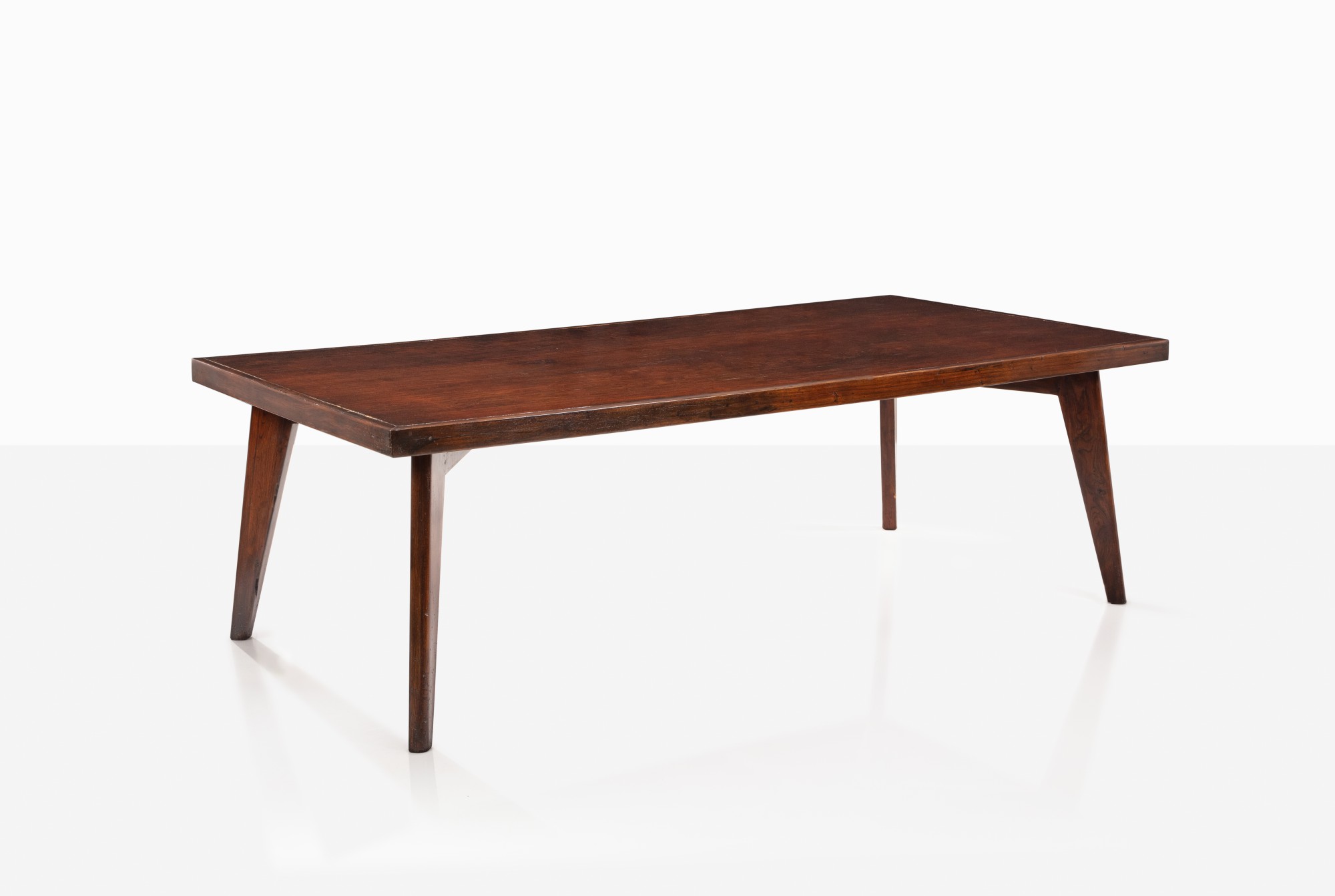
Table de salle à manger, modèle PJ-TA-01-B
Pierre was the technical mind behind many of these breakthroughs, the architect who understood how a vision became a building, how a drawing became a chair a person could actually inhabit. Their partnership broke during the Second World War when their political differences created an unbridgeable distance, but it resumed in the early 1950s for what would become the most consequential chapter of Pierre's life. In 1951, the government of India invited Le Corbusier to design Chandigarh, a new capital for the state of Punjab, built from the ground up on the plains south of the Himalayas. Le Corbusier accepted, and Pierre Jeanneret went with him, eventually staying on as Chief Architect from 1951 to 1965 while his cousin traveled between Europe and India.
It was Pierre who lived in Chandigarh, who understood its dust and heat and the rhythms of its new civil servants, who walked through the buildings he was designing and asked what the people inside them needed. The furniture he created for Chandigarh's High Court, Secretariat, Punjab University, and Assembly building answered that question with remarkable clarity. Working within tight budgets and with local materials, primarily teak and rattan cane, he developed a vocabulary of forms that were structurally honest, ergonomically thoughtful, and somehow deeply beautiful. The pieces he created for Chandigarh have since been catalogued with a scholarly precision that reflects how seriously the market takes them.
Pierre Jeanneret
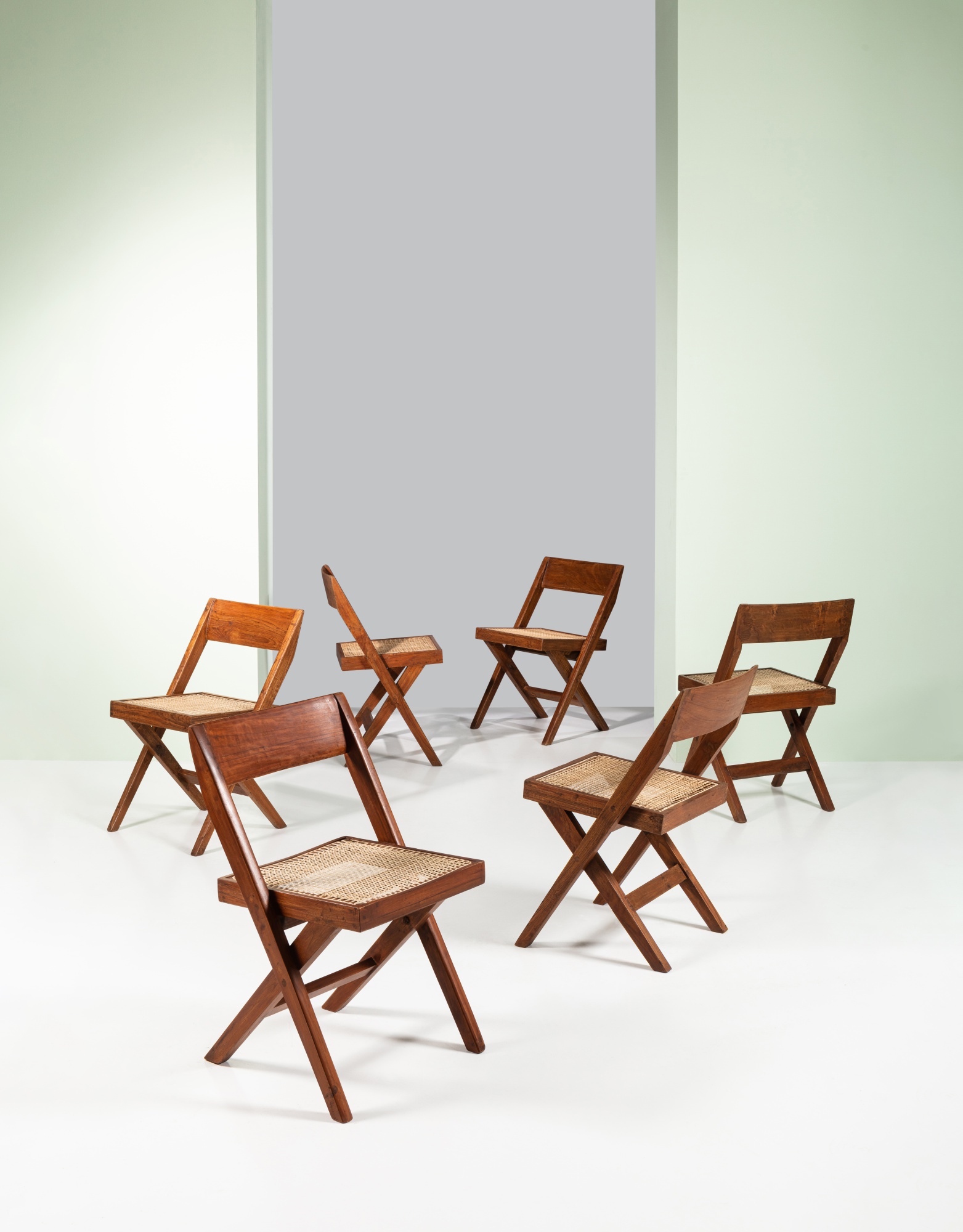
Suite de six chaises dites Library Chairs
The office chair, designated PJ SI 28 B, with its V shaped teak frame and woven cane seat and back, has become perhaps the most recognizable object in the entire canon. The easy chair, the library chair, the reading table with its frosted glass surface and lacquered steel frame, all of these carry the same quality of inevitability, as though no other form could have solved the problem. The scissor chair, with its crossed legs that recall both craft traditions and modernist geometry, is among the most photographed pieces of twentieth century design. What distinguishes all of them is the absence of pretension.
Jeanneret designed for use, and the objects survive decades of institutional life in a city that actually needed them. For collectors, the appeal of Jeanneret's Chandigarh pieces operates on several levels at once. There is the provenance, which for authenticated pieces traces directly to the buildings of a UNESCO recognized urban masterpiece. There is the materiality, the warmth of aged teak and the texture of original cane that no reproduction has ever convincingly replicated.
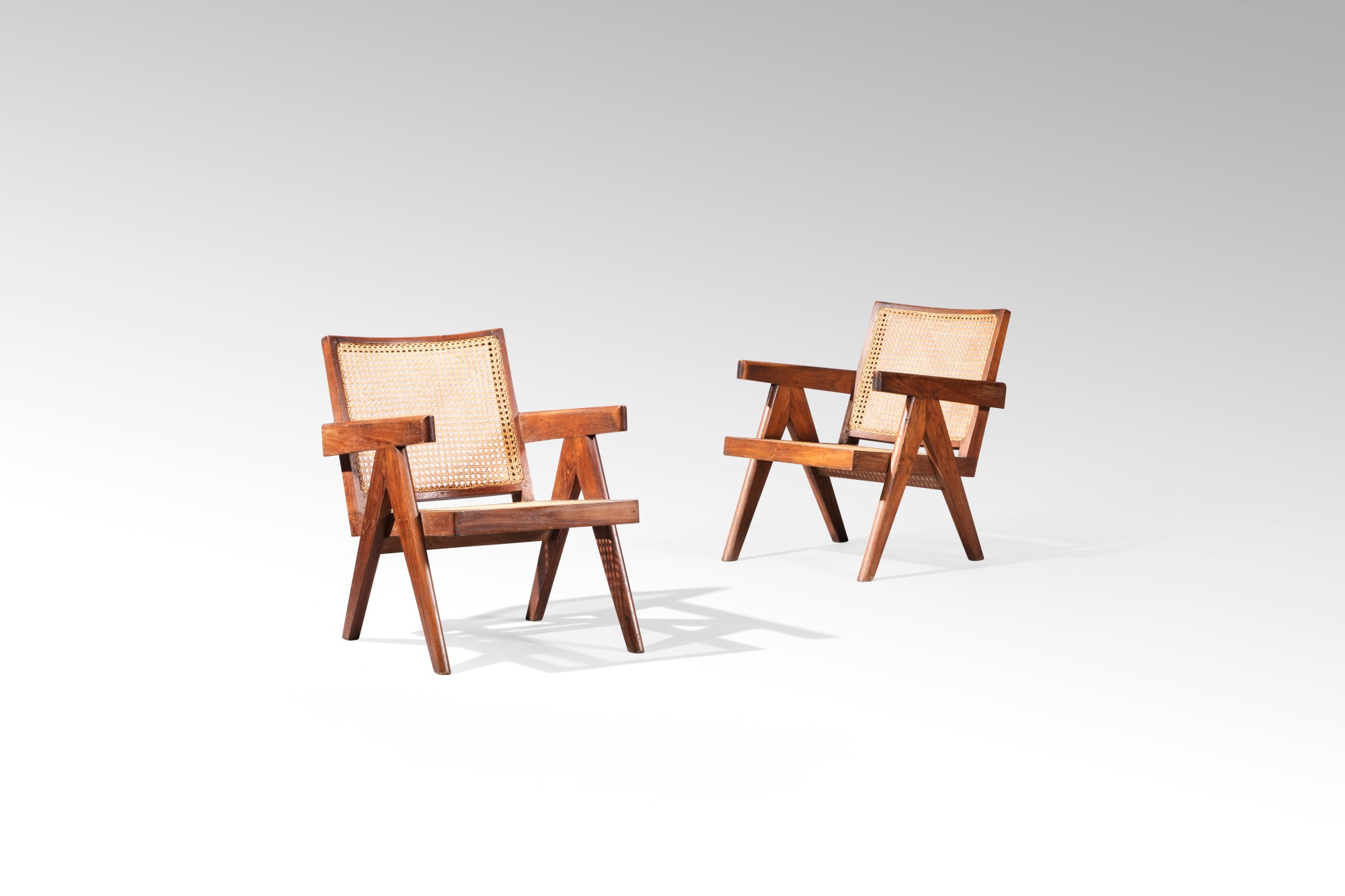
Pierre Jeanneret
Pair of Easy PJ-SI-29-A armchairs, circa 1952-1956
And there is the story, which connects a modest Swiss architect to one of the great post independence visions of modern India, a story about what design can do when it is asked to serve a whole society rather than a single patron. Major design galleries including Galerie Patrick Seguin in Paris and Kamelot Auctions in the United States have handled significant bodies of work, and important sets have appeared at Christie's, Sotheby's, and Bonhams. Collectors who have built deep holdings in Jeanneret often speak of an addictive quality to the work, each piece suggesting the next, each set incomplete without its companions. To understand Jeanneret fully, it helps to place him alongside the small group of architects who brought European modernism into dialogue with non European contexts and needs.
Maxwell Fry and Jane Drew, who worked alongside Le Corbusier and Jeanneret on the earliest phases of Chandigarh, shared his commitment to a socially engaged modernism adapted to climate and culture. Charlotte Perriand, his collaborator from the Paris years, pursued a parallel path through Japanese craft traditions. The Finnish architect Alvar Aalto, working with bent birch rather than teak, explored the same territory of warmth within structural logic. What separates Jeanneret from all of them is the sheer scale and coherence of the Chandigarh project, a single city that became his studio for fourteen years.
Pierre Jeanneret died in Geneva in 1967, two years after returning from India, recognized but not yet celebrated in the way the market and cultural conversation now demand. The reassessment of his legacy has accelerated dramatically in the twenty first century, driven partly by the auction market and partly by a genuine scholarly and curatorial reckoning with the figures who enabled modernism's great monuments without always receiving credit for them. Exhibitions at institutions including the Chandigarh Architecture Museum and retrospective presentations at major design fairs have reframed him not as Le Corbusier's lieutenant but as an author in his own right, a designer whose choices about teak thickness and cane weave and chair height were as consequential as any plan drawn on paper in Paris. To own a piece of Jeanneret's Chandigarh is to hold something that was made to be used, survived being used, and arrived in the present still asking to be sat in, still warm to the touch, still entirely itself.
Explore books about Pierre Jeanneret