Peter Blake

Peter Blake: Britain's Beloved Pop Art Visionary
Artist Spotlight · The Collection Editorial
“I want my art to be inclusive. I want it to be about everything.”
Peter Blake, interview
There is a moment, standing before Peter Blake's contribution to the cover of the Beatles' 1967 album Sergeant Pepper's Lonely Hearts Club Band, when the full ambition of British Pop Art becomes undeniable. That image, a collage of cultural heroes assembled like a congregation of the twentieth century's most vivid personalities, remains one of the most recognisable works of art ever produced. It did not simply illustrate an album. It proposed a new way of thinking about art itself, one in which celebrity, nostalgia, popular culture, and fine art craft could coexist as equals.
Peter Blake
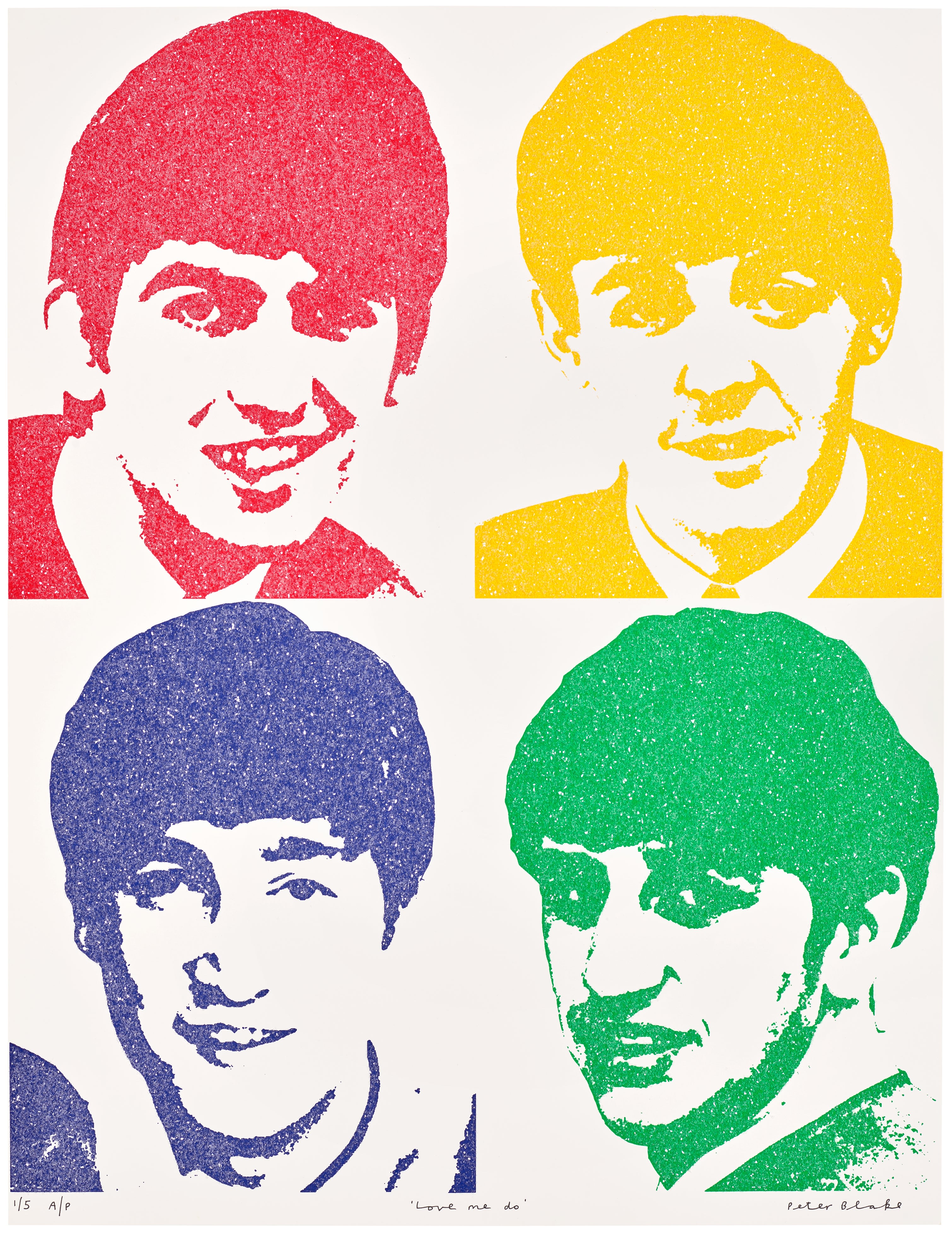
Love Me Do
More than five decades on, Blake's vision feels not merely relevant but genuinely prescient, and collectors around the world continue to discover in his prints and paintings a warmth and intelligence that rewards sustained looking. Peter Blake was born in Dartford, Kent, in 1932, into a working class family that gave him little in the way of formal cultural instruction but everything in the way of authentic popular experience. He studied at the Gravesend Technical College and School of Art before earning a place at the Royal College of Art in London, where he completed his studies in 1956. That formative period at the Royal College placed him alongside a generation of artists who would reshape British visual culture, and his National Diploma in Design with first class honours signalled a technical seriousness that would underpin even his most playful later works.
A subsequent scholarship allowed him to travel through Europe studying folk art traditions, a journey that deepened his lifelong fascination with vernacular imagery and the visual language of everyday life. Blake's early paintings of the 1950s announced a sensibility unlike anything else emerging from British studios at the time. Works such as On the Balcony, completed in 1955 and 1957 and now held in the Tate collection, arranged imagery from magazines, badges, and mass media with a rigour that was simultaneously analytical and affectionate. Where American Pop Art, which would come to dominate international conversations in the early 1960s, often adopted a cool and ironic distance from its sources, Blake brought genuine tenderness to the materials of popular life.
Peter Blake
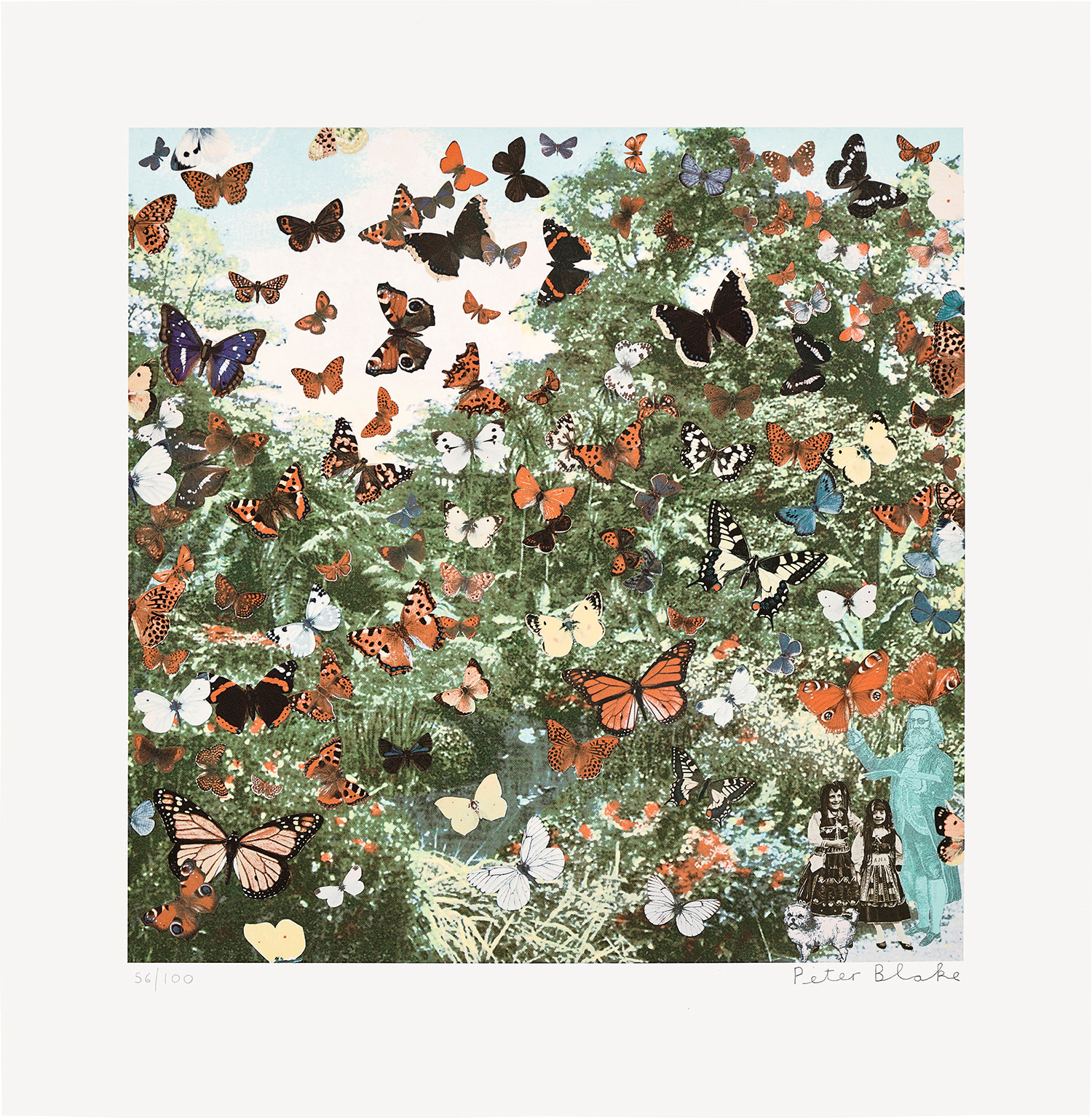
Hyde Park - Positively the Last Appearance of the Butterfly Man, from The London Suite
His wrestlers, his pin ups, his fairground wrestlers and music hall performers were never subjects of detached appropriation. They were figures he loved, and that love transmitted itself directly through the work. The 1960s brought Blake to international prominence, and his association with the British Pop movement placed him in conversation with artists including David Hockney, Richard Hamilton, and R.B.
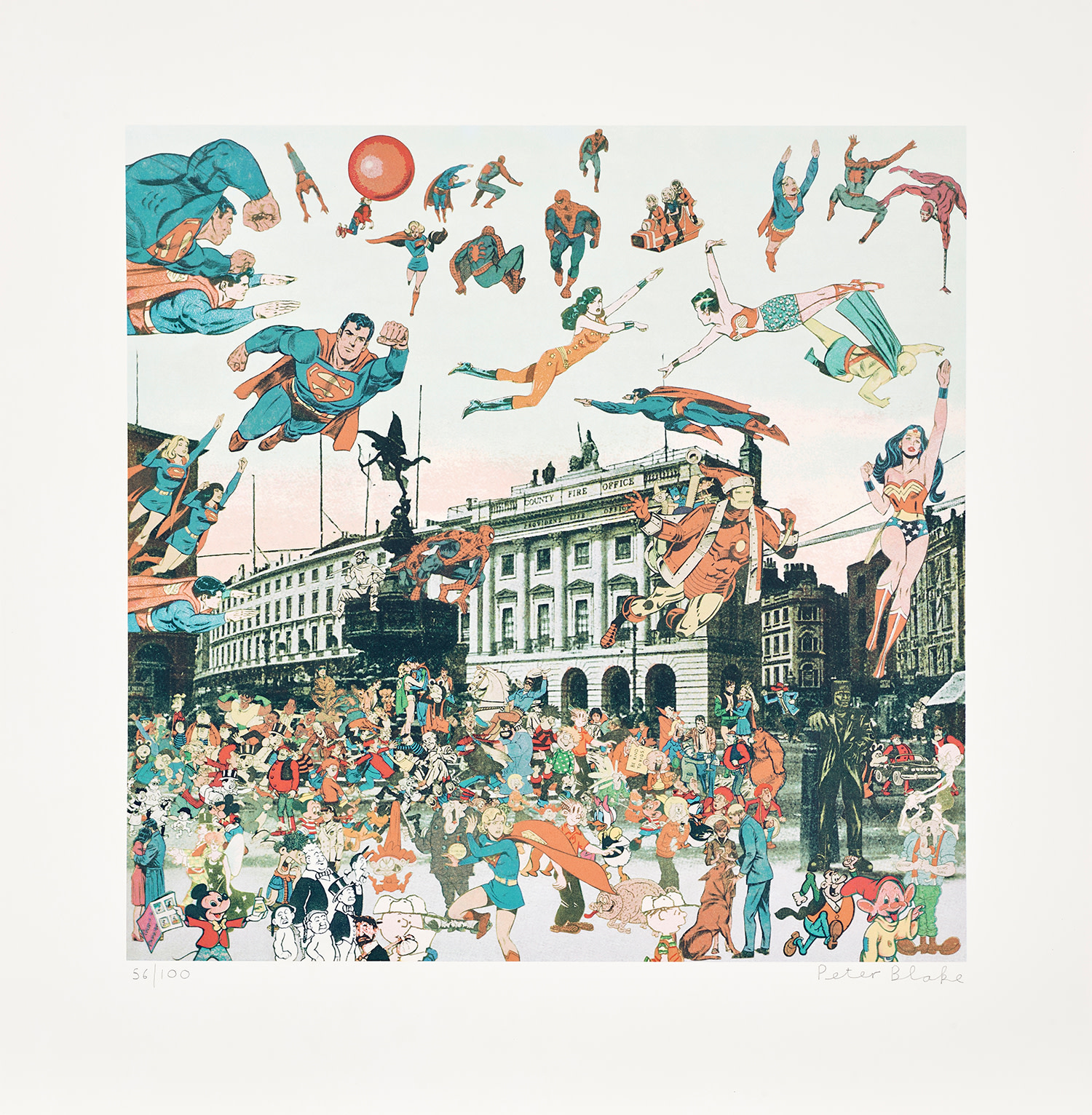
Kitaj, all of whom shared an interest in expanding the vocabulary of serious art to encompass the imagery of contemporary life. Blake's screenprints from this and subsequent decades demonstrate a mastery of the medium that elevated it well beyond reproductive craft. Works such as his celebrated Love Me Do screenprint, with its shimmering diamond dust finish on Colorplan paper, encapsulate the Blake method perfectly, taking a fragment of popular musical culture and transforming it through considered printmaking into something genuinely moving. His London Suite is another touchstone of his printed output, with individual works including Petticoat Lane, Hyde Park, Horse Guards Parade, Piccadilly Circus, and River Thames Regatta together forming a love letter to the city he has inhabited and celebrated across a lifetime of looking.
Peter Blake
Piccadilly Circus - The Convention of Comic Book Characters, from The London Suite
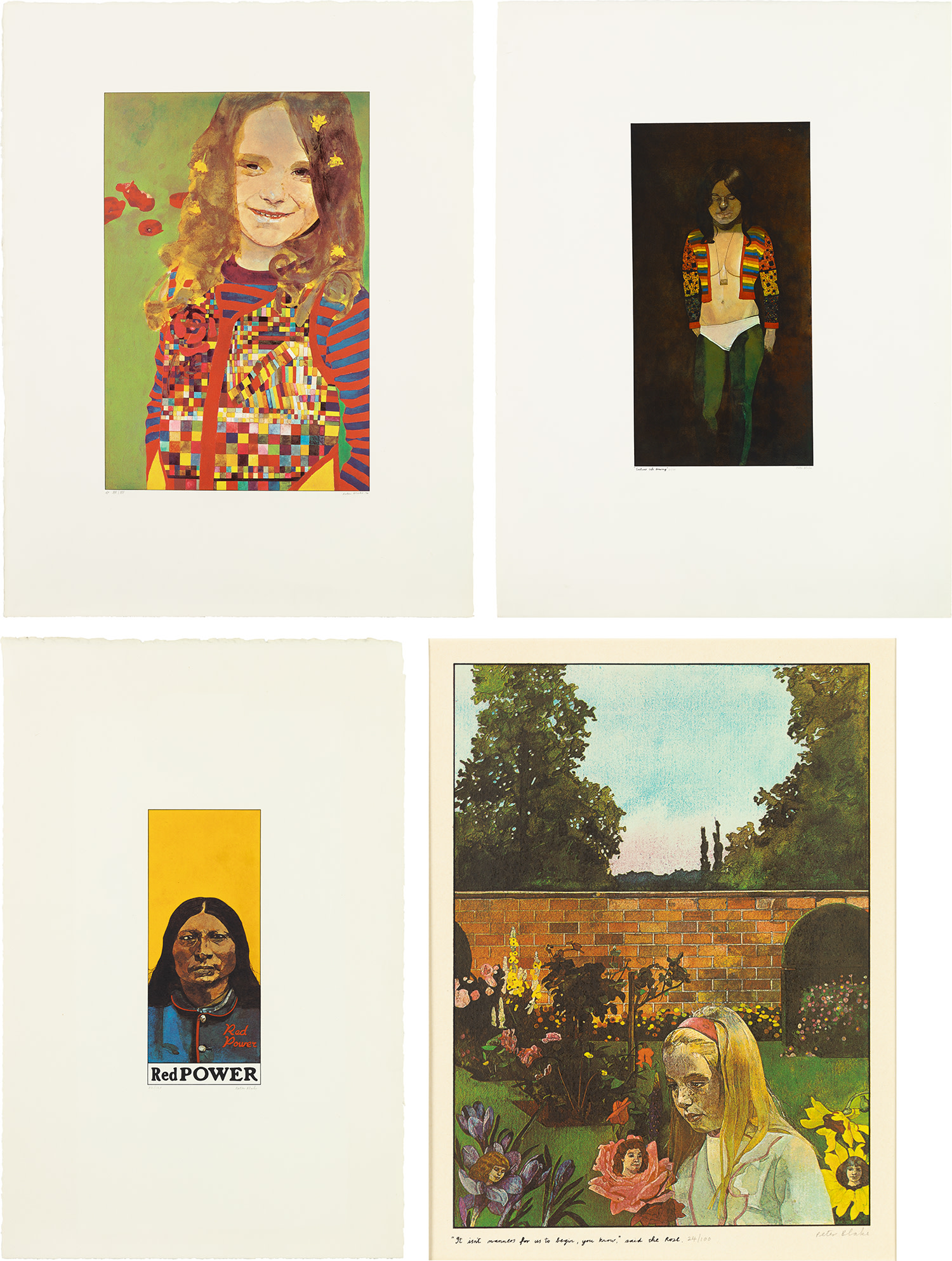
Each sheet, printed on Somerset paper with full margins, demonstrates the care and deliberateness that characterises Blake's approach to editions. The Far East Suite stands as one of the most ambitious and collectible bodies of Blake's print work, a series of signed and numbered editions published by CCA Galleries and printed at Worton Hall Studios that reflects his enduring interest in the imagery of faraway cultures filtered through his distinctly British sensibility. His illustrated editions of Lewis Carroll, particularly his Illustrations to Through the Looking Glass published by Waddington Graphics in London, reveal another dimension entirely, that of a draughtsman of exceptional delicacy whose imaginative world was shaped as much by Victorian narrative tradition as by the pop present. These works, some from editions of one hundred and others preserved as artist's proofs, have become prized by collectors who understand that Blake's versatility is not a dilution of his vision but an expression of its extraordinary range.
From a collecting perspective, Blake occupies a particularly enviable position in the market. His prints are accessible enough to attract collectors at an early stage of their journey while offering genuine depth and art historical significance that sustains long term interest. Signed and numbered editions from established publishers such as CCA Galleries and Waddington Graphics carry particular weight, and condition and provenance remain the primary determinants of value. Collectors drawn to British Pop Art naturally find themselves exploring the connections between Blake's output and that of his contemporaries, and understanding those relationships enriches the experience of living with any individual work.
Peter Blake
Illustrations to Through the Looking-Glass: three plates; The Wrestlers: four plates; Girl in a Poppy Field; and Costume Life Drawing
For those building a collection around the theme of post war British art, a Blake print is not merely a desirable acquisition but something close to a necessary one. Blake was awarded a CBE in 1983 and elevated to the rank of Commander of the Order of the British Empire, recognition that reflected both his cultural significance and his consistent artistic productivity over decades. He was a founding member of the Brotherhood of Ruralists in 1975, a group that sought to reconnect fine art with pastoral and literary traditions, demonstrating that his interests extended well beyond the metropolitan pop culture with which he is most readily associated. Retrospectives and exhibitions at institutions including the Tate Gallery have repeatedly affirmed his central position in the British art historical canon, and younger generations of artists continue to cite his example as evidence that serious art and popular pleasure need not occupy separate territories.
What endures most powerfully in Blake's work is its fundamental generosity of spirit. In an art world that has often rewarded conceptual austerity and critical distance, he has consistently made art that invites you in, that asks you to share in the pleasures of looking at wrestlers and rock stars, at London streets and Carroll's dreamscapes, with the same attentiveness and care he himself has brought to them across more than seven decades of practice. To collect Peter Blake is to participate in that generosity, to join a conversation about what popular culture can become when it is held in the hands of a genuinely great artist.
Explore books about Peter Blake
Peter Blake
Whitford, Frank
Peter Blake
Michael Compton
Peter Blake: A Retrospective
Morphet, Richard
Peter Blake: A Retrospective
Christopher Farr
Peter Blake: Twentieth Century Dreams
Tim Hilton

Peter Blake: Recent Work
Blake, Peter

Peter Blake: Book Designs and Illustrations
Andrew Causey
Peter Blake and Jann Haworth: The First Retrospective
Various
Peter Blake: Works on Paper
David Alan Mellor
Peter Blake: The Real World
Gooding, Mel

Peter Blake
Livingstone, Marco
Peter Blake: Gold Dreams
Richard Cork
Peter Blake: Drawings and Prints
Blake, Peter and others