Percy John Delf Smith
Percy Smith's Dance With the Eternal
Artist Spotlight · The Collection Editorial
There are moments in art history when a single series of works arrives with such quiet power that it takes decades for the world to fully understand what it has received. Percy John Delf Smith's Dance of Death, completed in 1919 in the immediate aftermath of the First World War, is one such moment. Created as Europe was still counting its dead and searching for language to hold the enormity of what had happened, Smith's etchings gave form to something that statistics and monuments could not. Today, as institutions and private collectors increasingly seek out works that speak to the human condition with directness and grace, Smith's prints feel not like relics but like dispatches from an experience that remains, in many ways, unfinished.
Percy John Delf Smith
Dance of Death, 1919
Percy John Delf Smith was born in 1882, and his early formation took place within the rich culture of British printmaking that flourished at the turn of the twentieth century. The etching revival of the late Victorian and Edwardian eras had established a serious audience for the medium, and Smith came of age understanding that a copper plate and a sharp needle could carry as much weight as any oil on canvas. He trained rigorously, developing a command of line and tone that would later allow him to render the most difficult of subjects with restraint and precision. That restraint would prove to be one of his greatest gifts as an artist.
Like many of his generation, Smith's artistic development was irrevocably shaped by the experience of the First World War. The war did not simply provide subject matter; it fundamentally reordered what art could be asked to do. For Smith, the encounter with mass death, with loss on a scale that exceeded ordinary human comprehension, pushed him toward an iconographic tradition that had navigated mortality before. The medieval Danse Macabre, in which Death appears as a figure who leads all people regardless of rank or station toward their end, offered Smith a framework that was both ancient and urgently contemporary.
Percy John Delf Smith
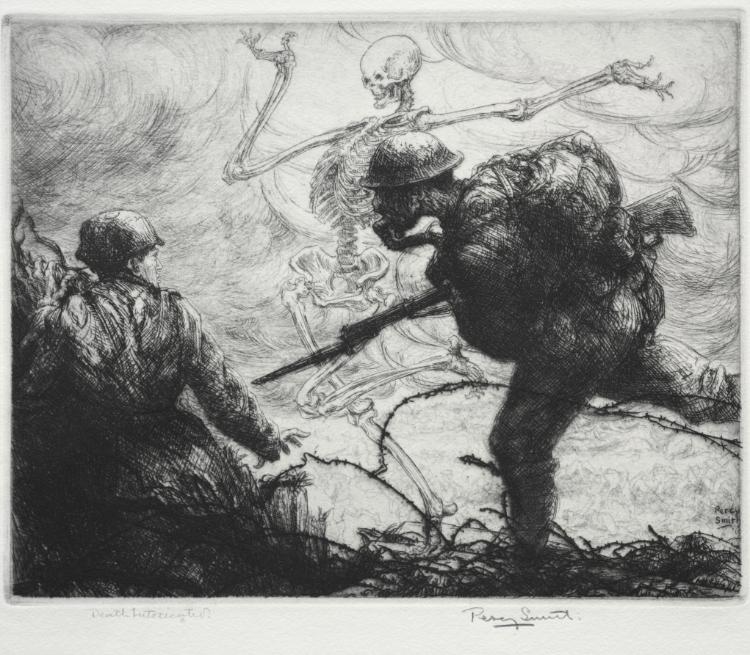
Dance of Death: Death Intoxicated, 1919
He did not borrow this tradition uncritically. He transformed it into something distinctly modern and deeply personal. The Dance of Death series, completed in 1919, is the work for which Smith is best remembered and most celebrated. The suite of etchings presents Death not as a triumphant or grotesque figure but as something more unsettling and more compassionate: a presence that waits, that ponders, that is awed, that is intoxicated by the world it must take from us.
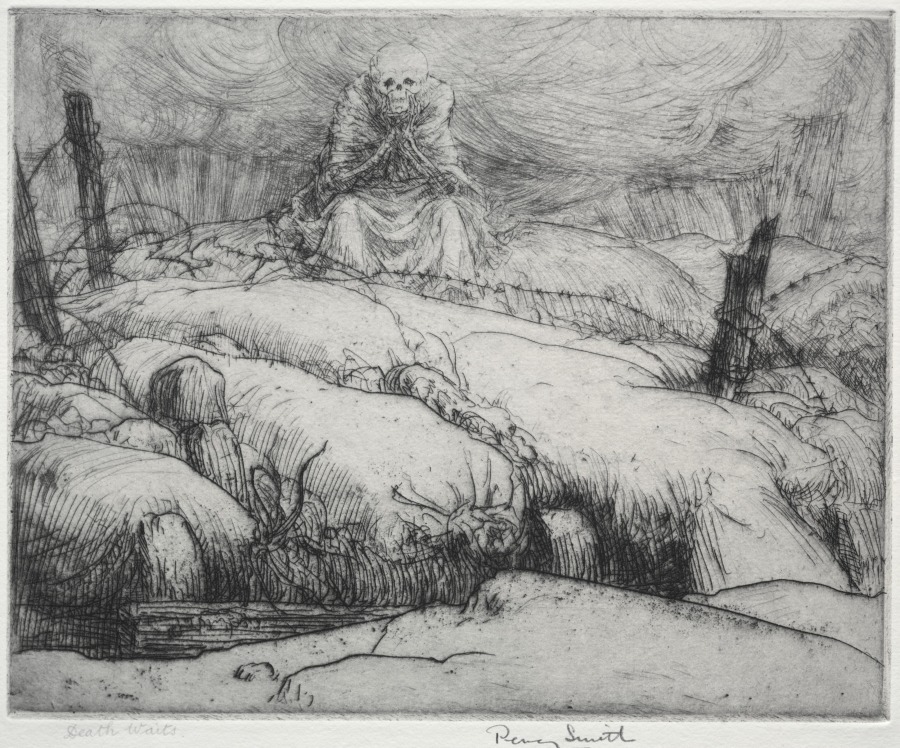
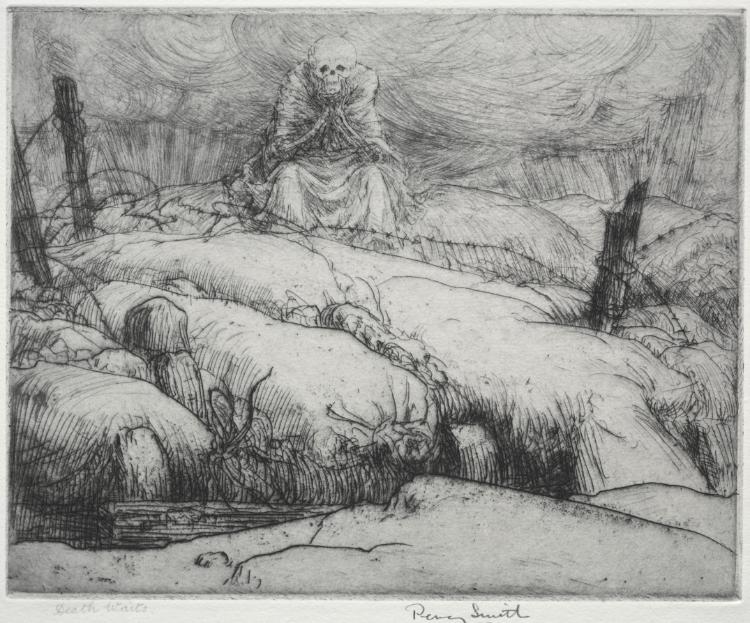
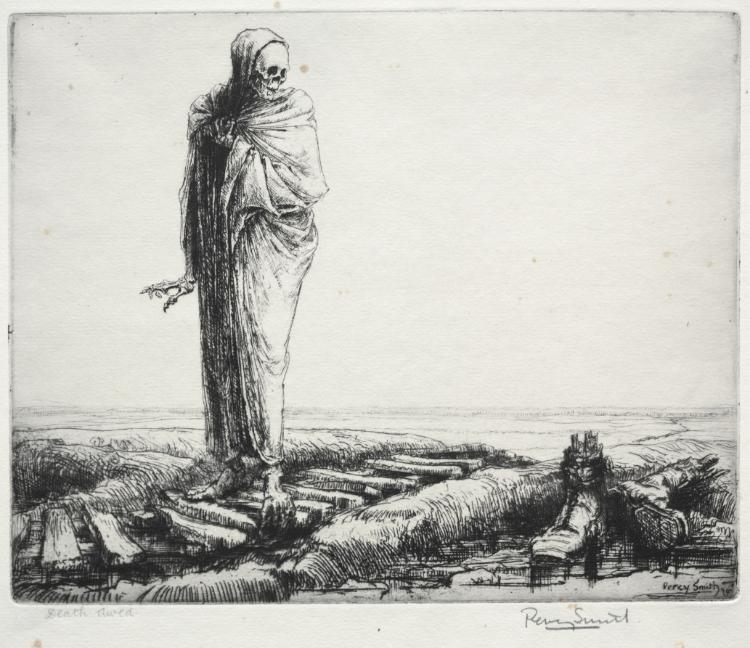
Each plate in the series is a meditation rather than a declaration. In Death Waits, there is a stillness that is almost unbearable in its patience. In Death Awed, Smith imagines something we rarely permit ourselves to consider, that the force which ends life might itself be moved by the beauty of what it must extinguish. Death Ponders and Death Refuses introduce a moral complexity into the tradition, suggesting hesitation and even refusal where one might expect only inevitability.
Percy John Delf Smith
Dance of Death: Death Waits, 1919
These are not images of horror. They are images of reckoning, and they are among the most original responses to the First World War that British art produced. Smith's technique in the Dance of Death series deserves close attention from anyone approaching his work. His line work is assured without being showy, capable of describing form with a minimum of marks while creating maximum emotional resonance.
The tonal range he achieves through careful aquatint and careful burnishing gives the prints a luminous quality that reproduction rarely captures fully. To hold one of these etchings under a good light is to understand immediately why printmaking attracted some of the most serious artistic minds of the early twentieth century. Smith belongs in a conversation with contemporaries such as Frank Brangwyn, whose large scale allegorical prints also grappled with themes of mortality and human endurance, and with the wider European tradition of war response that includes Käthe Kollwitz, whose own explorations of grief and loss through the print medium share something of Smith's emotional gravity and formal economy. For collectors considering Smith's work, several factors make this an especially compelling moment of engagement.
Percy John Delf Smith
Dance of Death: Death Awed, 1919
The Dance of Death series exists as a coherent artistic statement, and acquiring individual plates from the suite allows a collector to participate in a larger conversation about how artists process collective trauma. The works are historically significant as documents of the post First World War moment and as serious contributions to the long history of the memento mori tradition in Western art. Smith's prints are not widely held in private collections outside specialist circles, which means that serious collectors have a genuine opportunity to engage with work that institutional curators and art historians are only now returning to with fresh eyes. The combination of technical accomplishment, historical weight, and relative rarity makes Smith's etchings a particularly thoughtful acquisition for those building collections with real depth and point of view.
Placing Smith within art history requires looking in more than one direction at once. He stands within the British printmaking tradition, yes, but he also connects to the broader European inheritance of the Danse Macabre that runs from Hans Holbein the Younger's celebrated woodcut series of the sixteenth century forward through Alfred Rethel's nineteenth century neo Gothic treatments and into the early twentieth century, when the catastrophe of industrial warfare made the tradition feel not like a historical curiosity but like a living necessity. Smith's particular contribution was to infuse this tradition with the psychological interiority of modernism, to move Death from an allegorical figure into something closer to a character with an inner life. That shift is subtle but profound, and it distinguishes his work from more straightforward memento mori imagery.
The legacy of Percy John Delf Smith rests most securely in those seven etchings from 1919 and in what they demonstrate about the capacity of art to meet catastrophe without flinching and without sensationalizing. As conversations about war, memory, and the representation of collective suffering continue to shape both the art world and the broader culture, Smith's work offers a model of how an artist can hold the most difficult of subjects with dignity, imagination, and formal control. For those who spend time with his prints, the experience is one of quiet revelation. Smith reminds us that art made in the presence of great darkness can itself become a source of light.