Paul Sérusier
The Painter Who Unlocked Modern Color
Artist Spotlight · The Collection Editorial
“Colors, in themselves, have a beauty of their own which the artist must preserve, just as a musician preserves the timbre of his instruments.”
ABC de la Peinture, 1921
In the autumn of 1888, on a sun dappled afternoon at the edge of the Bois d'Amour near Pont Aven in Brittany, a young art student set up a small wooden panel and received a lesson that would alter the course of modern painting. His teacher was Paul Gauguin, a man already burning with radical conviction about what paint could do. The student was Paul Sérusier, and the result of that single afternoon session was a small, jewel like landscape barely larger than a paperback book, now known to the world as The Talisman. It is one of those rare objects in art history that genuinely deserves its mythology.
Paul Sérusier
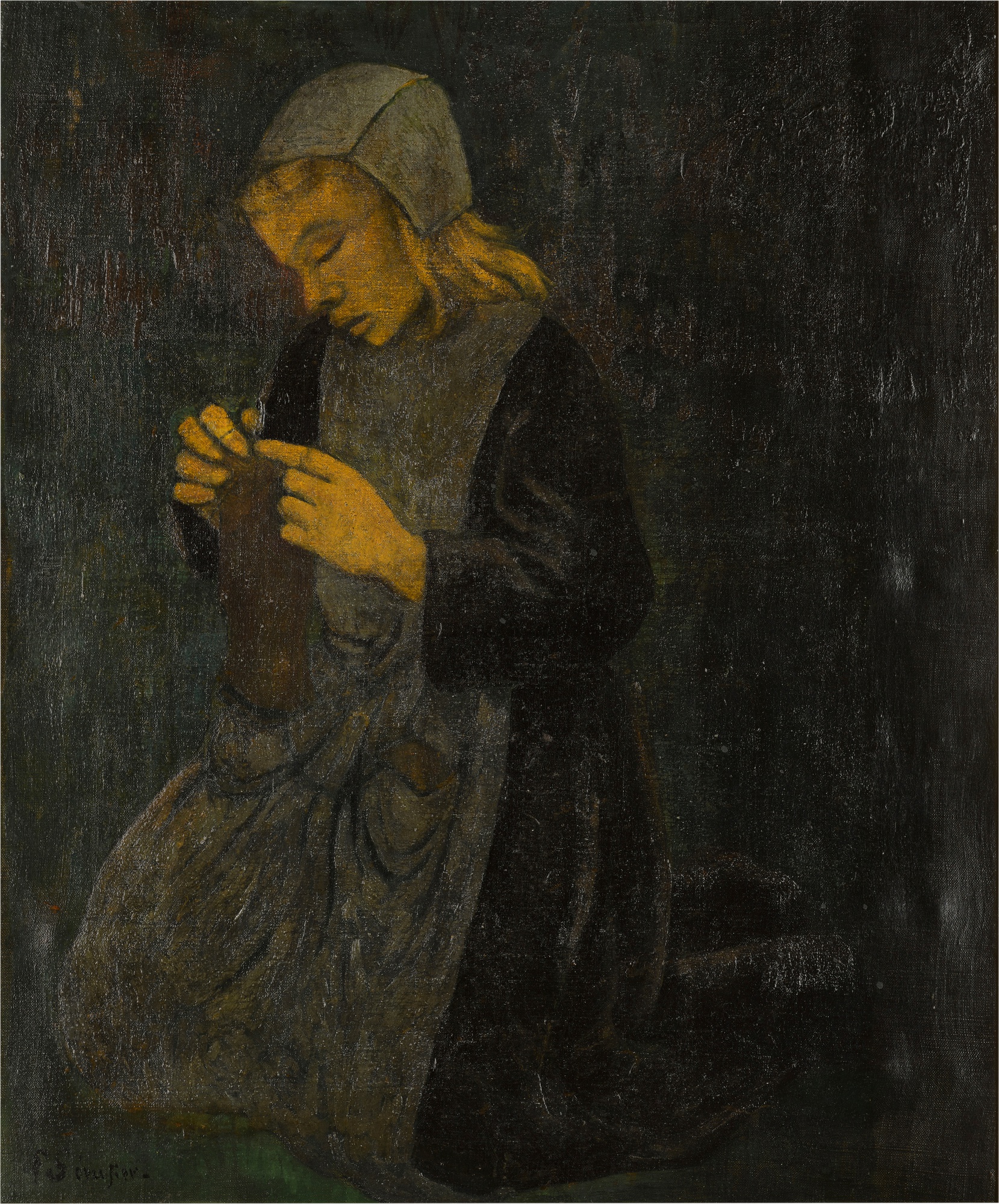
Jeune bretonne tricotant , 1896
Paul Sérusier was born in Paris in 1864, the son of a prosperous perfume manufacturer. His upbringing was comfortable and bourgeois, marked by a serious intellectual curiosity that would distinguish him throughout his life. He studied at the Académie Julian in Paris, one of the more progressive art schools of the era, where he distinguished himself not only as a painter but as a thinker and conversationalist. His peers there recognized in him someone unusually interested in the philosophy behind image making, in the why of art rather than merely the how.
It was this philosophical disposition that made his encounter with Gauguin so generative. The encounter at Pont Aven was brief but seismic. Gauguin, in his characteristically provocative manner, pushed Sérusier to abandon the imitative logic of academic painting and instead to ask what color could feel like in its most essential, unmediated form. The Talisman, painted under Gauguin's direct instruction, shows the landscape of the Bois d'Amour rendered in flat, bold patches of pure color, with the river rendered in startling oranges and reds, the trees pressing into deep greens and purples.
Paul Sérusier
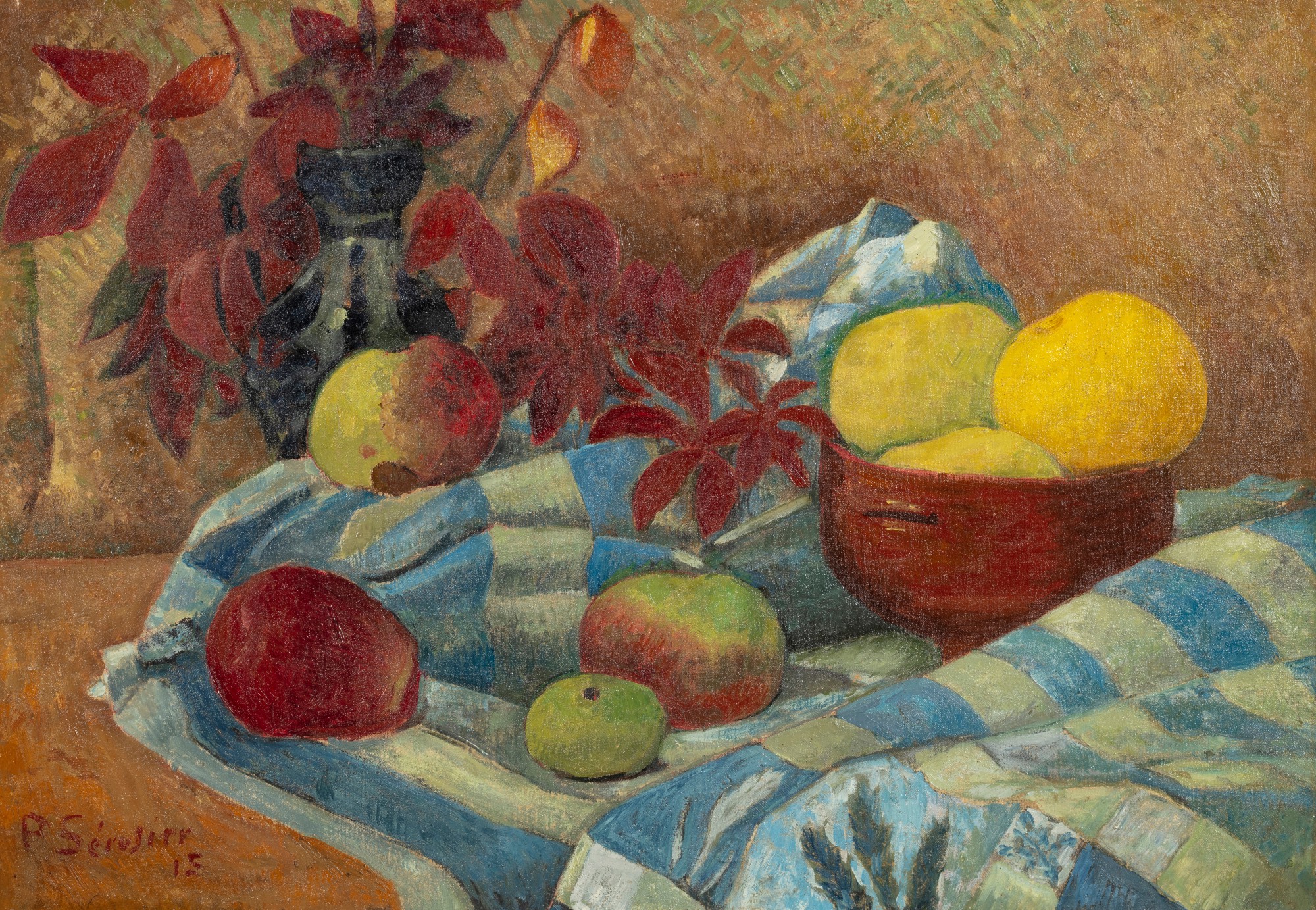
Nature morte aux pommes sur nappe aux carreaux bleus et bouquet feuillage d'automne, 1915
There is almost no detail in the conventional sense. What there is instead is an extraordinary sensation of color as structure, color as meaning. When Sérusier returned to Paris and showed the painting to his fellow students at the Académie Julian, it became a kind of manifesto handed down in pigment. Those students, including Pierre Bonnard, Maurice Denis, and Édouard Vuillard, became the Nabis, one of the most consequential avant garde movements of the late nineteenth century.
The Nabis, whose name derives from the Hebrew word for prophets, held that painting should convey inner spiritual and emotional truth rather than outward appearance. Sérusier was not only a founding catalyst but an ongoing intellectual force within the group. He developed a sustained interest in sacred geometry, medieval aesthetics, and later the religious philosophy of the Benedictine monastery at Beuron in Germany, where a community of monks had developed a distinctive hieratic style grounded in mathematical proportion. These ideas fed into his theoretical writing, culminating in his treatise ABC de la Peinture, first published in 1921.
Paul Sérusier
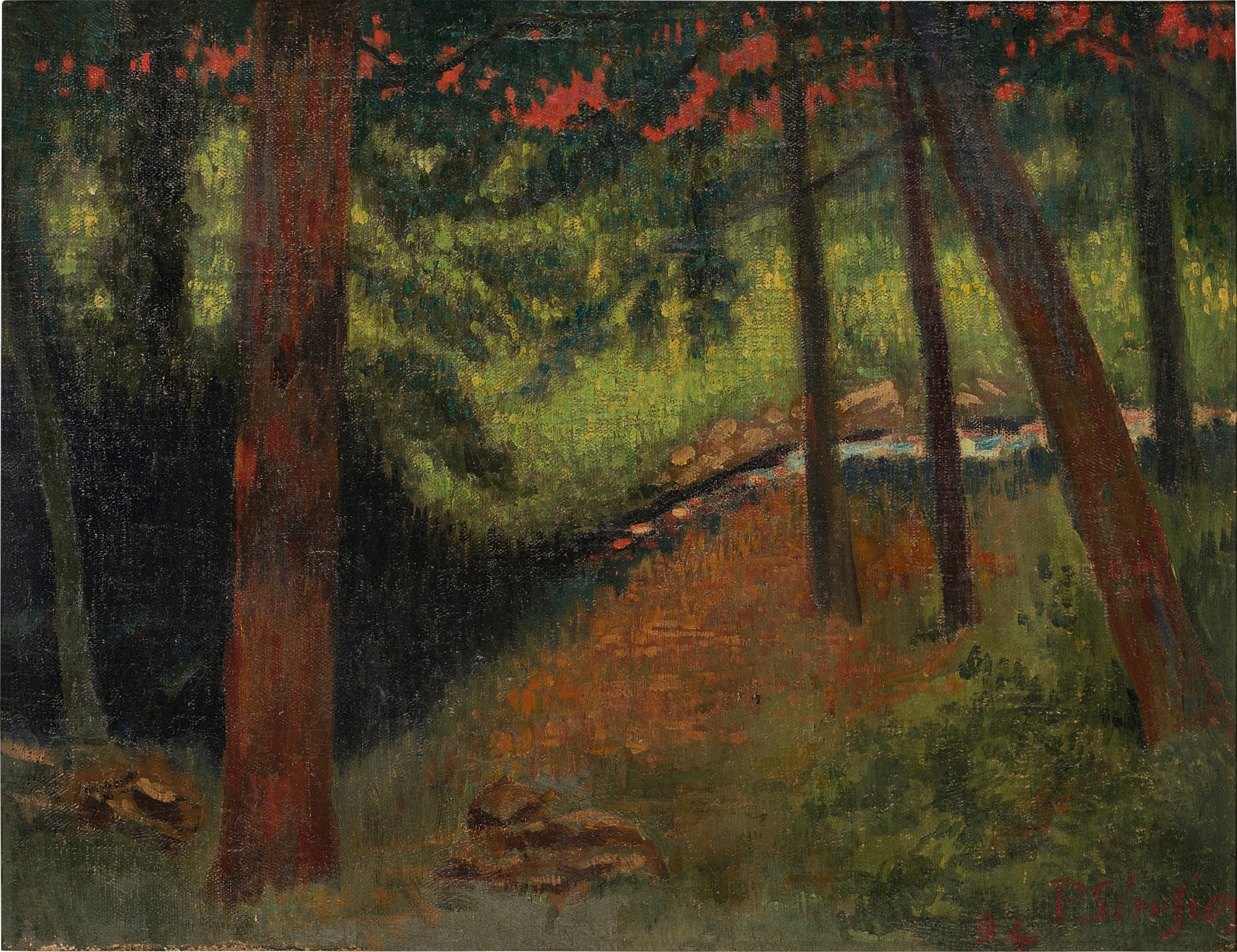
Ruisseau en sous bois (recto); Femme regardant l'apparition d'un cavalier de l'Apocalypse (verso) (A Double-Sided Work), 1904
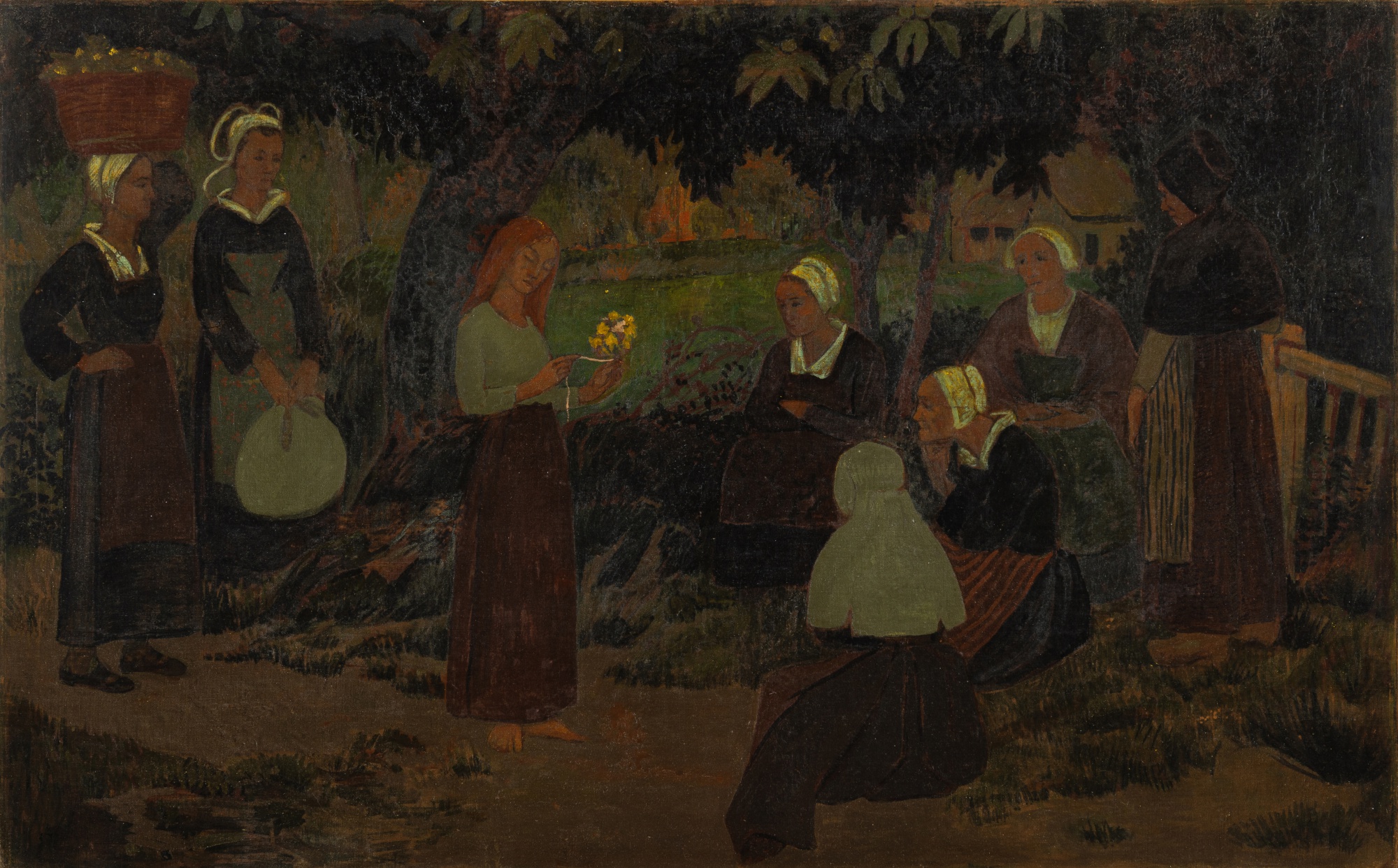
That text, part color theory and part spiritual meditation on artistic form, continued to be read and taught well into the twentieth century, influencing how subsequent generations understood the relationship between geometry, color, and meaning. The works available on The Collection offer a wonderful cross section of Sérusier's mature practice and reveal the remarkable range of his vision. Jeune bretonne tricotant from 1896 places a young Breton woman in quiet industry, her figure anchored in a warm palette that recalls the timeless quality of folk imagery while maintaining the flat decorative intelligence of the Nabis. Halte aux bouquets de fleurs from 1895 is a study in the expressive potential of everyday still life, with bouquets arranged with a simplicity that feels both modern and deeply rooted in the rhythms of rural Brittany.
The double sided work from 1904, Ruisseau en sous bois on one face and a visionary female figure on the other, is a remarkable object that speaks to the dual currents in Sérusier's practice: the observed natural world and the world of spiritual imagination. Nature morte aux pommes sur nappe aux carreaux bleus et bouquet feuillage d'automne from 1915 brings together the still life tradition and Sérusier's continuing meditation on color harmony, with the blue checked tablecloth creating a rhythmic geometry that anchors the composition. La Lecture from 1919 is one of his later interiors, quiet and contemplative, a figure absorbed in reading rendered with the unhurried warmth that characterizes his finest figure paintings. For collectors, Sérusier occupies a particularly rewarding position in the market.
Paul Sérusier
Halte aux bouquets de fleurs, 1895
He is absolutely central to one of the defining movements of the Post Impressionist era, and yet his name has not always commanded the same auction premiums as his Nabis contemporaries Bonnard and Vuillard. This creates a genuine opportunity. Works by Sérusier have appeared at major auction houses including Christie's, Sotheby's, and Drouot, with Breton subjects and still lifes being among the most sought after. His paintings from the 1890s and early 1900s, the period of his deepest engagement with Nabis ideas and Breton subject matter, are particularly prized.
Collectors drawn to the work of Bonnard or Denis will find in Sérusier something that adds essential depth to any collection oriented around this period, offering the chance to own a painting by the artist who, more than anyone else, pressed the spark that ignited the entire movement. In terms of art historical context, Sérusier belongs to a constellation of artists who together transformed European painting in the years between Impressionism and the full emergence of abstraction. His work is in dialogue not only with Gauguin, whose synthetist theories provided the initial impetus, but also with the Symbolist painters, with early twentieth century sacred art traditions, and with the broader European interest in decorative flatness that runs from the Nabis through Matisse and beyond. He is held in collections including the Musée d'Orsay in Paris, which owns The Talisman itself, as well as the Musée des Beaux Arts de Brest and the Pont Aven Museum, institutions that have done much to preserve and celebrate his legacy in Brittany.
The story of Paul Sérusier is ultimately a story about what happens when a gifted, philosophically inclined mind encounters a radical idea at exactly the right moment. The Talisman did not spring from nowhere; it was the product of a particular sensibility meeting a particular challenge and rising to meet it with extraordinary openness. That quality of openness, of genuine receptivity to the possibilities of paint and color and form, runs through everything Sérusier made across a long and productive career. He was a teacher, a theorist, a mystic of a kind, and above all a painter of genuine beauty and conviction.
To live with one of his works is to live with a piece of the moment modern art became possible.
Explore books about Paul Sérusier
Paul Sérusier: The Search for Sacred Art
Belinda Thomson
Sérusier et l'Académie Julian: L'Art et l'Enseignement
Denys Sutton
Paul Sérusier 1864-1927
Musée de Pont-Aven
The Talisman: Symbol and Substance in the Art of Paul Sérusier
Caroline Boyle-Turner
Sérusier and the Nabis: The French Symbolist Movement
Jean Clair