Paul Morrison
Paul Morrison, Where the Garden Grows Monumental
Artist Spotlight · The Collection Editorial
There is a particular kind of quiet that falls over a gallery when Paul Morrison's work takes over a wall. It is not the silence of absence but of abundance, of a world rendered in pure black and white that somehow feels more alive, more charged with possibility, than colour alone might permit. Morrison has spent decades building a practice that is singular in contemporary British art, one that transforms the humble vocabulary of botanical illustration and cartoon graphics into something approaching the epic. His works have appeared in major institutions across Europe and North America, and in recent years collector interest has grown steadily, reflecting a broader critical recognition that Morrison occupies a genuinely important place in the story of painting and printmaking at the turn of the twenty first century.
Paul Morrison
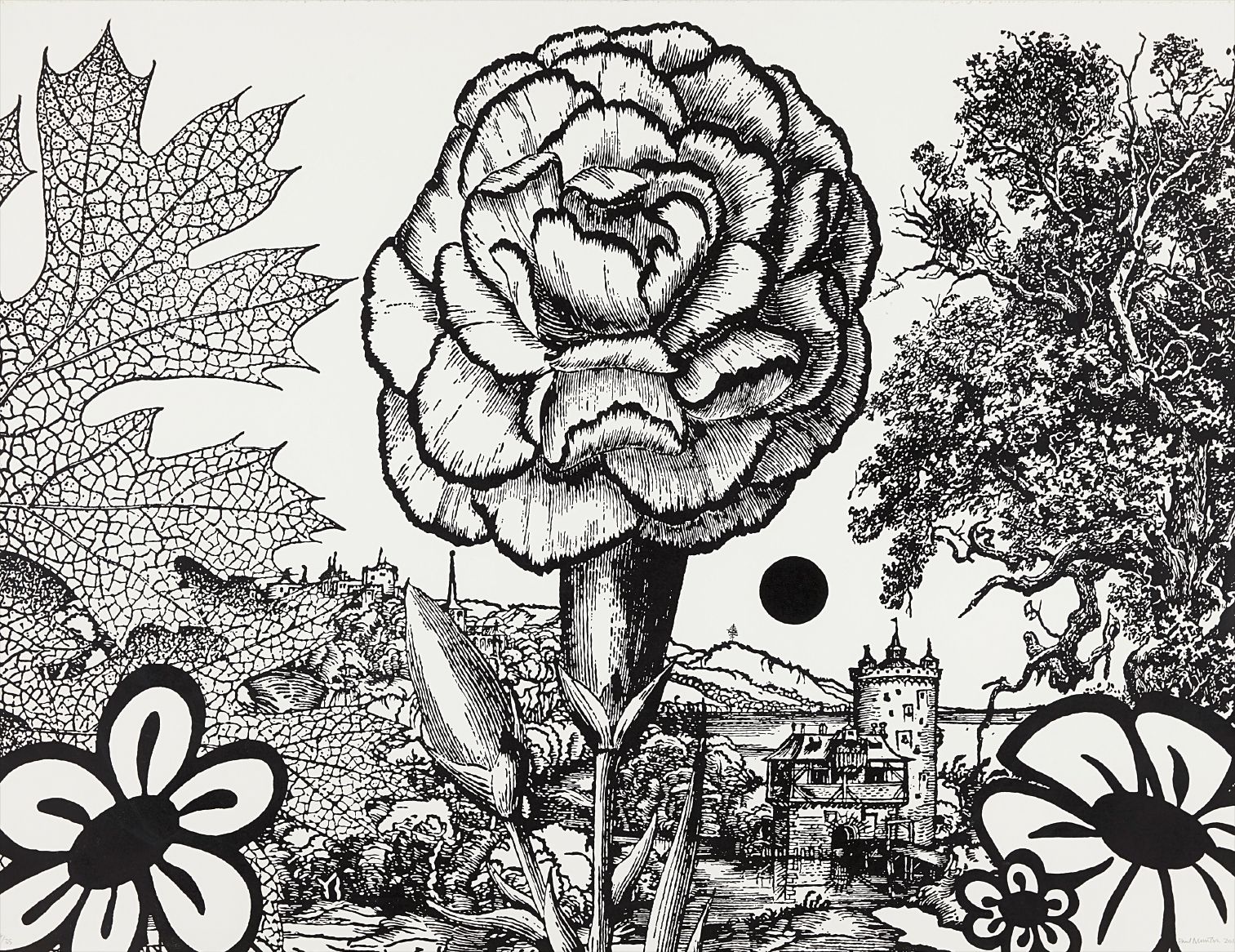
Rhexia
Morrison was born in Liverpool in 1966, a city whose relationship with popular culture, design, and a certain hard edged romanticism left its mark on many artists of his generation. He studied at Leeds Polytechnic and then at Goldsmiths College in London, completing his postgraduate work during the years when the Young British Artists were beginning to dominate conversation in the capital. Morrison's sensibility, however, ran against the grain of much of that moment. Where many of his contemporaries reached for shock and spectacle, Morrison turned inward, toward the library, toward the archive, toward the quiet strangeness of images that had already lived long lives before he encountered them.
The formative influence on Morrison's practice was not any single movement but rather a fascination with the way images travel and transform across time. He became deeply interested in the illustrative traditions of botanical drawing, those meticulous renderings of plants and flowers produced for scientific and decorative purposes across several centuries. What drew him was not their accuracy but their artificiality, the way a plant translated into a woodcut or an engraving becomes something flatter, stranger, and in its own way more intense than the living thing it depicts. He began to see in these sources a language that could carry psychological weight far beyond their original intent, and that discovery became the engine of his entire body of work.
Paul Morrison
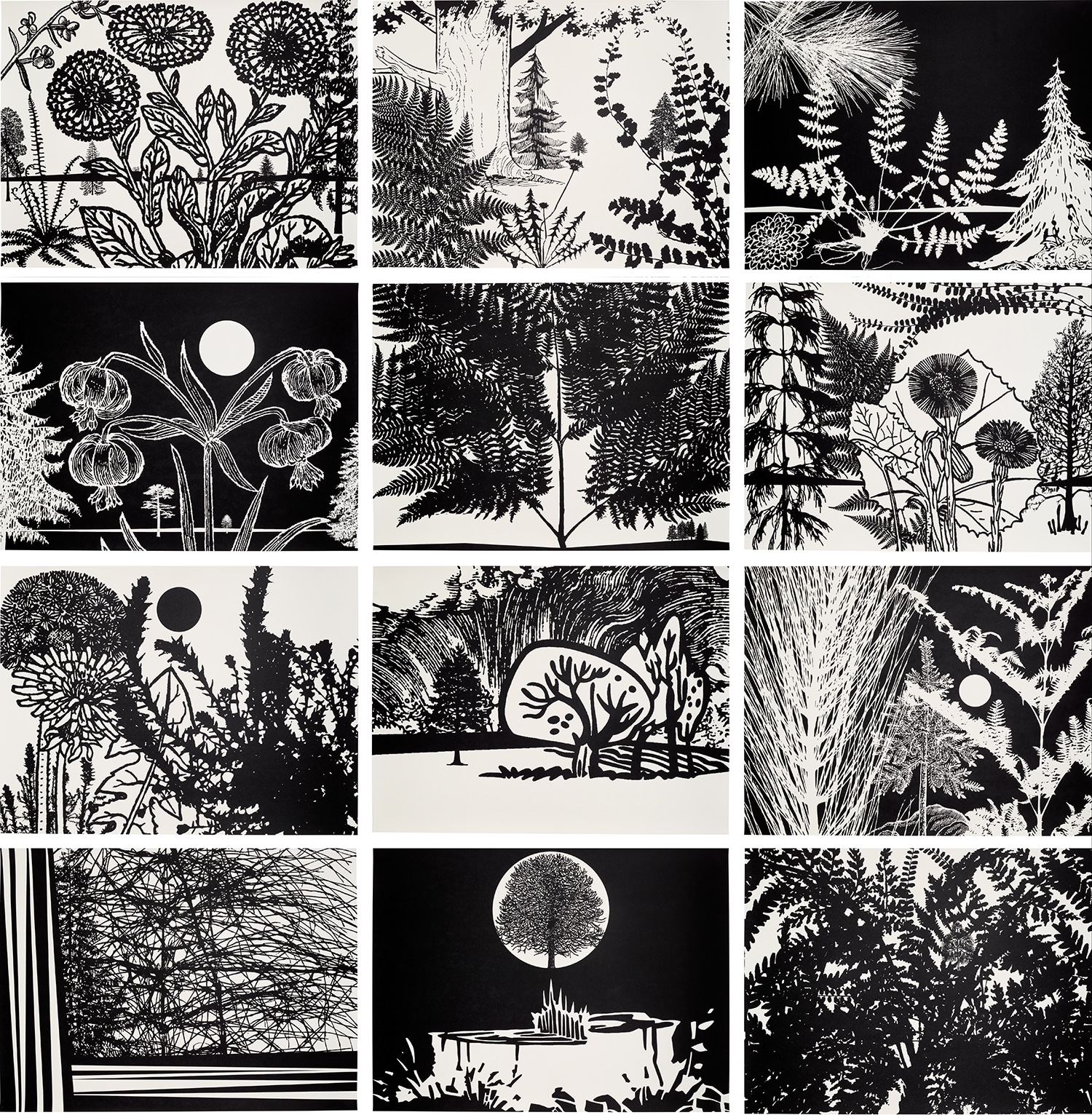
Black Dahlias
Morrison works at a scale that transforms his source material entirely. A flower or leaf lifted from an eighteenth century botanical plate, blown up to fill a canvas several metres across and rendered in stark black and white, ceases to be decorative and becomes something else altogether, something that hovers between the familiar and the uncanny. His technique draws on the bold outlines and flat graphic quality of cartoon illustration, so that his compositions feel simultaneously naive and knowing, playful and serious. This blurring of registers is entirely deliberate.
Morrison has long been interested in the way different visual traditions carry different cultural assumptions, and his work exploits the tension between them with great intelligence and wit. Among the works that best represent his achievement, his print series and editions hold a particularly important place. "Rhexia", published in 2011 by Pace Editions in New York, is a strong example of his approach in the print medium: signed, dated, and produced in a carefully controlled edition of 35, it demonstrates his ability to translate his monumental painted sensibility into multiples without any loss of presence or authority. "Black Dahlias", published by The Paragon Press in London in a set of 12 prints from an edition of 45, is another defining work, its title alone signalling the layering of art historical and popular cultural reference that runs through everything Morrison makes.
Paul Morrison
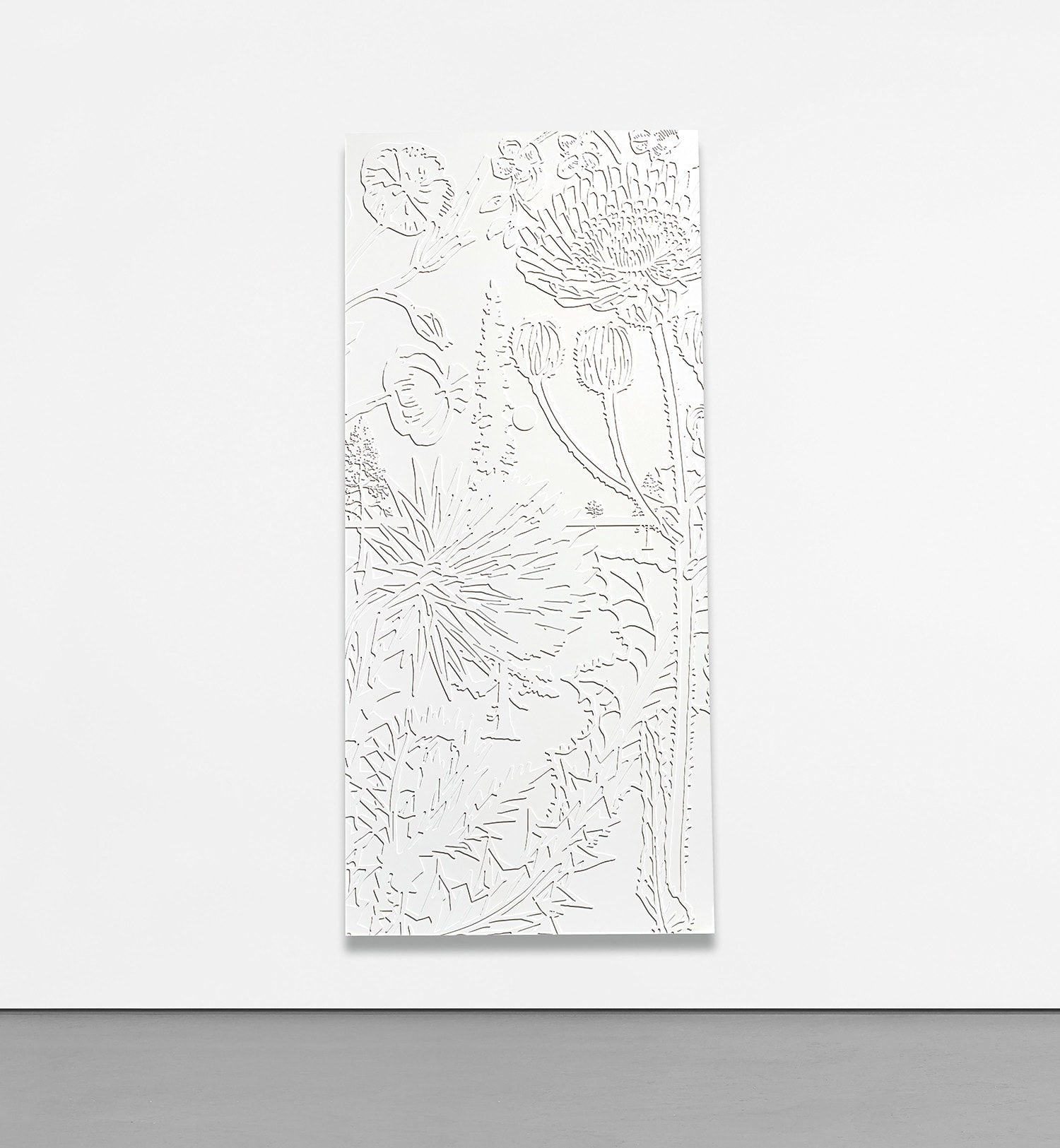
Hilum, from Door Cycle
Then there is "Hilum, from Door Cycle", published by Edition Schellmann in Munich and New York, a work that connects his botanical imagery to a deeper meditation on thresholds and transitions. These editions were produced with some of the most respected print publishers in the world, a testament to the seriousness with which Morrison has approached the technical demands of his chosen medium. For collectors, Morrison's prints represent a compelling entry point into a practice that is both intellectually rich and visually rewarding. The editions were produced in relatively small numbers, with artist's proofs adding an additional layer of rarity and desirability for those who seek them out.
What distinguishes a Morrison print from much of its contemporaneous production is the sense that each work has been conceived specifically for the medium rather than simply reproduced from a painted source. His collaborations with Pace Editions, The Paragon Press, and Edition Schellmann place him in illustrious company, and works from these publishers have a strong track record of holding and building value over time. Collectors who are drawn to artists working at the intersection of art history, graphic design, and conceptual practice will find in Morrison a figure who rewards sustained attention. In terms of art historical context, Morrison's work invites comparison with several important precedents.
The monumental flatness of his compositions recalls aspects of Ellsworth Kelly's plant drawings, though Morrison brings a very different psychological charge to similar raw material. His relationship to appropriation and the reworking of found imagery places him in a broader conversation with artists such as Sigmar Polke and Raymond Pettibon, both of whom mined the boundaries between high art and popular visual culture with similarly productive results. There is also something in Morrison's practice that echoes the great English tradition of the visionary natural image, a lineage that runs from William Blake through Samuel Palmer to the present day. What makes Morrison genuinely important, and what will ensure his work remains relevant as tastes and conversations shift, is the consistency and integrity of his vision.
He has never chased the market or bent his practice toward fashion. The botanical world he has made his own is both ancient and perpetually contemporary, a domain of forms that carry meaning across centuries and cultures. His works ask us to look again at images we think we know, to feel the strangeness at the heart of the familiar, and to find in the apparently decorative a genuine psychological depth. That is a rare and valuable thing in any artist.
In Morrison's hands it becomes something to be genuinely celebrated.