Paul Ferney
Paul Ferney Draws the World Into Joy
Artist Spotlight · The Collection Editorial
There is a particular kind of creative courage required to commit fully to warmth, to make work that is unapologetically celebratory, tender, and human in a contemporary art world that so often rewards severity. Paul Ferney, the American artist and illustrator whose oil on linen panel "Moonlight" arrives with quiet confidence into 2026, embodies that courage completely. His newest work signals not a departure but a deepening, a continued refinement of a practice built over decades on the belief that hand drawn marks and intimate imagery can carry genuine emotional weight. For collectors and institutions beginning to take serious notice, the timing feels exactly right.
Paul Ferney
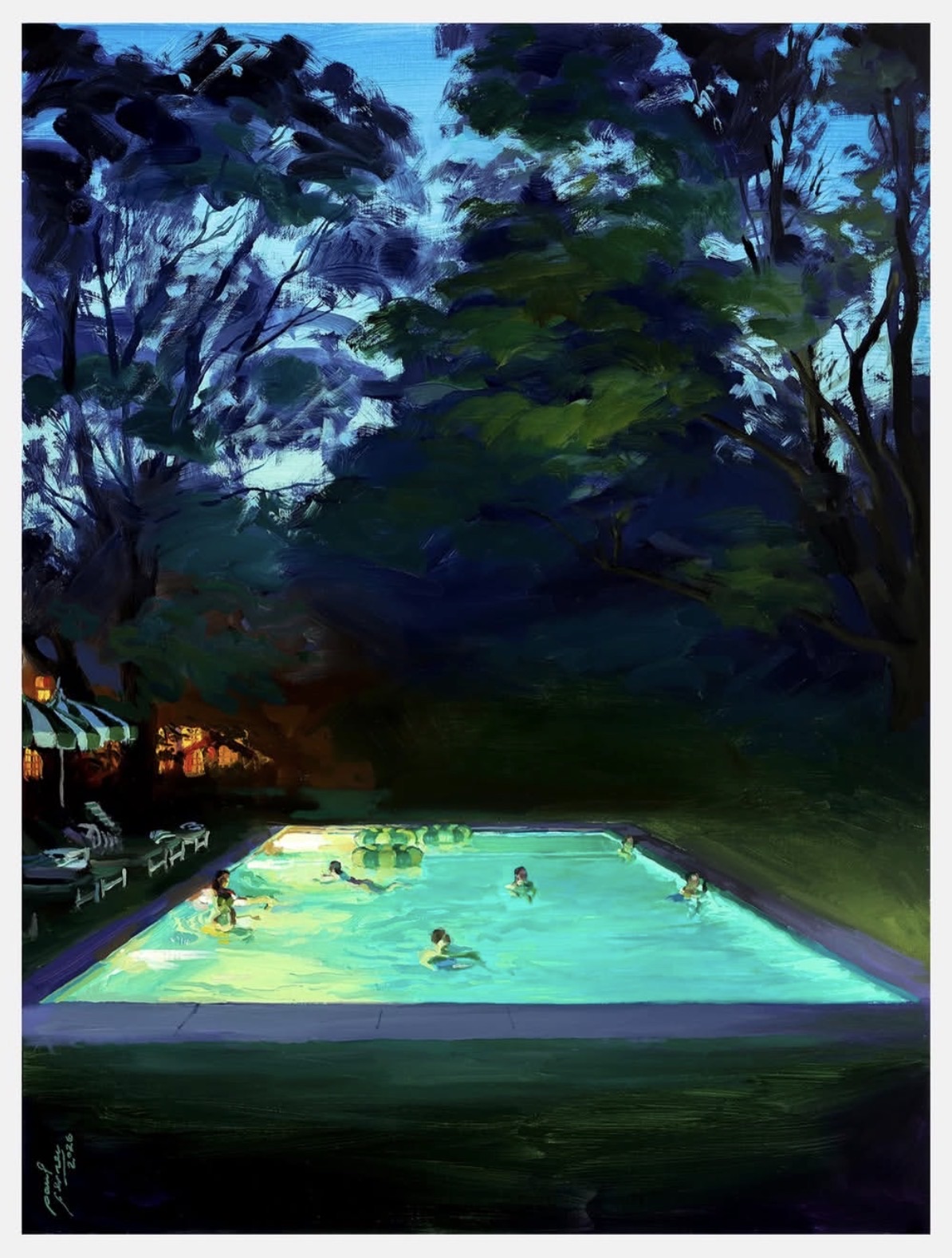
Moonlight, 2026
Ferney was born in 1967, coming of age in an America where the boundaries between fine art, craft, and commercial illustration were being actively questioned and, in many cases, productively dissolved. The folk art traditions of rural America, the vernacular signage of small towns, the domestic textile and pottery traditions carried forward by craftspeople across the country, all of these formed an informal but powerful visual education. Where many artists of his generation absorbed the cool ironies of postmodernism, Ferney seems to have looked instead toward the handmade, the local, and the deeply personal as sources of genuine meaning rather than subjects for detached commentary. His formation as an artist reflects a sensibility shaped equally by illustration culture and the longer history of American decorative arts.
Working across painting, illustration, printmaking, and mixed media, Ferney developed a practice that refuses easy categorization. He is at once a painter of real seriousness and a maker of objects that feel accessible, even inviting, to audiences who might otherwise keep a cautious distance from contemporary art. This accessibility is not a limitation. It is, in fact, one of the most sophisticated things about his work.
To be genuinely welcoming while maintaining artistic integrity is far harder than it appears. The signature elements of Ferney's visual vocabulary are recognizable from the first encounter. Loose, gestural linework anchors compositions that feel both spontaneous and carefully considered. His use of botanical motifs, flowers, leaves, vines, and organic forms that drift across the picture plane, connects his work to a tradition running from Pennsylvania Dutch folk painting through the Arts and Crafts movement and forward into the contemporary craft revival that has gained significant momentum since the early 2000s.
Playful typography woven into his compositions nods to the hand lettered signs and broadsides of American vernacular culture, giving his work a literary dimension that rewards close looking. His color palette, warm and luminous without ever tipping into sentimentality, is one of the most immediately pleasurable things about spending time with his pieces. "Moonlight," painted in oil on linen panel and dated 2026, offers a compelling example of where Ferney's practice currently stands. Oil on linen is a material choice with deep art historical resonance, and the decision to work in this medium speaks to an artist who takes the physical and historical dimensions of painting seriously even while his imagery remains rooted in the personal and the intimate.
The linen panel format, smaller in scale than grand salon painting, aligns with a long tradition of works made for close, private contemplation, works meant to be lived with rather than viewed from a distance. For collectors building thoughtful interiors as well as serious collections, this kind of work offers something genuinely rare. Contextualizing Ferney within the broader landscape of contemporary American art means looking at a moment in which the decorative arts, folk traditions, and craft practices have achieved new critical standing. Artists working in adjacent territories, those who blend fine art ambition with the material and visual languages of craft, printmaking, and illustration, have attracted growing institutional and market attention over the past decade.
Ferney belongs to a lineage that includes the pattern and decoration movement of the 1970s and the subsequent generations of artists who have argued, convincingly, that beauty and decorative intention are not enemies of serious artistic thought. His work also sits comfortably in conversation with the broader figurative and nature based painting revival that has defined much of the most interesting American studio practice in recent years. From a collecting perspective, Ferney represents the kind of opportunity that experienced advisors recognize and newer collectors are learning to appreciate. His is a practice with genuine intellectual and historical roots, a distinctive visual identity that is immediately legible across a body of work, and a warmth that makes his pieces genuinely pleasurable to live with over time.
Works that combine these qualities with the level of craft evident in pieces like "Moonlight" tend to reward early attention. The hand drawn quality of his linework means that each piece carries an intimacy and specificity that reproduction cannot fully capture. To encounter a Ferney original is to feel the presence of the artist's hand in a way that is increasingly valued in an era of digital saturation. What Ferney ultimately offers, both to art history and to the collectors fortunate enough to bring his work into their lives, is a sustained argument for the radical potential of joy.
In a cultural moment that can feel defined by anxiety and irony, his commitment to the celebratory, the botanical, the domestic, and the luminous reads not as naivety but as a genuine and hard won artistic position. The craft revival with which his practice aligns is not nostalgia for its own sake. It is a serious reconsideration of what making things by hand, with care and with love for the traditions one inherits, can mean in the present tense. Paul Ferney is making that argument beautifully, and the art world is listening.