Njideka Akunyili Crosby
Njideka Akunyili Crosby Paints the World Whole
Artist Spotlight · The Collection Editorial
“I want to make work that is grounded in specific experiences but that has the capacity to reach broadly.”
Njideka Akunyili Crosby, interview with LACMA
There are artists who document the world, and there are artists who remake it. Njideka Akunyili Crosby belongs emphatically to the second category. In recent years, her luminous mixed media paintings have moved from the walls of pioneering galleries into the permanent collections of some of the most respected institutions on earth, including the Tate in London, the Whitney Museum of American Art in New York, and the Los Angeles County Museum of Art. Her presence in these collections is not merely a market achievement.
Njideka Akunyili Crosby
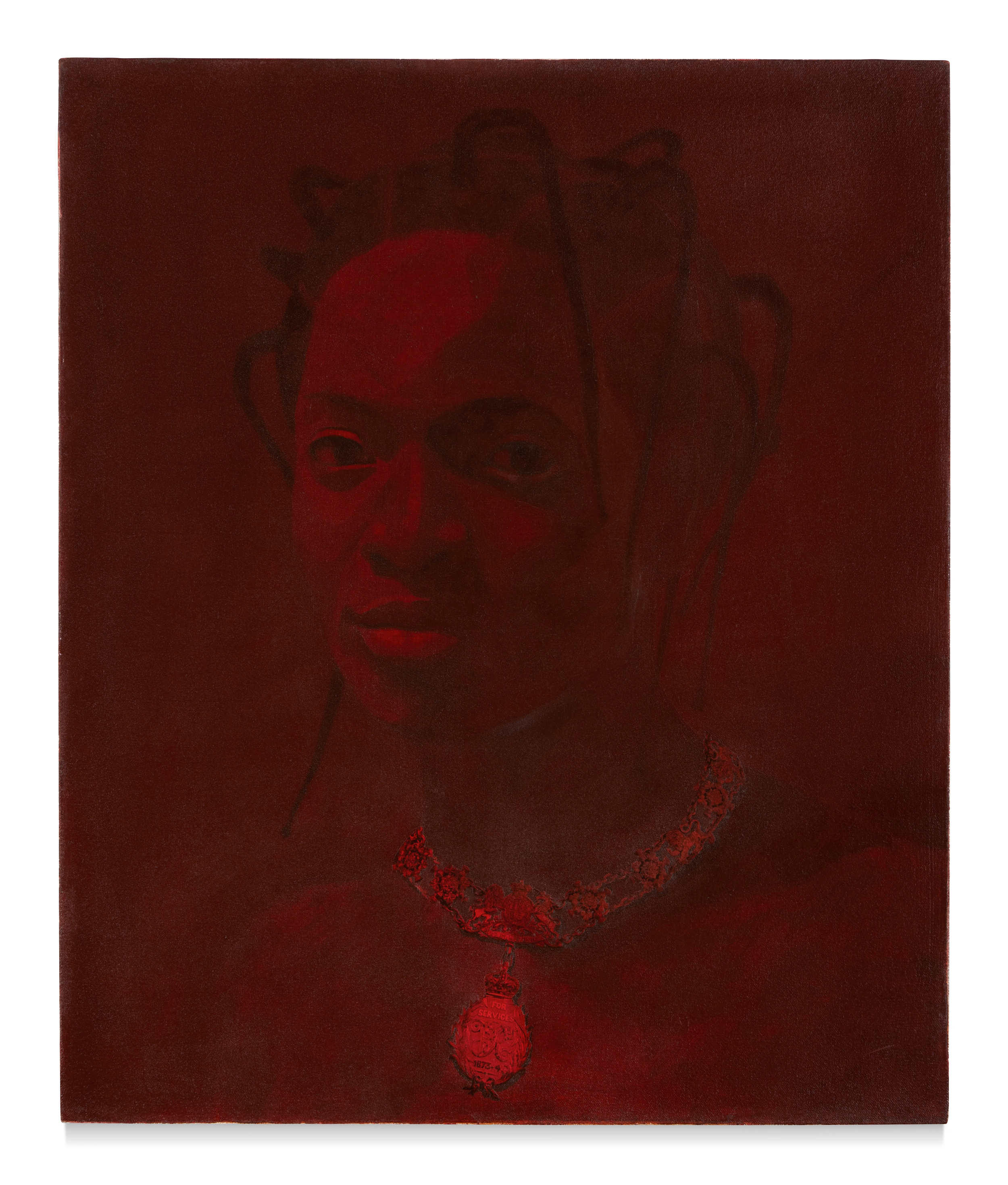
For Services - Victoria Regina, 2013
It is a cultural statement about whose stories deserve to be told in the grandest rooms, and whose interiors, whose bodies, whose daily rituals constitute the subject matter of serious art. Akunyili Crosby was born in Enugu, Nigeria in 1983, and spent her formative years in Enugu and Lagos before moving to the United States as a teenager to attend the Hill School in Pennsylvania on a scholarship. That crossing, the Atlantic passage from Nigeria to America and everything it asked of a young person in terms of adaptation, code switching, and self reinvention, would become the animating subject of her entire practice. She went on to study at Swarthmore College, then earned her MFA from Yale School of Art in 2011, where she developed the technical ambition and conceptual rigor that would define her mature work.
Yale placed her in conversation with a tradition of American painting, and she absorbed that tradition deeply, even as she was already planning the ways she would transform it. Her artistic development accelerated rapidly after graduate school. Working from her studio in Los Angeles, Akunyili Crosby began constructing paintings that were, from the outset, about layering in the most literal sense. She builds her large scale works by applying transfers of imagery sourced from Nigerian newspapers, magazines, Nollywood film stills, and popular culture ephemera directly onto the canvas surface.
Over and through these transferred images she paints in oil and acrylic, creating figures, domestic interiors, and intimate scenes that sit at the intersection of two visual worlds. The Nigerian imagery bleeds through the skin of her subjects, appears in the patterns of furniture and flooring, becomes part of the atmosphere of rooms that are simultaneously recognizable and dreamlike. The effect is not collage in any decorative sense. It is more like a theory of consciousness, a demonstration of how memory and culture live inside us, visible just beneath the surface.
“Nigeria is very present in my work. But so is America. I live in the hyphen.”
Njideka Akunyili Crosby, ArtReview
Among her most celebrated works is For Services, Victoria Regina, completed in 2013. The title alone signals her comfort with complexity, invoking the British imperial honor system in the same breath as her own presence in the former empire's cultural sphere. The painting brings together portraiture, found imagery, and art historical reference in a way that feels both intimate and encyclopedic. This work exemplifies what makes Akunyili Crosby so important: she does not ask viewers to choose between the personal and the political, between beauty and critique.
She insists that they are the same thing. Her paintings are gorgeous and demanding in equal measure, and that combination is extraordinarily rare. The art world took notice decisively in 2017, when Akunyili Crosby was awarded a MacArthur Fellowship, the so called genius grant, which recognized the scale of her ambition and the originality of her vision. Her inclusion in the Whitney Biennial, along with solo and group exhibitions at institutions including the Norton Museum of Art and the Baltimore Museum of Art, cemented her reputation as one of the defining painters of her generation.
Victoria Miro in London has been central to her gallery representation, bringing her work to international audiences and placing it in significant private collections alongside artists of comparable stature and ambition. For collectors, Akunyili Crosby represents a compelling confluence of factors that rarely align so cleanly. Her work is intellectually serious, visually arresting, and historically significant, but it is also emotionally warm, rooted in the textures of real life and real relationship. The domestic interiors she paints, couples on sofas, figures reading or watching television, the quiet choreography of shared living, carry a tenderness that draws viewers in before the conceptual depth reveals itself.
Collectors drawn to artists who engage with diaspora, identity, and transnational experience will find in her work a practitioner at the absolute summit of that conversation. Works from her early to mid career, including pieces from around 2012 through 2016, are particularly sought after, as they represent the consolidation of her signature approach and are now held by institutions that validate their lasting importance. To place Akunyili Crosby in art historical context is to understand both how deeply she has absorbed her influences and how completely she has exceeded them. Her engagement with portraiture connects her to a lineage running from Velázquez through Alice Neel, while her interest in pattern, surface, and the politics of representation resonates with the work of Kehinde Wiley and Kerry James Marshall, two artists who have similarly transformed the possibilities of figurative painting in the twenty first century.
Her use of collage and transfer recalls Romare Bearden in its emotional intelligence, and like Bearden, she understands that fragmentation is not the opposite of wholeness. It is one of its most honest forms. Among her contemporaries working across diaspora and identity, artists such as Toyin Ojih Odutola and Lynette Yiadom Boakye share her commitment to centering Black life with complexity and grace, and collectors who admire one will almost certainly find themselves drawn to the others. What Njideka Akunyili Crosby has built over the course of her career is something that will only become more significant with time.
She has created a visual language for an experience that millions of people live every day and that art history had, for too long, failed to fully see: the experience of belonging to more than one world, of carrying multiple cultures in the body simultaneously, of finding home in the hyphen between identities. Her paintings do not merely represent this experience. They enact it, they embody it, they make it visible and beautiful and unmistakably present. To encounter her work is to understand something about contemporary life that no amount of sociological description could convey.
That is the gift of a genuinely great artist, and Njideka Akunyili Crosby is, without question, exactly that.