Nicolas Schöffer
Nicolas Schöffer: The Artist Who Animated Light
Artist Spotlight · The Collection Editorial
“Space is not a void to be filled but a living substance to be organized.”
Nicolas Schöffer
There is a moment, standing before one of Nicolas Schöffer's towering cybernetic towers or one of his intimate kinetic sculptures, when the boundary between art and living organism seems to dissolve entirely. The polished stainless steel discs rotate, catch the light, and scatter it across walls and ceiling in patterns that are never quite the same twice. This is not accidental. Schöffer spent decades designing works that would breathe, respond, and evolve in real time, anticipating by generations the art world's current fascination with generative and algorithmic aesthetics.
Nicolas Schöffer
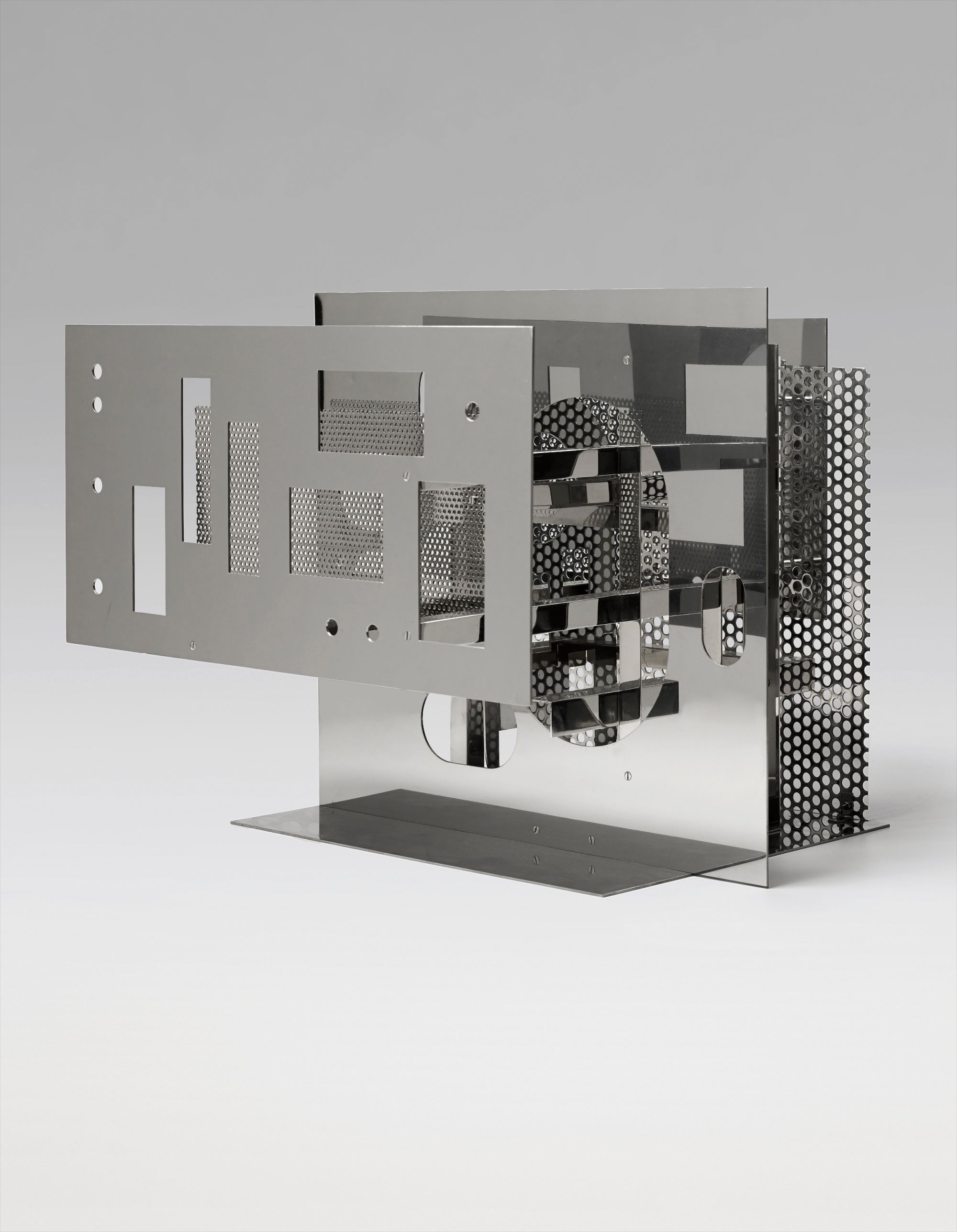
Luxus XII
As institutions across Europe and the United States revisit the history of kinetic and cybernetic art with fresh urgency, Schöffer's contribution stands out as foundational, visionary, and surprisingly contemporary. Nicolas Schöffer was born in 1912 in Kalocsa, Hungary, a provincial city south of Budapest distinguished by its vibrant folk art traditions and its deeply decorative visual culture. He trained at the Budapest Academy of Fine Arts before relocating to Paris in 1936, the city that would become his permanent home and the stage for his most ambitious experiments. Paris in the late 1930s and postwar years was electric with competing visions of what art could become, and Schöffer absorbed them all while ultimately charting a course that belonged entirely to himself.
His early work showed a painter's sensitivity to light and surface, qualities that would later be translated into three dimensions with extraordinary technical sophistication. The turning point came in the early 1950s, when Schöffer began to develop what he termed spatiodynamism, a practice built on the idea that sculpture need not be static but could engage dynamically with space, time, and the viewer. He was drawn to the writings of Norbert Wiener on cybernetics, the then emerging science of self regulating systems, and saw in those ideas a framework for an entirely new kind of artwork. Rather than fixing a form in bronze or stone, Schöffer wanted to create structures that could receive information from their environment and generate responses.
Nicolas Schöffer
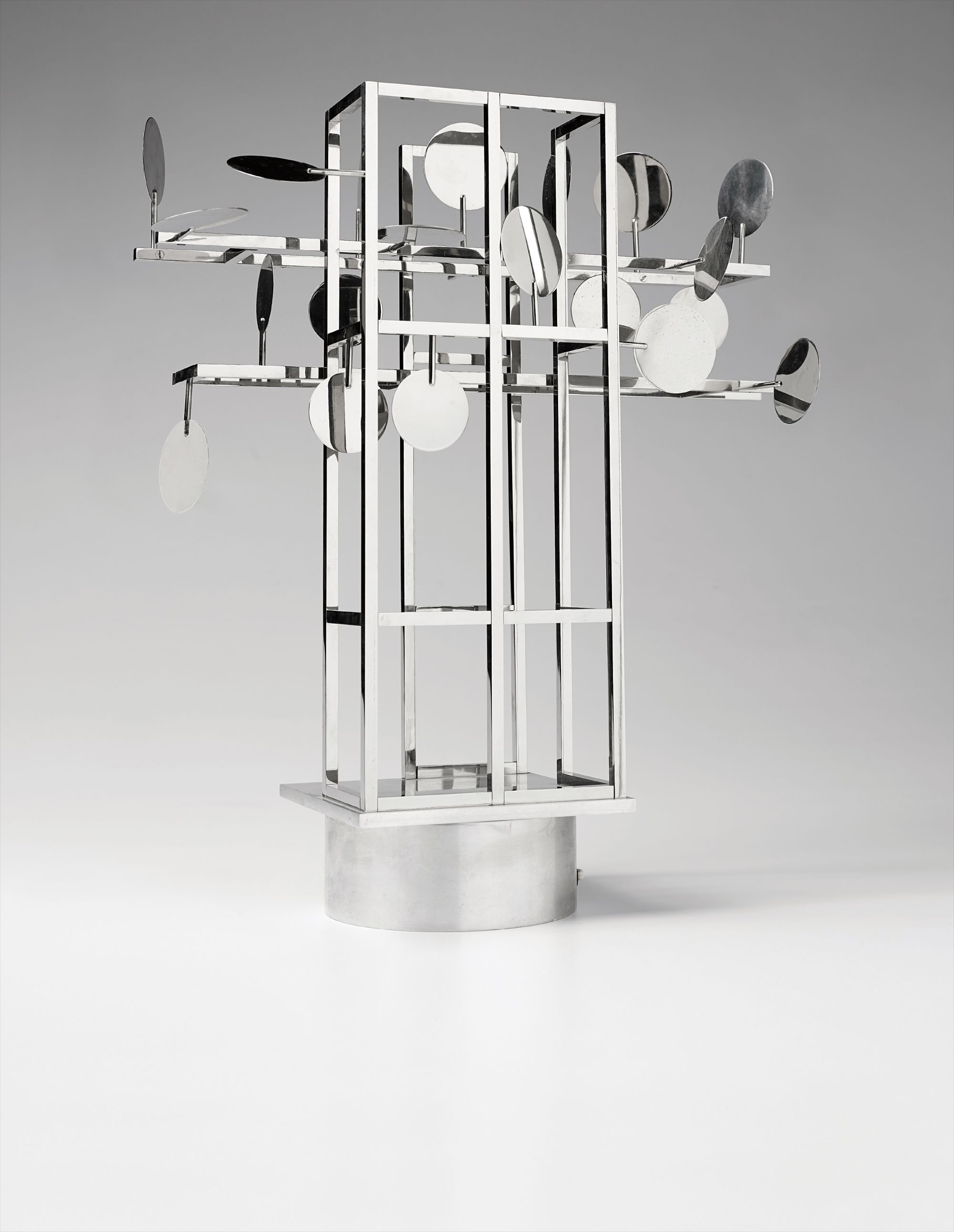
Chronos X
His thinking was rigorous and systematic, but the results were always sensuous and surprising, which is precisely what sets him apart from contemporaries who pursued similar intellectual territory. His breakthrough into public consciousness came with the landmark CYSP 1 in 1956, widely regarded as the world's first cybernetic sculpture. Created in collaboration with the electronics company Philips, this extraordinary work used photocells and a microphone to detect light, color, and sound in its environment, triggering a motorized response through rotating planes and colored lights. CYSP 1 was performed at the Festival d'Art d'Avant Garde in Marseille and later on the roof of Le Corbusier's Cité Radieuse, a pairing of two revolutionary visions of modern life that felt almost prophetic in retrospect.
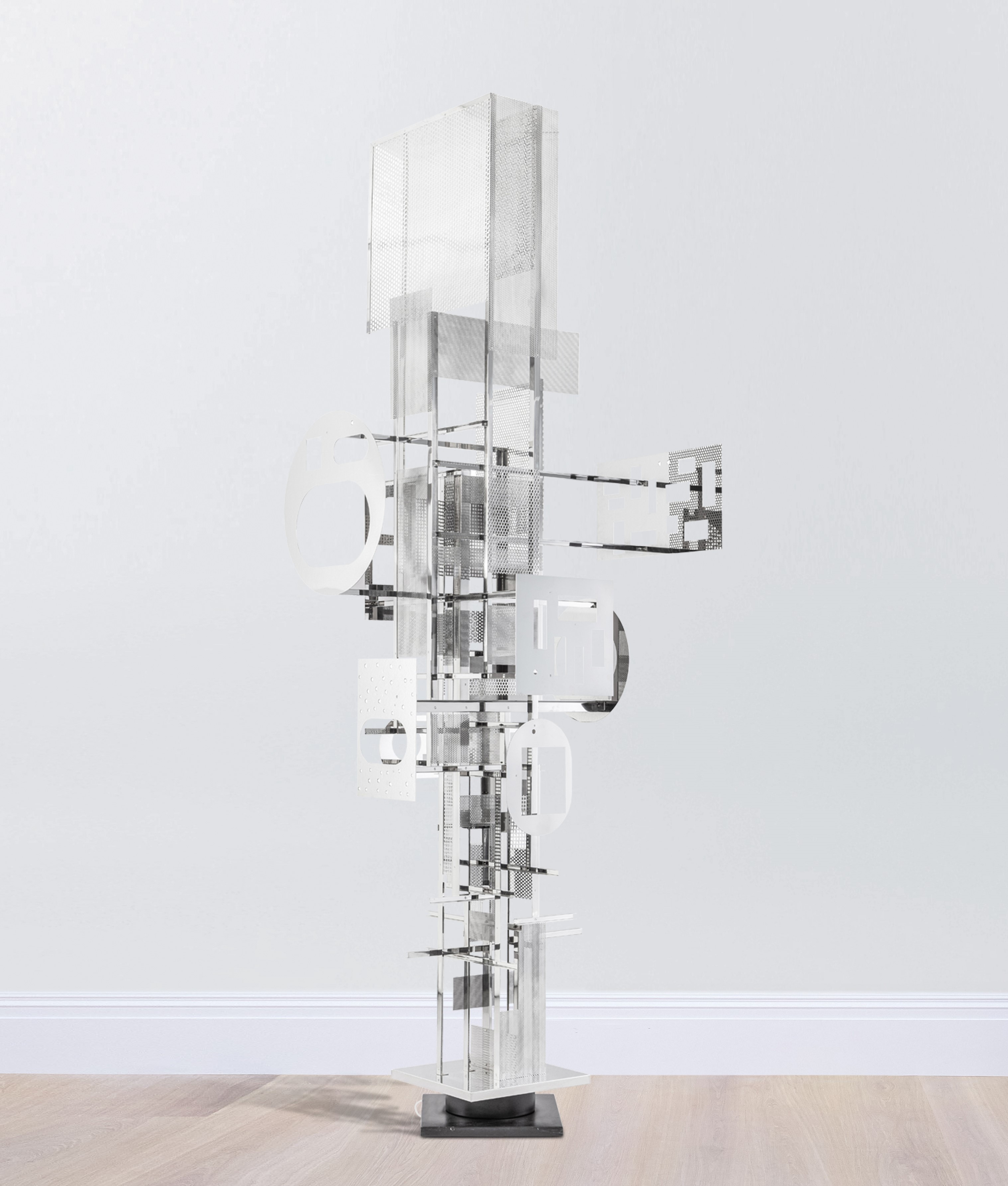
The work announced Schöffer as one of the most genuinely experimental artists working anywhere in Europe. Throughout the 1960s and 1970s, Schöffer's practice expanded in both scale and ambition. He created monumental spatiodynamic towers for public spaces, including his celebrated tower for the Parc de Saint Cloud near Paris, a structure that used light and sound to animate its surroundings. At the same time he continued to develop smaller, more intimate works, the sculptures that collectors today find most accessible and most deeply rewarding to live with.
Nicolas Schöffer
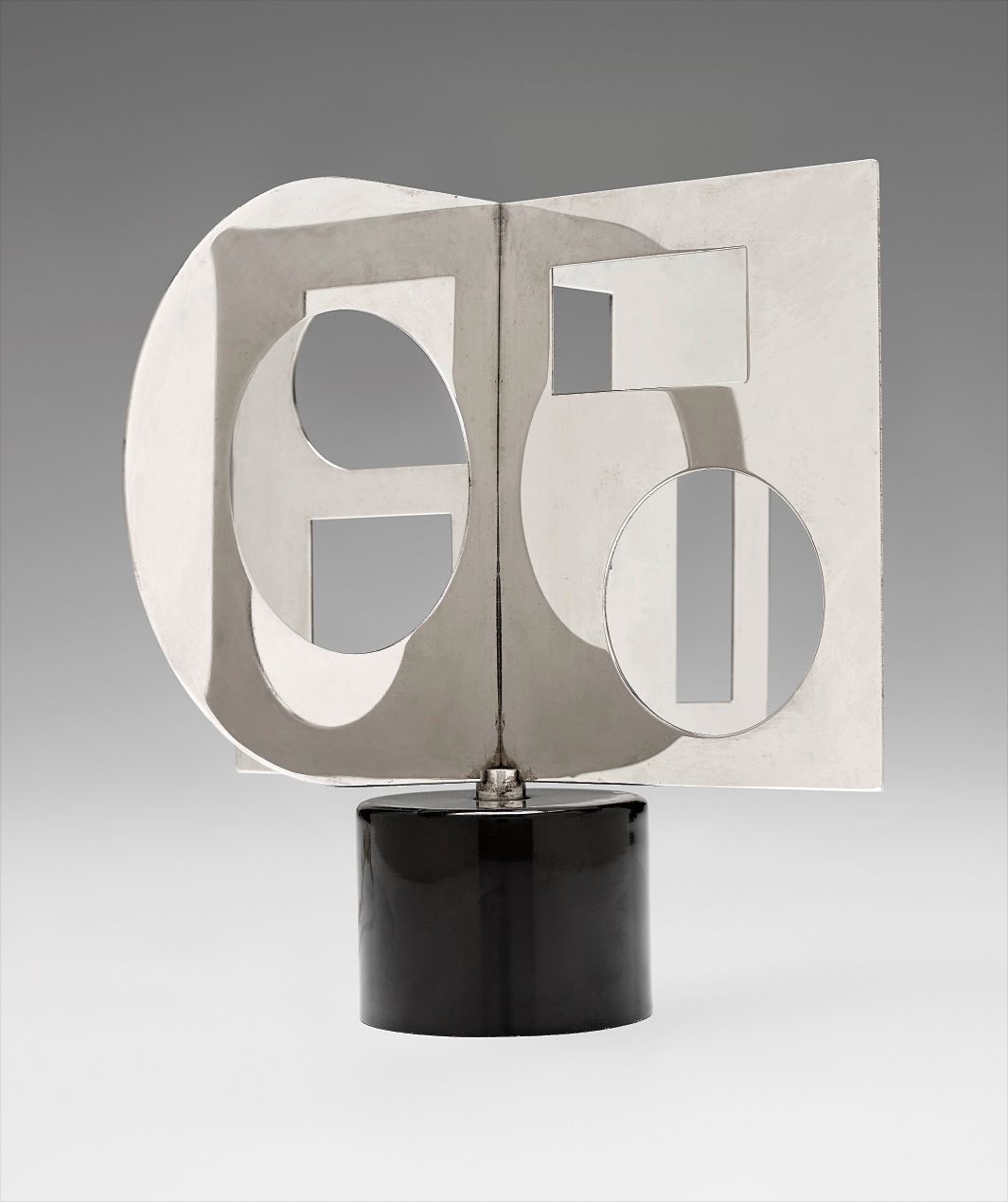
Minisculpture I
Works such as Chronos X, with its motorized base and mirror polished stainless steel discs, distill his entire philosophy into something that can inhabit a room and transform it. Luxus XII and Lux XII similarly demonstrate his mastery of reflective surfaces and programmed movement, creating miniature environments of perpetual luminous change. His Minisculpture series brought this vision into an even more domestic register, producing kinetic objects of exquisite refinement that feel at home in both a modernist interior and a more intimate, personal setting. For collectors, Schöffer's work occupies a fascinating and genuinely rewarding position in the market.
He sits at the intersection of postwar European sculpture, kinetic art, and early conceptual and technological practice, a convergence that gives his work both historical depth and forward looking relevance. Auction results for Schöffer have been consistently strong in specialist sales at Sotheby's, Christie's, and Artcurial, where his kinetic sculptures attract bidders who understand the rarity and significance of works in excellent mechanical condition. The motorized components in his sculptures require care and expertise to maintain, and works that retain their original mechanisms and functionality command particular attention and premiums from serious buyers. Collectors should look for works that demonstrate the full range of his signature language: the open steel armature, the mirror polished rotating elements, the interplay between structural geometry and captured light.
Nicolas Schöffer
Sculpture Volume, 1960
Within the broader sweep of art history, Schöffer belongs to a generation of artists who transformed sculpture's relationship with time and motion. His closest contemporaries include Jean Tinguely, whose mechanical sculptures shared a fascination with movement but inclined toward playful entropy rather than systematic order; Alexander Calder, who pioneered the mobile and established the idea of sculpture as choreography; and the artists of the Groupe de Recherche d'Art Visuel, including Julio Le Parc and François Morellet, who shared Schöffer's commitment to systematic visual research. What distinguishes Schöffer from all of them is his sustained engagement with cybernetics as not merely a metaphor but an actual structural principle: his sculptures were genuinely responsive systems, not just moving objects. Schöffer died in Paris in 1992, leaving behind a body of work that has only grown in resonance with time.
In an era when artists are routinely celebrated for their use of sensors, algorithms, and interactive technologies, it is worth remembering that Schöffer was doing all of this in the 1950s and 1960s, with analogue electronics and an artist's intuition about what light and motion could mean for the human spirit. His sculptures are not relics of a technological optimism that has since faded. They are living objects, as genuinely alive as art can be, and they continue to astonish everyone fortunate enough to encounter them.
Explore books about Nicolas Schöffer
Nicolas Schöffer
Frank Popper
Schöffer: Monographie
Pierre Restany
Nicolas Schöffer: Lumière et Mouvement
Various contributors
The Art of Light and Space
Peter Plagens
Kinetic Art: Theory and Practice
Frank Popper
Nicolas Schöffer: Structures Lumino-Dynamiques
Jean Clay