Nam June Paik

Nam June Paik, Prophet of Our Screens
Artist Spotlight · The Collection Editorial
“The future is now.”
Nam June Paik
Imagine the Guggenheim Museum Bilbao in the mid 2000s, its vast atrium filled with the warm, flickering glow of hundreds of cathode ray tubes stacked into towering sculptures, their images cycling through fragments of television history, Buddhist iconography, and the restless pulse of modern life. That is the world Nam June Paik built, and it is a world we now inhabit so completely that we can barely see the walls he broke down to build it. Decades after he first pointed a video camera at the streets of New York City and played back the footage the same evening, his vision feels not historical but prophetic, a blueprint for an age defined by screens, streams, and the collision of technology with human longing. Paik was born in Seoul, South Korea, in 1932, the youngest son of a prosperous textile manufacturer.
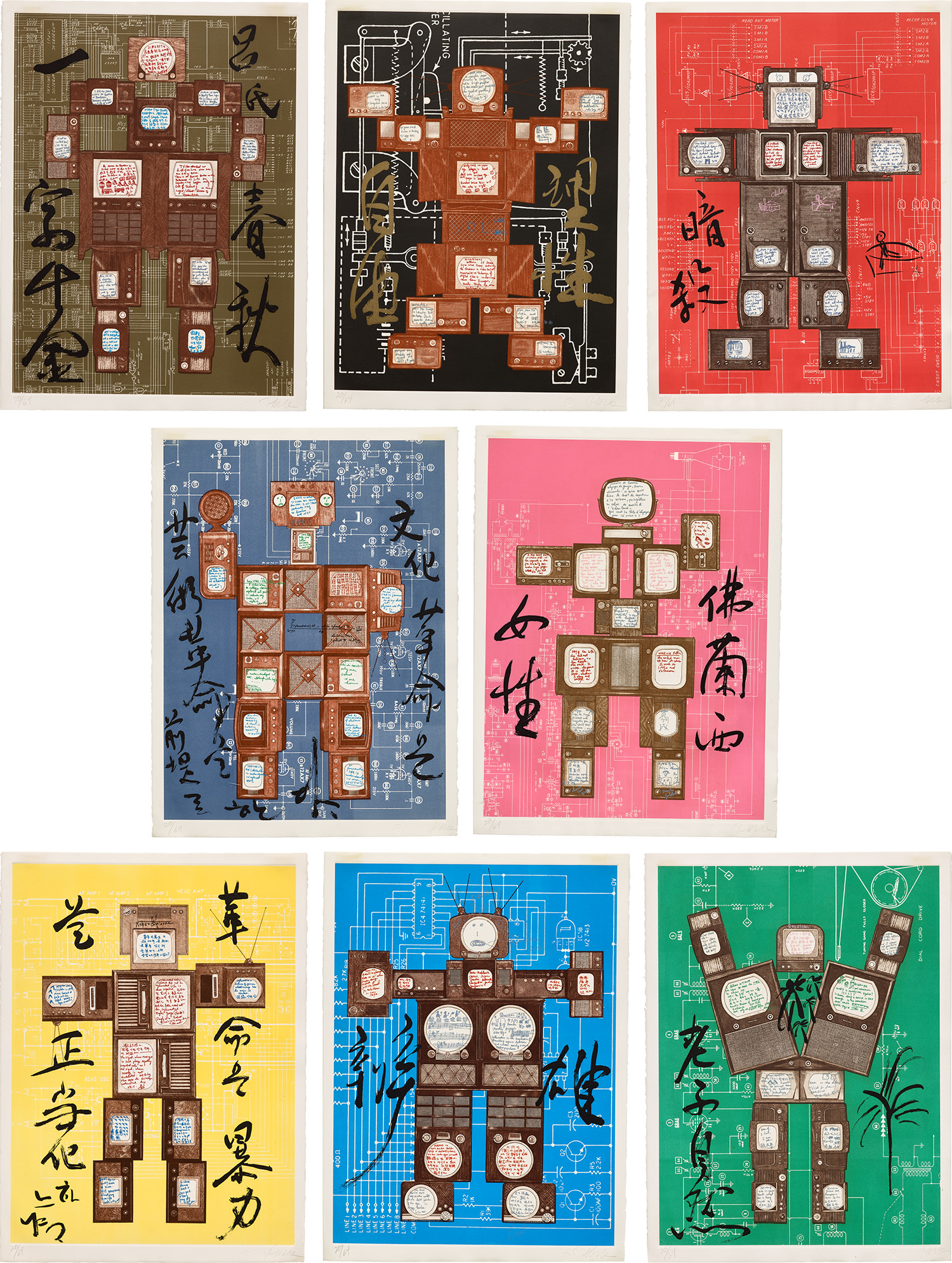
Nam June Paik
Evolution/Revolution/Resolution, 1989
His early education was steeped in classical music, and he showed exceptional promise as a pianist, a training that would inform every aspect of his later practice even as he eventually turned against the instrument itself. When the Korean War forced his family to flee, first to Hong Kong and then to Japan, Paik enrolled at the University of Tokyo, where he studied music and art history, writing his thesis on the composer Arnold Schoenberg. This grounding in the European avant garde tradition gave him both a deep fluency in Western cultural forms and, crucially, a desire to push past them. It was in Germany, at the University of Munich and later at the Freiburg Conservatory, that Paik's trajectory shifted irrevocably.
He encountered the composer Karlheinz Stockhausen and fell into the orbit of John Cage, whose ideas about chance, duration, and the dissolution of the boundary between art and life became formative touchstones. By the early 1960s, Paik had aligned himself with Fluxus, the gloriously unruly international network of artists, composers, and poets who believed that art should be as unpredictable and alive as a heartbeat. His 1960 performance at the Fluxus Festival in Wiesbaden, during which he destroyed a piano on stage, was not mere provocation. It was a declaration of intent, an announcement that the inherited structures of Western culture were available for dismantling and reimagining.
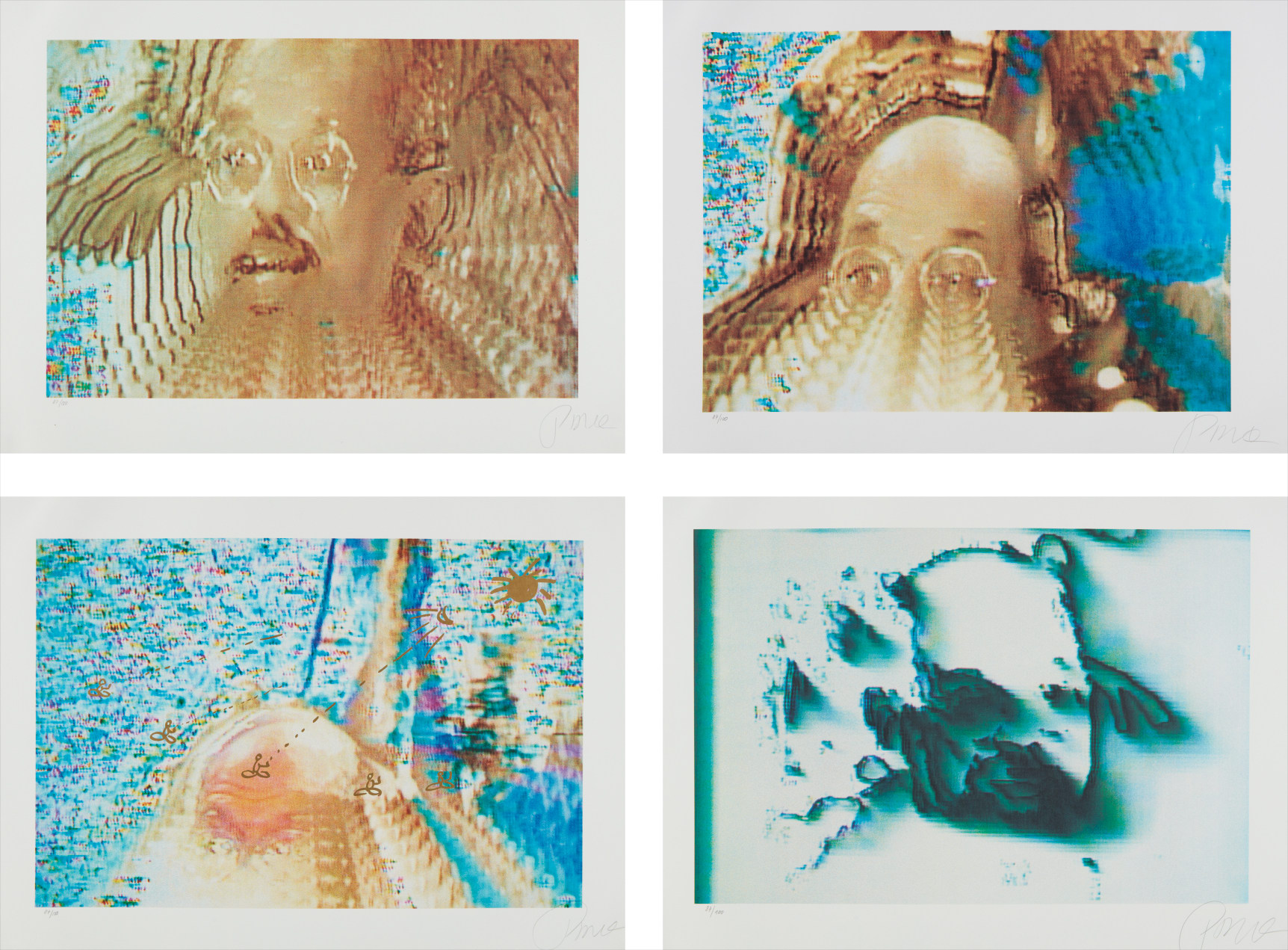
Nam June Paik
Allen in Vision, four plates
The pivot to video came in 1965, the year Paik purchased one of the first Sony Portapak cameras to reach New York, recording Pope Paul VI's motorcade through the city and screening the footage that evening at Cafe au Go Go in Greenwich Village. That single act inaugurated video art as we understand it today. What followed was a career of extraordinary invention. Paik collaborated with the cellist Charlotte Moorman in a series of performances that fused music, performance art, and technology into something genuinely new.
“TV has been attacking us all our lives. Now we can attack it back.”
Nam June Paik, 1965
He created his famous TV Buddha in 1974, placing a serene bronze figure before a closed circuit television that showed its own live image, collapsing centuries of spiritual contemplation into a single, witty, deeply serious loop. His robot sculptures, assembled from obsolete televisions, radios, and electronic components, gave the detritus of consumer culture a strange, totemic dignity. Works like TV Tower from 1998 and the remarkable Gotherbot from 1994, which combines monitors, antique cameras, VHS tapes, and an assortment of repurposed hardware, demonstrate his conviction that obsolescence is not the enemy of meaning but one of its richest sources. Among the works available through The Collection, the range of Paik's practice becomes beautifully visible.
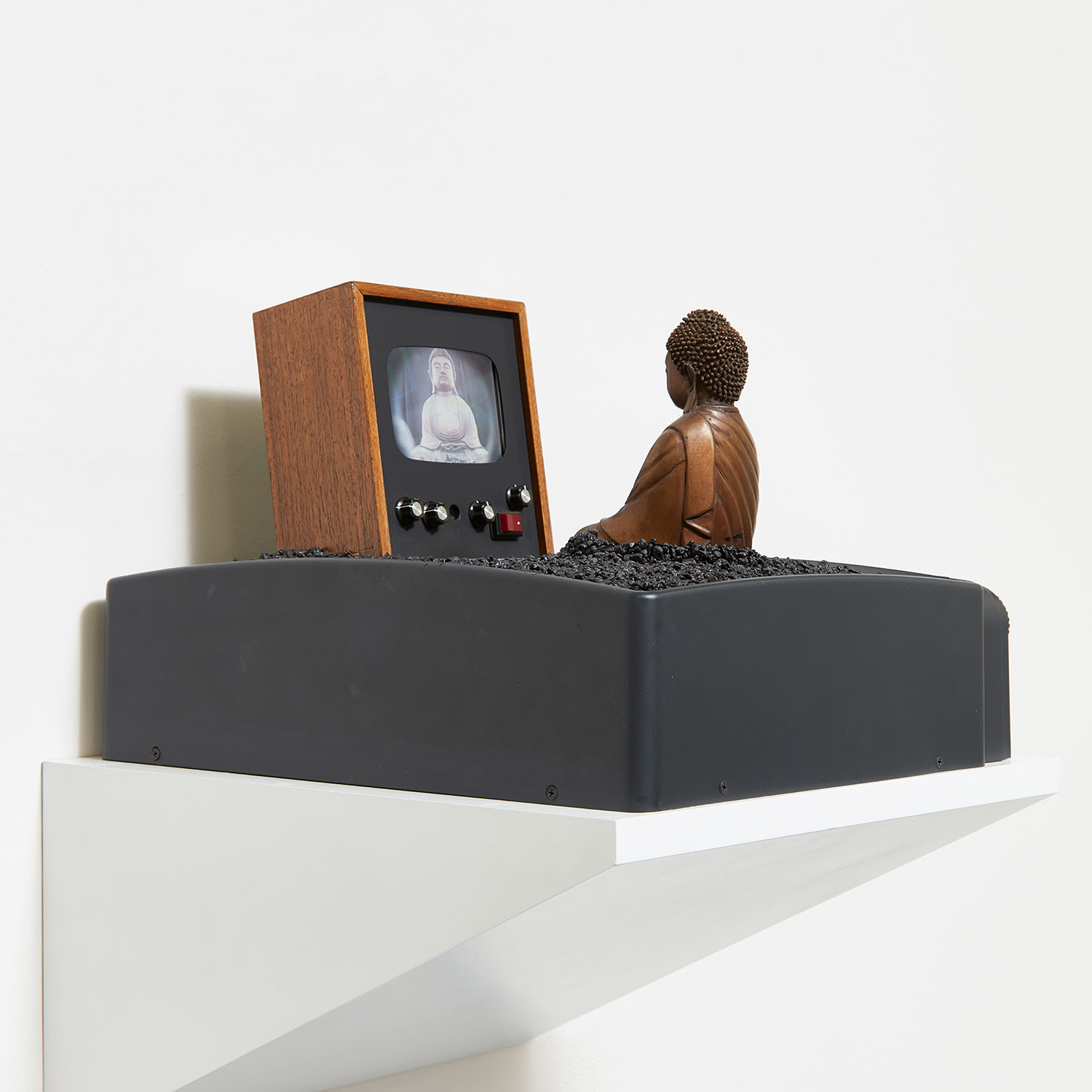
Nam June Paik
Enlightenment Compressed, 1994
Enlightenment Compressed from 1994 brings together a color LCD television, a video camera, a bronze Buddha, and aquarium stones in a wooden cabinet, condensing his lifelong dialogue between Eastern philosophy and Western technology into an object of quiet, meditative power. The print series März, a complete portfolio of twenty lithographs with screenprint on Rives BFK paper, reveals a less often discussed dimension of his work: his commitment to works on paper as spaces of experimentation and playful energy. The Allen in Vision suite, four signed and numbered prints published by Editions Nicole Fauché in Paris, honors Allen Ginsberg with the same affectionate irreverence Paik brought to his canvas tribute to Joseph Beuys, another towering Fluxus figure with whom he maintained a lifelong creative friendship. The work Beuys as Indian Chief and TV Eyes, rendered in ink, oil, and collage on canvas with computer controlled airbrush, is among the most vivid records of that remarkable bond.
For collectors, Paik occupies a singular position in the market. His works span an enormous range of media and scale, from intimate prints and works on paper to large scale video sculptures, which means there are meaningful points of entry at many levels. The print portfolios are particularly valued not only for their rarity and condition but because they document Paik's thinking in a form that is immediate, joyful, and deeply personal. His video sculptures, when they come to market, tend to generate intense competition, in part because their physical complexity and the care required for their preservation makes each surviving example precious.
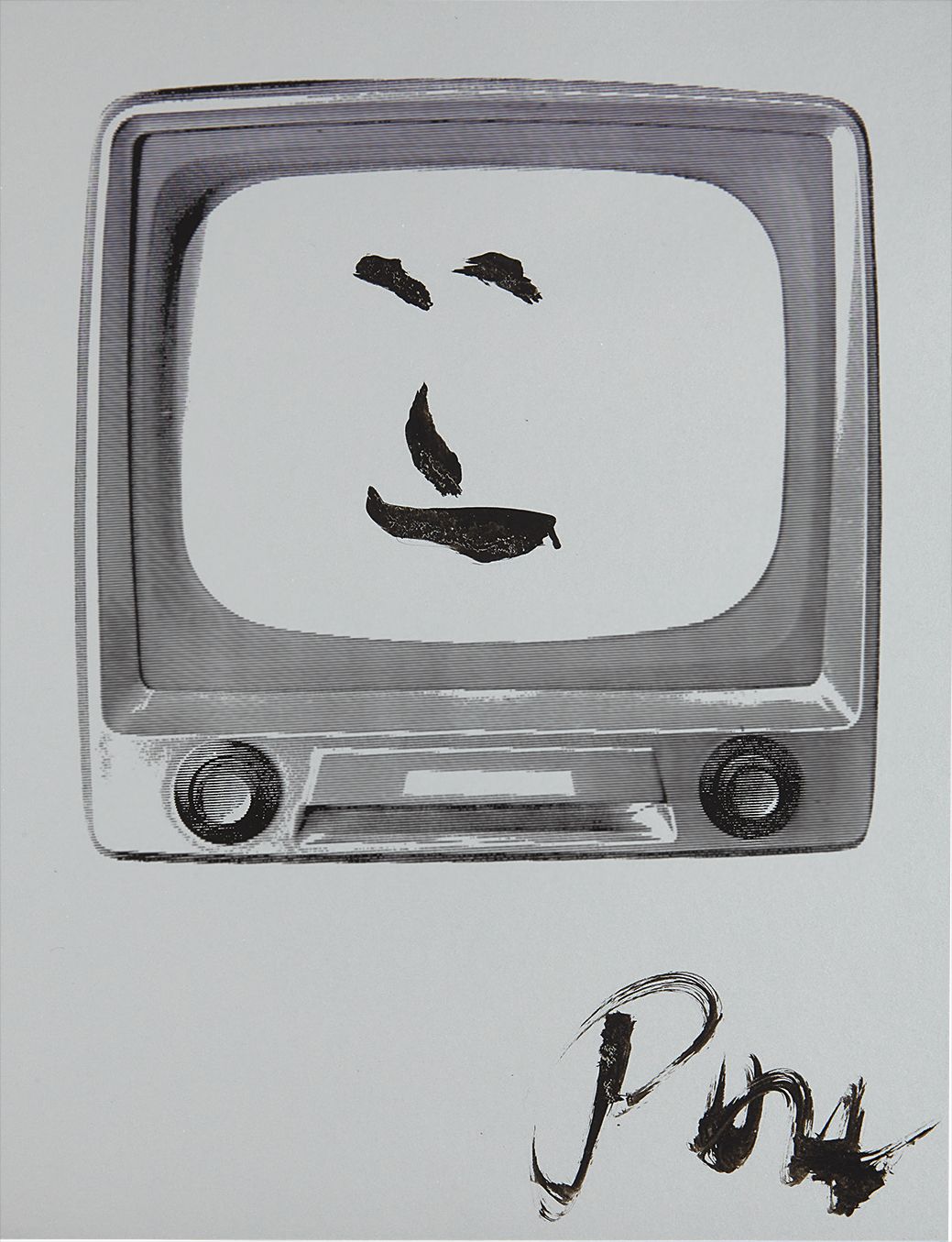
Nam June Paik
Smiling Face
Auction houses including Christie's and Sotheby's have consistently confirmed strong demand for his work across categories, and institutional acquisitions by museums from the Smithsonian American Art Museum to the San Francisco Museum of Modern Art have anchored his critical standing across decades. To understand Paik fully, it helps to situate him within a constellation of peers who shared his appetite for dissolving the boundaries between disciplines. John Cage was his great teacher and inspiration. Joseph Beuys was a kindred spirit.
Artists like Yoko Ono and Wolf Vostell, fellow travelers in the Fluxus world, pursued related questions about participation, duration, and the activation of everyday objects. In the generation that followed, artists including Bill Viola, Gary Hill, and Bruce Nauman have each acknowledged the space that Paik's innovations opened for them, a lineage that now extends to virtually every practitioner working with digital or moving image media today. What makes Paik so vital to engage with now, nearly two decades after his death in Miami in January 2006, is the precision of his prophecy. He understood, at a moment when most artists were still painting or sculpting in inherited traditions, that television and video would become the primary environments of human consciousness.
He did not lament this. He embraced it with curiosity, humor, and a Buddhist sense that transformation is not loss but possibility. His robots wear their obsolete components like medals. His Buddha faces its own reflection without anxiety.
In a culture that often experiences technology as alienating or overwhelming, Paik's work offers something rarer: the genuine warmth of a mind that loved the modern world enough to wrestle with it on its own terms, and to find beauty in the static.
Explore books about Nam June Paik
Nam June Paik: A Retrospective
John G. Hanhardt
Nam June Paik: Fluxus Master
John G. Hanhardt and Michael Mansfield
Nam June Paik: Robot K-456; Variations on Themes of Korea
Walter Grasskamp
Nam June Paik: Hongik University Museum of Art Retrospective
Nam June Paik Art Center
Video Art: Nam June Paik
Maria Vesna and others
Nam June Paik: 1932-2006
Barbara London
Nam June Paik: The Worlds of Nam June Paik
John G. Hanhardt
Nam June Paik: Exposition of Music - Electronic Television
David Ross