Mickalene Thomas
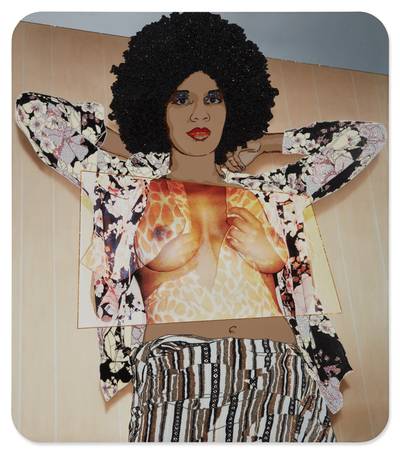
Mickalene Thomas Shines on Her Own Terms
Artist Spotlight · The Collection Editorial
“I want to create a kind of portraiture that gives Black women the visibility and dignity that has historically been denied them.”
Mickalene Thomas, Brooklyn Museum interview
In 2025, Mickalene Thomas released a new mixed media work titled A Little Taste Outside of Love, a title that carries the same warm audacity that has defined her practice for more than two decades. It arrives at a moment when Thomas is as critically celebrated as she has ever been, her work appearing in major institutional collections from MoMA to the Guggenheim, and her influence felt across a generation of artists who have followed her in centering Black feminine experience with unapologetic joy. The work is both a continuation and a deepening, a signal that Thomas has no intention of standing still. Mickalene Thomas was born in 1971 in Camden, New Jersey, and her early life was shaped by the vivid, complicated presence of her mother, Sandra Bush, a woman of striking beauty and magnetic personality who would become one of Thomas's most enduring subjects.
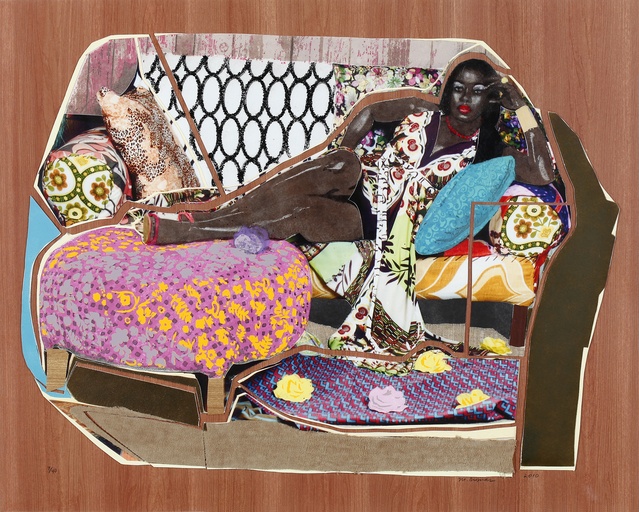
Mickalene Thomas
You're Gonna Give Me the Love I Need, 2010
Growing up in proximity to that kind of feminine power, and later grappling with it through the lens of her own identity as a queer Black woman, gave Thomas material that was intensely personal and, it turned out, universally resonant. She went on to study at the Pratt Institute in Brooklyn before completing her MFA at the Yale School of Art in 2002, entering one of the most rigorous and storied programs in American art education at exactly the right moment to sharpen her conceptual instincts. Her development as an artist drew on an unusually wide constellation of references. She looked closely at the history of Western portraiture and found it lacking, found it structured around an idea of beauty and worthiness that systematically excluded women who looked like her.
She turned to Henri Matisse and Gustave Courbet with curiosity and a certain productive suspicion, absorbing their compositional strategies and their lush chromatic sensibilities while insisting on replacing their subjects with her own. She also looked to Romare Bearden, to blaxploitation cinema, to the pages of Jet and Ebony magazines, and to the interiors of domestic Black life as spaces of genuine grandeur. What emerged from this process was a visual language that felt entirely her own. The defining material move of Thomas's practice is, of course, rhinestones.
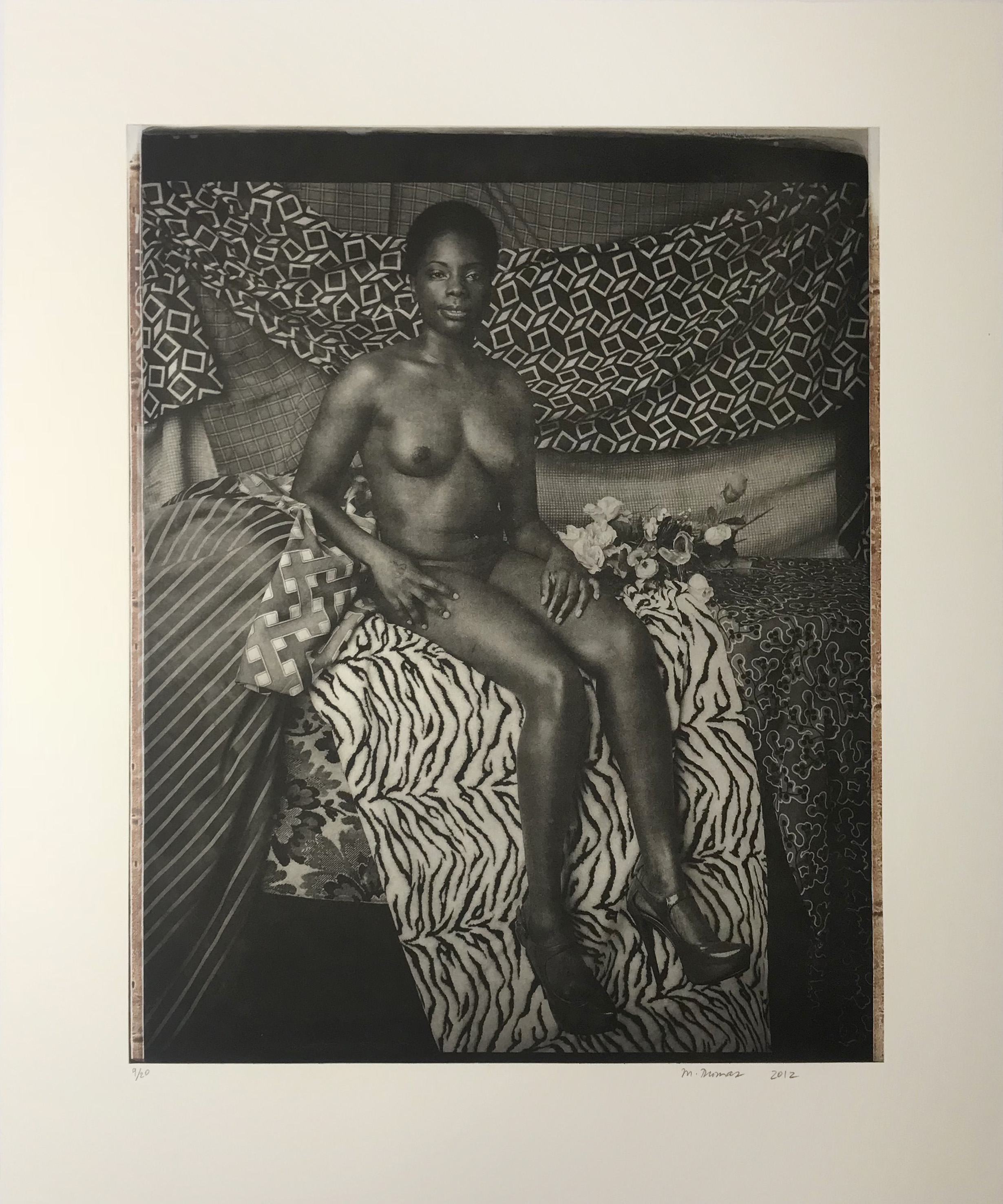
Mickalene Thomas
Portrait of Marie Sitting in Black and White, 2012
From the mid 2000s onward she began embedding these small, glittering elements into her large scale paintings on wood panel, creating surfaces that catch and hold light in ways that conventional paint simply cannot. Works like All She Wants to Do Is Dance (Fran), completed in 2009 in rhinestones, acrylic and enamel on panel, and Clarivel Right from 2014, which adds oil and glitter to that signature mix, demonstrate the full effect of this approach. The figures in these paintings radiate from within the picture plane, commanding attention not because the viewer is told to look but because the work makes looking irresistible. There is something deeply democratic and deeply subversive about choosing rhinestones, a material associated with glamour, performance and the aesthetics of working class celebration, as the vehicle for a conversation with the grand tradition of European oil painting.
“Rhinestones are about spectacle, but they are also about the everyday glamour of Black women I grew up around.”
Mickalene Thomas, Art in America
Thomas's output extends well beyond painting into collage, photography, installation, and printmaking, and in each medium she maintains the same conceptual clarity. Her photogravure Portrait of Marie Sitting in Black and White from 2012 and the luminous Portrait of Maya 10 from 2024, a UV pigment print layered with screenprint, glitter and varnish on Somerset paper, show how fluidly she moves between processes. Her prints have become particularly important within her market, offering collectors a chance to acquire works of real ambition and material complexity at a range of price points. The series Trois Divas, published by Brand X Editions in New York, and the singular mixed media print I Have Been Good to Me, which incorporates screenprint, monoprint, silica flocking and wood veneer, exemplify the seriousness and invention she brings to multiples.
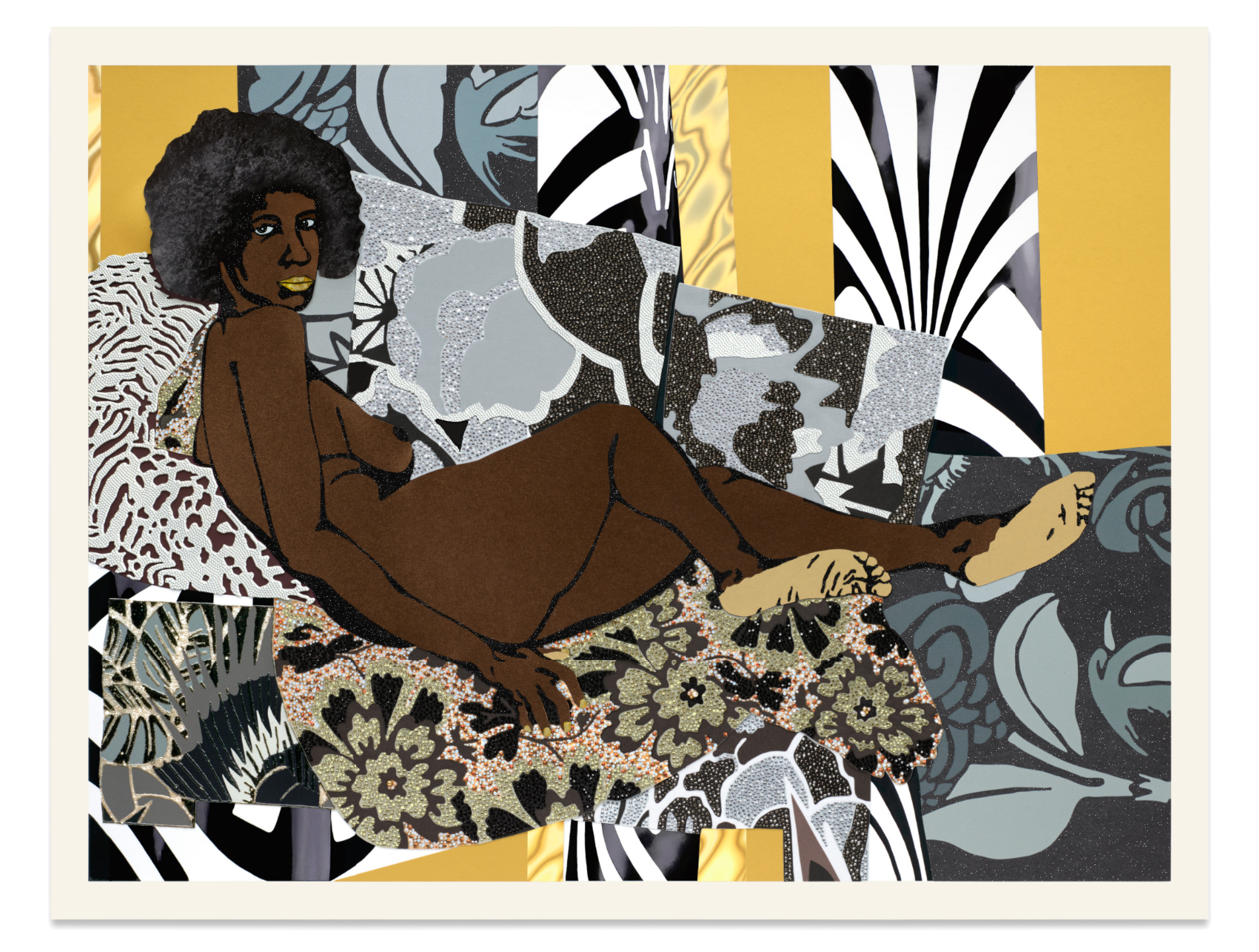
Mickalene Thomas
A Little Taste Outside of Love, 2025
These are not afterthoughts; they are fully realized works. For collectors approaching Thomas's market, the breadth of her practice is both the challenge and the opportunity. At the primary level, her paintings on panel represent some of the most sought after works in contemporary American art, and her institutional footprint, with major pieces at MoMA and the Guggenheim and exhibition histories at the Brooklyn Museum and the Aspen Art Museum, provides the kind of context that sophisticated collectors look for. Her works on paper and editioned prints offer a meaningful entry point and have demonstrated consistent appeal.
Collectors are drawn not only to the visual drama of her work but to its intellectual coherence: Thomas is building a body of thought as much as a body of objects, and the works read more richly the more one understands the tradition she is simultaneously honoring and revising. In the broader landscape of contemporary art, Thomas belongs to a group of painters who have transformed how portraiture functions in the twenty first century. Her conversation with artists like Kerry James Marshall, Kehinde Wiley, and Titus Kaphar around the reclamation of Black subjectivity in painting is one of the defining cultural dialogues of our era. She is equally in dialogue with figures like Kara Walker and Lorna Simpson, who have used different strategies to interrogate how race and gender are constructed through image making.
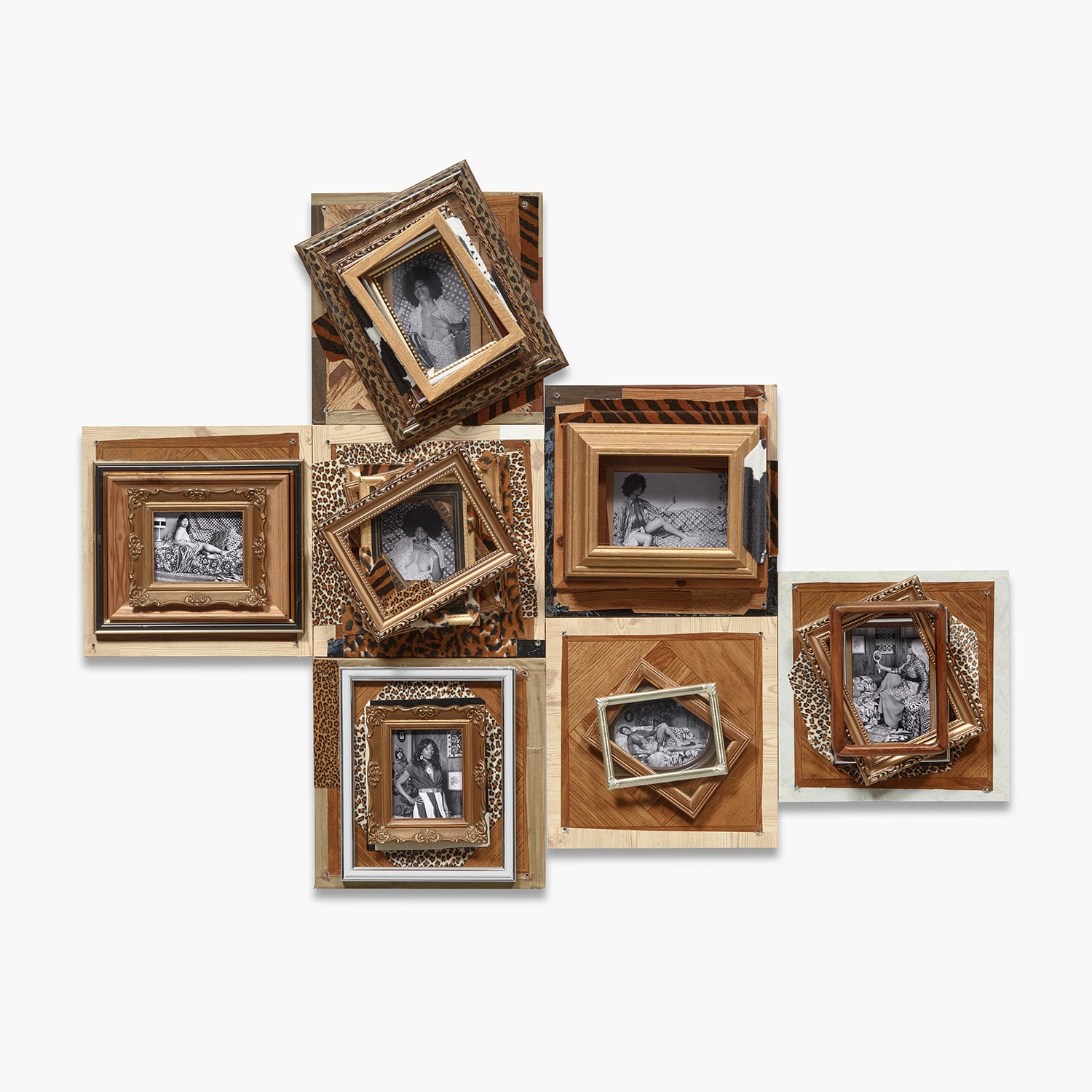
Mickalene Thomas
Photomontage 5
Thomas's particular contribution to this conversation is the insistence on pleasure, on the erotic charge and genuine delight that her compositions invite, as an intellectual and political position in its own right. What will endure about Mickalene Thomas is the completeness of her vision. She arrived at her practice knowing exactly what she wanted to say and invented the tools to say it with maximum feeling. The rhinestones, the interiors, the reclining figures, the layered references, the luminous prints, all of it coheres into a world that is unmistakably hers.
At a moment when the art world is rightly asking harder questions about whose beauty counts, whose interiority matters, and whose pleasure deserves to be memorialized in paint, Thomas has already been answering those questions for twenty years, with brilliance and with joy.
Explore books about Mickalene Thomas