Michael Delucia
Michael DeLucia Builds Beauty From Industrial Bone
Artist Spotlight · The Collection Editorial
Something has shifted in the conversation around geometric abstraction, and Michael DeLucia sits comfortably at the center of that shift. Galleries across the United States have steadily grown their representation of artists working at the intersection of minimalist form and fabricated material, and DeLucia's practice stands out as one of the more intellectually rigorous and visually arresting voices in that space. His sculptures and works on plywood panels carry the quiet confidence of an artist who has spent decades refining a singular vision, one that rewards sustained attention and reveals new dimensions the longer you stand before it. DeLucia was born in 1978, part of a generation of American artists who came of age during a period of tremendous restlessness in contemporary art, when the legacy of minimalism was being interrogated, expanded, and occasionally dismantled by a new wave of practitioners unafraid to blend industrial fabrication with conceptual rigor.
Michael Delucia
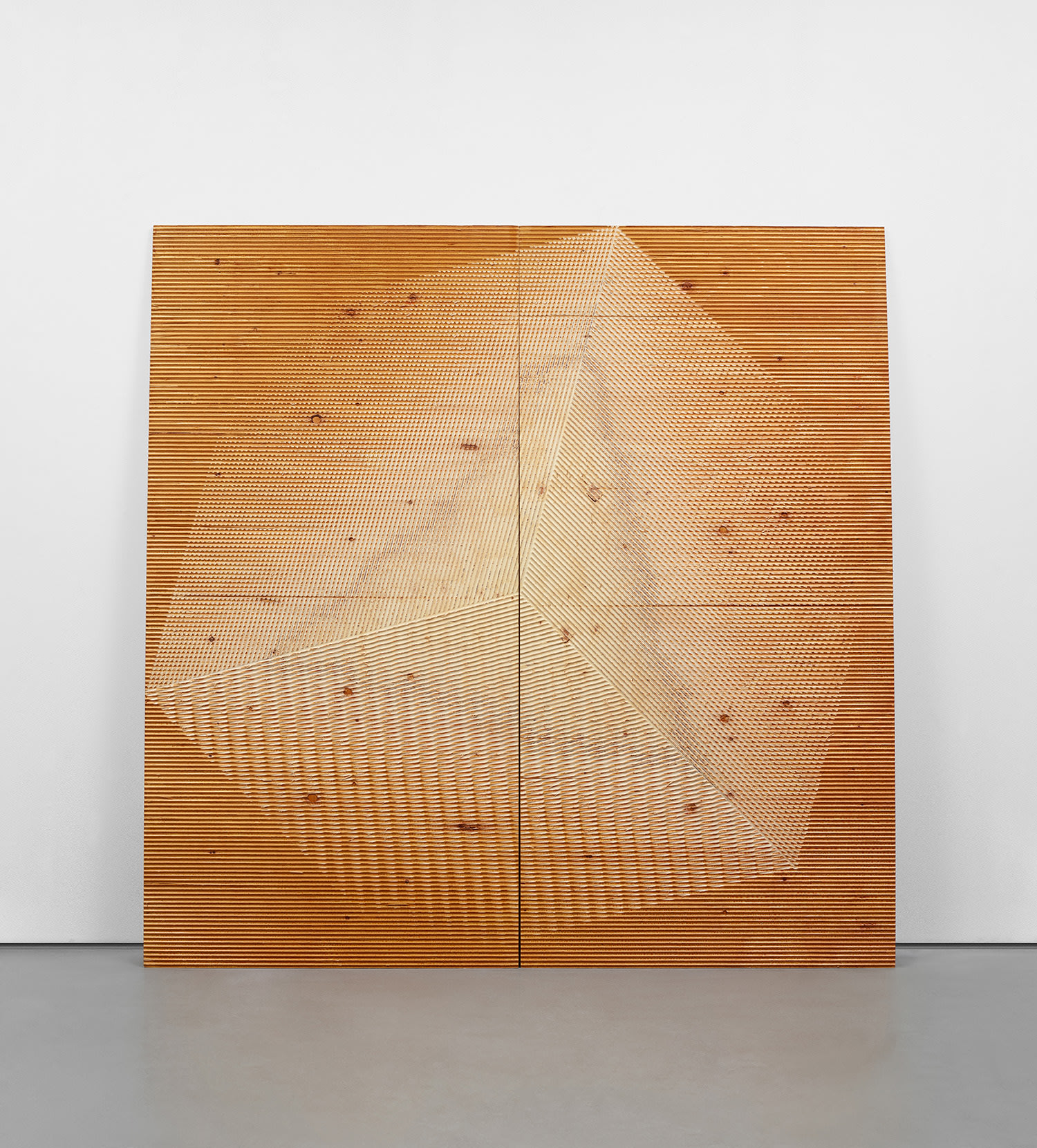
shellac on plywood, in 2 parts, 2012
That generational position gave DeLucia both a deep respect for the formal traditions that preceded him and a freedom to push beyond their more austere constraints. His formation as an artist reflects an absorption of that dual inheritance, and his mature work feels like a genuine synthesis rather than a simple reaction. The development of DeLucia's practice has moved through several distinct phases, each building upon the last with a sense of careful accumulation rather than abrupt rupture. His early engagement with welded steel and wire mesh established the foundational vocabulary of his sculptural work: an interest in how fabricated industrial materials could be coaxed into producing effects of lightness, transparency, and spatial ambiguity.
Those large scale constructions played with shadow and negative space in ways that felt both architecturally grounded and almost atmospheric, as though the structure were as interested in the air around it as in its own material presence. Over time, that investigation migrated and expanded onto the flat plane of plywood panels, where DeLucia began applying shellac, acrylic, and high pressure laminate in configurations that maintain the geometric rigor of his three dimensional work while opening new questions about surface, depth, and the nature of pictorial space. Among the works that best represent the depth of DeLucia's thinking are his plywood panel pieces, several of which are presented in two part configurations that invite the viewer to consider how meaning is constructed through adjacency and repetition. "Shellac on Plywood, in 2 Parts" from 2012 is a quietly revelatory work, deploying the humble material of shellac with a precision and sensitivity that transforms what might seem like a straightforward industrial process into something almost meditative.
Michael Delucia
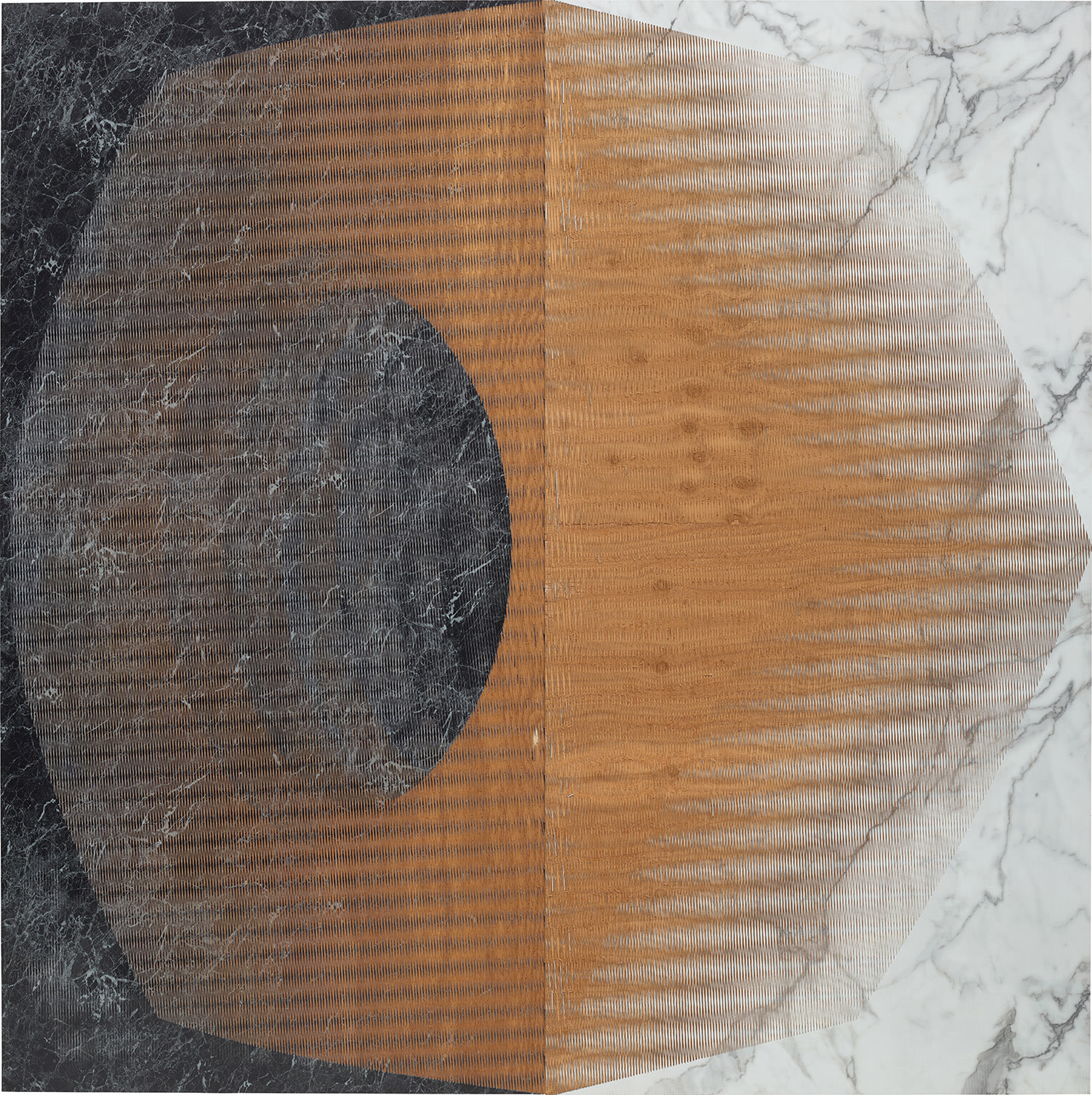
high pressure laminate on plywood, in 2 parts, 2014
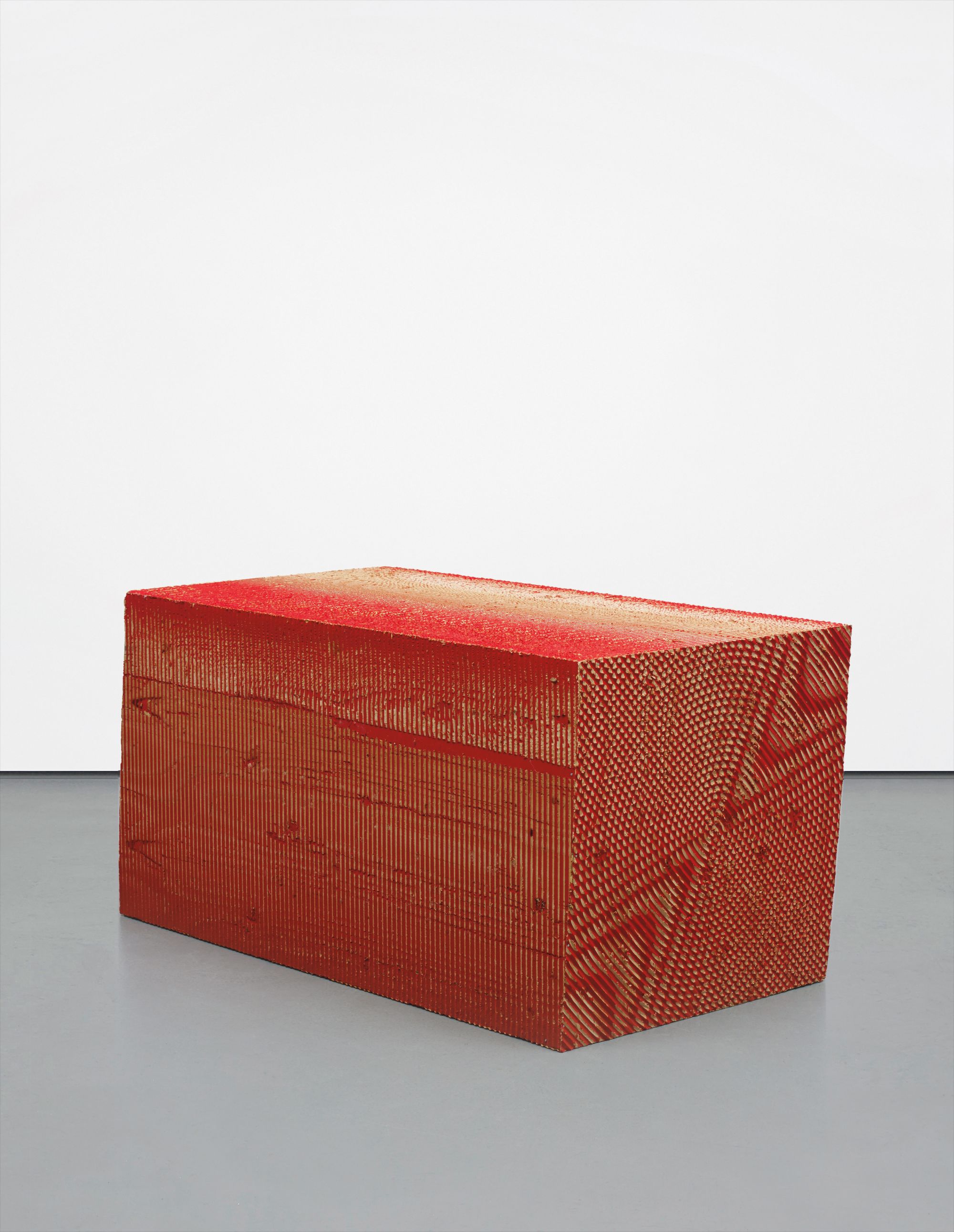
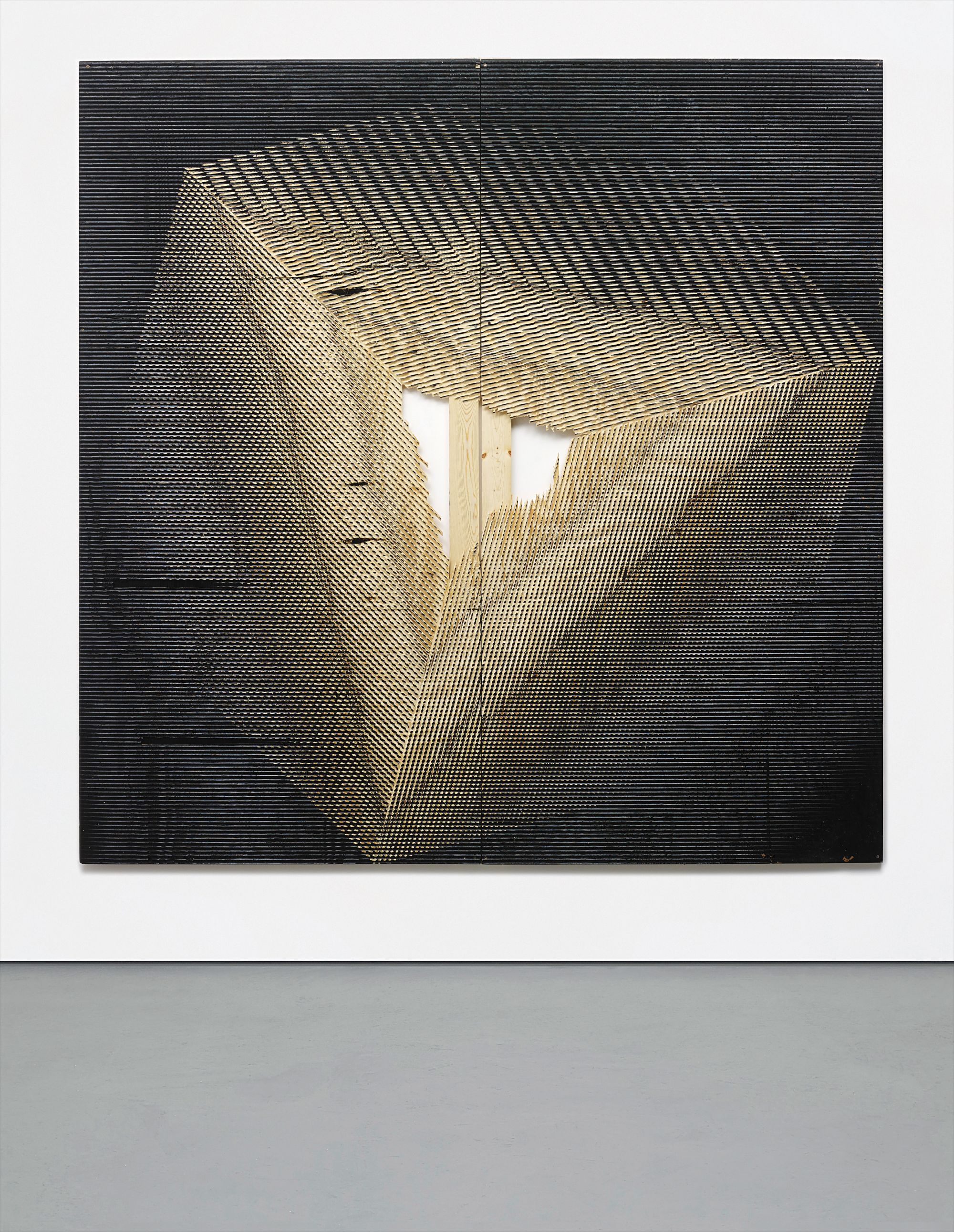
The 2014 "High Pressure Laminate on Plywood, in 2 Parts" pushes that sensibility further, using a material more commonly associated with commercial interiors to achieve an effect that is simultaneously cool and intimate. Works like "Cube (Black)" and "Cube (Projection 5)" extend his geometric investigations into territory that recalls the great minimalist lineage of Donald Judd and Sol LeWitt while remaining entirely and recognizably DeLucia's own. "Box (White/Blue) B" from 2011 is another touchstone, its restrained palette and architectural clarity making it one of the more immediately compelling entry points into his practice for collectors encountering his work for the first time. For collectors, DeLucia's work presents an unusually compelling proposition.
The plywood panel works in particular offer a point of access that feels both intellectually serious and domestically livable, qualities that do not always coexist so gracefully in contemporary geometric abstraction. There is nothing forbidding about DeLucia's surfaces even as they ask genuine questions about materiality and perception. Collectors who are drawn to artists working in the tradition of minimalism and post minimalism, those who admire figures like Tauba Auerbach, Pae White, or Wade Guyton, will find in DeLucia a practice that shares their rigorous formal commitments while maintaining a warmth of surface and a craftsmanly attention to material that sets his work apart. The two part panel works are especially worth seeking, as they demonstrate most fully his interest in seriality and the generative tension between repetition and difference.
Michael Delucia
Log
DeLucia's work situates itself within a lineage that stretches back through the great American minimalists and post minimalists of the 1960s and 1970s, but it does so without nostalgia or pastiche. Where Judd pursued the industrial object as a philosophical statement about objecthood itself, DeLucia is more interested in the residue of process, the way a material carries the evidence of its making and the decisions of its handler. His engagement with laminate and shellac echoes the interest that artists like Jessica Stockholder and Tom Burr have shown in vernacular and commercial materials, finding within them a richness that more conventionally prestigious art materials can rarely match. He shares with Wade Guyton and Kelley Walker a fascination with how industrial processes can produce objects that confound easy categorization, occupying the space between painting, sculpture, and functional object with genuine ease.
What makes DeLucia matter today is precisely his commitment to a practice that refuses the spectacular in favor of the considered. At a moment when so much contemporary art competes for attention through scale and provocation, his work asks for something different: patience, proximity, and a willingness to let meaning accumulate slowly. The plywood panels reward that patience by revealing, over time, a universe of subtle decisions, about grain and surface and the precise weight of a color against a neighboring form, that make each work feel like a complete statement. His sculptures, with their play of light through steel and mesh, remind us that space itself is a material, one that can be shaped and articulated with as much care as any solid object.
Michael Delucia
Cube (black)
DeLucia is an artist whose reputation has grown steadily and whose work, once encountered, tends to stay with the collector in ways that more immediately arresting art often does not. That staying power is among the most reliable indicators of lasting importance, and it is one that collectors would do well to take seriously.
Explore books about Michael Delucia
Michael Delucia: The Complete Works
Robert C. Morgan
Delucia: Paintings and Drawings 1990-2010
Peter Halley
The Architecture of Abstraction: Michael Delucia's Visual Language
Linda Shearer
Michael Delucia: A Monograph
Carolyn Christov-Bakargiev
Color and Form: The Evolution of Michael Delucia's Work
Michael Auping