Michael Childers
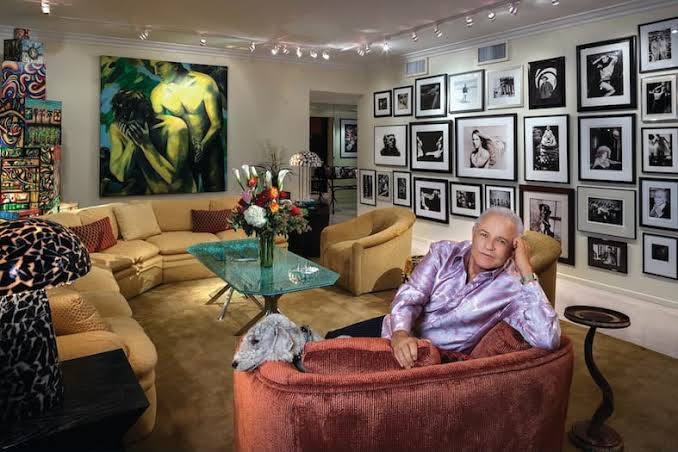
Michael Childers, Witness to a Brilliant World
Artist Spotlight · The Collection Editorial
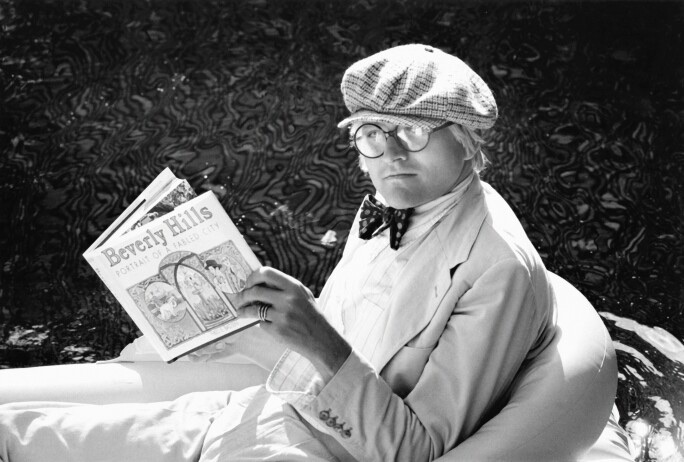
There is a particular photograph that stops people in their tracks. It is 1980, and David Hockney floats on a raft in a sun drenched pool, utterly absorbed in a book, entirely himself. The image is tender and unhurried, a stolen moment of genius at rest. Michael Childers made it, and in doing so, he captured something essential not just about Hockney but about the entire luminous world the two men shared.
Michael Childers
David Hockney (Hockney in raft with book), 1980
That photograph has become one of the defining images of a cultural era, a reminder that the greatest portraits are acts of love as much as acts of vision. Michael Childers was born in 1947 and grew up in the American South, eventually making his way to California, where he enrolled at the University of Southern California's School of Cinema. It was a formative education, one that attuned him to the grammar of images and the architecture of a frame. Los Angeles in the late 1960s and early 1970s was a crucible of creative energy, a place where Hollywood glamour collided with countercultural experimentation and the emerging language of gay liberation.
Childers absorbed all of it. He developed an eye trained equally on spectacle and on quiet human truth. His relationship with the British director John Schlesinger, which began in the early 1970s and lasted until Schlesinger's death in 2003, placed Childers at the very center of international artistic life. Through Schlesinger he moved between the worlds of cinema, theater, music, and fine art with remarkable fluency.
He photographed the great figures of his time not as a distant observer but as a trusted companion. Andy Warhol, Rudolf Nureyev, Helmut Berger, Faye Dunaway, Elton John, and countless others sat for him or were caught in unguarded moments that revealed far more than any formal session might. His access was extraordinary, and his discretion was absolute. What distinguishes Childers's practice from that of his contemporaries in celebrity and arts photography is precisely this quality of intimacy without intrusion.
He understood that the most revealing portrait is made at the moment a subject forgets the camera is there. His work with David Hockney is perhaps the finest expression of this instinct. The two men were genuine friends, and the photographs Childers made of Hockney across several decades constitute an extraordinary visual biography of one of the twentieth century's most important painters. The 1980 raft image belongs to this body of work: casual in its composition, profound in its feeling, and technically assured in the way it uses California light to build a mood of complete contentment.
Childers's photographs were exhibited internationally during his peak working decades, appearing in major galleries and museums that recognized the documentary and artistic significance of his archive. His work sits at the intersection of several important traditions. He inherits something from the great Hollywood portrait photographers of the studio era, figures like George Hurrell, who understood the relationship between light and legend. He is equally connected to the tradition of documentary portraiture practiced by artists such as Peter Hujar and Robert Mapplethorpe, who were his contemporaries and who shared his commitment to photographing LGBTQ+ life and culture with dignity, complexity, and unflinching beauty.
Placed alongside the work of Mapplethorpe or Hujar, Childers's photographs read as part of a coherent cultural project: the creation of an alternative archive, a record of lives and communities that mainstream culture was slow to acknowledge. For collectors, the appeal of Childers's work is multidimensional. On one level, his photographs offer direct access to some of the most significant cultural figures of the late twentieth century, documented at close range by someone they trusted. A Childers print is not a press photograph or a paparazzi shot.
It carries the weight of genuine relationship. On another level, his images are simply beautiful objects, rigorously composed and printed, that reward extended looking. The market for mid century and late century documentary photography has strengthened considerably over the past decade, with collectors increasingly recognizing that the photographic archive of the post war artistic world is finite and historically irreplaceable. Works by photographers who moved in the same circles as Childers, including Hujar and Mapplethorpe, have achieved significant auction records at houses including Christie's and Sotheby's, and the broader critical reappraisal of this generation continues to bring new attention and new prices.
Collectors drawn to Childers's work often describe the experience of acquiring a print in terms that go beyond conventional art market logic. There is something about holding a photograph of Hockney at leisure in 1980, or Nureyev caught in a corridor, or Warhol in an unguarded moment, that feels like inheriting a piece of lived history. The photographs function simultaneously as aesthetic objects and as primary documents. This dual nature is increasingly valued in serious collections, where the conversation between artistic quality and cultural significance has become one of the central questions of contemporary collecting practice.
It is worth noting that Childers continued his image making work into documentary filmmaking, bringing the same sensibility he developed as a still photographer to longer form visual storytelling. This expanded practice underscores the coherence of his creative vision. Whether in a single frame or across the duration of a film, he has always been interested in the same essential question: what does a human being look like when they are most fully themselves. That question has animated some of the finest portraiture in the history of the medium, and Childers belongs in that lineage without qualification.
Today, as institutions and collectors undertake a sustained reconsideration of LGBTQ+ cultural production and its place in art history, Childers's archive carries additional significance. He documented a world and a community at a moment of enormous creative fertility, before loss and epidemic reshaped that community irrevocably. His photographs are records of joy and of genius, made with love and with skill by someone who was himself part of the story. That insider perspective, so rare and so irreplaceable, is what gives his work its lasting power.
To collect Michael Childers is to invest in one of the essential visual accounts of twentieth century cultural life, made by a man who was there, who cared, and who knew exactly what he was seeing.