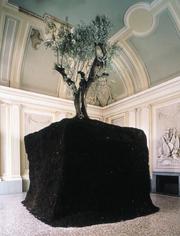
Maurizio Cattelan

Maurizio Cattelan, Art's Greatest Irreverent Genius
Artist Spotlight · The Collection Editorial
“I have nothing to say, and I am saying it.”
Maurizio Cattelan
Few artists in the contemporary world have managed to hold an entire culture in suspense quite like Maurizio Cattelan. When his work "Comedian" a banana duct taped to a wall sold at Art Basel Miami Beach in December 2019 for $120,000, and then again at Sotheby's New York in November 2024 for $6.2 million, the world erupted in a familiar mixture of laughter, outrage, and genuine wonder. That reaction, equal parts bewilderment and delight, is precisely the territory Cattelan has occupied for over three decades.
Maurizio Cattelan
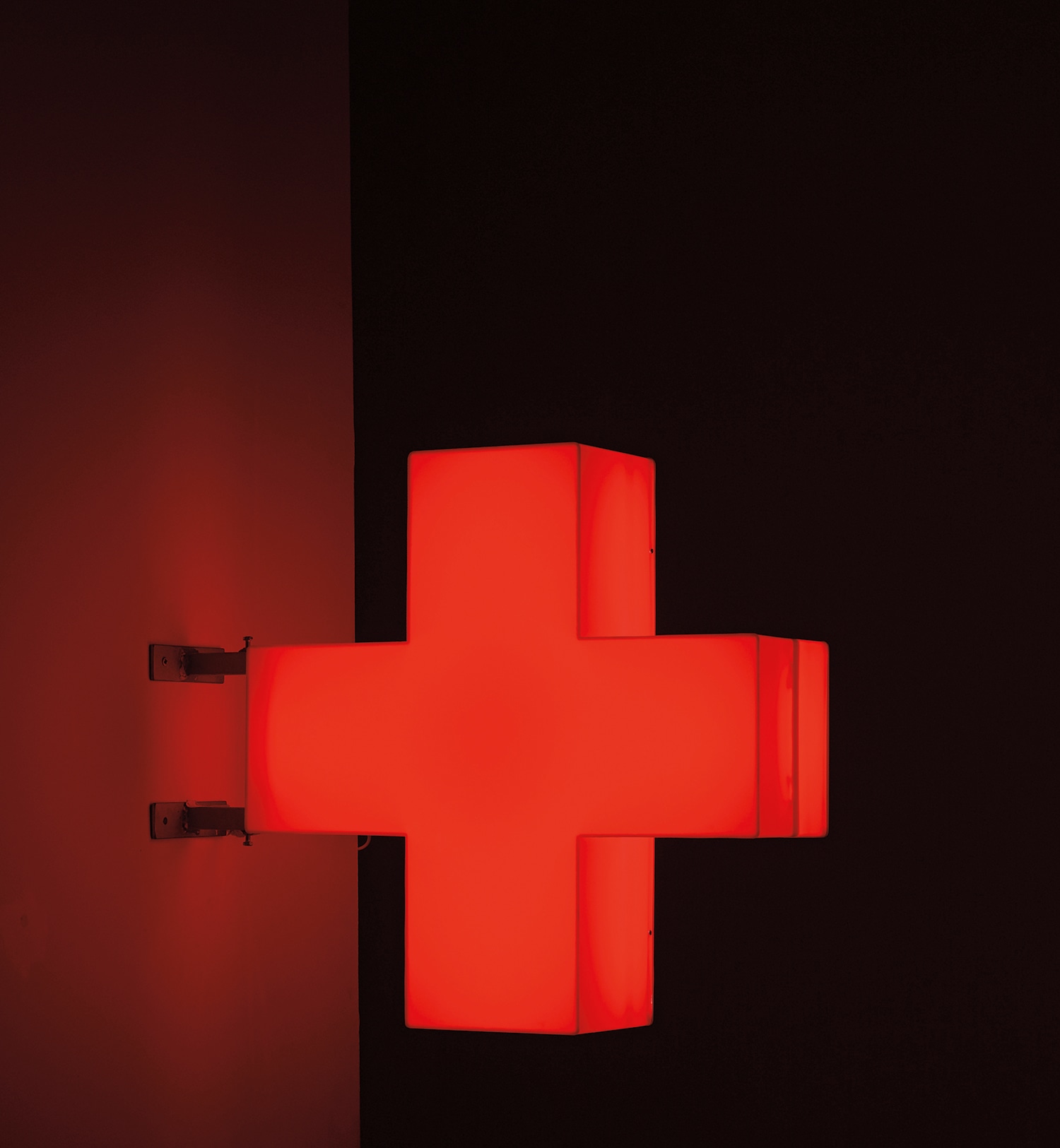
electric light, perspex, metal, transformer and wall bracket, 1997
He is, without question, one of the most consequential and entertaining artists alive. Cattelan was born in Padua, Italy, in 1960, into modest circumstances that offered little obvious runway toward an international art career. He was largely self taught, never completing a formal art school education, and spent his early years working a series of odd jobs including as a mortuary assistant, a gardener, and a furniture maker. These experiences, grounded in the practical and the unglamorous, left an unmistakable imprint on an artistic sensibility that would always privilege the physical, the absurd, and the surprisingly tender over the purely theoretical.
Italy in the 1960s and 1970s was also alive with Arte Povera and its radical reimagining of materials and meaning, a current that quietly shaped how Cattelan thought about objects and their relationship to the world. His artistic career began gaining traction in the late 1980s and early 1990s, though his early work was marked as much by cunning as by craft. Cattelan famously rented out his exhibition space at the Venice Biennale to a perfume company when he could not afford to produce new work, presenting the transaction itself as the artwork. This gesture announced everything essential about him: the refusal of conventional artistic piety, the embrace of the institution as both subject and material, and a wit sharp enough to cut through pretension without ever losing genuine feeling.
Maurizio Cattelan
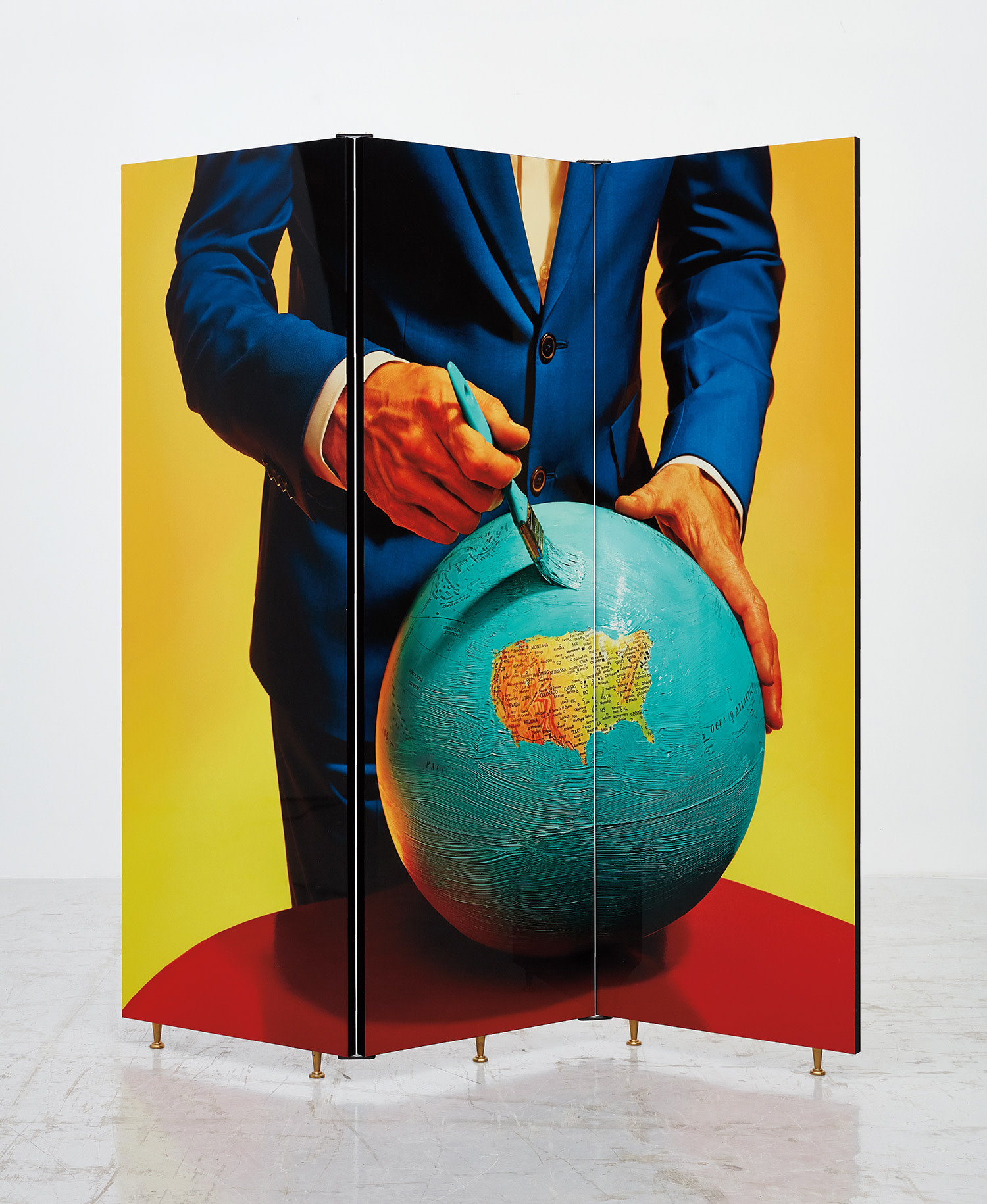
varnish and UV color print on wood screen with brass and metal hardware, 2015
By the mid 1990s he was working with galleries including Massimo De Carlo in Milan and later Marian Goodman Gallery, and his reputation as one of the most provocative and original voices in European art was firmly established. The works that made Cattelan internationally famous are almost impossible to encounter without feeling something shift in your understanding of what sculpture can be. "Him" (2001) presents a kneeling child sized figure of Adolf Hitler in prayer, a work of such concentrated moral complexity that viewers routinely report being unable to look away. "La Nona Ora" (1999), depicting Pope John Paul II struck down by a meteorite, sparked protests in the Polish parliament and became one of the most discussed works of its era.
“Everyone is forced to change roles every single moment of his life.”
Maurizio Cattelan
His full size stuffed horse suspended through a ceiling, "Novecento" (1997), and the three schoolboys hanging by their necks from an oak tree in Milan's Piazza XXIV Maggio, "L.O.V.E.
Maurizio Cattelan
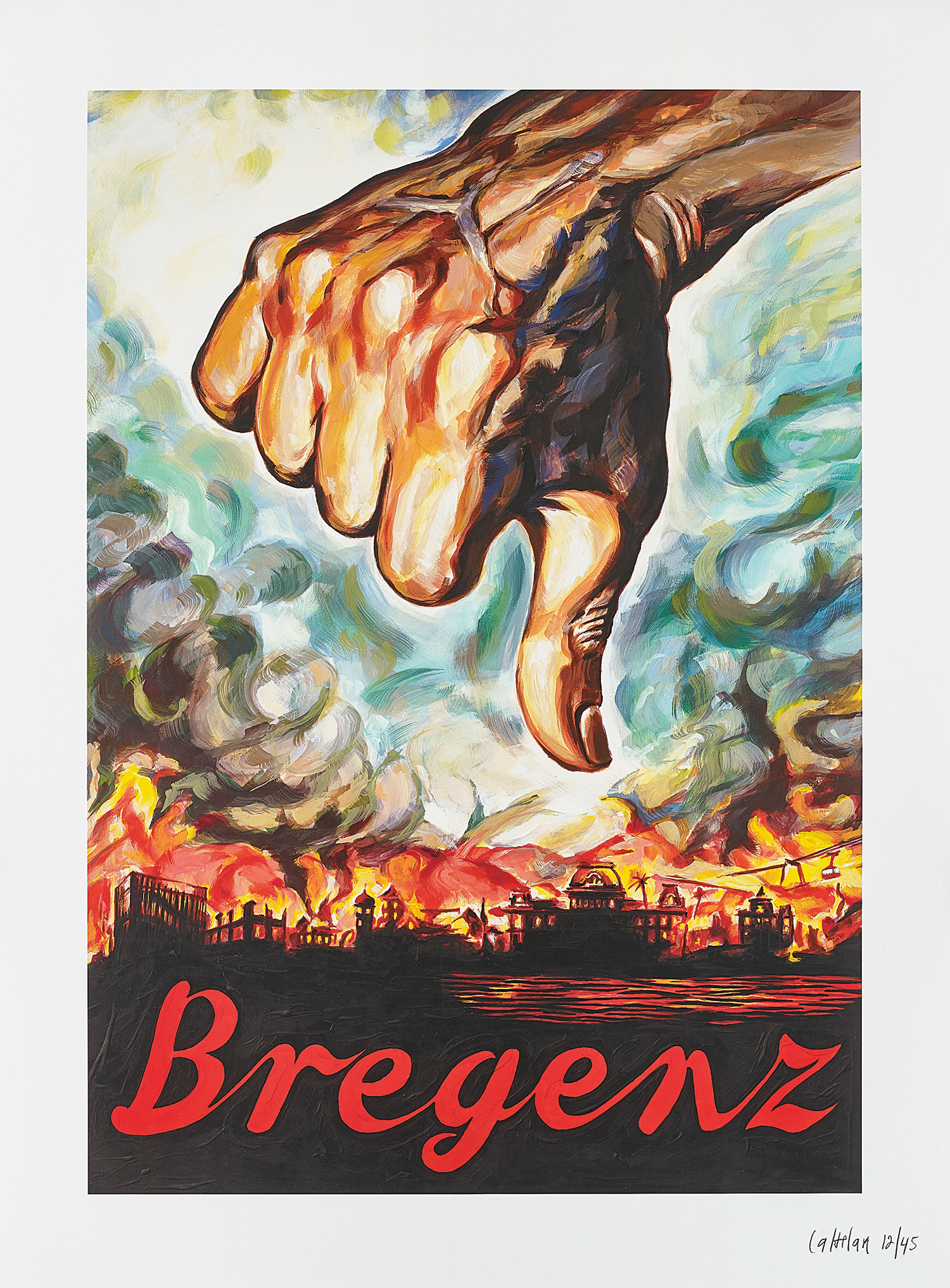
Bregenz
" adjacent in spirit if not in form, collectively constitute a body of work unafraid of discomfort. Yet underneath the provocation is always a profound humanism, a genuine curiosity about mortality, power, failure, and grace. The 2008 work "Daddy Daddy" in polyurethane resin, steel, and epoxy paint extends this vocabulary into something at once monumental and intimate, the relationship between scale and emotion being one of Cattelan's most reliable and moving instruments. Cattelan announced his retirement from art making in 2011, staging an extraordinary retrospective at the Solomon R.
Guggenheim Museum in New York titled "All," in which he suspended virtually his entire body of work from the museum's famous rotunda. It was a gesture of both farewell and self assessment, hanging his life's work quite literally in mid air. The retirement did not hold. By the mid 2010s he was making work again, including the solid gold toilet titled "America" (2016), installed in a working bathroom at the Guggenheim and later stolen from Blenheim Palace in 2019.
Maurizio Cattelan
Maurizio Cattelan
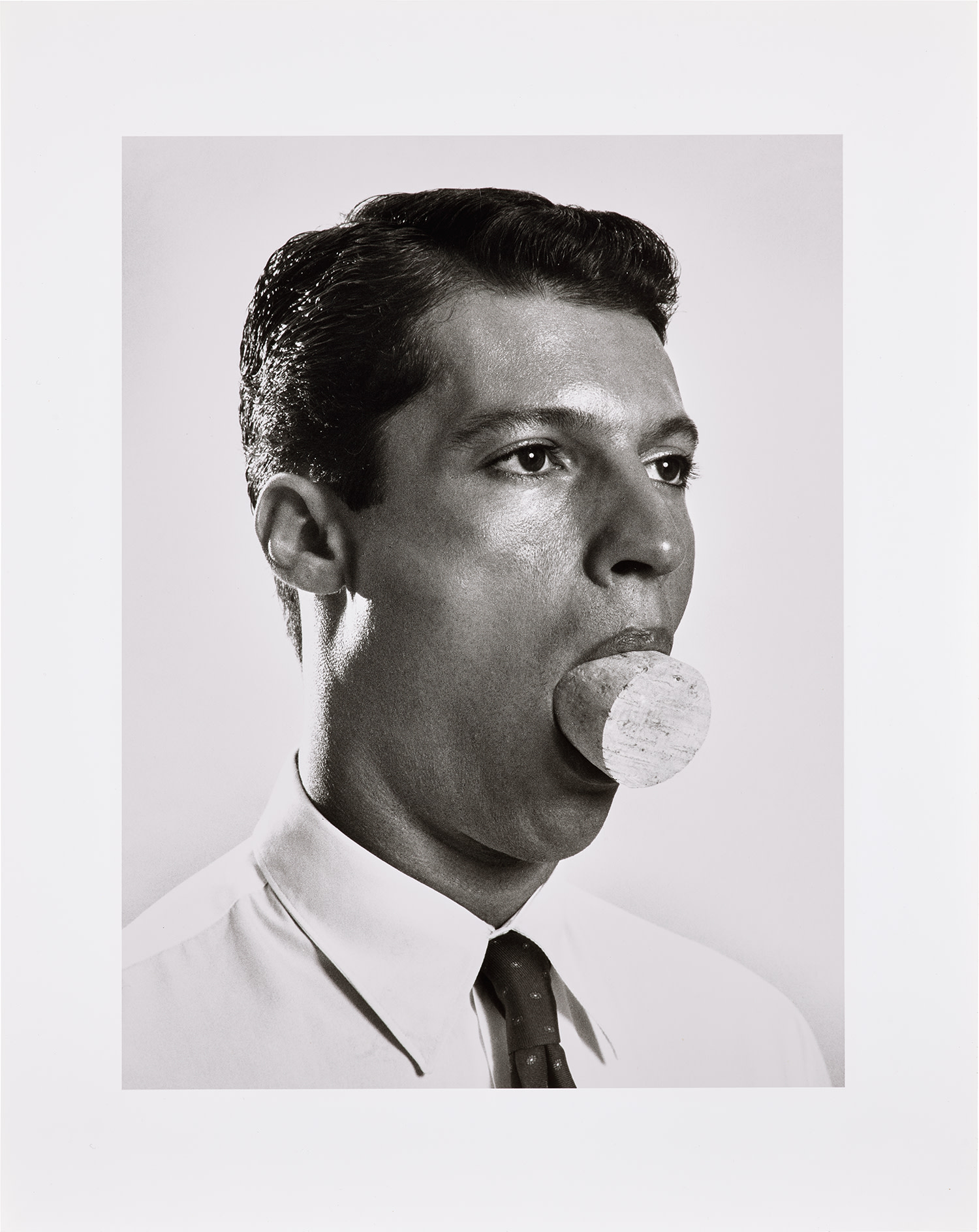
His return confirmed what the art world had suspected all along: Cattelan is constitutionally incapable of silence, and the world is richer for it. For collectors, Cattelan's work represents one of the most compelling and culturally durable propositions in the contemporary market. His prints, editions, and works on paper offer meaningful points of entry into a practice that at its largest scale commands figures that only institutional and ultra high net worth buyers can access. Works in ink and pen on paper, photographic editions including gelatin silver prints and digital pigment prints on rag paper, and smaller sculptural editions allow collectors at a range of levels to hold something genuinely connected to one of the defining artistic minds of the last thirty years.
The wit and the weight are present at every scale. Auction results consistently confirm broad and deepening demand, with secondary market prices for editions and works on paper showing sustained strength at houses including Christie's, Sotheby's, and Phillips. Cattelan belongs to a generation and tradition that includes artists such as Paul McCarthy, Mike Kelley, and Kara Walker, figures who use humor, horror, and the body to interrogate power and mythology. His Italian context places him in conversation with the Arte Povera masters and with artists like Piero Manzoni, whose infamous "Artist's Shit" (1961) casts a long and generative shadow over Cattelan's own relationship between commodity and critique.
He has also functioned as a major curateur and cultural instigator through projects like the magazine Toilet Paper, which he co founded with photographer Pierpaolo Ferrari in 2010. That publication, filled with surreal and viscerally beautiful imagery, demonstrates the full range of his visual intelligence beyond any single medium or format. What makes Cattelan essential, now as much as ever, is his refusal to let art become comfortable. He understands that the best art is not decoration but disturbance, not affirmation but question.
His quote that everyone can be a collector echoes Beuys's famous democratizing impulse while adding his own characteristic twist: the idea that roles are fluid, that the boundary between artist and audience, between critical statement and artwork, is always negotiable. In a cultural moment when the art world grapples constantly with questions of value, access, and meaning, Cattelan's practice feels not like a relic of 1990s provocation but like a living, urgent, and deeply joyful argument for why art matters at all. To collect his work is to participate in that argument, and to find, invariably, that you are smiling.
Explore books about Maurizio Cattelan