Mary Cassatt

Mary Cassatt, Luminous Pioneer of Intimate Life
Artist Spotlight · The Collection Editorial
“I am independent. I can live alone and I love to work.”
Mary Cassatt, letter to Louisine Havemeyer
In 2024, the Philadelphia Museum of Art continued to honor its most celebrated expatriate daughter with sustained attention to her works across its collection galleries, a reminder that Mary Cassatt remains one of the most beloved and consistently studied American artists in the world. Her paintings, pastels, and prints draw crowds not through spectacle or provocation but through something rarer and more enduring: a profound warmth, an exquisite attentiveness to the textures of daily life, and a technical mastery that rewards the closest looking. Institutions from Paris to Washington to Tokyo have built significant holdings around her work, and the market for her prints in particular has never been more appreciative. She is, in the best sense, an artist whose time keeps arriving.
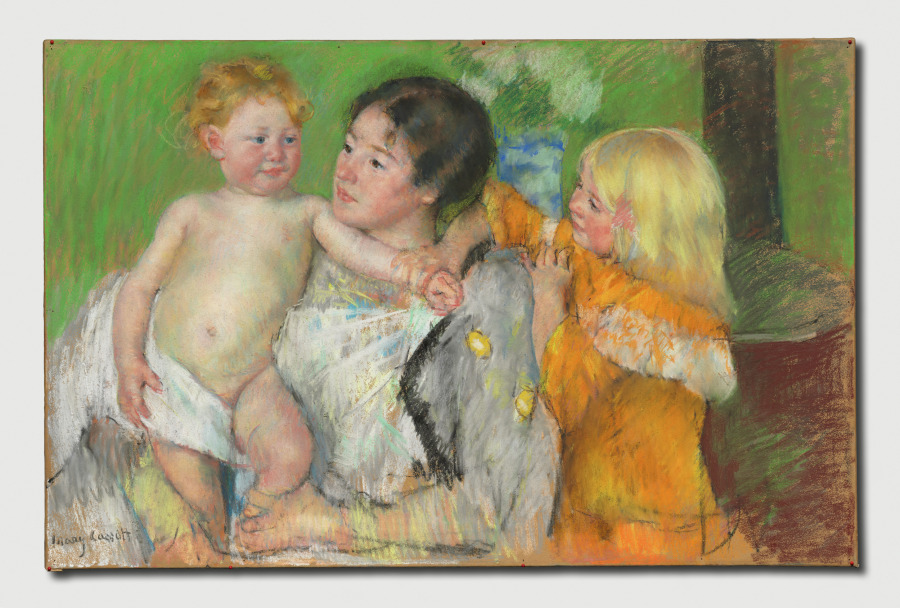
Mary Cassatt
After the Bath, 1901
Mary Stevenson Cassatt was born in Allegheny City, Pennsylvania in 1844 into a prosperous and intellectually curious family. Her father, Robert Cassatt, was a successful banker and speculator, and the family traveled extensively through Europe during her childhood, exposing her early to the great museums of Paris, Berlin, and Heidelberg. This early immersion in European culture planted a seed that would eventually transform her life entirely. By the time she enrolled at the Pennsylvania Academy of the Fine Arts in Philadelphia in 1861, she had already sensed that the conventions of American artistic training would not be sufficient for what she wanted to achieve.
Frustrated by the slow pace and limited ambitions of the curriculum, she left for Europe in 1866, determined to study the old masters and the living avant garde on their own ground. The Paris she arrived in was electric with artistic possibility. Cassatt studied in the studio of Charles Chaplin, copied works at the Louvre, and traveled to Italy, Spain, and Belgium to absorb the lessons of Velázquez, Correggio, and Rubens. Her early submissions to the Paris Salon were accepted in 1868, a significant achievement for any painter and a remarkable one for a young American woman.
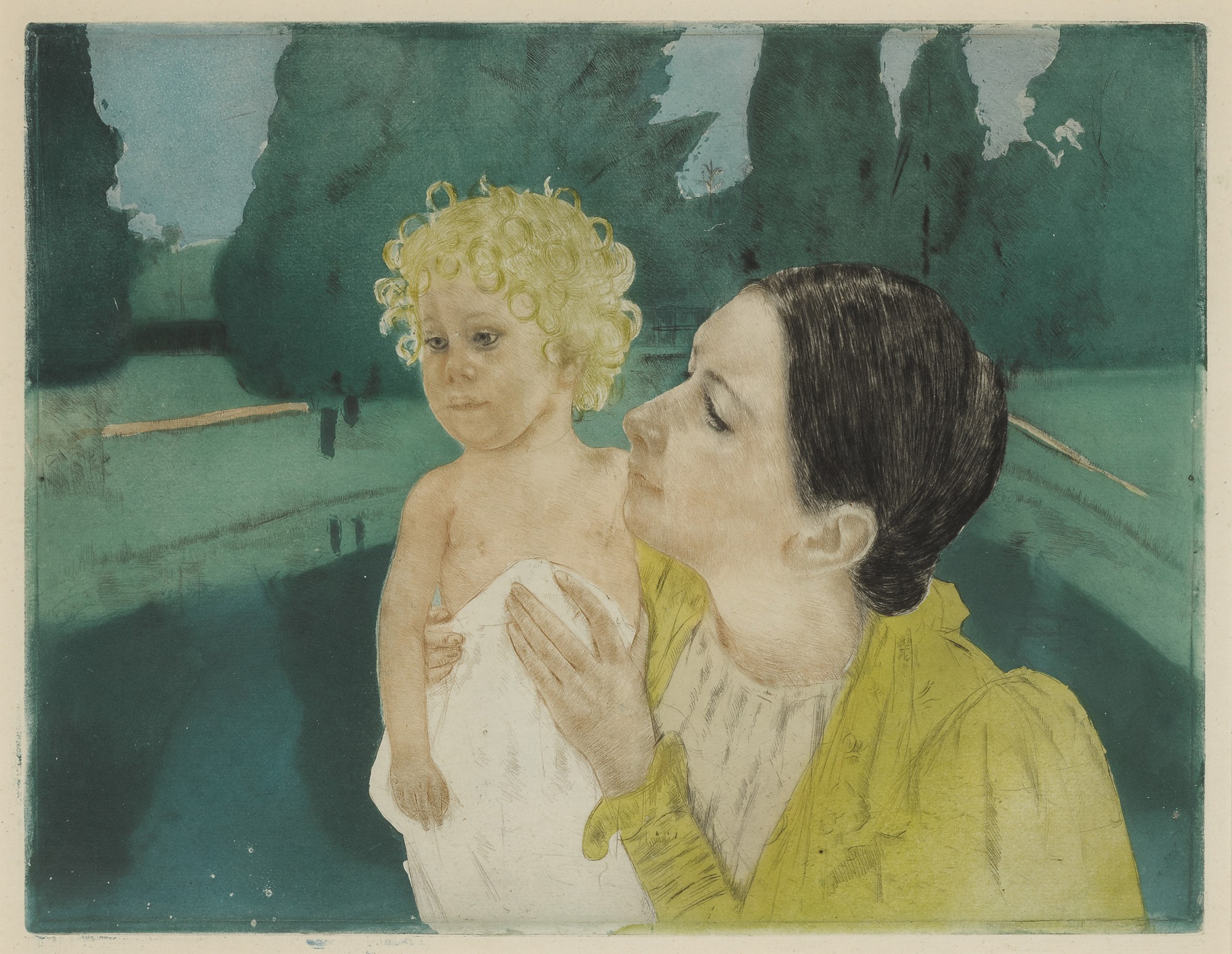
Mary Cassatt
By the Pond (Breeskin 161; Matthews & Shapiro 21)
But it was her encounter with the work of Edgar Degas in a dealer's window on the Boulevard Haussmann in the early 1870s that changed everything. She later recalled that the experience made her see art differently than she had before. When Degas formally invited her to join the Impressionists in 1877, she accepted with characteristic decisiveness. She would exhibit with the group in 1879, 1880, 1881, and 1886, the only American to do so, and she became a full and essential member of their circle rather than a peripheral admirer.
“I hate conventional treatment. I will not do what they ask me to do.”
Mary Cassatt
Cassatt's artistic development through the Impressionist years was marked by a deepening originality. She excelled at capturing figures in the private spaces of bourgeois life, at theater boxes, dressing tables, garden chairs, and drawing rooms, rendered with a freshness of observation that was entirely her own. Her 1880 etching known as Lady in a Loge, Facing Right shows the range of her printmaking ambition even at that early stage, the figure composed with a confidence that rivaled Degas himself. In the early 1890s, following a trip to Japan and exposure to the color woodblock prints of Kitagawa Utamaro and others at a major exhibition in Paris in 1890, she produced her landmark series of color aquatints that are among the most original graphic works of the entire nineteenth century.
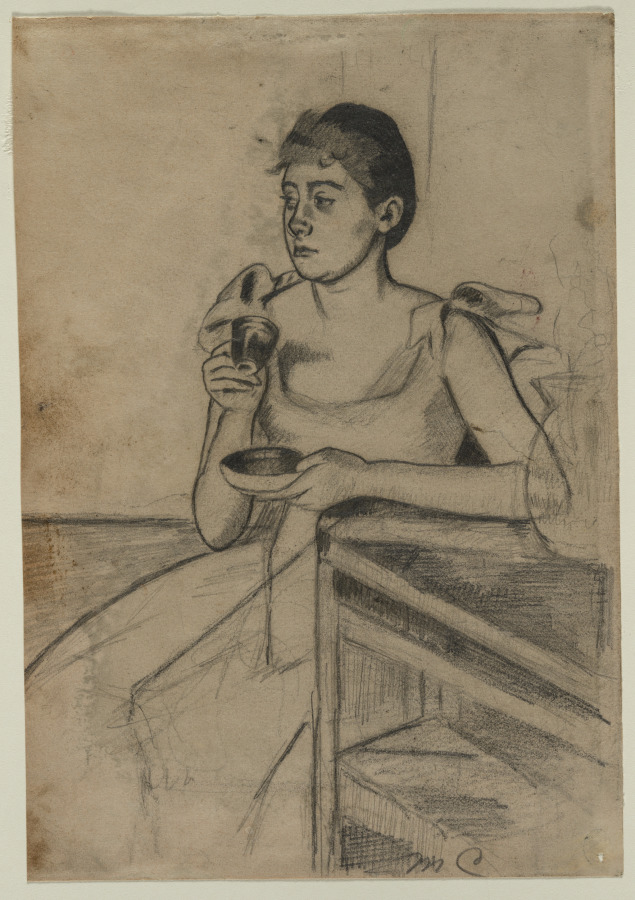
Mary Cassatt
After-Dinner Coffee (recto), 1884
Works such as By the Pond from around 1896 demonstrate her mastery of flattened planes, bold contour lines, and subtly modulated color fields, synthesizing Japanese formal principles with Western Impressionist sensibility in a way that was entirely unprecedented. The subjects for which she is most celebrated are the tender and monumental images of mothers and children that occupied much of her mature career. These are not sentimental pictures in any diminishing sense. Works like Baby Charles Looking Over His Mother's Shoulder from 1900 and Mrs.
Harris Whittemore and Baby Helen from 1898 approach their subjects with the same formal rigor and psychological intelligence she brought to everything else. The mothers in these compositions are never passive; they are present, capable, and physically confident, and the children they hold are individuals, not props. Her 1901 pastel After the Bath is a particularly striking example, the figure caught in a moment of domestic transition, the light falling with the directness and honesty that define her best work. Cassatt understood that the domestic sphere was not a lesser subject but an endlessly rich one, and she treated it with the full resources of her considerable gifts.
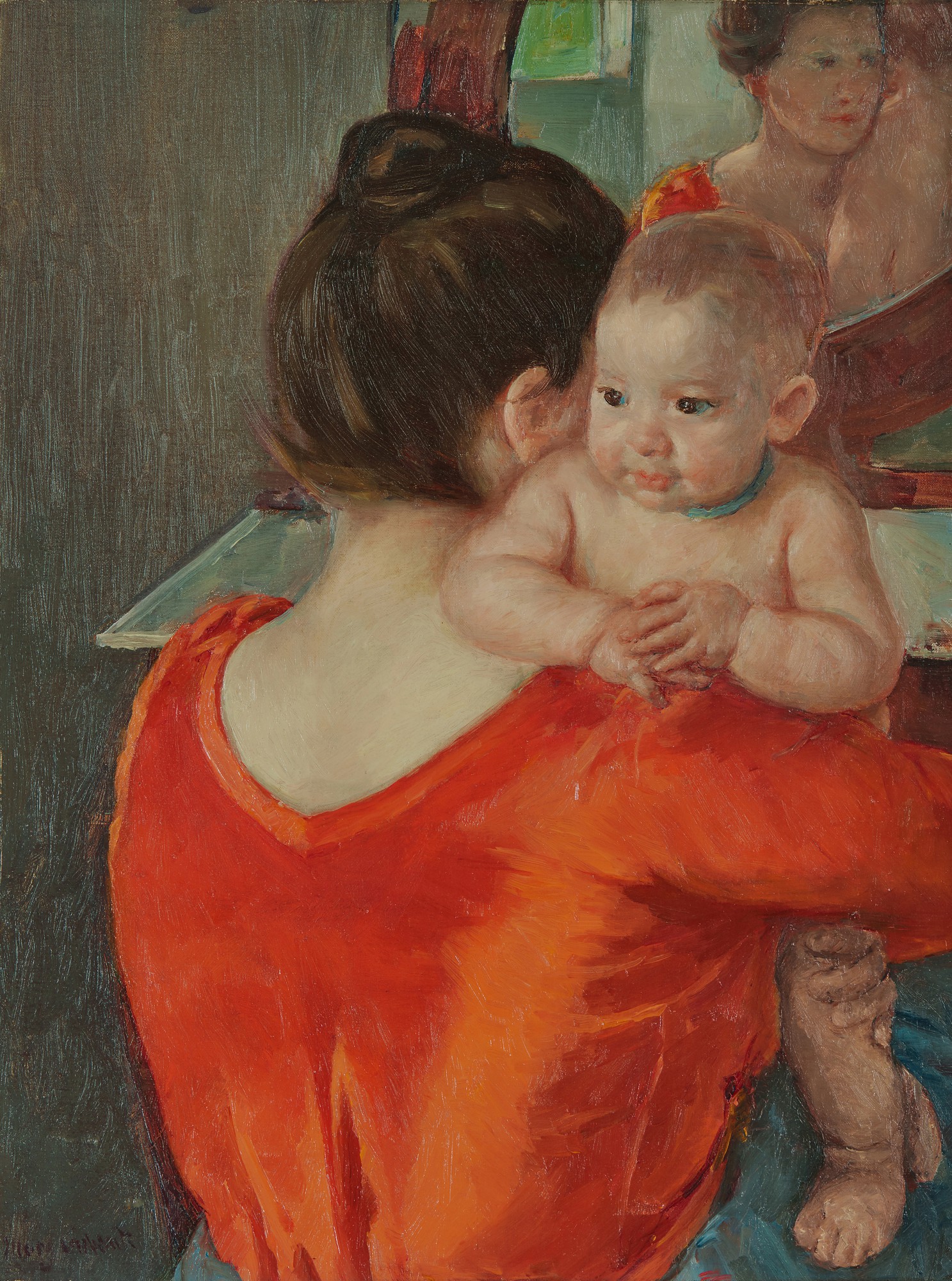
Mary Cassatt
Baby Charles Looking Over His Mother's Shoulder (No. 3), 1900
For collectors, Cassatt represents one of the most compelling intersections of historical importance and aesthetic pleasure available in the market today. Her prints, particularly the drypoints and color aquatints, have been strong performers at auction for decades, and works on paper including her pastels carry significant institutional and private demand. Drypoints such as Sara Smiling and Denise Holding Her Child offer collectors access to her graphic sensibility at a range of price points, and the care she brought to each impression means that condition and provenance matter enormously in evaluating any individual work. Auction houses including Christie's, Sotheby's, and Bonhams have consistently offered her works across their Impressionist and American art sales, and major private American collections assembled in the late nineteenth and early twentieth century often featured her work as a cornerstone acquisition.
Her friend and advocate Louisine Havemeyer was among the most significant early collectors, and the Havemeyer bequest to the Metropolitan Museum of Art helped cement Cassatt's institutional standing on both sides of the Atlantic. To understand Cassatt fully it helps to place her within the broader constellation of Impressionist practice. Berthe Morisot, her closest peer among the Impressionist group, shared her interest in domestic interiors and female experience, though Morisot's touch was more atmospheric and Cassatt's more structurally assertive. Degas, her great friend and intellectual sparring partner, shaped her approach to composition and printmaking but never diminished her independence.
Eva Gonzalès, the Spanish painter Gustave Courbet, and the Japanese masters she admired all left traces in her work without overwhelming it. She absorbed everything and remained unmistakably herself. Mary Cassatt died in 1926 at her estate, Château de Beaufresne, north of Paris, having spent the last decade of her life largely blind and unable to paint. She had devoted herself in her final years to advocating for women's suffrage and encouraging American collectors to acquire Impressionist works, a cultural contribution whose effects are still felt in the holdings of museums across the United States.
Her legacy is that of an artist who refused every limitation placed on her, by geography, by gender, by convention, and who produced in response a body of work of extraordinary beauty and enduring human truth. To encounter a Cassatt print or pastel is to be reminded that looking closely at life, at the people nearest to us, is not a modest ambition. It is among the most important things art can do.
Explore books about Mary Cassatt
Mary Cassatt: A Life
Barbara Buhler Lynes
Mary Cassatt: Modern Woman
Judith A. Barter
Mary Cassatt and Her Circle
Nancy Mowll Mathews

Cassatt and Her Circle
Griselda Pollock
Mary Cassatt: The Color Prints
Nancy Mowll Mathews and Barbara Stern Shapiro
Mary Cassatt: Oils and Pastels
Erica E. Hirshler
Mary Cassatt: An American Observer
Colin B. Bailey
The Letters of Mary Cassatt
Nancy Mowll Mathews