Marsden Hartley
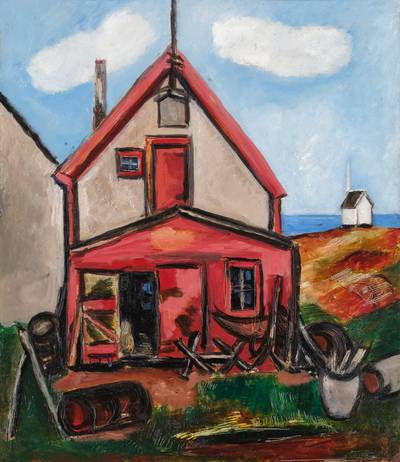
Marsden Hartley, America's Most Restless Visionary
Artist Spotlight · The Collection Editorial
“I would rather be a complete human being than a great artist.”
Marsden Hartley, letters and writings
There is a moment in the permanent collection galleries at the Metropolitan Museum of Art in New York when visitors tend to stop walking. It happens in front of a Marsden Hartley canvas, usually without warning, as though the painting reaches out and insists on being seen. The colors are too bold, the geometry too urgent, the feeling too raw to pass by. That same quality of magnetic insistence has driven a steady and accelerating reassessment of Hartley's place in American art history, with major institutions revisiting his work through focused exhibitions and acquisitions.
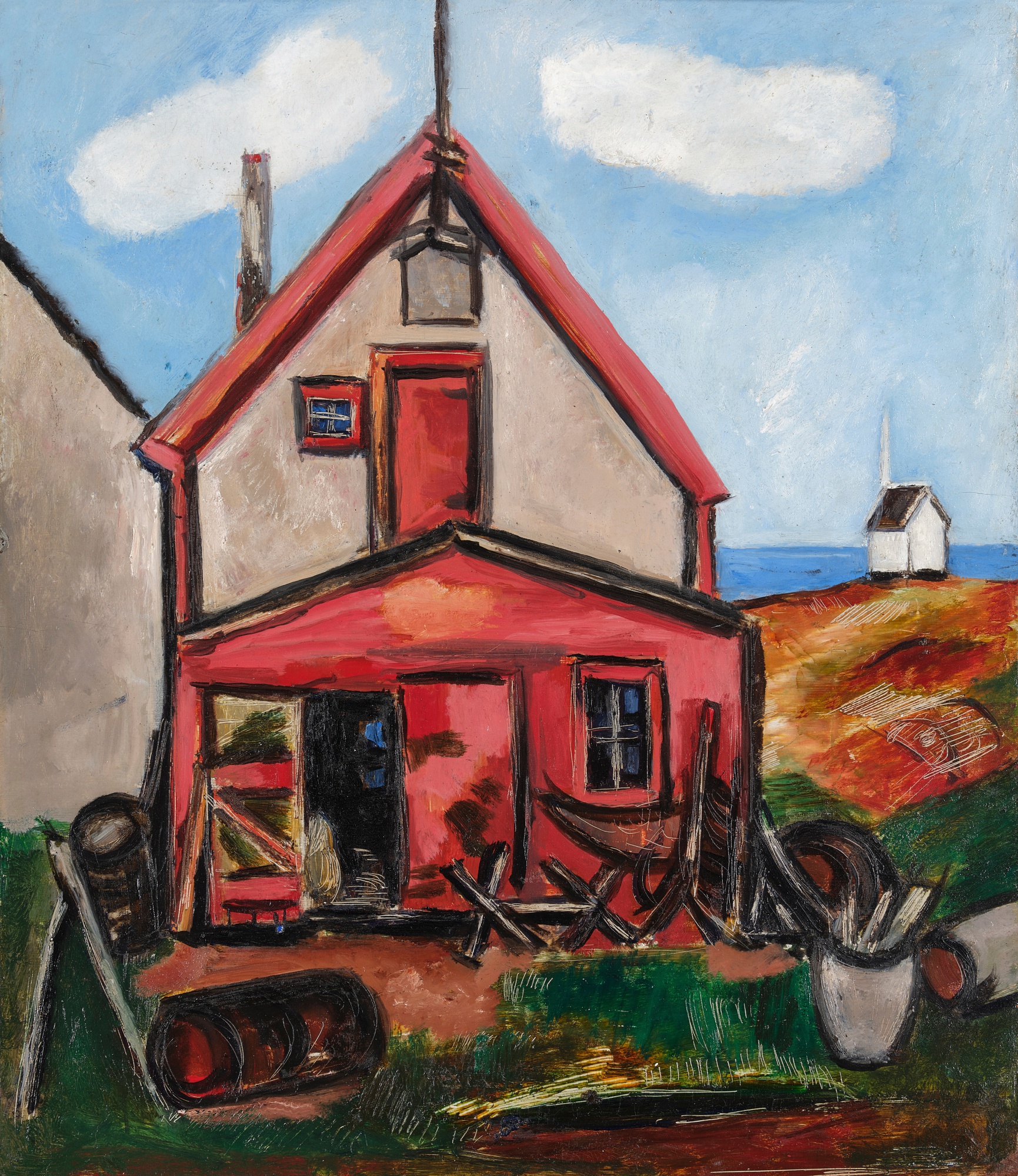
Marsden Hartley
Pink House, 1940
The Whitney Museum of American Art, the National Gallery of Art, and the Smithsonian American Art Museum all hold significant holdings, and scholarly attention to his correspondence and writings has deepened the conversation around his singular vision. Marsden Hartley was born Edmund Hartley on January 4, 1877, in Lewiston, Maine, a mill town shaped by granite cold and working class life. His mother died when he was eight years old, an early loss that colored his emotional interior for decades. Raised partly by relatives and partly by his father, he found refuge in the natural world of the Maine landscape, a bond that would prove lifelong even as he traveled restlessly across continents.
He took the name Marsden in honor of a family friend who became a patron, and he enrolled at the Cleveland School of Art before moving to New York in 1900 to study at the Chase School and later the National Academy of Design. Maine never left him, even when he was thousands of miles from its shores. The turning point in Hartley's formation came in 1909 when Alfred Stieglitz welcomed him into the orbit of Gallery 291 on Fifth Avenue in Manhattan. Stieglitz, the legendary photographer and gallerist, gave Hartley his first solo exhibition that same year, an act of faith that launched the painter onto the American modernist stage.
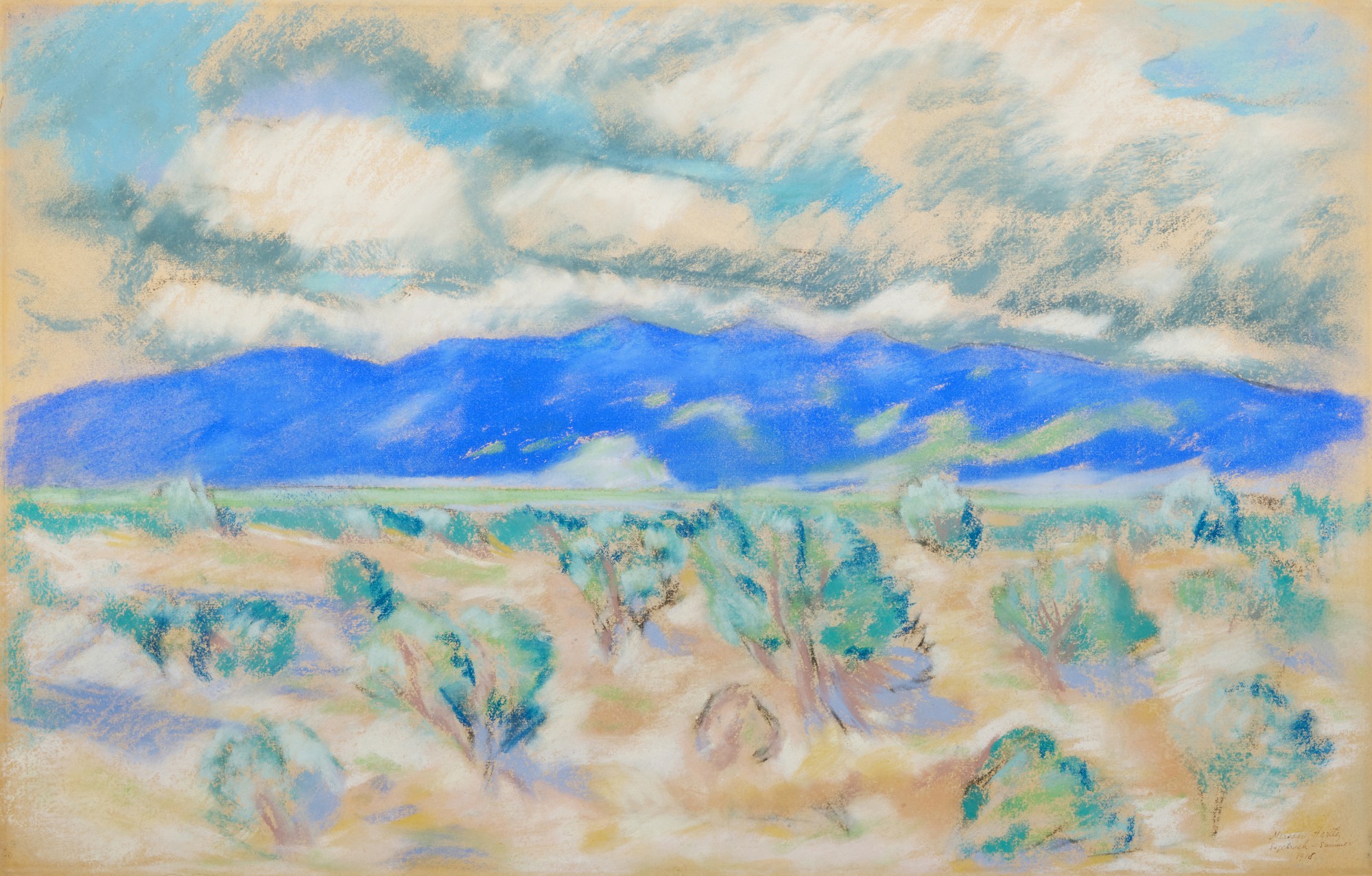
Marsden Hartley
Sagebrush, 1918
Through Stieglitz, Hartley encountered the work of Cézanne, Matisse, and Picasso, and absorbed the intellectual energy of a circle that included Georgia O'Keeffe, John Marin, and Arthur Dove. This community of mutual influence and fierce ambition pushed Hartley toward abstraction at a moment when few American artists had made that leap with any conviction. Between 1912 and 1915, Hartley made the first of several transformative journeys to Europe, traveling to Paris and then to Berlin, where he fell into the intellectual and bohemian world of the German Expressionists and encountered the work of Wassily Kandinsky. Berlin proved electrifying.
“I have come to the end of what might be called the crisis in my life as a painter.”
Marsden Hartley, letter to Alfred Stieglitz, 1913
He formed a deep friendship with the young German military officer Karl von Freyburg, and when von Freyburg was killed in battle in 1914, Hartley channeled his grief and his love into one of the most remarkable bodies of work in American modernism. The so called German Officer paintings, a series of large, heraldic canvases dense with military insignia, iron crosses, flags, and numbers rendered in fierce primary colors, stand among the most emotionally charged abstractions produced during the early twentieth century. They are simultaneously tribute, elegy, and coded devotion, painted by a man who could not speak his grief openly in the language of his time. What makes Hartley extraordinary as a painter is the sheer range of his reinvention.
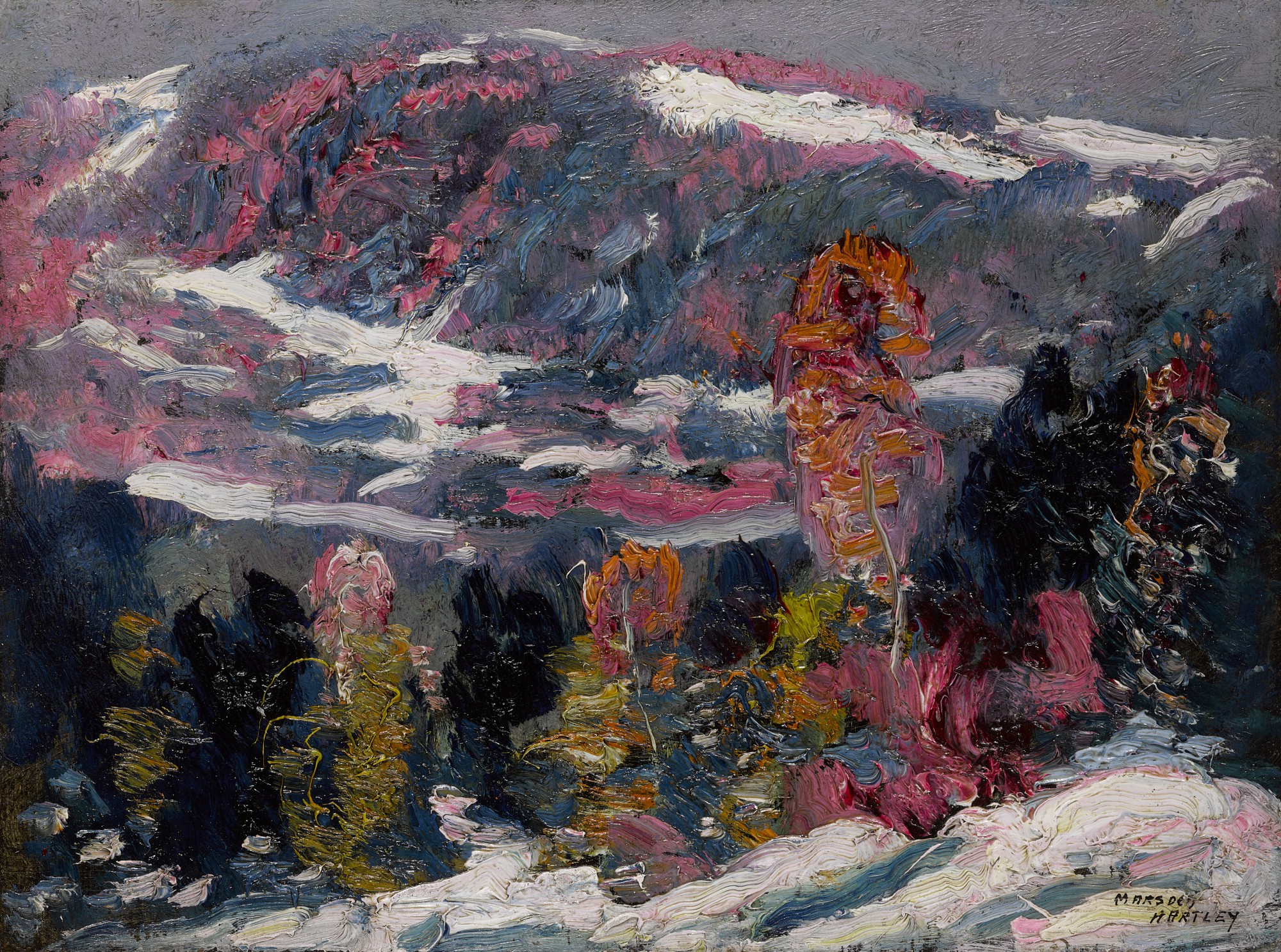
Marsden Hartley
Songs of Winter, 1909
After the German Officer series, he moved through phases with the restless energy of someone perpetually in conversation with the world around him. His New Mexico canvases of the late 1910s and 1920s, painted during stays in Taos and Santa Fe, brought the arid southwest into dialogue with his understanding of Cézanne's structural rigor. Works such as Sagebrush from 1918, a pastel on paperboard in the collection available on The Collection, demonstrate his sensitivity to the particularities of place and his instinct for translating landscape into something felt rather than merely seen. His Dogtown series of the 1930s, painted in the abandoned granite outpost above Gloucester, Massachusetts, gave American landscape painting a geological weight and psychological gravity it had rarely possessed.
The works available through The Collection offer a remarkable window into the full sweep of Hartley's career. Pink House from 1940 captures the late Maine period at its most confident and direct, the forms simplified, the color declarative, the sense of place absolute. Songs of Winter from 1909 reveals the painter in his formative American phase, working through the influence of Albert Pinkham Ryder toward something distinctly his own. Provincetown from 1916 places him in Cape Cod at a moment when that community was a crucible of American modernism.
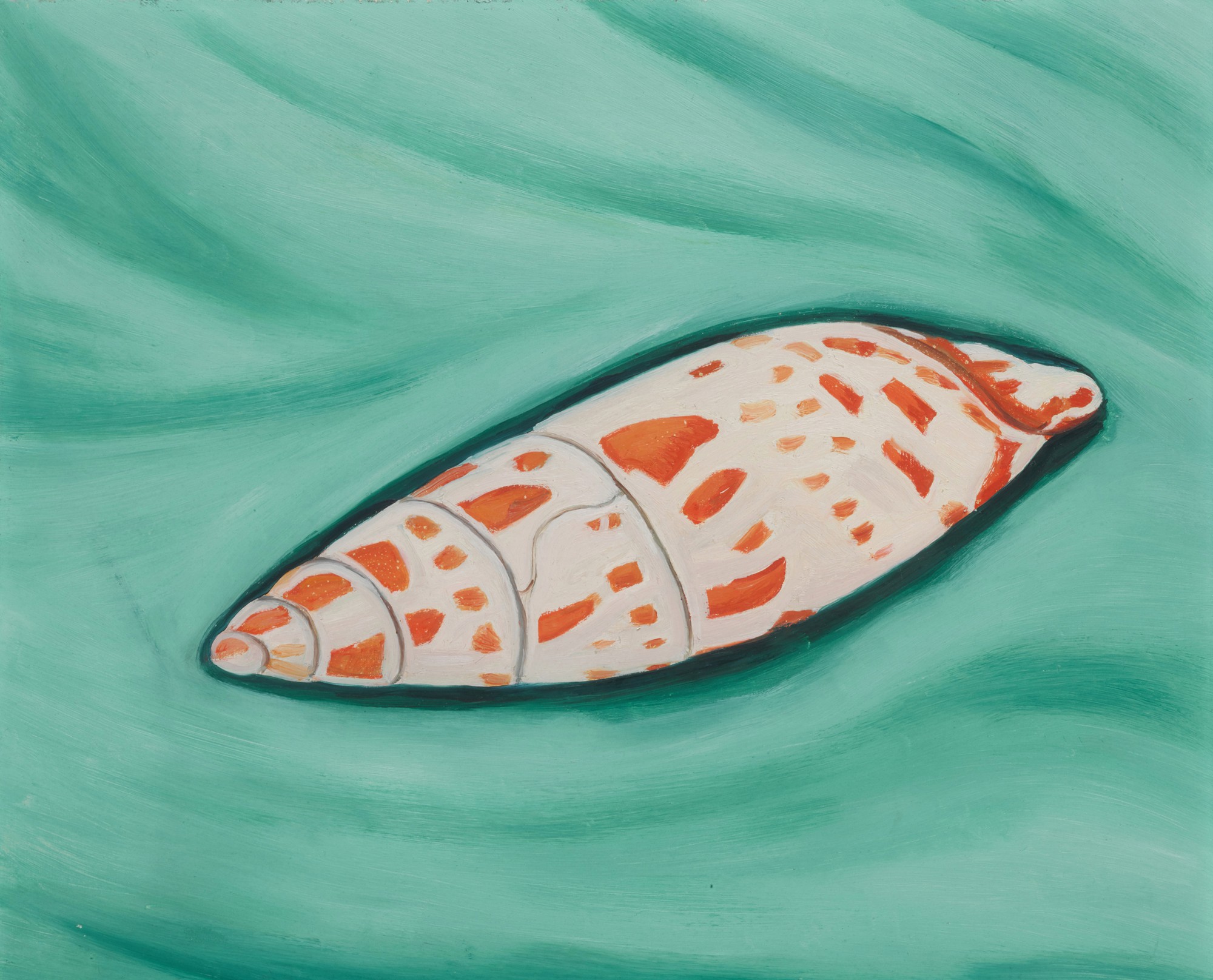
Marsden Hartley
Shell
Tropic Fantasy from 1935 shows the more exotic register he reached during his time in Bermuda and the American South. Together these works trace not one painter but many, all of them unmistakably Hartley. For collectors, Hartley presents one of the most compelling value propositions in American modernism. His market has historically traded below the prices commanded by his contemporaries O'Keeffe and Dove, despite the art historical case for his equal or greater importance to the development of American abstract painting.
Major institutions have been steady buyers, and auction results at Christie's and Sotheby's have shown consistent appreciation for works from his key periods, particularly the German Officer paintings, the Nova Scotia canvases, and the late Maine landscapes. Works on paper, including pastels such as Sagebrush, offer accessible entry points into a practice that deserves the same reverence collectors extend to the most celebrated names in twentieth century American art. Within the broader history of modernism, Hartley belongs to a lineage that connects European Expressionism to the American experience with unusual honesty. He bridges the worlds of Kandinsky and Cézanne on one side and anticipates the emotional directness of Abstract Expressionism on the other.
Artists such as Arthur Dove, John Marin, and Charles Demuth were his closest American peers, sharing the Stieglitz circle and the belief that American painting could achieve something distinct from and equal to what was happening in Paris and Berlin. Internationally, his German Officer series invites comparison with the most emotionally loaded canvases of Ernst Ludwig Kirchner and Franz Marc, painters who were also trying to hold an entire felt world inside the frame. The legacy of Marsden Hartley is ultimately that of a painter who refused every available comfort. He did not settle into a single style or a single place.
He moved, reinvented, suffered, and produced, driven by a vision that was larger than his circumstances allowed him to fully declare. What remains is a body of work of astonishing depth and range, one that continues to reward looking with the feeling that something urgent and true is being communicated across time. To collect Hartley is to participate in an ongoing act of recognition, bringing one of American art's most searching and generous spirits the attention he spent a lifetime reaching toward.
Explore books about Marsden Hartley
Marsden Hartley
Barbara Haskell
Marsden Hartley: American Modern
Gail R. Scott
The Letters of Marsden Hartley
Ste. Croix Fleming and Robert K. Martin
Marsden Hartley: Painter and Poet
Jonathan Katz

Marsden Hartley and the West
Gail R. Scott
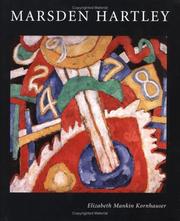
The Art of Marsden Hartley
Elizabeth Turner
Marsden Hartley: A Life
Jennifer L. Roberts