Mark Grotjahn
Mark Grotjahn: Painting's Most Joyful Optical Force
Artist Spotlight · The Collection Editorial
“The Butterflies are fairly planned out. They're still intuitive, but I generally know where they're going.”
Mark Grotjahn, 2007
There are artists who refine a single idea across a career, and then there are artists who make that refinement feel like revelation every time. Mark Grotjahn belongs firmly to the latter category. His recent appearances at major international auctions and continued institutional acquisitions confirm what collectors and curators have long understood: Grotjahn is among the most consequential American painters working today, a figure whose influence on contemporary abstraction has only deepened with time. His canvases carry an almost physical charge, and standing before one in person remains an experience that no reproduction can fully prepare you for.
Mark Grotjahn
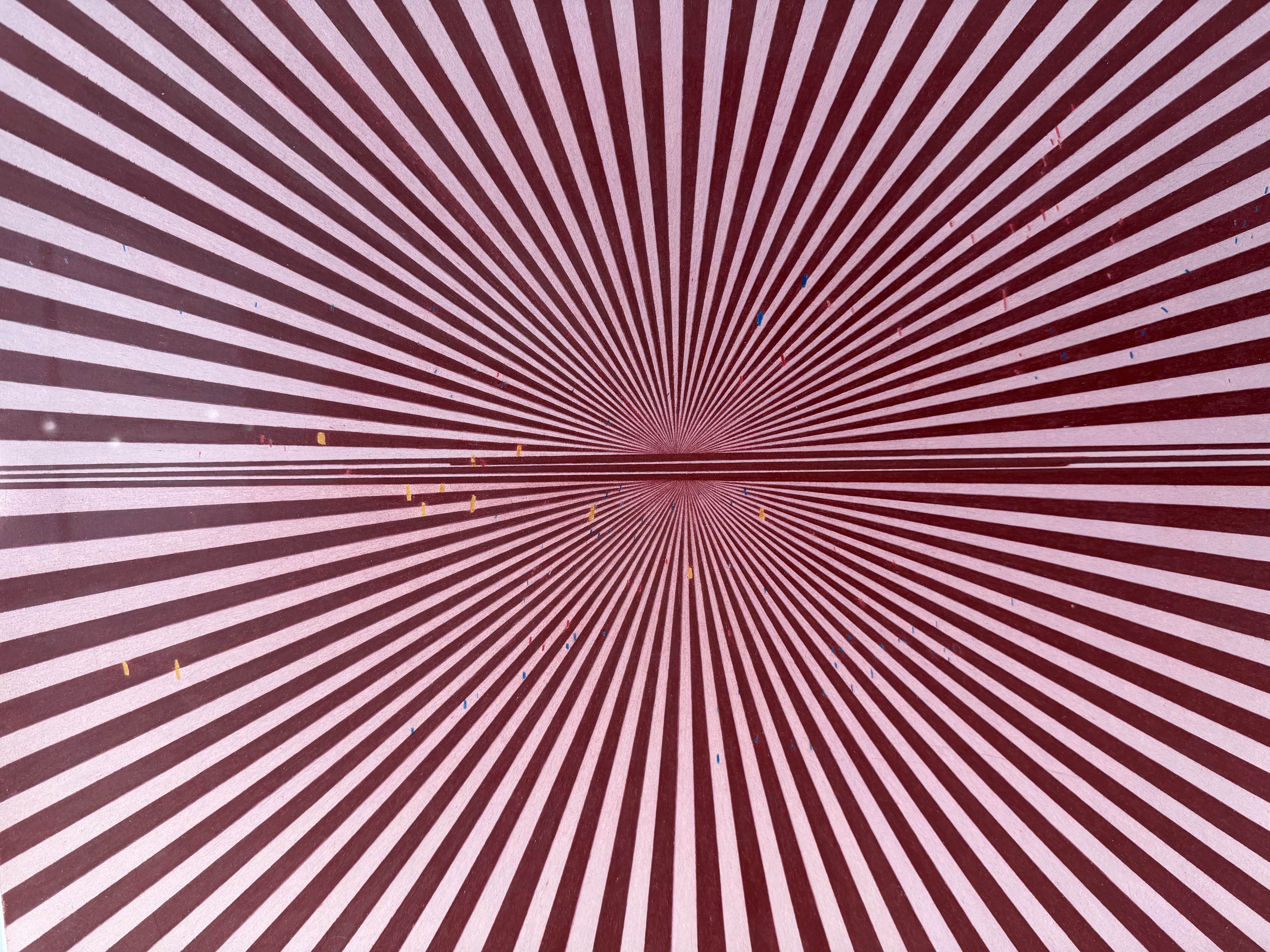
Untitled (Tuscan Red and Pink Rose Butterfly 45.90), 2015
Grotjahn was born in Pasadena, California in 1968, and his formation as an artist unfolded along the Pacific Coast that would become so central to his identity. He studied at the University of Colorado at Boulder before earning his MFA from the University of California at Berkeley in 1995. These years on the West Coast placed him at a productive remove from the dominant conversations happening in New York, giving his practice a self determined quality that still reads clearly in the work. He came of age absorbing both the rigorous formal traditions of American abstraction and the more freewheeling experimental spirit that Northern California nurtured in its artists.
After graduate school, Grotjahn settled in Los Angeles, and the city has shaped his practice ever since. His early career included a period working at the Los Angeles County Museum of Art, where his proximity to a world class collection gave him an intimate understanding of art history from the inside out. His first significant gallery relationships developed in Los Angeles, and by the early 2000s he had begun attracting serious attention. The Butterfly paintings that would define his reputation emerged during this period, first appearing as works on paper in colored pencil before expanding into monumental oil paintings on linen.
Mark Grotjahn
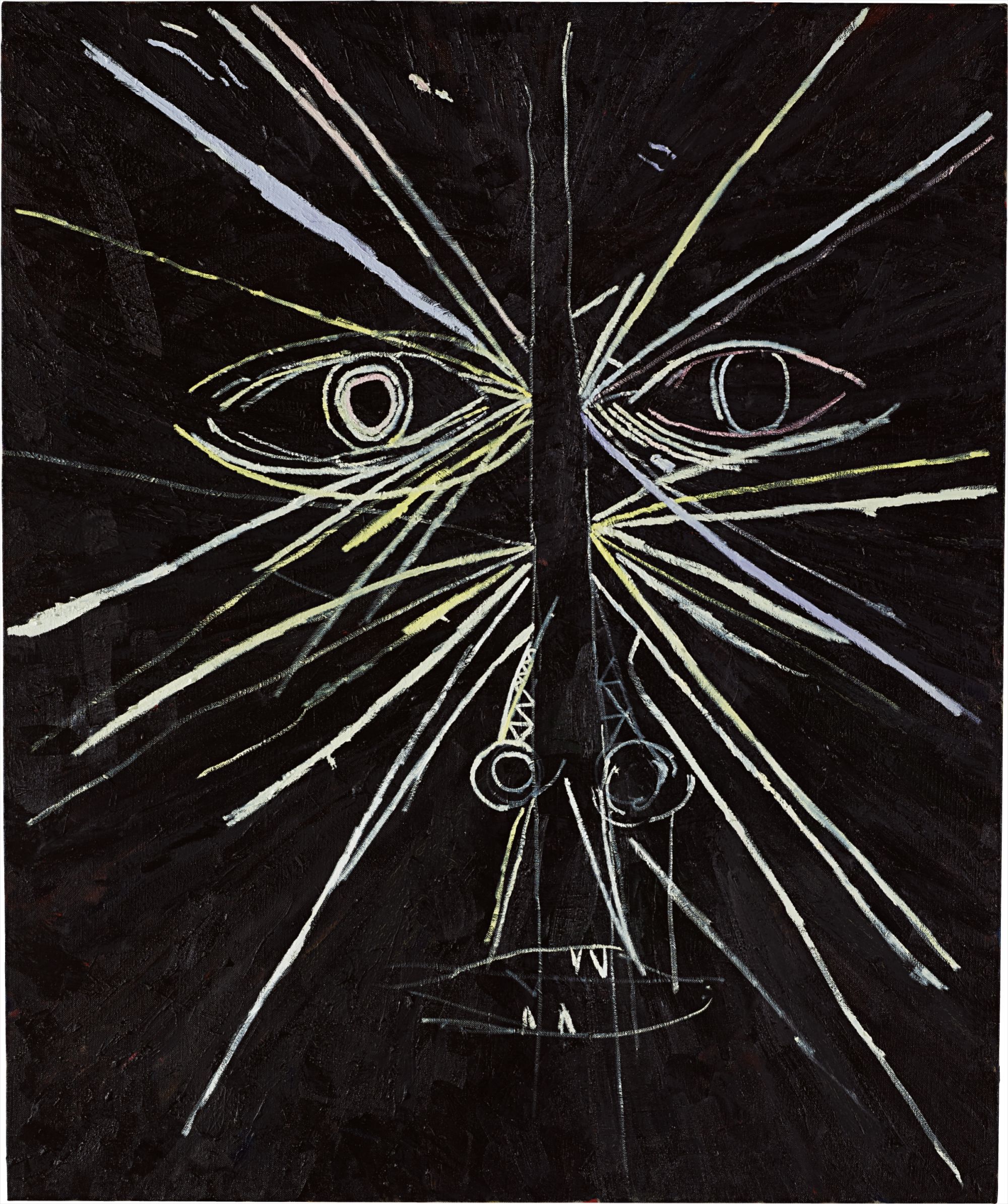
"The ‘Face Paintings’ allow me to express myself in a way that the ‘Butterflies’ don’t. I have an idea as to what sort of face is going to happen when I do a ‘Face Painting,’ but I don’t exactly know what color it will take, or how many eyes it’s going to have, whereas the ‘Butterflies’ are fairly planned out. They’re still intuitive, but I generally know where they are going. It’s a different kind of freedom, a different kind of expressionism. It’s personal without being overtly personal."
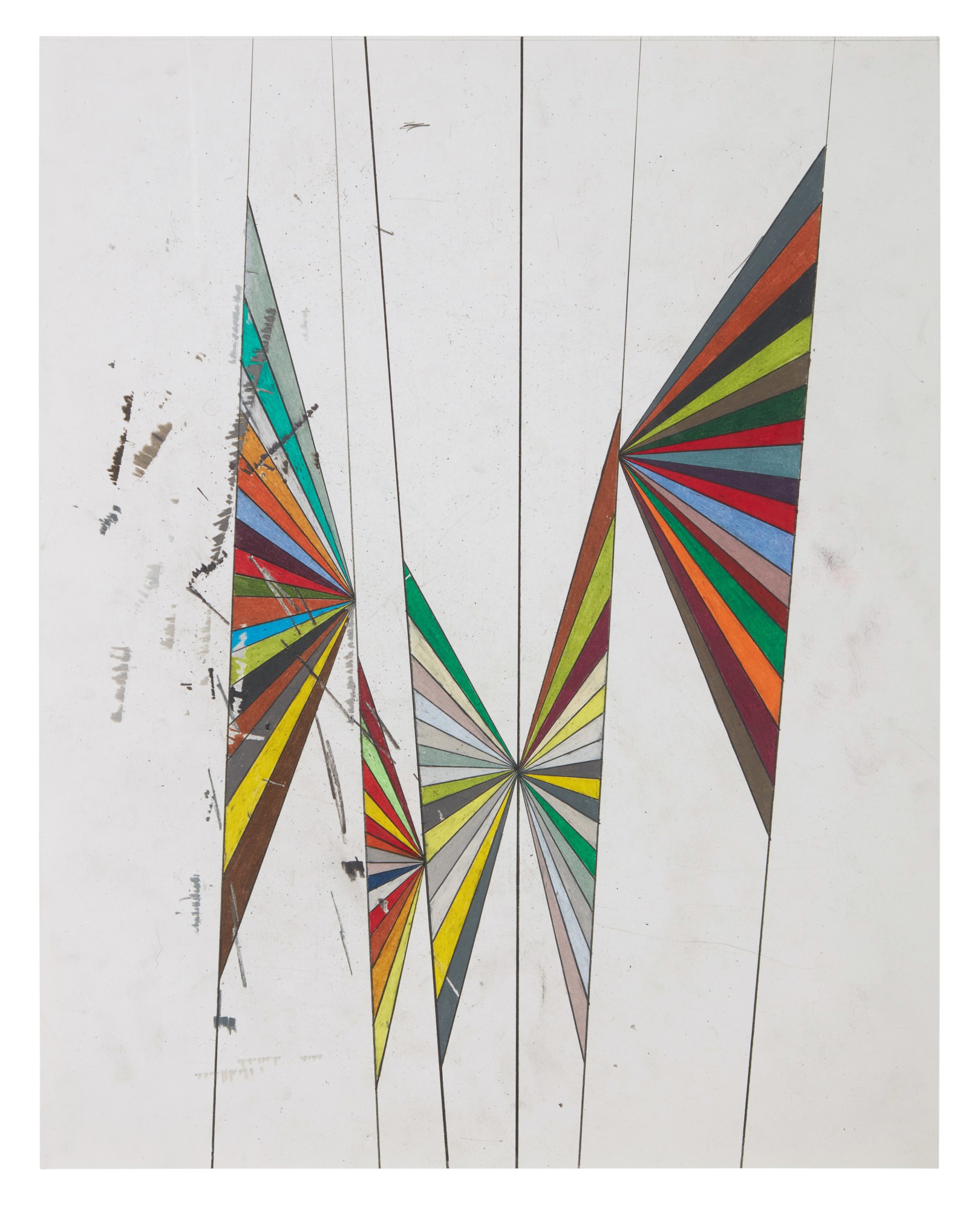
These early works on Strathmore Bristol paper, dense with radiating lines and virtuosic draftsmanship, remain among the most compelling objects in his entire output. The Butterfly series is Grotjahn's signature achievement, and its logic is deceptively simple. Each composition originates from one or two vanishing points positioned at the edges or corners of the picture plane, with lines radiating outward in patterns that create an overwhelming sense of depth and optical vibration. The effect is somewhere between the precision of Op Art and the gestural energy of Abstract Expressionism, a combination that feels entirely original.
“The Face Paintings allow me to express myself in a way that the Butterflies don't. It's personal without being overtly personal.”
Mark Grotjahn
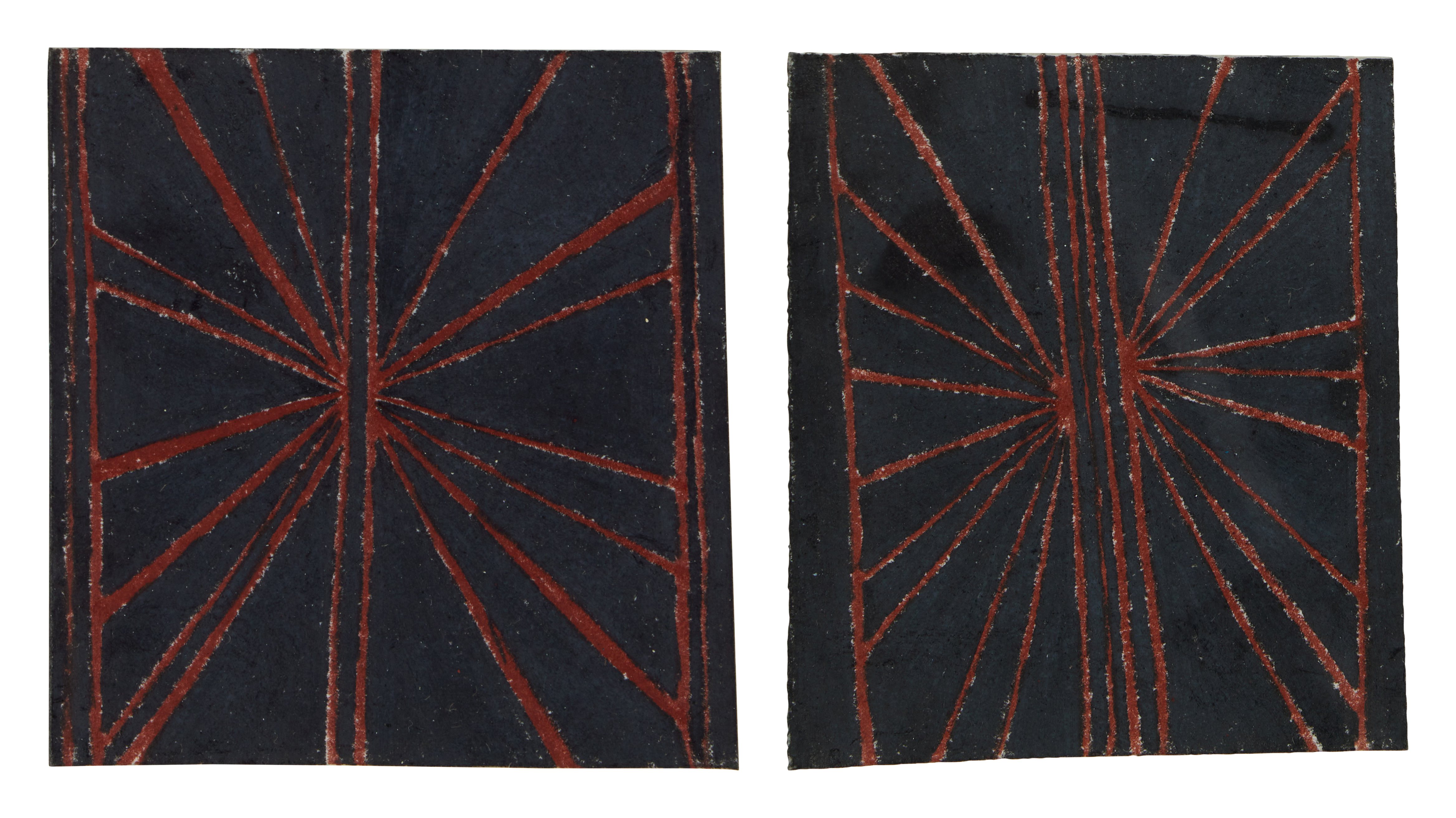
Works such as the 2004 oil on linen featuring his own name inscribed within the title demonstrate how Grotjahn folds authorship and autobiography directly into the formal structure of the painting without ever becoming sentimental about it. The 2006 diptych in pencil on paper, with its pairing of black and brown butterfly forms, shows how even a restrained palette yields maximum optical intensity in his hands. His 2015 colored pencil work in Tuscan red and pink rose is a masterclass in how color temperature can shift the emotional register of an otherwise consistent formal system. Beyond the Butterflies, Grotjahn has developed a body of work in mask sculptures that reveals a completely different but equally rigorous dimension of his thinking.
Mark Grotjahn
Untitled (Black and Brown Butterfly 647a & 647b), 2006
Cast in bronze and layered with oil paint, these works engage with primitivist art history in a way that is knowing rather than appropriative, and their rough, encrusted surfaces stand in deliberate contrast to the optical refinement of the paintings. The 2012 bronze mask in brown, orange, and black is a powerful example, its surface bearing the traces of process in a way that feels both ancient and urgently contemporary. Grotjahn has spoken about how the Face Paintings and related works offer him a different kind of expressive freedom from the more architecturally planned Butterflies, a freedom that is personal without demanding biographical disclosure from the viewer. From a collecting perspective, Grotjahn's market reflects the seriousness with which institutions and private collectors have pursued his work.
His paintings are held in the permanent collections of the Museum of Modern Art in New York, the Whitney Museum of American Art, and the Hammer Museum in Los Angeles, among others. Auction results for major Butterfly paintings have consistently placed him among the top tier of living American painters, with significant works achieving prices that reflect both strong institutional validation and fierce competition among collectors. Works on paper, particularly the early colored pencil Butterfly compositions, represent an especially compelling entry point into the practice. They demonstrate the full range of his formal thinking at a scale and price point that has historically made them among the most sought after works in his catalogue.
Mark Grotjahn
Untitled, 2005
Collectors who have followed the arc of his career from those early Bristol paper works through the large scale linens have been rewarded with a coherent and still evolving body of work that deepens in meaning the more closely it is studied. In situating Grotjahn within art history, the most useful comparisons are to artists who similarly investigated the mechanics and phenomenology of painting as their primary subject. The optical investigations of Bridget Riley and Victor Vasarely are clearly relevant precedents, though Grotjahn's work carries a warmth and physicality that distinguishes it from the cooler registers of classical Op Art. His engagement with gesture and surface connects him to painters like Christopher Wool and Wade Guyton, fellow travelers in the ongoing American interrogation of what abstraction can still mean.
The collaboration with Takashi Murakami, resulting in jointly signed limited edition works, speaks to his standing within the broader international contemporary art conversation, a painter who commands the attention of peers working at the highest level of global visibility. What makes Grotjahn matter today, more than two decades into a career that shows no signs of slowing, is the consistency of his ambition alongside a genuine willingness to expand and complicate his practice. He is not an artist content to repeat a successful formula, even when that formula has generated some of the most recognizable and beloved images in contemporary painting. The continued development of the mask sculptures, the explorations of cardboard as a support in works like the 2018 Free Capri painting mounted on linen, and his sustained engagement with drawing all testify to a restless intelligence at work.
For collectors and institutions building serious holdings in contemporary American art, Grotjahn represents not just a blue chip proposition but something rarer: an artist whose work rewards sustained looking and continued engagement across an entire career.