Marjane Satrapi
Marjane Satrapi: A Voice That Transforms Lives
Artist Spotlight · The Collection Editorial
“I think that no matter where you live, the most important thing is to be yourself and never let anyone else make you feel less for it.”
Marjane Satrapi
In recent years, the original ink drawings that form the foundation of Marjane Satrapi's landmark graphic novel Persepolis have emerged as some of the most sought after works in the contemporary art market. Institutions from the Centre Pompidou in Paris to the Museum of Modern Art in New York have deepened their engagement with the graphic novel as a fine art medium, and Satrapi's pages sit at the very center of that conversation. The raw, unmediated power of her original black and white compositions on paper reminds viewers that what they are looking at is not illustration in any diminished sense, but drawing as testimony, as survival, as art. Satrapi was born in Rasht, Iran, in 1969 and grew up in Tehran in a progressive, intellectual family with deep roots in Iranian political history.
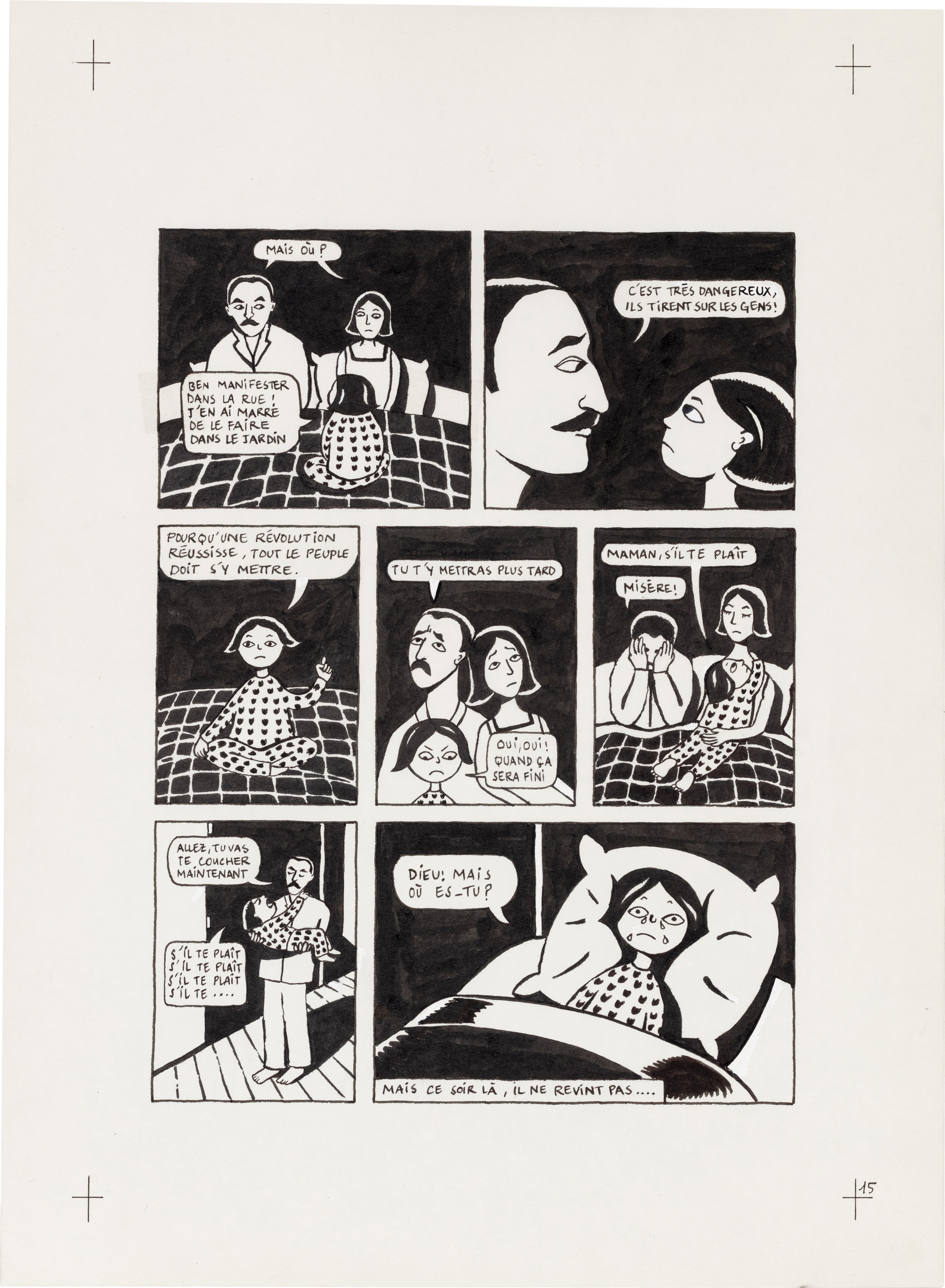
Marjane Satrapi
Persepolis (Original Book Art, page 15), 2000
Her great uncle was Fereydoun Farrokhzad, a celebrated Iranian singer and poet, and her family's commitment to social justice and free thought left an indelible mark on her. She came of age during one of the most turbulent periods in modern history, witnessing the Islamic Revolution of 1979 and enduring the Iran and Iraq War throughout her adolescence. These formative years did not crush her spirit so much as concentrate it, giving her the raw material for a body of work that would eventually reach millions of readers across the globe. As a teenager, Satrapi was sent by her parents to Vienna to study at the Lycée Français, a decision born of both love and necessity given the increasingly restrictive climate in Tehran.
The experience of exile and displacement, of being Iranian in Europe and never quite belonging fully to either world, became one of the animating themes of her artistic practice. She returned to Iran before eventually settling permanently in France, studying at the École des Arts Décoratifs in Strasbourg and later becoming a central figure in the vibrant Parisian comics and illustration scene of the late 1990s. It was in Paris that she found both her community and her form. The publication of Persepolis in France in 2000 by the publisher L'Association was an immediate cultural event.
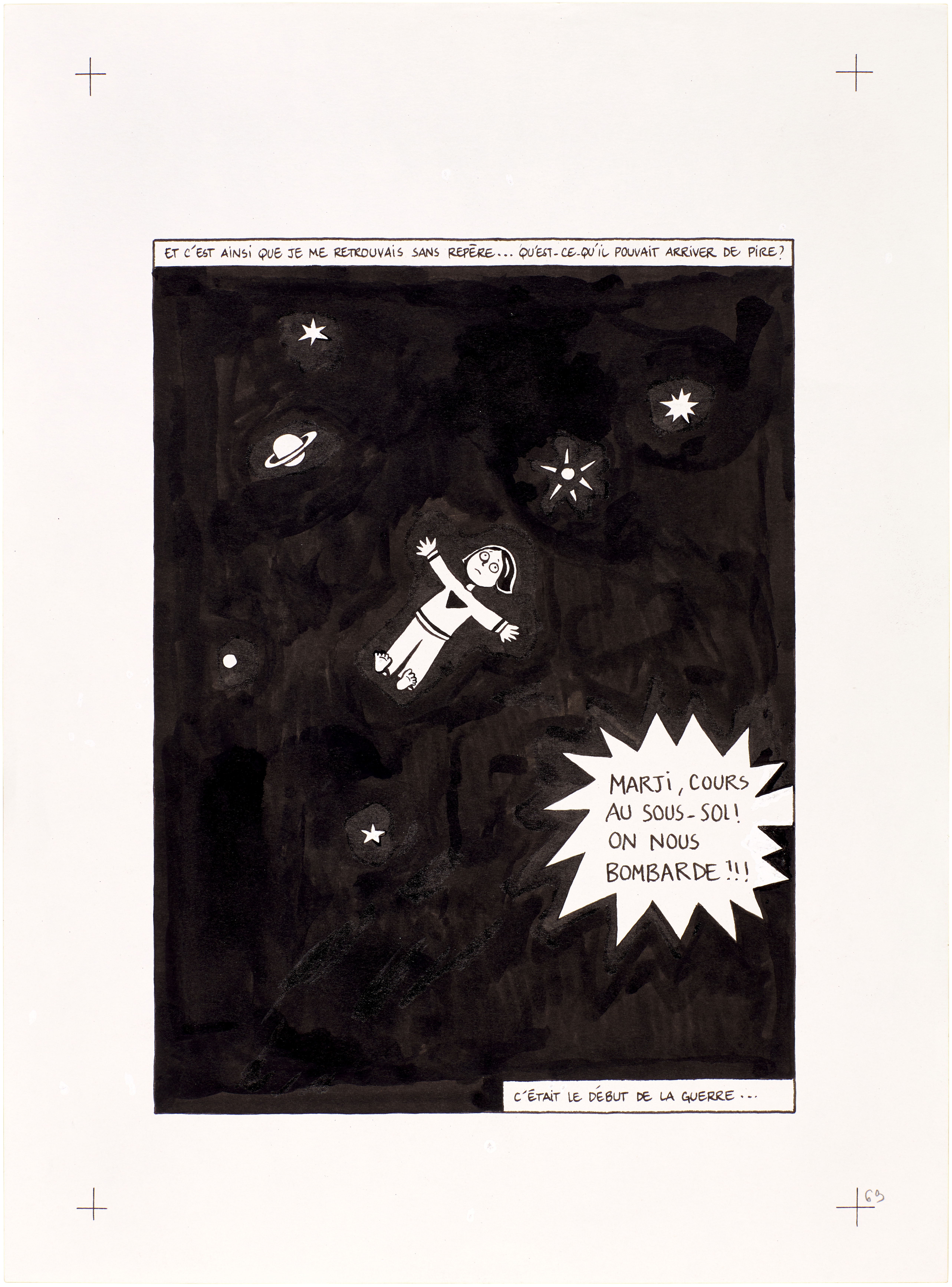
Marjane Satrapi
Persepolis (Original Book Art, page 69), 2000
Satrapi's decision to work in stark, high contrast black and white was not merely aesthetic but deeply considered. The graphic simplicity of her line work drew consciously on the Persian miniature tradition, on political cartoons, and on the expressionist visual language of artists like Frans Masereel and Lynd Ward, whose wordless novels in woodcut had long explored suffering and resistance. Her compositions balance intimacy and grandeur with remarkable ease, moving from the domestic scale of a child's bedroom to the vast, terrible scale of revolution and war, sometimes within the same sequence of panels. The work announced a major artistic intelligence fully formed.
“I realized that there was a world out there and it was full of people who thought and felt and had emotions just like me.”
Interview, The Guardian
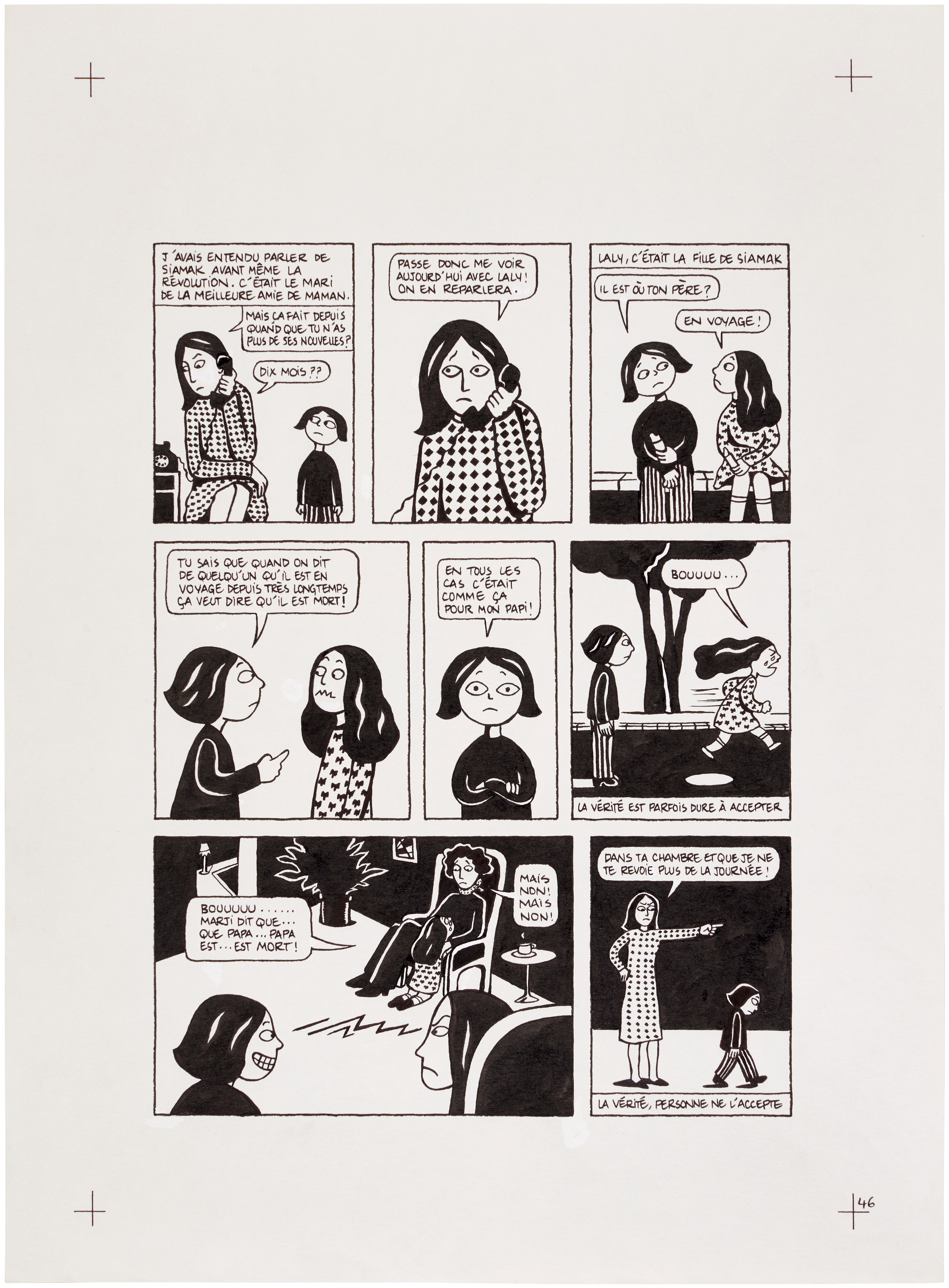
The original pages from Persepolis, executed in ink on paper, are extraordinary objects to encounter in person. What reproduces as bold graphic simplicity reveals itself, up close, as something far more nuanced: evidence of a hand making urgent decisions, of marks placed with the confidence of someone who has earned the right to speak. Pages such as those depicting Marji's early confrontations with ideology, her experiences of loss, and the quietly heroic figures of her parents and grandmother carry an emotional charge that purely literary prose rarely achieves. Each page functions as both a narrative unit and a standalone composition, and it is this dual nature that makes them so compelling to collectors who understand the history of works on paper.
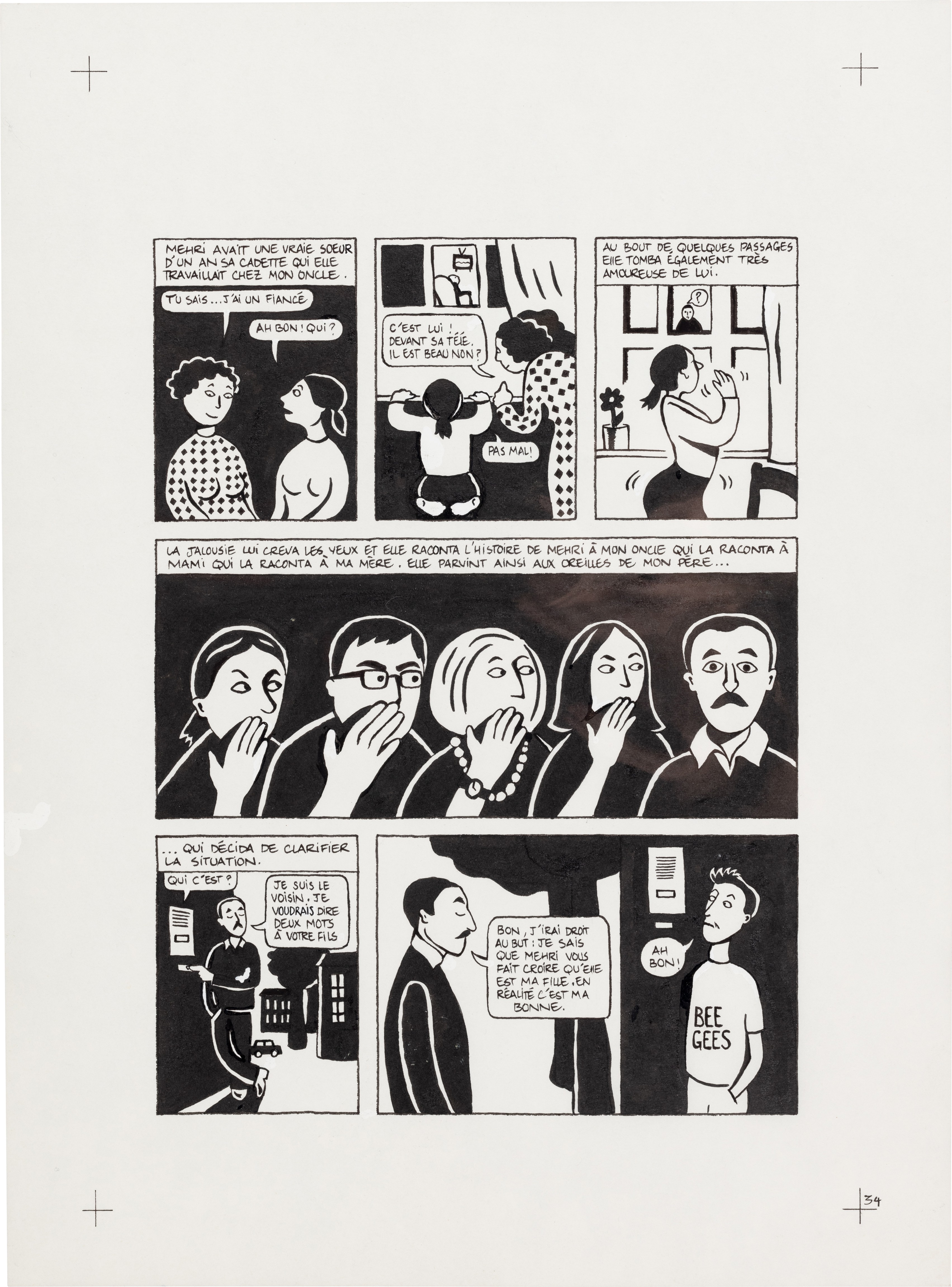
Marjane Satrapi
Persepolis (Original Book Art, page 34), 2000
For collectors, the original Persepolis pages represent a genuinely rare opportunity. Unlike the work of many celebrated artists, where original materials are dispersed across decades and geographies, these pages belong to a discrete, historically bounded body of work tied to a single transformative project. The collector who acquires a page from Persepolis is acquiring a piece of one of the defining cultural documents of the early twenty first century. Satrapi occupies a position in the history of the graphic novel comparable to the one Art Spiegelman holds with Maus, and the market has begun to reflect that stature.
Works from Persepolis appear rarely at auction and in specialist galleries, which makes direct acquisition through platforms like The Collection a particularly meaningful avenue for serious collectors. Within the broader landscape of contemporary art, Satrapi's practice connects to a rich tradition of artists who have used sequential image making and autobiography to bear witness to history. Art Spiegelman's Maus is the natural point of comparison, but her visual sensibility also resonates with the work of Joe Sacco, whose graphic journalism brought the same moral seriousness to the Palestinian conflict, and with the Iranian American painter Shirin Neshat, whose photographs and films explore the tensions between Iranian identity and the Western gaze. Satrapi's willingness to render the personal and the political as inseparable places her firmly in the tradition of artists for whom making art is an act of conscience.
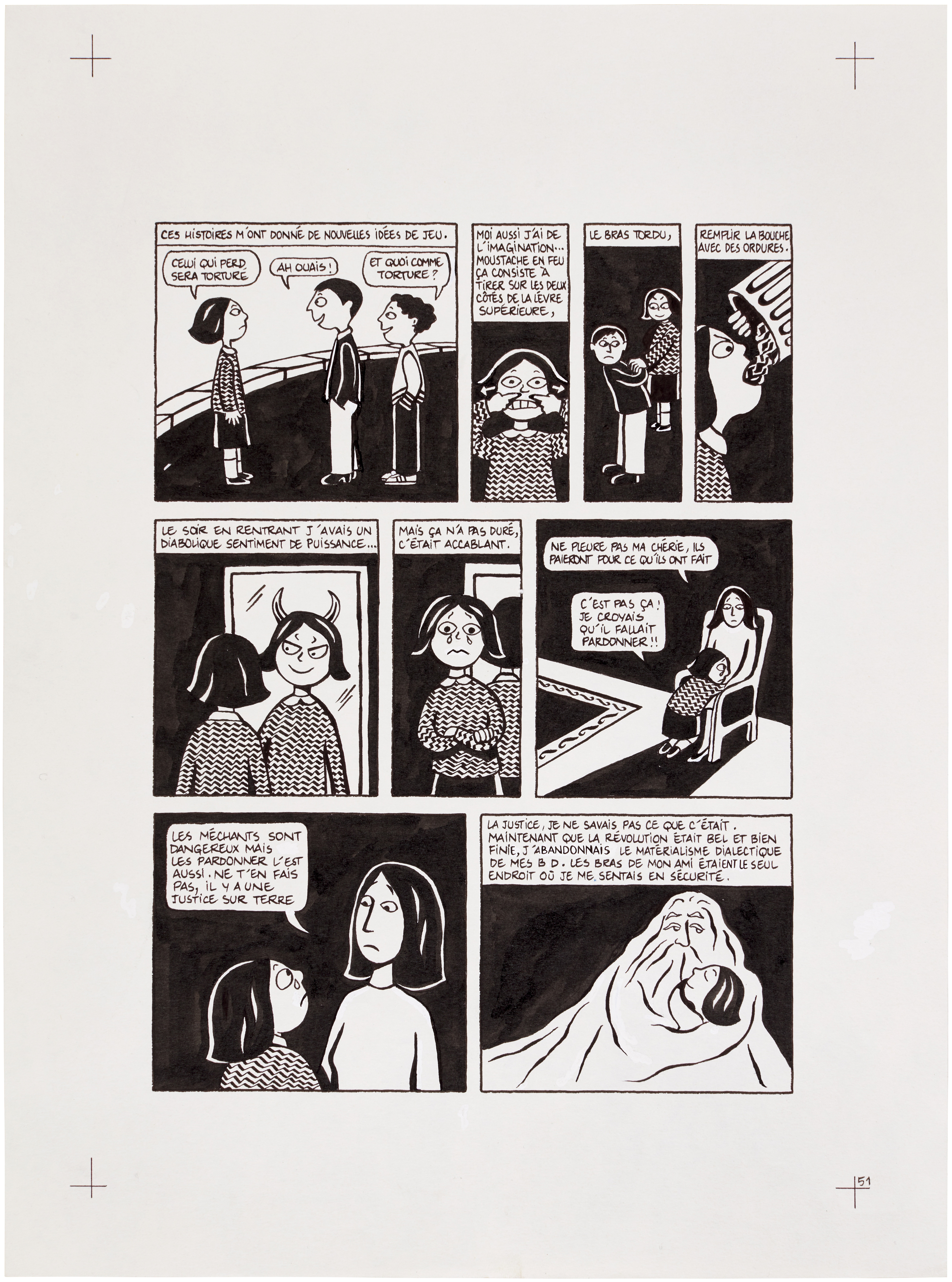
Marjane Satrapi
Persepolis (Original Book Art, page 51), 2000
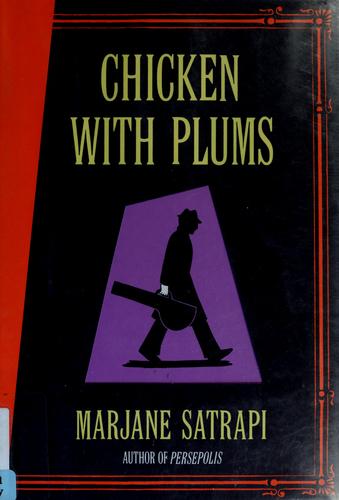
Satrapi has also distinguished herself as a filmmaker, co directing the animated adaptation of Persepolis in 2007, which won the Jury Prize at the Cannes Film Festival and received an Academy Award nomination for Best Animated Feature. Her subsequent films, including Chicken with Plums in 2011, further demonstrated the range and ambition of her creative vision. Yet it is the drawings that remain her most essential contribution, the place where her voice is most direct and most irreplaceable. In a cultural moment when questions of identity, belonging, political repression, and the courage to speak freely feel urgently alive, Satrapi's work does not age.
It deepens.
Explore books about Marjane Satrapi