María Blanchard

María Blanchard, Cubism's Most Luminous Secret
Artist Spotlight · The Collection Editorial
In the winter of 1927, visitors to the Galerie Van Leer in Paris encountered something they had not quite expected from one of the city's most serious avant garde painters. The works on view were tender, luminous, and deeply human. Children reading by windows. Mothers cradling infants.
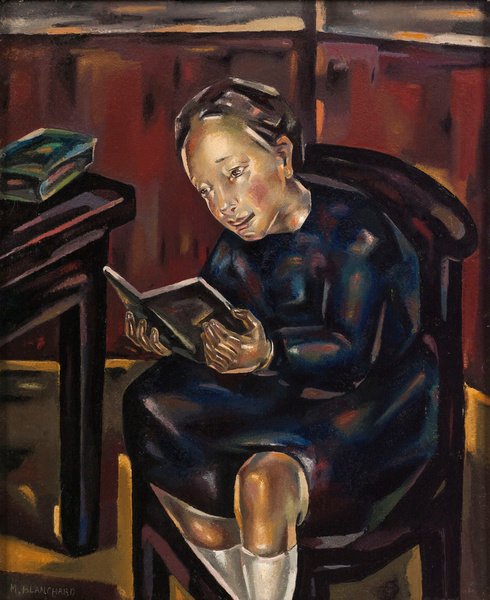
María Blanchard
Petite fille lisant, 1929
The fractured geometries of Cubism had not disappeared, but they had been softened, warmed, turned inward. The painter was María Blanchard, a Spanish artist who had spent years at the radical center of Parisian modernism, and who was now revealing a side of her vision that moved audiences to genuine emotion. It is a body of work that continues to reward collectors and museum audiences alike, and whose significance within the story of twentieth century art is only now receiving the full attention it deserves. María Gutiérrez Cueto was born in 1881 in Santander, on the northern coast of Spain, into a family of intellectual and artistic leanings.
Her father was a journalist and her mother had French and Cuban heritage, a cosmopolitan mix that would later ease her passage into Parisian bohemian life. From birth, Blanchard lived with a spinal condition that left her with a pronounced physical disability, a circumstance that shaped her inner life profoundly and that she navigated with extraordinary resilience and quiet determination. Rather than diminish her ambition, the challenges of her early years seem to have concentrated it. She was drawing with seriousness before adolescence, and her family, to their lasting credit, recognised and supported that gift.
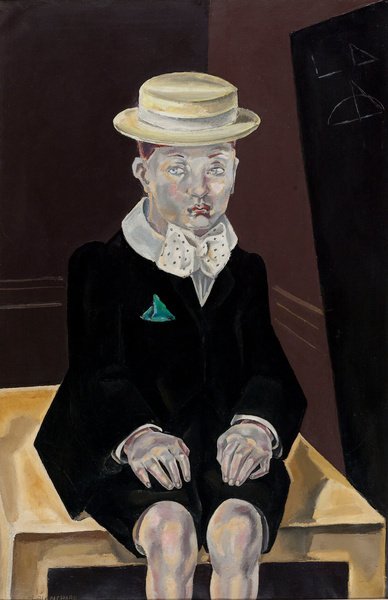
María Blanchard
Petit garçon au canotier, 1923
Her formal training began at the Escuela de Bellas Artes de San Fernando in Madrid, where she studied under painters including Manuel Benedito and Emilio Sala, absorbing a rigorous classical foundation. She also worked with the Basque painter Guiard, and received crucial encouragement from the celebrated Spanish master Hermenegildo Anglada Camarasa. The Spanish government awarded her a grant to study abroad, and in 1909 she arrived in Paris, the city that would become her true artistic home. She enrolled at the Académie Vitti and later worked under Henri Martin and Hermenegildo Anglada Camarasa, but it was through her immersion in the living avant garde of Montparnasse that her artistic identity truly crystallised.
In Paris, Blanchard entered one of the most intellectually charged artistic communities in history. She became close friends with Juan Gris, the Spanish Cubist whose influence on her work would prove decisive. Through Gris she deepened her engagement with Cubism, the movement that sought to represent objects and figures from multiple viewpoints simultaneously, fracturing visual reality into interlocking planes of color and geometry. By 1913 Blanchard was exhibiting in the Salon des Indépendants alongside figures including Jean Metzinger and Albert Gleizes.
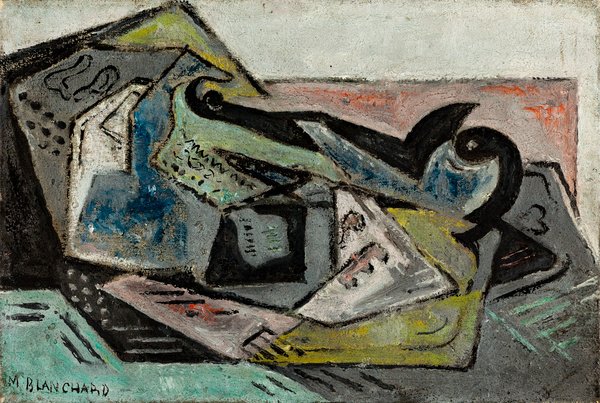
María Blanchard
Nature morte aux journaux, 1919
She showed at the Section d'Or exhibition in 1912, a landmark gathering of Cubist artists that placed her unambiguously within the movement's inner circle. Diego Rivera was another close friend from this period, and the warmth of these relationships can be felt in the generosity and humanity that runs through even her most formally rigorous compositions. What makes Blanchard's development so compelling to trace is the arc it follows from pure structural experimentation toward a richly expressive figuration. Her Cubist works from around 1916 to 1920, including the magnificent "Nature morte aux journaux" of 1919, demonstrate a complete command of the idiom.
Fragmented forms, overlapping planes, a flattened pictorial space animated by subtle tonal contrasts: these are works that stand comparison with the finest Synthetic Cubism being produced anywhere in Europe at the time. Yet from the early 1920s onward, the geometry begins to yield. Children appear. Domestic interiors warm with diffuse, golden light.
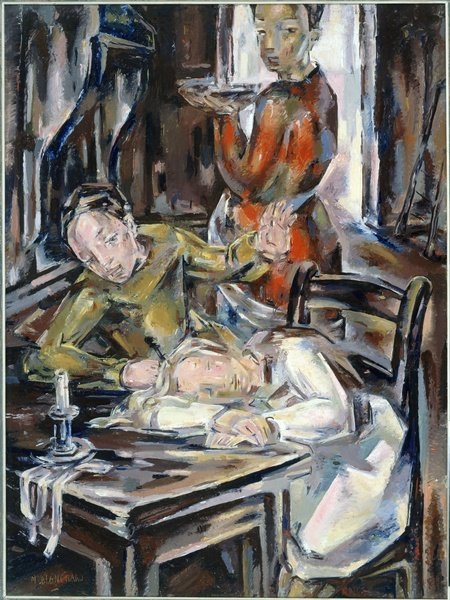
María Blanchard
La fillette endormie, 1929
Works like "Petit garçon au canotier" from 1923 and "Le vannier" from 1924 show a painter integrating the structural lessons of Cubism into a figurative language entirely her own, one that carries real emotional weight without ever descending into mere sentimentality. Her late works are perhaps the most quietly astonishing of all. "Petite fille lisant" and "La fillette endormie," both painted in 1929, are among the most tender paintings produced in interwar Paris. The children in these canvases are rendered with a warmth that recalls the great Spanish tradition, an echo of Velázquez and Zurbarán in their still, absorbed presences, yet the underlying geometry that structures each composition is unmistakably modern.
Blanchard had developed a synthesis that was genuinely her own. She was not retreating from modernism but deepening it, insisting that formal innovation and human feeling were not opposites. It is this conviction, expressed across a body of work spanning portraiture, still life, maternity scenes, and figure studies, that gives her practice its remarkable coherence and its lasting appeal. For collectors, Blanchard's work occupies a fascinating position in the market.
She is firmly established in major Spanish collections, including the Museo Nacional Centro de Arte Reina Sofía in Madrid, which holds important examples of her output, and her work appears regularly at auction through leading houses including Christie's, Sotheby's, and Drouot in Paris. Her prices reflect both genuine critical esteem and the ongoing reappraisal of women modernists that has transformed collecting priorities over the past two decades. Works from her mature figurative period, roughly 1922 to 1930, are particularly sought after for their accessibility and emotional directness. Still life compositions from her Cubist phase offer an entry point into her earlier, more structurally experimental work and represent strong value for collectors building a coherent holding in early twentieth century European modernism.
Blanchard sits naturally alongside artists including Juan Gris, Jean Metzinger, and Fernand Léger in any serious survey of Parisian Cubism, and her work invites comparison with that of her contemporaries Sonia Delaunay and Suzanne Valadon in the way it insists on lived experience as the ground of formal innovation. She is also a significant figure within the Spanish artistic tradition, a peer and counterpart to painters including Anglada Camarasa and a crucial link between the classical heritage of Spanish painting and the revolutionary energies of European modernism. As museums and scholars continue to revisit the full breadth of the Cubist movement, Blanchard's place within it grows more secure and more central with each passing year. Her death in Paris in 1932 came too soon, cutting short a practice that was still evolving and still surprising.
She was fifty years old. What she left behind is a body of work of genuine distinction: formally rigorous, emotionally alive, and unmistakably personal. At a moment when collectors and institutions are actively seeking out the figures whose contributions were overlooked or undervalued by a narrower telling of art history, María Blanchard stands as one of the most rewarding rediscoveries available. To spend time with her paintings is to understand that the history of modernism is larger, warmer, and more various than the canonical narratives have sometimes allowed.
She deserves every new admirer she finds.
Explore books about María Blanchard
María Blanchard, 1881-1932
Juan Manuel Bonet
María Blanchard: Catálogo razonado de la obra pictórica
Juan Manuel Bonet
María Blanchard: 1881-1932
Musée d'Art Moderne et d'Art Contemporain de Liège
María Blanchard: La modernidad silenciosa
Fernando Huici
María Blanchard: Una pintora moderna
Concha Lomba