Maarten Baas
Maarten Baas Burns Bright, Always
Artist Spotlight · The Collection Editorial
“I want to make things that have a soul, that have something to say beyond their function.”
Maarten Baas, Design Academy Eindhoven interview
In the spring of 2009, the Museum of Arts and Design in New York staged a landmark exhibition titled 'Design Art' that sent ripples through both the design world and the contemporary art market. Maarten Baas was among the generation of Dutch makers who found themselves at the centre of that conversation, their work refusing to sit quietly in either category. More than fifteen years on, his pieces continue to command extraordinary attention at auction and in institutional collections alike, and the questions his practice raises about authorship, material memory, and what we dare call beautiful have only grown more urgent and more resonant. Baas was born in Germany in 1978 and raised in the Netherlands, a country with an almost genetic relationship to design rigour and conceptual daring.
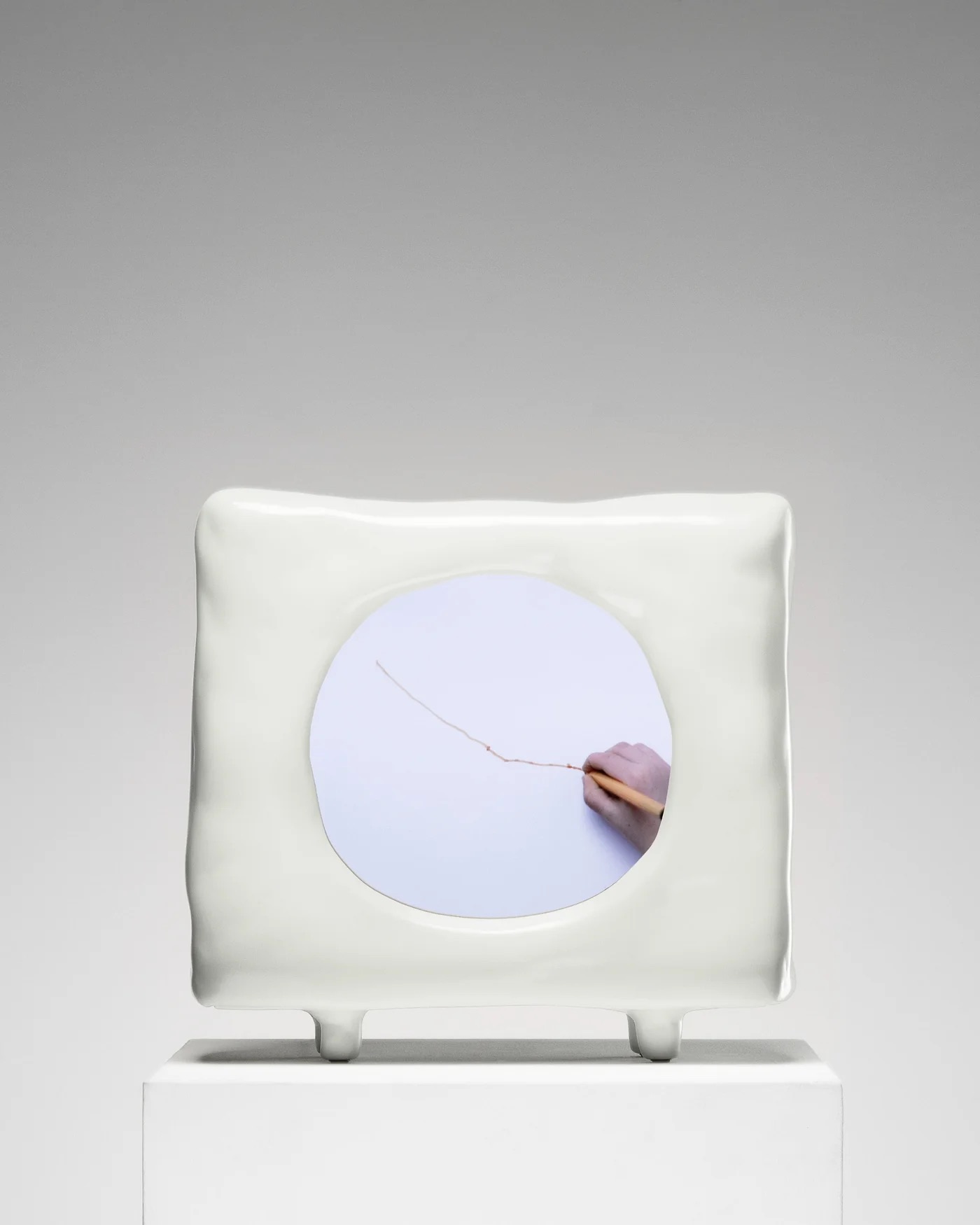
Maarten Baas
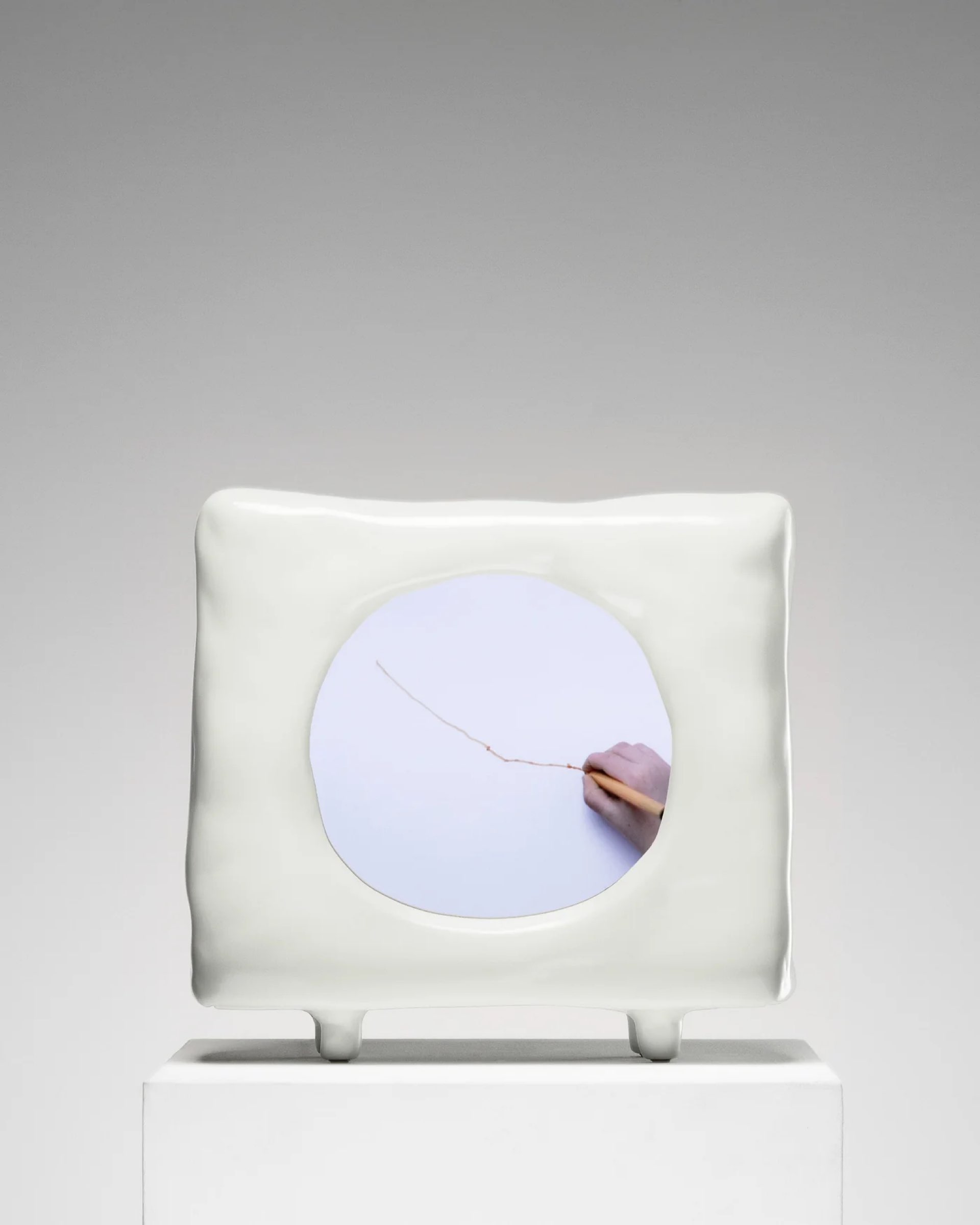
Children's Clock, 2022
He studied at the Design Academy Eindhoven, the institution that has arguably done more than any other in the world to cultivate a generation of designers who think like artists. Eindhoven in the late 1990s and early 2000s was a genuinely electric environment, producing figures such as Hella Jongerius and Jurgen Bey alongside Baas, each pursuing a fundamentally different relationship between the hand, the idea, and the object. For Baas, the academy was the place where he learned to ask the most dangerous and productive question available to a young maker: what happens when you destroy the thing you were supposed to make? The answer came in 2002 with his graduation project, which would become the defining series of his early career.
Baas took canonical furniture pieces by architects and designers including Gerrit Rietveld, whose Red Blue Chair is among the most recognisable objects in the history of modern design, and Antoni Gaudi, and subjected them to open flame. He then coated the charred remains in transparent epoxy resin, freezing the destruction at the precise moment before total loss. The series, known as Smoke, was both an act of irreverence and a declaration of love. By burning icons, Baas was not dismissing them but reanimating them, forcing a confrontation with the fragility that lies beneath every canonical object.
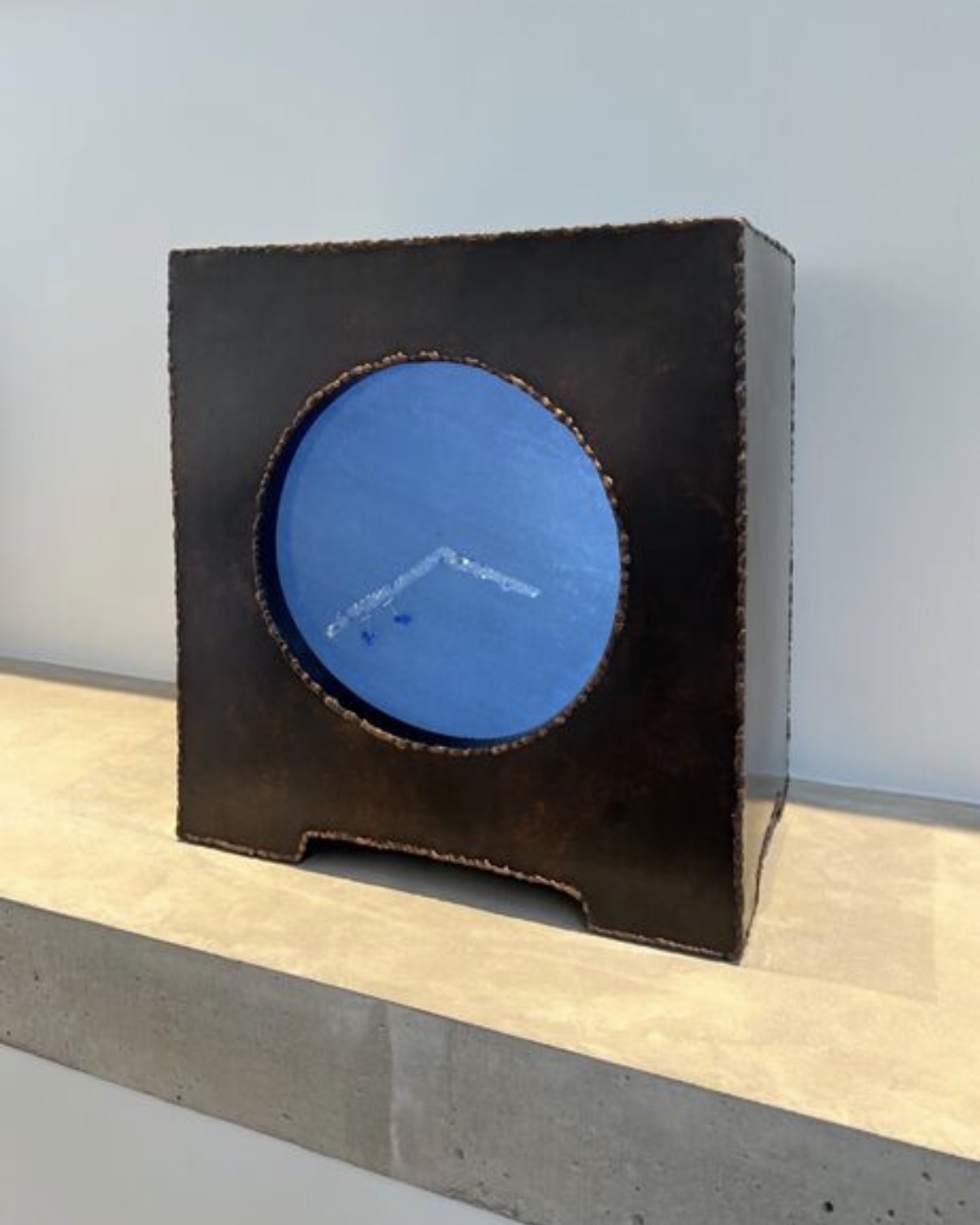
Maarten Baas
Real Time Sweepers Mantel Clock Copper, 2021
The work was acquired by major collections almost immediately and launched him into international visibility while he was still in his mid twenties. From Smoke, Baas moved into territory that was, if anything, even more viscerally physical. The Clay furniture series, which he began developing in the mid 2000s in collaboration with his studio, involved hand modelling resin by hand directly over metal armatures, producing chairs and tables that carry the visible traces of every touch, every correction, every moment of hesitation. Where Smoke spoke of destruction and preservation, Clay spoke of becoming, of the object as something still in the process of finding itself.
A Clay dining chair is not finished in the conventional sense; it is arrested, the way a sculptor might choose to leave tool marks visible in bronze. Collectors who live with these pieces report that they change in different lights, that the surfaces seem to breathe. That quality of intimacy is not accidental. It is the whole point.
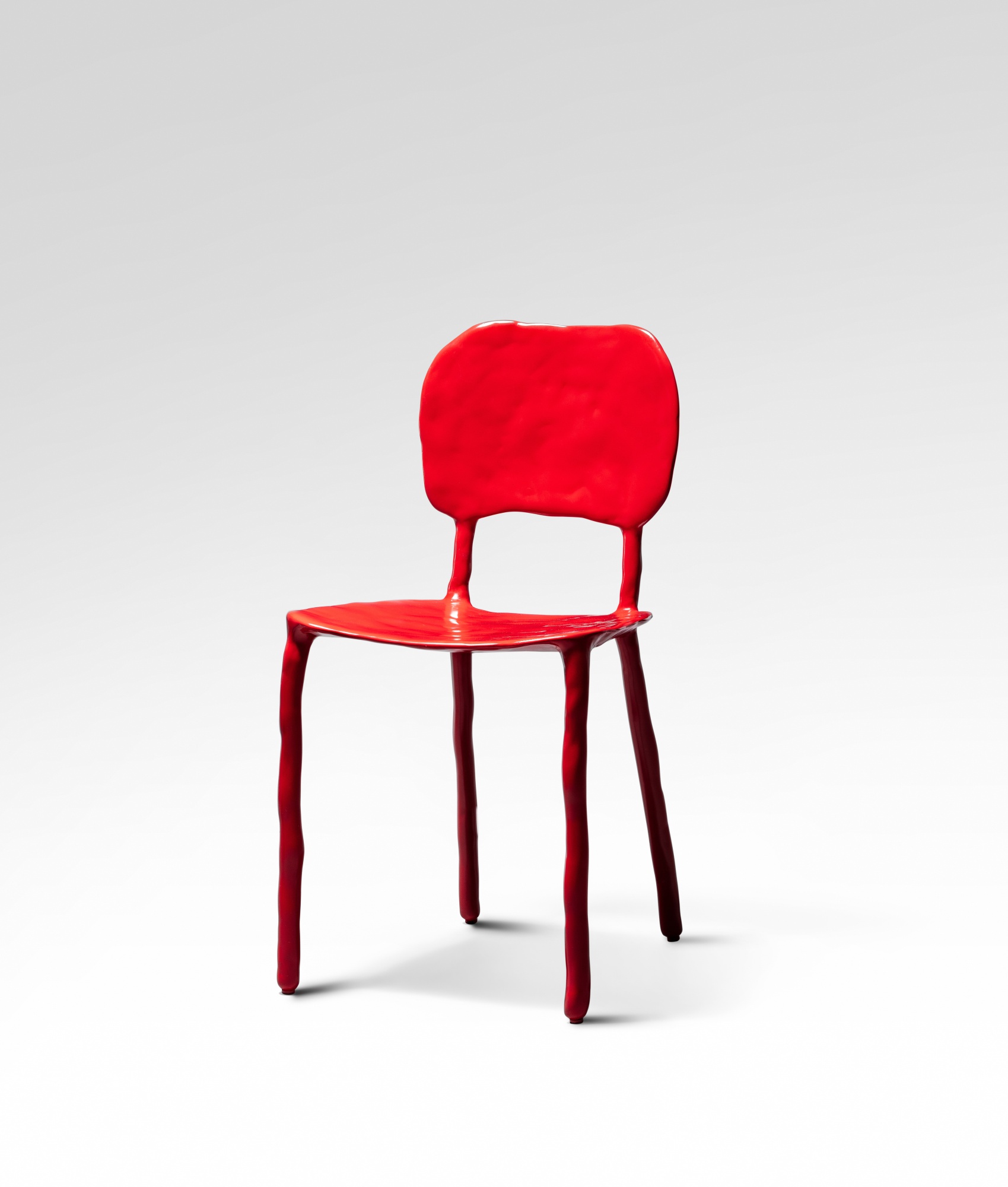
Maarten Baas
Dining chair, série Clay
Baas has also built an extraordinary body of work around time itself, most notably through his ongoing series of functioning clocks in which the display of the hour and minute is performed rather than mechanical. The Grandfather Clock series and the various iterations of Real Time, in which a figure inside the clock face paints over the hands each minute, introduced a layer of conceptual theatre that brought his work to an even wider audience. The Real Time Sweepers Mantel Clock in copper and the Children's Clock, with its handmade stainless steel casing and clay elements, represent the maturation of this thinking into objects of genuine sculptural authority. These are not novelties.
They are philosophical propositions about duration, presence, and the human compulsion to measure what cannot ultimately be held. They also happen to be extraordinarily beautiful, and that combination of intellectual seriousness and sensory pleasure is at the core of what makes Baas so enduringly compelling. For collectors, the appeal of Baas sits at a productive intersection. His work is championed by institutions including the Museum of Modern Art in New York and the Stedelijk Museum in Amsterdam, which confers the kind of institutional validation that sustains long term market confidence.
At the same time, his practice remains recognisably the work of a single imagination, scaling without losing the handmade quality that gives each piece its particular character. At Phillips and Christie's, significant Baas works have attracted serious competition from collectors across Europe, North America, and Asia. Those new to his practice are well advised to look closely at the Clay series and the clock works as entry points, since both represent the full range of his thinking in objects that are also genuinely liveable. The works hold up under daily looking, which is not a small thing.
To understand Baas fully it helps to place him within a broader tradition of Dutch and Northern European design thinking that has consistently privileged concept alongside, and sometimes above, function. Droog Design, the collective that transformed international perceptions of Dutch design from the early 1990s onward, created the cultural permission for work like his to exist. Figures such as Hella Jongerius and Studio Job share with Baas a commitment to the object as a bearer of meaning rather than merely a solution to a practical problem, though each has pursued that commitment through very different material languages. In the wider art historical frame, Baas invites comparison with artists such as John Chamberlain, who found beauty in destruction and compression, and with the Arte Povera movement's insistence on the intelligence latent in humble and transformed materials.
What Baas has achieved, and what makes his position in the contemporary canon so secure, is the construction of a practice that is genuinely irreducible. You cannot mistake a Baas for anyone else's work, and that specificity is among the rarest gifts an artist or designer can possess. His ongoing engagement with time, with the handmade, and with the productive tension between care and destruction keeps his practice alive and evolving rather than consolidating around a signature that becomes a style. There is a generosity in his work, an invitation to think and to feel simultaneously, that collectors and institutions have responded to with sustained enthusiasm for more than two decades.
The fire he started in Eindhoven in 2002 is still burning, and the light it casts only gets more interesting.
Explore books about Maarten Baas