Louise Nevelson

Louise Nevelson: Queen of the Black Night
Artist Spotlight · The Collection Editorial
“I had to clear everything away and create a new world. That is what I did.”
Louise Nevelson
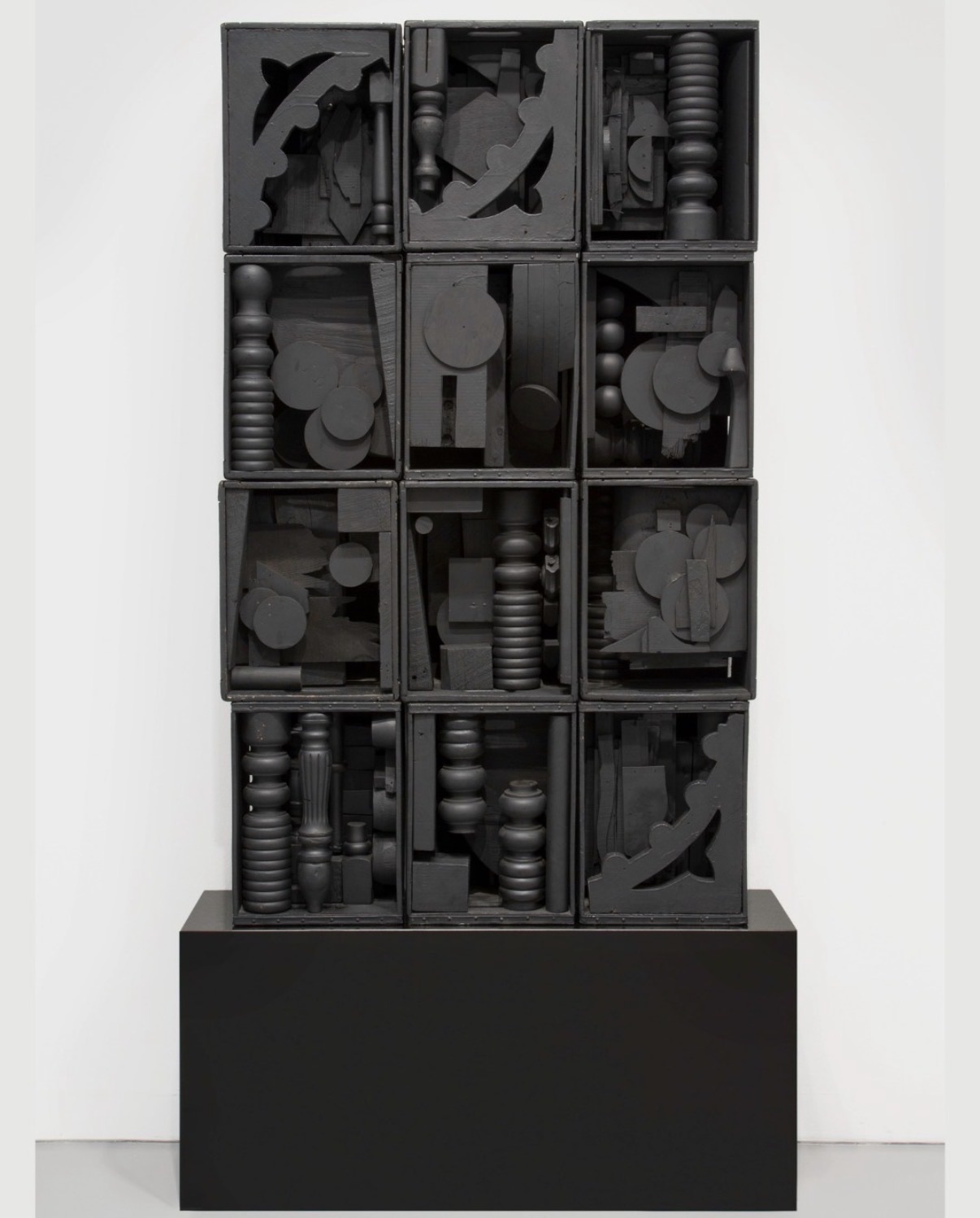
In the grand sweep of twentieth century American art, few moments feel as cinematically charged as the first time a viewer encounters one of Louise Nevelson's great black walls. Standing before a work like Black Wall from 1964, a towering assemblage of wooden boxes, spindles, chair legs, and architectural fragments unified under a single coat of matte black paint, the experience is less like looking at sculpture and more like stepping into a dream that has solidified overnight. The Museum of Modern Art, the Whitney Museum of American Art, and the Pace Gallery have all staged significant presentations of her work over the decades, but the hunger for Nevelson continues to grow. Major institutions are revisiting her legacy with fresh eyes, and the market for her most significant assemblage works has never been more attentive.
Louise Nevelson
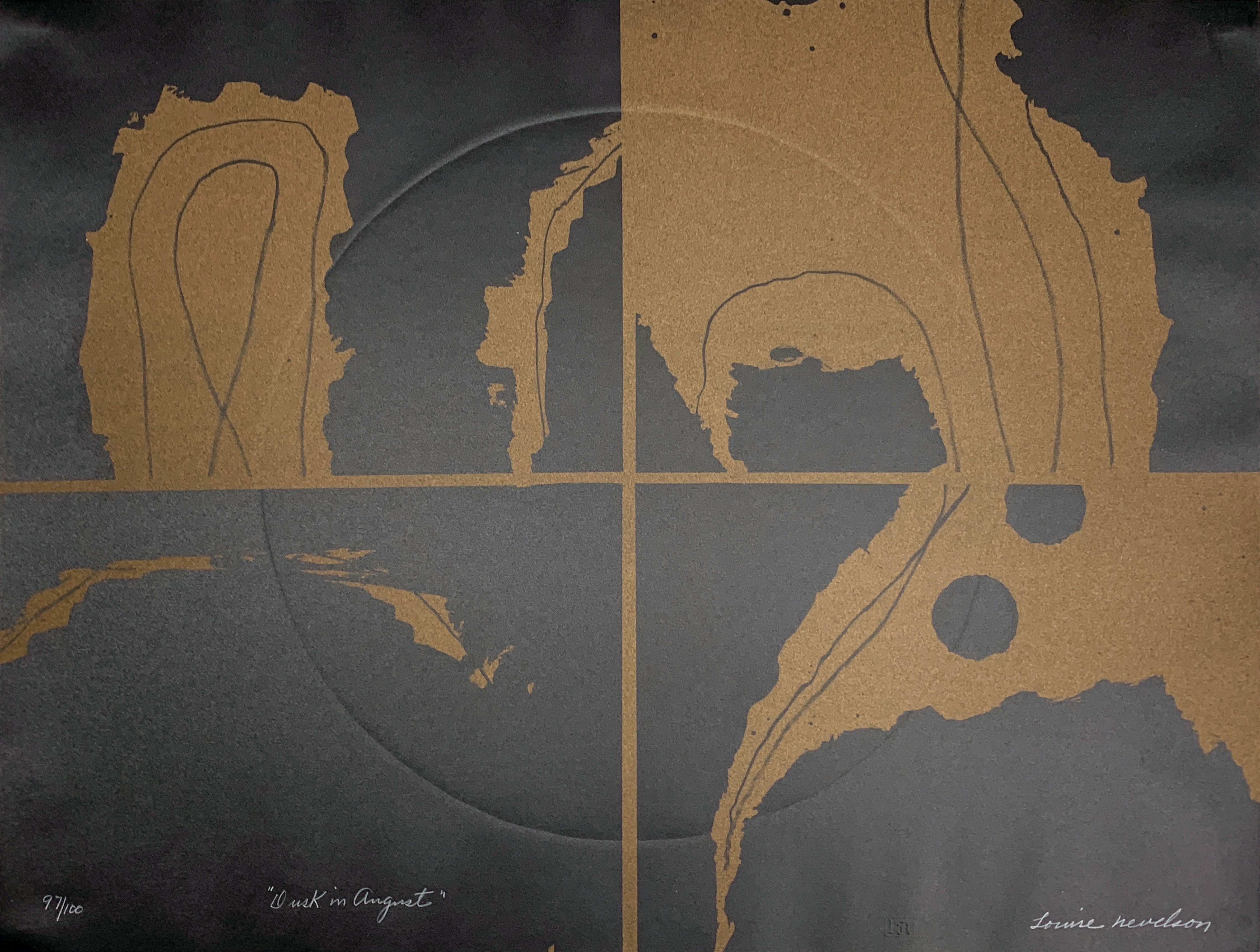
Dusk in August from Portfolio 9, 1967
Louise Nevelson was born Leah Berliawsky in 1899 in Pereiaslav, in the Russian Empire, the territory that is now Ukraine. Her family emigrated to the United States in 1905, settling in Rockland, Maine, a small coastal town that was, by any measure, a world away from the cultural centers she would one day conquer. From childhood she was drawn to form, to the tactile pleasure of objects, to the way light behaved differently across different surfaces. She studied at the Art Students League in New York, absorbing the discipline and rigor that serious artistic training demands, and later traveled to Munich to study under Hans Hofmann, whose teachings about pictorial structure and the push and pull of form would leave a lasting impression on her spatial thinking.
The path to her signature style was neither short nor straight. Through the 1930s and 1940s Nevelson experimented with painting, printmaking, and three dimensional forms, absorbing influences from Cubism, Surrealism, and the Pre Columbian art she encountered during travels to Mexico. She studied briefly with Diego Rivera and felt a deep kinship with the way ancient Mesoamerican sculpture commanded space and projected psychological weight. It was in the 1950s, however, that everything crystallized.
Louise Nevelson
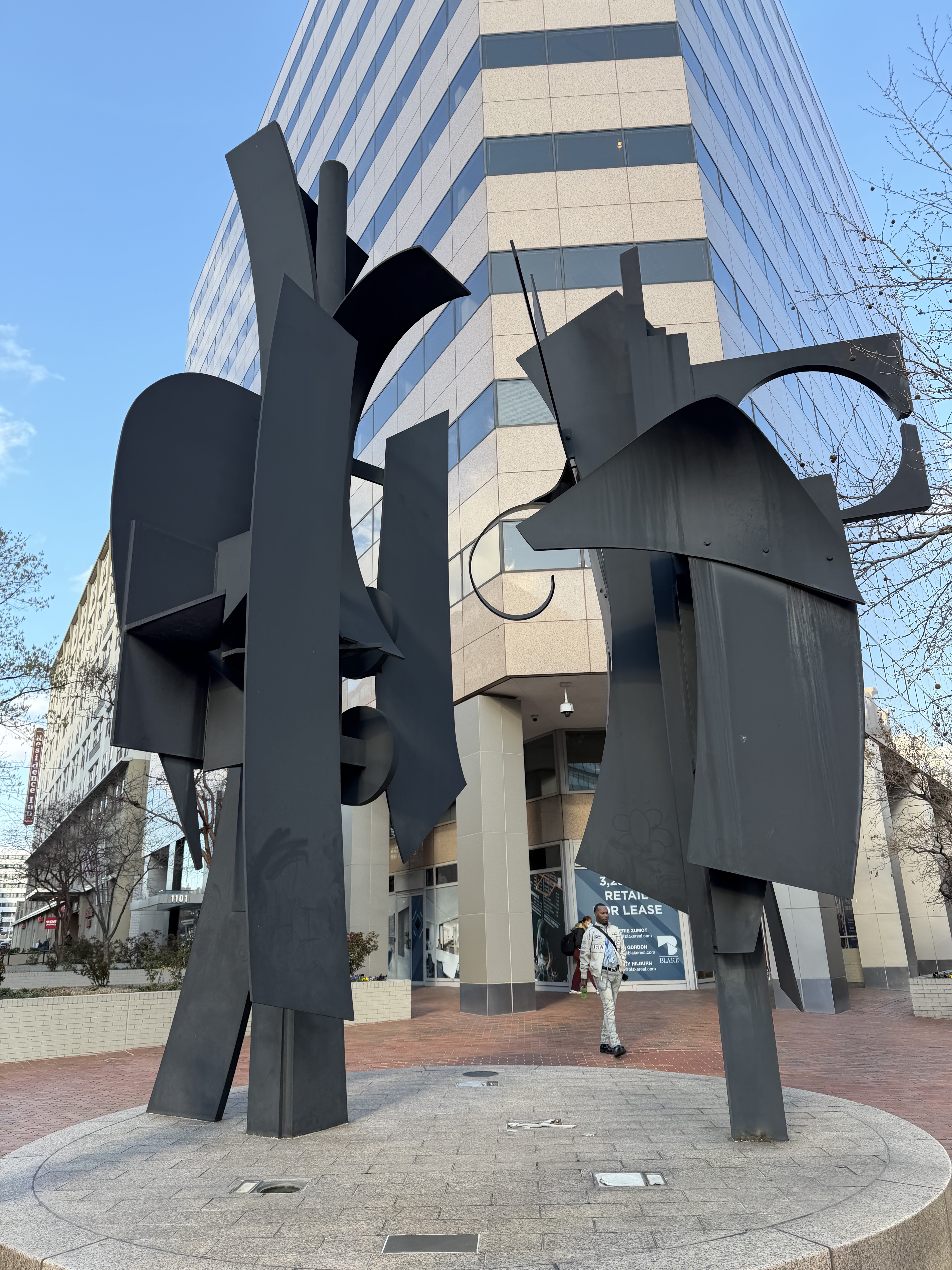
Sky Landscape, 1983
She began constructing her celebrated wall reliefs from found wood, discarded furniture, architectural salvage, and urban detritus, unifying each composition with a single color, most famously black, though she also worked extensively in white and gold. The decision to paint everything the same color was an act of supreme artistic intelligence: it stripped away the distraction of material identity and forced the viewer to encounter pure form, pure shadow, pure rhythm. The works that define her legacy are the ones that feel most like inhabited environments. Sky Landscape from 1983, executed in black painted steel with its characteristic sheets and cylinders, demonstrates how her vocabulary translated from intimate wood construction to the monumental scale of public commission.
“I never felt like a victim. I felt I had all the riches in the world just with my mind.”
Dawns and Dusks, 1976
Black Wall from 1964 remains one of the purest expressions of her assemblage practice, a meditation on accumulation and unity that rewards sustained attention. The Wedding Present from 1977, constructed from painted wood boxes in fourteen parts, reveals the ceremonial quality that always underlay her work, the sense that these were not objects to be merely observed but thresholds to be crossed. Her printmaking, including the lithographs gathered in suites such as Dusk in August, showed that her compositional instincts translated seamlessly into works on paper, giving collectors an accessible point of entry into her visual world without any sacrifice of ambition. For collectors, Nevelson presents an extraordinary range of acquisition possibilities.
Louise Nevelson
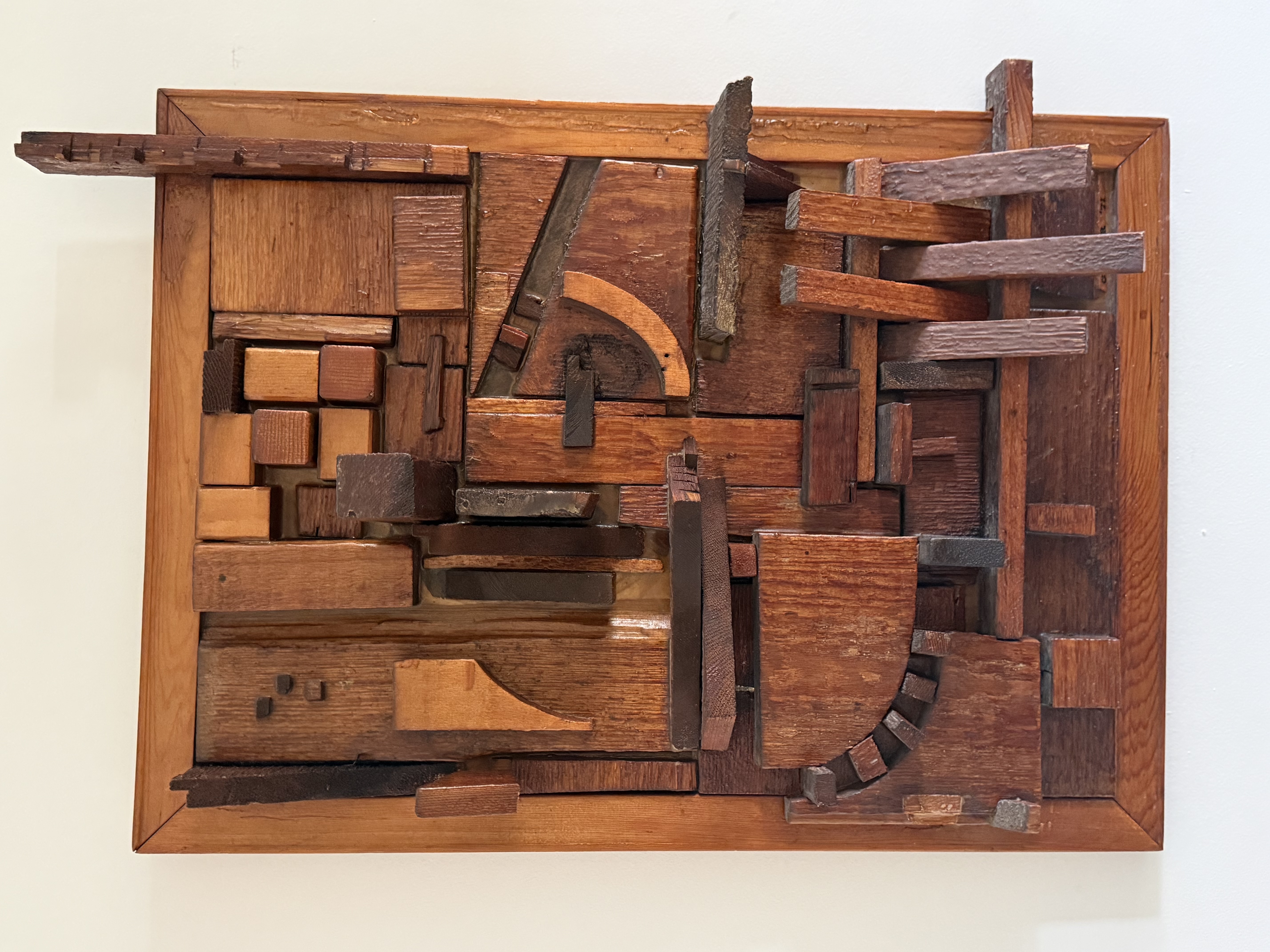
Untitled
At the upper end of the market, her large scale wood and steel assemblages are serious museum quality trophies, works that anchor a collection and command a room with undeniable authority. Her maquettes, such as the Maquette for Sky Landscape I from 1977 in welded steel and the Maquette for Monumental Sculpture VII from 1976 in painted wood, offer something particularly rare: direct insight into her process, the working models through which she tested and refined compositions before executing them at full scale. These small works carry enormous conceptual weight. Her cast paper reliefs, multiples, and lithographs extend the Nevelson conversation into a more accessible register without diluting the integrity of the work.
“The freer that women become, the freer will men be. Because when you enslave someone, you are enslaved.”
Louise Nevelson
Galleries including Pace, which represented her for decades, have long understood that the breadth of her output makes her a uniquely versatile presence in a sophisticated collection. Nevelson belongs to a constellation of artists who transformed what sculpture could be in the postwar era. Her closest peers in spirit include Joseph Cornell, whose shadow box constructions share her devotion to the poetic power of found objects, and John Chamberlain, who was similarly drawn to industrial material as a vehicle for expressive form. The Assemblage movement that MoMA recognized in its landmark 1961 exhibition, The Art of Assemblage, provided an art historical framework for what she and contemporaries like Robert Rauschenberg and Lee Bontecou were doing, though Nevelson's environmental ambitions always pushed beyond simple categorization.
Louise Nevelson
Black Wall, 1964
She was also a vital figure in the emergence of feminist art history, as scholars and curators from the 1970s onward recognized how her career had been persistently undervalued relative to her male contemporaries, despite the fact that her formal innovations were no less radical than those of David Smith or Mark di Suvero. What makes Nevelson so vital today is not nostalgia but relevance. In an era when artists and collectors alike are drawn to installation, to environmental experience, to art that transforms space rather than simply occupying it, Nevelson reads as a prophet. She understood that sculpture was not just object but atmosphere, not just form but feeling, long before those ideas became widespread.
Her insistence on the expressive power of found and discarded material speaks directly to contemporary concerns about labor, consumption, and the life of things. And her biography, the immigrant girl from Rockland, Maine who became the most commanding presence in New York sculpture, carries the particular resonance of a story about will, vision, and absolute refusal to be diminished. To collect Nevelson is to collect that conviction in its most concentrated and enduring form.
Explore books about Louise Nevelson

Louise Nevelson
Arnold B. Glimcher

Dawns and Dusks
Louise Nevelson with Diana MacKown
Louise Nevelson
Linda L. Cathcart
Louise Nevelson: Emotional Landscapes
Arnold B. Glimcher
Louise Nevelson: Light and Shadow
Laurie Wilson
Louise Nevelson: A Retrospective
Bonnie Clearwater

The Sculpture of Louise Nevelson: Constructing a Legend
Laurie Wilson