Lita Albuquerque
Lita Albuquerque Paints the Infinite Blue
Artist Spotlight · The Collection Editorial
“We are made of the same stuff as stars. That is not a metaphor. That is physics.”
Lita Albuquerque
There are artists who work within the world, and there are artists who expand it. Lita Albuquerque belongs unmistakably to the second category. In recent years, her profile has risen with a renewed institutional urgency, as museums and cultural organizations across the United States and Europe have revisited the Light and Space movement with fresh eyes, recognizing Albuquerque as one of its most visionary and enduring practitioners. Her work has been the subject of significant scholarly attention, and her large scale installations continue to be sought for landmark public commissions that few other living artists could credibly undertake.
Lita Albuquerque
Untitled
At a moment when the art world is hungry for work that carries genuine philosophical weight alongside visual splendor, Albuquerque's practice feels not merely relevant but necessary. Lita Albuquerque was born in 1946 in Santa Monica, California, a city whose particular quality of coastal light would prove formative. She studied at the University of California, Los Angeles, where she was immersed in a Southern California arts scene that was, in the late 1960s and early 1970s, among the most intellectually alive in the world. The milieu that shaped her included artists exploring perception, light, and materials with a rigorous conceptual curiosity that distinguished the West Coast from the more object focused tendencies of the New York scene.
It was an environment that rewarded artists who thought cosmically and worked with patience, and Albuquerque absorbed both lessons deeply. Her early practice drew on the foundational energies of the California Light and Space movement, a loosely affiliated group of artists working in Southern California from the 1960s onward who shared an interest in how light, color, and spatial experience could alter human perception. Artists such as James Turrell, Robert Irwin, and Maria Nordman were her contemporaries, and their collective investigations into phenomenology and the immaterial gave Albuquerque a framework within which her own singular vision could emerge. What distinguished her from the outset was a commitment to the body and the cosmos as twin poles of meaning, a belief that the human figure is not separate from the universe but is, in the most literal sense, made of it.
Lita Albuquerque
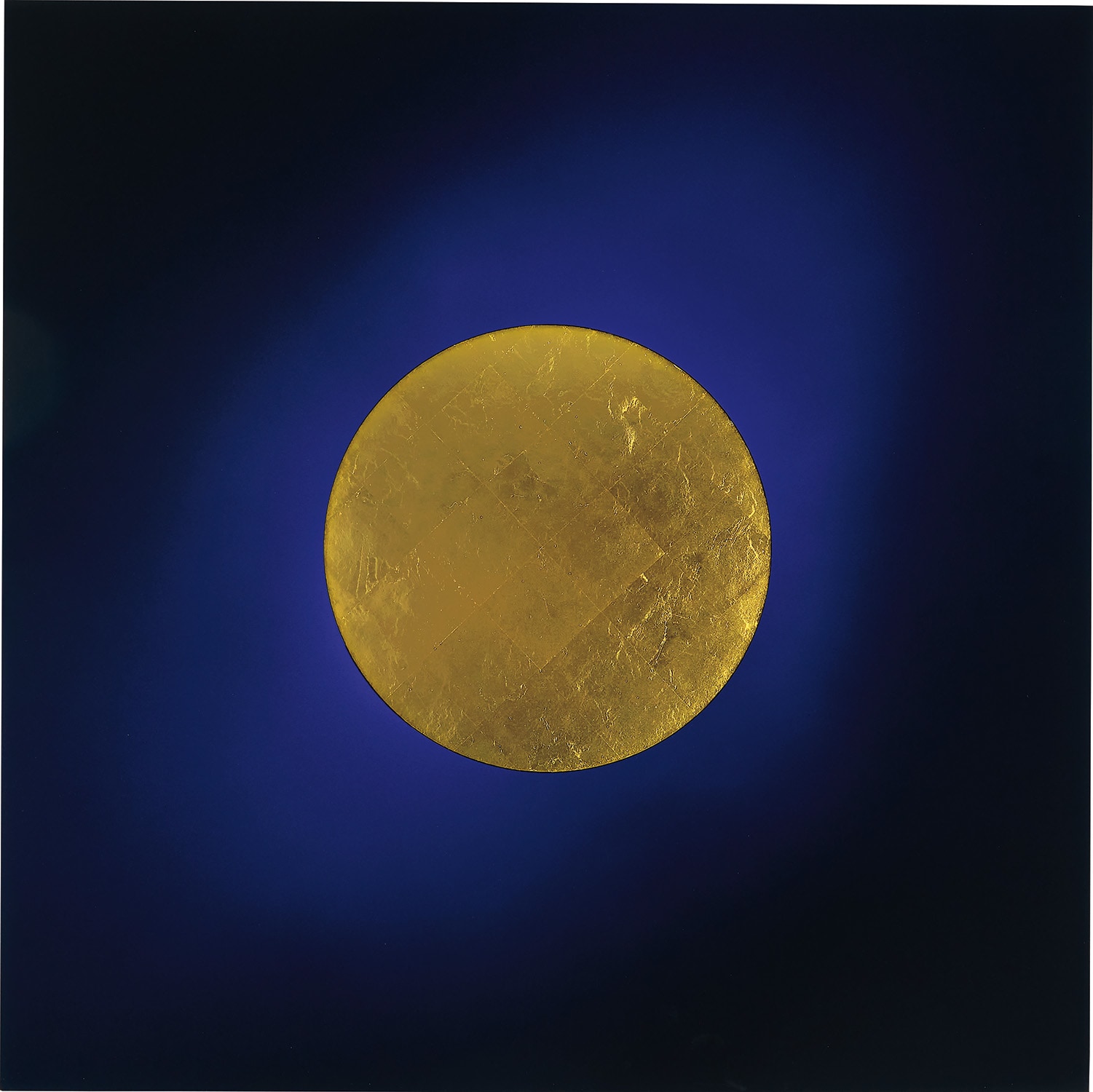
Auric Field Solar Flash (Gold au2), 2017
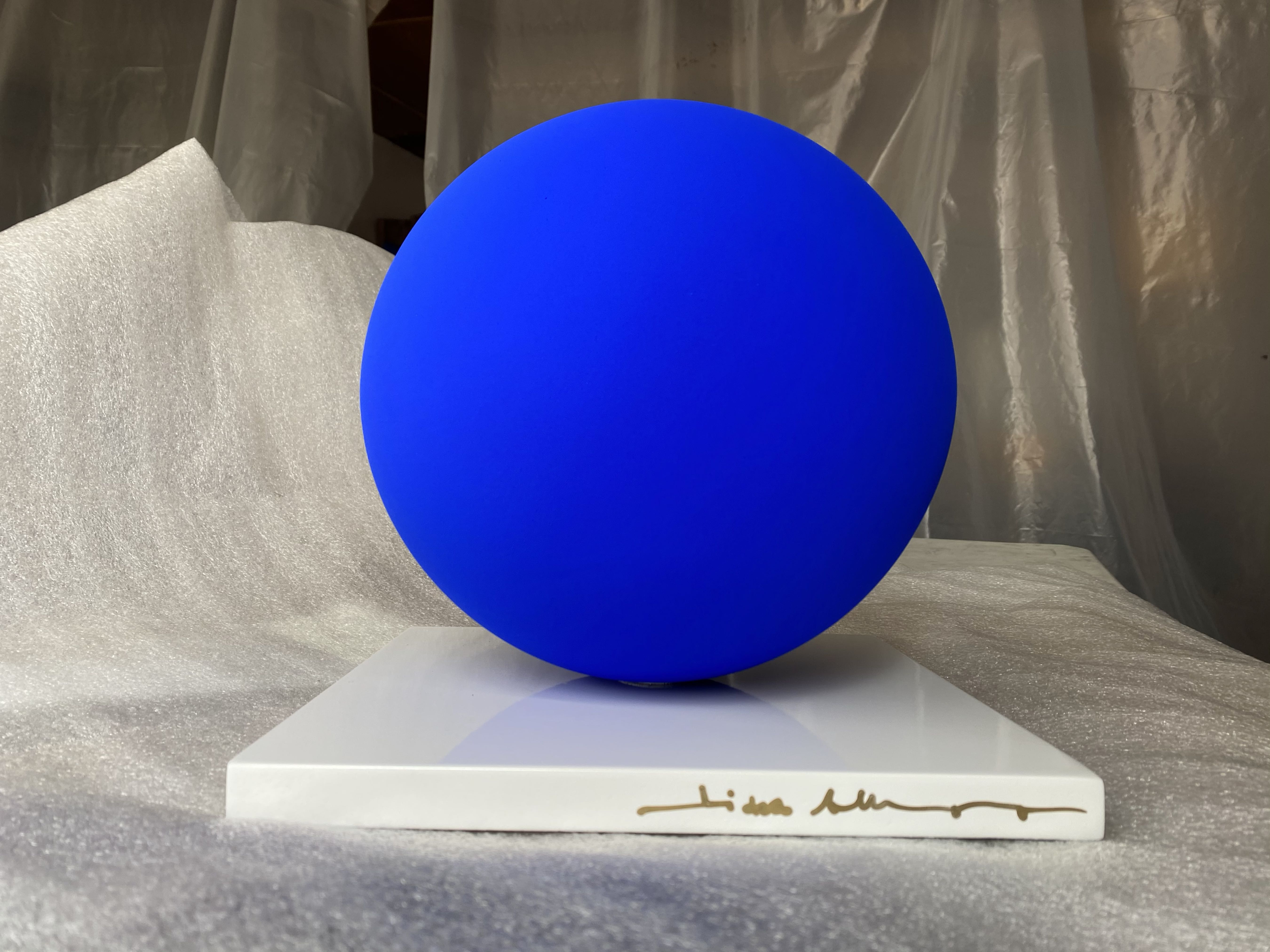
The breakthrough that defined her public identity came through her use of ultramarine blue pigment, a material with a history as rich and charged as any in Western art. Lapis lazuli ground to powder, the pigment has carried sacred associations across centuries, appearing in the robes of the Virgin Mary in medieval painting and in the skies of Renaissance masters. Albuquerque reclaimed this material not for its historical weight alone but for its capacity to collapse distance, to make the viewer feel simultaneously grounded and dissolved into something vast. Her site specific works, in which she spreads or applies this pigment across landscapes, floors, and walls, create environments that function less like exhibitions than like encounters.
The blue does not decorate space. It transforms it. Among her most celebrated projects is Spine of the Earth, first realized in 1980 in the Mojave Desert, in which she created an ephemeral alignment of pigmented spheres stretching across the desert floor toward the horizon. The work engaged directly with the relationship between celestial alignment and human presence, and it established the template for what would become a sustained practice of site specific interventions in extreme and resonant landscapes, including Antarctica.
Her 2009 project Stellar Axis, realized on the Ross Ice Shelf in Antarctica, placed 99 blue spheres on the ice in a pattern mirroring the positions of 99 stars in the Southern Hemisphere sky. It was a work of extraordinary ambition, requiring years of logistical and conceptual preparation, and it stands as one of the most emotionally affecting large scale installations of the past two decades. Albuquerque's studio paintings and works on panel are the intimate counterpart to these monumental gestures. Works such as Auric Field Solar Flash, from 2017, demonstrate the sophistication with which she moves between scales and materials.
In that work, pigment on panel meets 24 karat gold on resin, creating a surface that seems to radiate from within, evoking solar energy and auric fields with a restraint that amplifies rather than diminishes the work's power. Her use of gold alongside her signature blues and pigments creates an alchemical resonance, suggesting transformation, illumination, and the passage between states. These panel works are where collectors can engage most directly with the full range of her material intelligence, and they hold remarkable presence at almost any scale. For collectors, Albuquerque represents a compelling intersection of art historical significance and living vitality.
Her works sit within a lineage that connects the Minimalist and Conceptual movements of the 1960s and 1970s to the contemporary moment, giving them a depth of context that rewards sustained attention. The physicality of her pigment works, the way the material carries light and shifts across surfaces, means they are genuinely transformative in a domestic or institutional setting. Collectors who have lived with her paintings consistently describe them as active presences rather than static objects, works that change with the time of day and season, repaying years of looking. Her market has grown steadily as institutional recognition of the Light and Space movement has deepened, and her works are increasingly understood as foundational to any serious account of American art in the late twentieth and early twenty first centuries.
Within the broader landscape of art history, Albuquerque occupies a position of quiet centrality. She is of a generation with Agnes Martin, whose meditative horizontals share something of the same spiritual seriousness, and she anticipates the environmental and cosmological concerns that now animate a younger generation of artists working with land, light, and ecological consciousness. Her influence on artists exploring the relationship between the human body and the natural world is considerable, though she wears that influence with characteristic understatement. To encounter her work is to be reminded that art at its most ambitious is not about making things but about revealing conditions, making visible the forces that surround and constitute us.
Lita Albuquerque has spent more than five decades building a practice that is as philosophically rigorous as it is visually ravishing. At a time when the questions her work has always asked, about our place in the cosmos, about the nature of light and matter, about what it means to be a conscious body in an infinite universe, feel more urgent than ever, her art arrives not as comfort but as clarification. She gives form to the formless and scale to the unimaginable, and in doing so she offers something that only the most essential artists can: a way of seeing that persists long after the encounter ends.