Lee Ufan

Lee Ufan: The Master of Resonant Silence
Artist Spotlight · The Collection Editorial
“A painting is not just a picture. It is a place where the world and I meet.”
Lee Ufan, interview with Artforum
In 2023, the Lisson Gallery in London mounted a quietly commanding exhibition of Lee Ufan's recent paintings and sculptures, reminding a new generation of collectors why this Korean born, Tokyo educated philosopher turned artist remains one of the most vital figures in postwar and contemporary art. Visitors moved through the space slowly, drawn into the particular quality of attention his work demands, a sense that looking is itself a form of listening. The show was emblematic of a career that has unfolded over six decades with remarkable consistency of purpose and ever deepening sophistication. Few artists alive today have so completely fused intellectual rigour with painterly feeling.
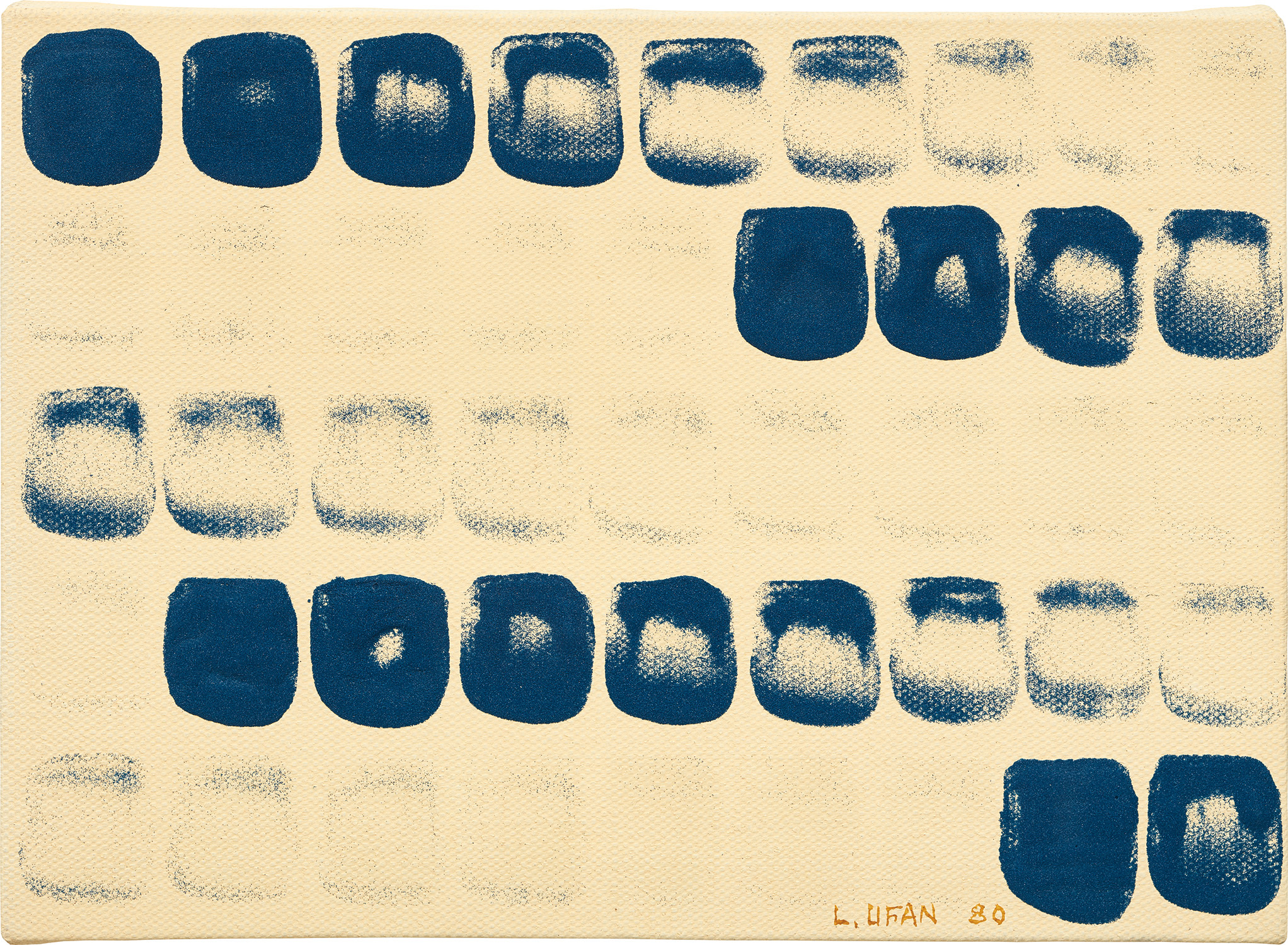
Lee Ufan
From Point No. 800115, 1980
Lee Ufan was born in 1936 in Haman, South Korea, during the period of Japanese colonial rule, a circumstance that shaped his lifelong preoccupation with encounters between cultures, materials, and states of being. He moved to Japan in 1956, initially to study Korean literature at Seoul National University before transferring to Nihon University in Tokyo, where he ultimately studied philosophy. That philosophical training was not incidental. It became the foundation of everything.
His deep engagement with phenomenology, particularly the ideas of Martin Heidegger and Maurice Merleau Ponty, gave him a conceptual framework for thinking about presence, perception, and the relationship between a human body and the material world. By the late 1960s, Lee had become a central theorist and practitioner of Mono Ha, the Japanese art movement whose name translates roughly as School of Things. Mono Ha rejected the dominance of human artifice and instead foregrounded the encounter between natural and industrial materials, stones placed beside steel plates, rope coiled near glass, objects in a state of tension or rest with one another and with the space around them. Lee's theoretical writings were as influential as his sculptures during this period, and his 1969 essay questioning the nature of modern art helped define the movement's intellectual stakes.
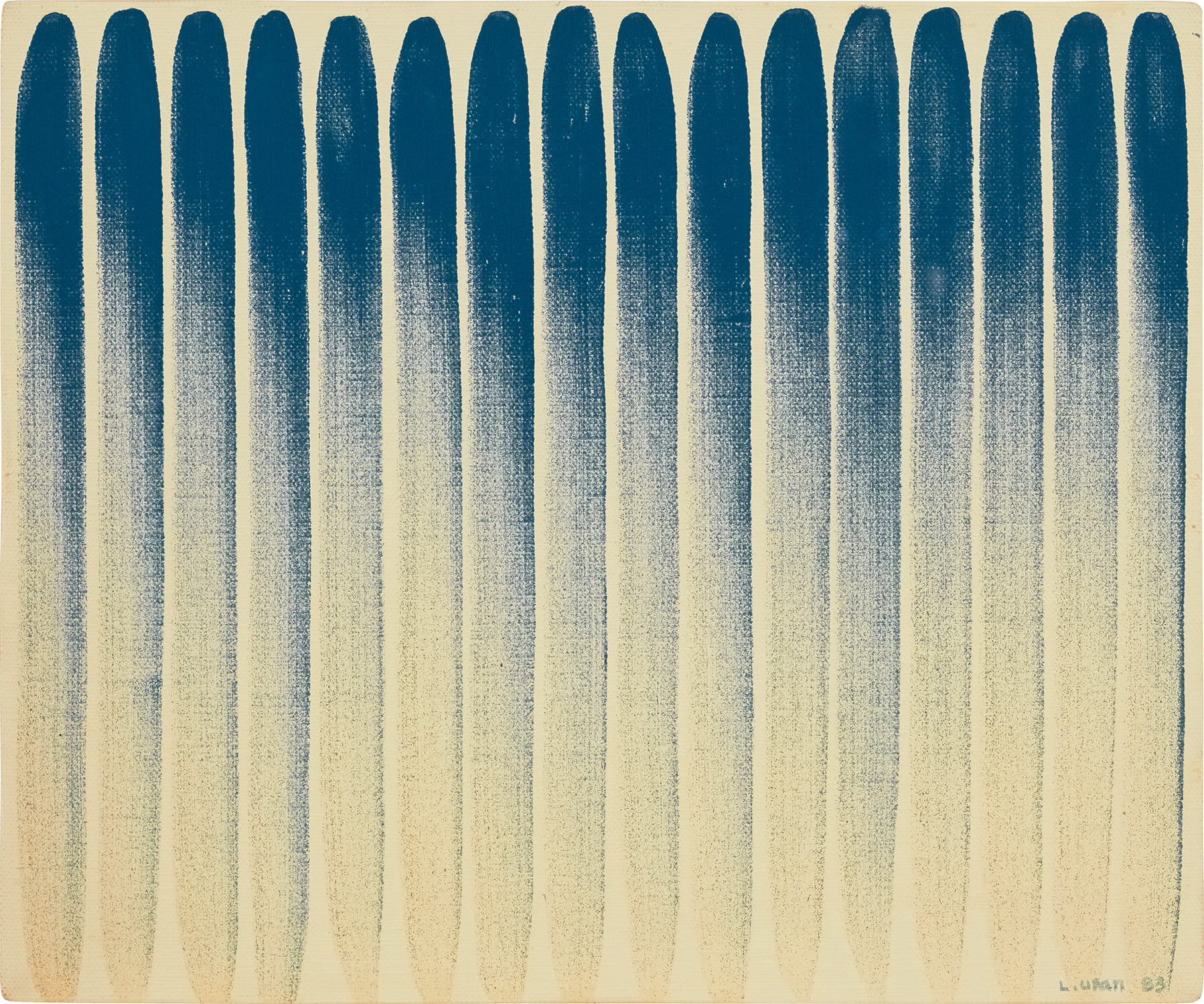
Lee Ufan
From Line, 1983
He was, in every sense, both its philosopher and its most gifted visual practitioner. The 1970s marked a decisive turn in Lee's painting practice, when he began the series that would define his mature identity as an artist. The From Point works, begun in 1973, consist of individual brushstrokes of mineral pigment applied to raw canvas, each mark laid down with complete attention and then left to fade as the pigment disperses into the weave of the fabric. The effect is of something arriving and departing simultaneously, of energy expressed and then released.
“I do not want to make something. I want to encounter something.”
Lee Ufan
The From Line series, which developed alongside and after From Point, extended this logic into horizontal bands of pigment that traverse the canvas with the weight and deliberateness of a drawn breath. Works such as From Line No. 790372 from 1979 and From Point No. 800115 from 1980 are among the purest expressions of this vision, each one a meditation on the limits of gesture and the generosity of empty space.
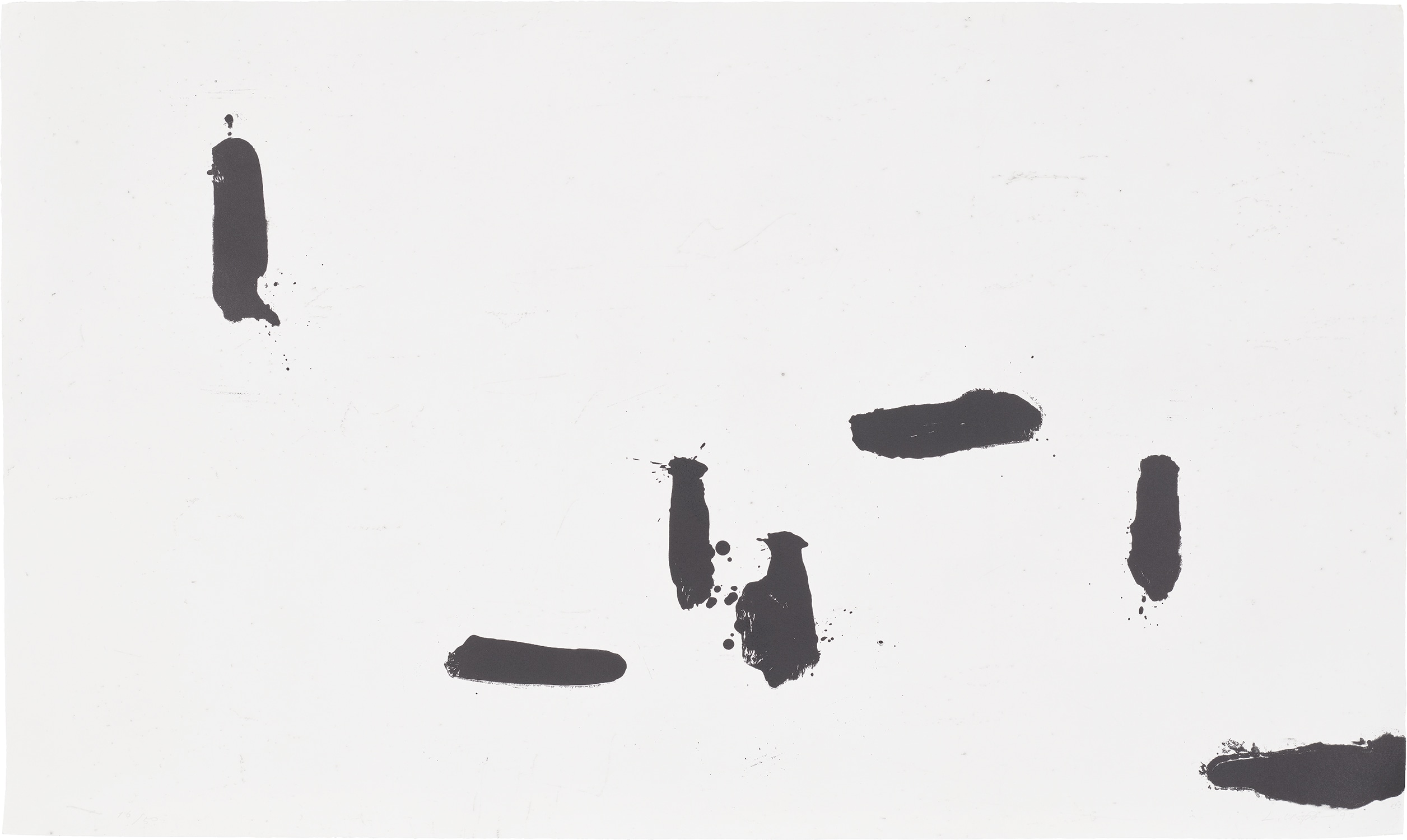
Lee Ufan
In Milano 2
Lee Ufan has described his working method in terms of encounter rather than expression, and that distinction matters enormously when standing before his canvases. Where expressionism projects the self outward, Lee's paintings create a situation in which the self is asked to dissolve or at least to become porous. The mineral pigments he favors, many derived from natural sources, age beautifully and carry a material gravity that oil paint rarely achieves. His later series, including Dialogue, which began in the 2000s and is represented by the luminous 2008 watercolour on paper in The Collection, demonstrates an even more refined economy.
A single cloud of pigment against an expanse of white becomes a conversation between presence and absence, between the made and the unmade. As a collecting proposition, Lee Ufan occupies a position of unusual strength and stability. His work is held in the permanent collections of major institutions including the Museum of Modern Art in New York, the Guggenheim Bilbao, and the National Museum of Modern and Contemporary Art in Korea. The Lee Ufan Museum, designed by Tadao Ando and opened on the island of Naoshima in Japan in 2010, stands as one of the most considered artist museum collaborations of the modern era.
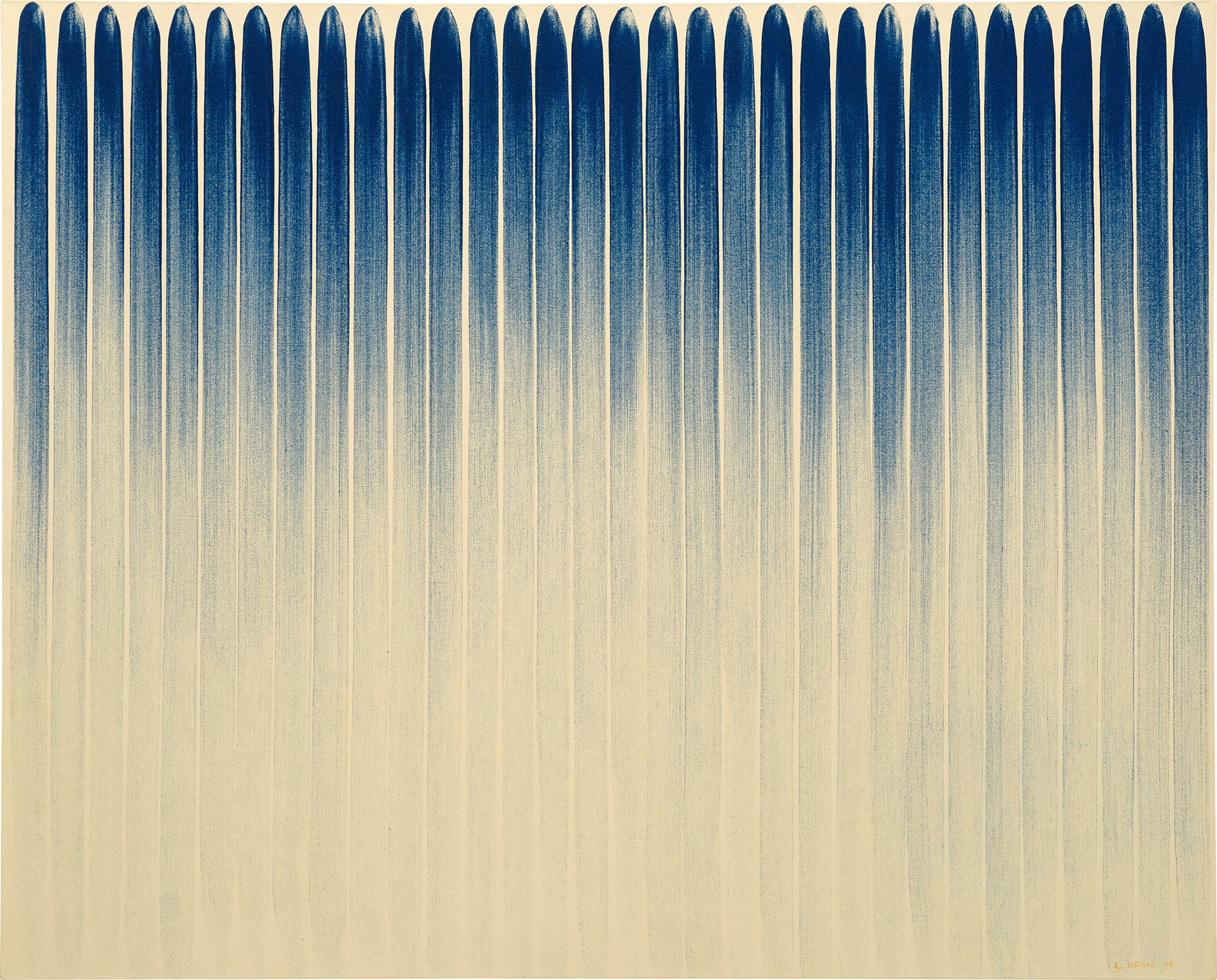
Lee Ufan
From Line No. 790372, 1979
At auction, his paintings and works on paper have performed consistently at the top end of the postwar and contemporary market, with major canvases from the From Line and From Point series regularly achieving results in the hundreds of thousands and occasionally exceeding one million dollars. His prints, including the accomplished In Milano lithographs with drypoint produced in collaboration with master printmakers, offer a more accessible entry point into a practice of unimpeachable integrity. Collectors drawn to Lee Ufan frequently find themselves moving toward related artists who share his investment in material presence, reduction, and philosophical depth. The Italian Arte Povera movement, with figures such as Jannis Kounellis and Mario Merz, explored similar terrain around the same period, as did the American minimalists Donald Judd and Robert Ryman, though Lee's relationship to Eastern philosophy gives his work a distinct spiritual and phenomenological character that sets it apart.
Among Korean artists, Park Seo Bo and Chung Sang Hwa are natural companions, and the broader Dansaekhwa movement to which they belong has experienced a sustained critical and market renaissance over the past decade, bringing new institutional and collector attention to the entire generation. What endures in Lee Ufan's work, and what ultimately accounts for its hold on collectors, critics, and casual viewers alike, is its insistence that art is not about the accumulation of meaning but about the creation of conditions for encounter. In an era saturated with imagery, noise, and the relentless assertion of the self, his paintings and sculptures offer something genuinely rare: they ask you to slow down, to notice the space around things, to feel the weight of a single mark on an expanse of silence. That invitation, extended over more than half a century with unbroken seriousness and evolving grace, is the measure of a truly major artistic life.
Explore books about Lee Ufan
Lee Ufan: Monograph
Lee Ufan, Various Contributors
Lee Ufan: Catalogue Raisonné
Yoshiaki Tono
Lee Ufan: Relatum
Joan Kee
Lee Ufan: Discourse on Art
Lee Ufan
Lee Ufan: Painting as Meditation
Museum of Modern Art Tokyo
Lee Ufan: Retrospective 1973-2008
Various Curators
Lee Ufan: Philosophy and Practice
Choi Byung-chul
Lee Ufan: Stone and Canvas
Gao Minglu