Larry Bell
Larry Bell: Light Itself Becomes the Art
Artist Spotlight · The Collection Editorial
“I am trying to make something that does not exist until you look at it.”
Larry Bell
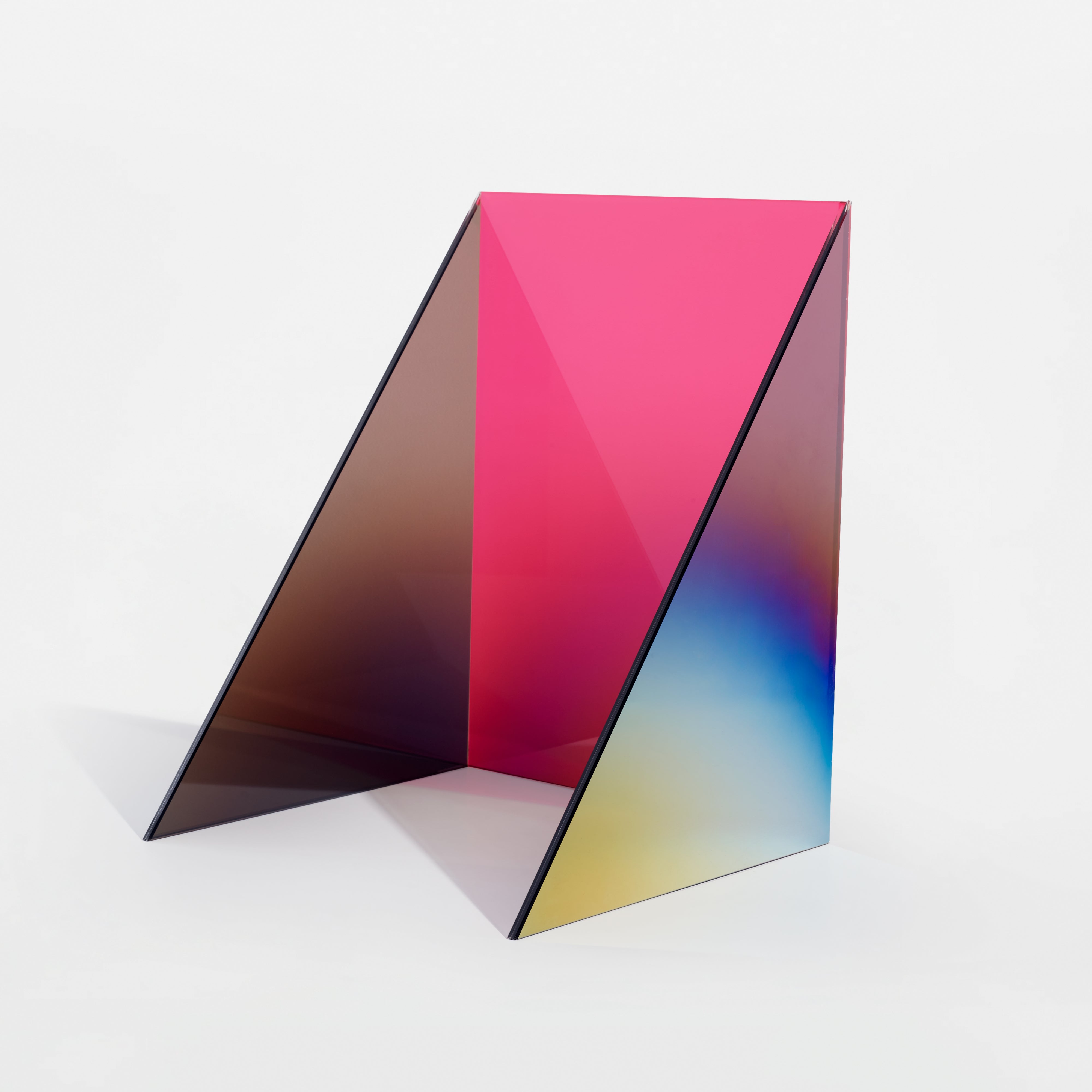
There is a particular quality of light in New Mexico, a clarity that seems to strip the world down to its essential frequencies, and Larry Bell has spent decades learning to speak its language. His studio in Taos, where he has worked since the early 1970s, sits at altitude with a sky that behaves like a living canvas, shifting its chromatic registers hour by hour. It is no coincidence that an artist so devoted to the behavior of light, to the way it bends through coated glass and shimmers across vacuum deposited surfaces, would find his home in one of the most luminously demanding landscapes in the American Southwest. Bell's recent Triolith works, including the striking "Untitled Triolith C SS" from 2020, demonstrate that at over eighty years old he remains not merely productive but genuinely exploratory, pushing coated glass into new architectural configurations that feel entirely of this moment.
Larry Bell
Untitled Triolith C SS, 2020
Larry Bell was born in Chicago in 1939 and raised in Los Angeles, a city that in the late 1950s was becoming one of the most electrically charged creative environments in the world. He studied at the Chouinard Art Institute in Los Angeles, where he was exposed to a generation of California artists who were rethinking what painting and sculpture could be. Los Angeles in that era was not simply New York's lesser sibling; it was developing its own visual vocabulary rooted in car culture, aerospace industry materials, Pacific light, and a certain laid back intellectual daring. Bell absorbed all of it, and the influence of Southern California's famed Light and Space movement would prove foundational to everything he would later achieve.
By the early 1960s, Bell had found his way to the Ferus Gallery in Los Angeles, one of the most consequential commercial galleries in American art history. Ferus, run by Irving Blum and the legendary curator Walter Hopps, showed artists including Ed Ruscha, Ed Moses, Robert Irwin, and Ken Price, placing Bell in extraordinary company at a formative moment. It was here that Bell began developing his signature approach to coated glass cubes, objects that seemed to dissolve their own materiality even as they made their physical presence undeniable. The cubes, with their vacuum deposited metallic coatings of materials such as silicon monoxide and inconel, transformed ambient light into something participatory, pulling the viewer into a perceptual dialogue that no photograph could fully capture.
Larry Bell
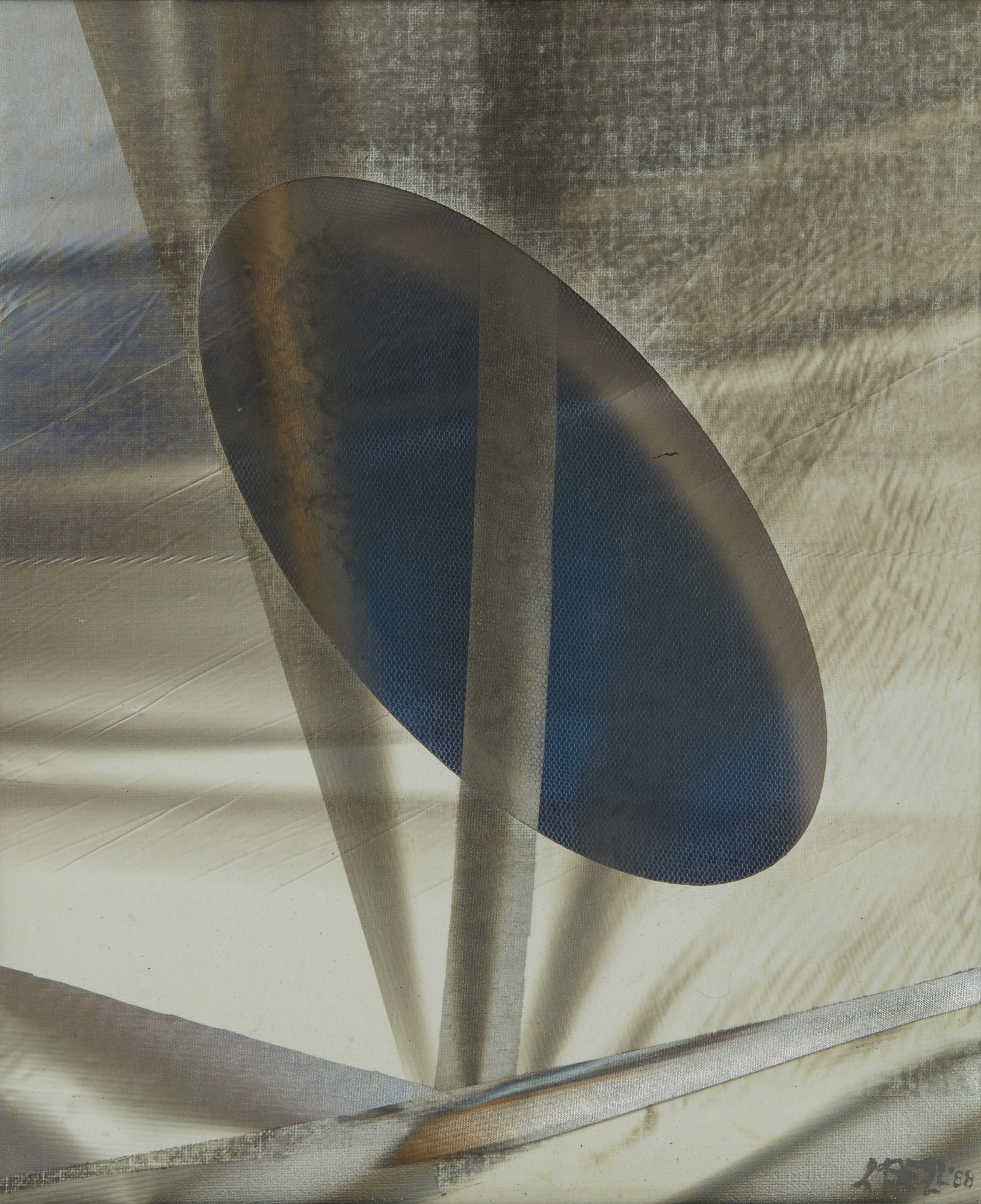
Mirage Construction #4
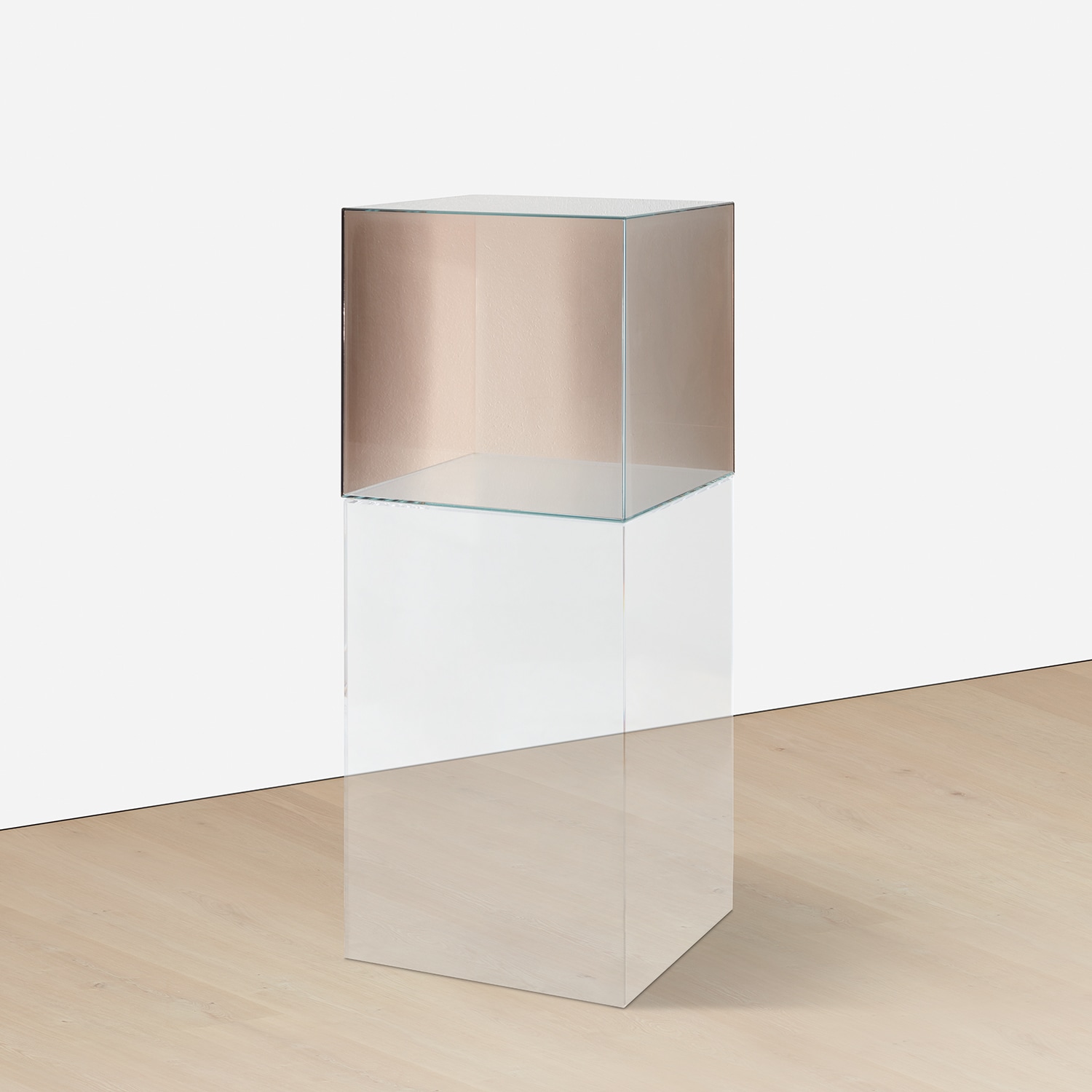
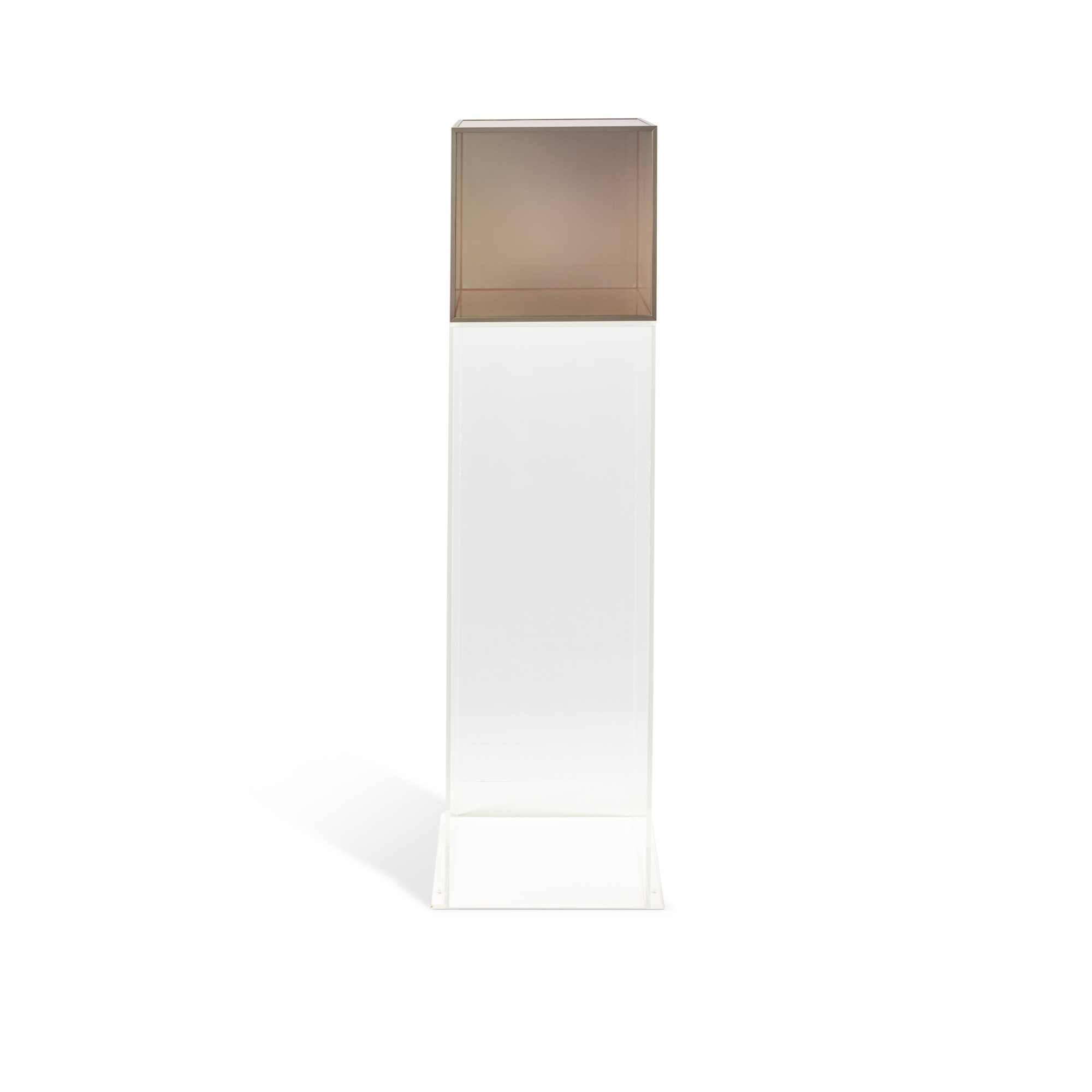
The evolution of Bell's practice across six decades reveals an artist of rare intellectual consistency. His early cube works, such as the remarkable "Cube 5" from 1967 and later iterations like "Cube 14 (Amber)" from 2005 and "Cube 46" from 2007, established a formal language he has continued to expand rather than abandon. His Mirage series, including works on canvas and hand cast paper that deploy aluminum and silicon monoxide, brought his perceptual investigations to a two dimensional surface without sacrificing their essential mystery. The "Mirage Construction" works and "Medium Size Mirage Study" pieces are among the most sophisticated explorations of optical phenomena in contemporary art, sitting at a genuinely unusual intersection between painting, sculpture, and pure sensory experience.
Meanwhile works such as "Vse 23" from 1982, a vapor drawing with paper collage coated in oxidized aluminum, demonstrate how consistently Bell has thought across media, treating every surface as a potential laboratory for light. The breadth of Bell's practice extends into artists' books and works on paper that deserve far more attention than they typically receive. "Animated Discourse," a complete artist's book comprising 140 pages of offset lithographs arranged to form a photographic code with a hidden paper decoder, reveals a conceptual playfulness and narrative intelligence that enriches understanding of his broader project. His collage works, including pieces from the Fraction series that layer aluminum and silicon monoxide onto wove paper, offer collectors a more intimate point of entry into his visual thinking.
Larry Bell
Cube #14 (Amber), 2005
These works on paper carry the full weight of his perceptual concerns in a format that rewards close, patient looking in the domestic spaces where most collected art actually lives. From a collecting perspective, Bell occupies a position of genuine significance within the Light and Space canon, a movement whose market has deepened considerably in recent years as institutions and collectors have come to appreciate the full art historical importance of California's postwar avant garde. Bell's works appear regularly at major auction houses including Christie's and Sotheby's, and his glass cube works in particular have attracted serious institutional and private interest. Collectors drawn to artists such as Robert Irwin, James Turrell, Peter Alexander, or DeWain Valentine will find in Bell a practice of comparable ambition and considerably richer variety.
His range across sculpture, painting, works on paper, and artists' books makes him an unusually flexible addition to a collection, capable of holding its own in both intimate and grand contexts. Bell's place within art history is secure and arguably still being fully recognized. He is a central figure in the Light and Space movement, a West Coast counterpart to the Minimalist impulse that reshaped American sculpture in the 1960s, but one animated by a more sensory, phenomenological concern than the cooler geometries of Donald Judd or Carl Andre. His work has been collected and exhibited by major institutions including the Museum of Modern Art in New York, the Art Institute of Chicago, the Los Angeles County Museum of Art, and the Stedelijk Museum in Amsterdam.
Larry Bell
Cube # 5, 1967
The fact that his practice has continued to evolve well into the twenty first century, producing works as vital as the 2020 Triolith series, places him in the company of artists who have not coasted on historical reputation but have kept asking genuine questions. What ultimately makes Larry Bell so compelling, and so enduringly rewarding to collect and to live with, is the quality of attention his work demands. These are not objects that announce themselves and then go quiet. They change with the hour, with the season, with the position of the viewer and the conditions of surrounding light.
They are, in the most precise sense, alive. Bell has spent a lifetime developing the technical mastery and the perceptual sensitivity to create objects that place light itself on the level of subject matter, and in doing so he has made a body of work that belongs not just to the history of American art but to the longer human conversation about what seeing actually is.
Explore books about Larry Bell
