Käthe Kollwitz

Käthe Kollwitz: A Voice That Never Fades
Artist Spotlight · The Collection Editorial
“I want to have an effect on my time, in which human beings are so perplexed and in need of help.”
Käthe Kollwitz, diary entry
In 2019, the Käthe Kollwitz Museum in Cologne mounted a landmark retrospective drawing thousands of visitors who stood in quiet contemplation before works that felt as urgent as the morning news. That same year, the museum in Berlin dedicated to her legacy reported record attendance, a testament to how powerfully her vision continues to resonate across generations and geographies. There is something about encountering a Kollwitz in person that stops you completely. Her images do not merely ask for your attention.
Käthe Kollwitz
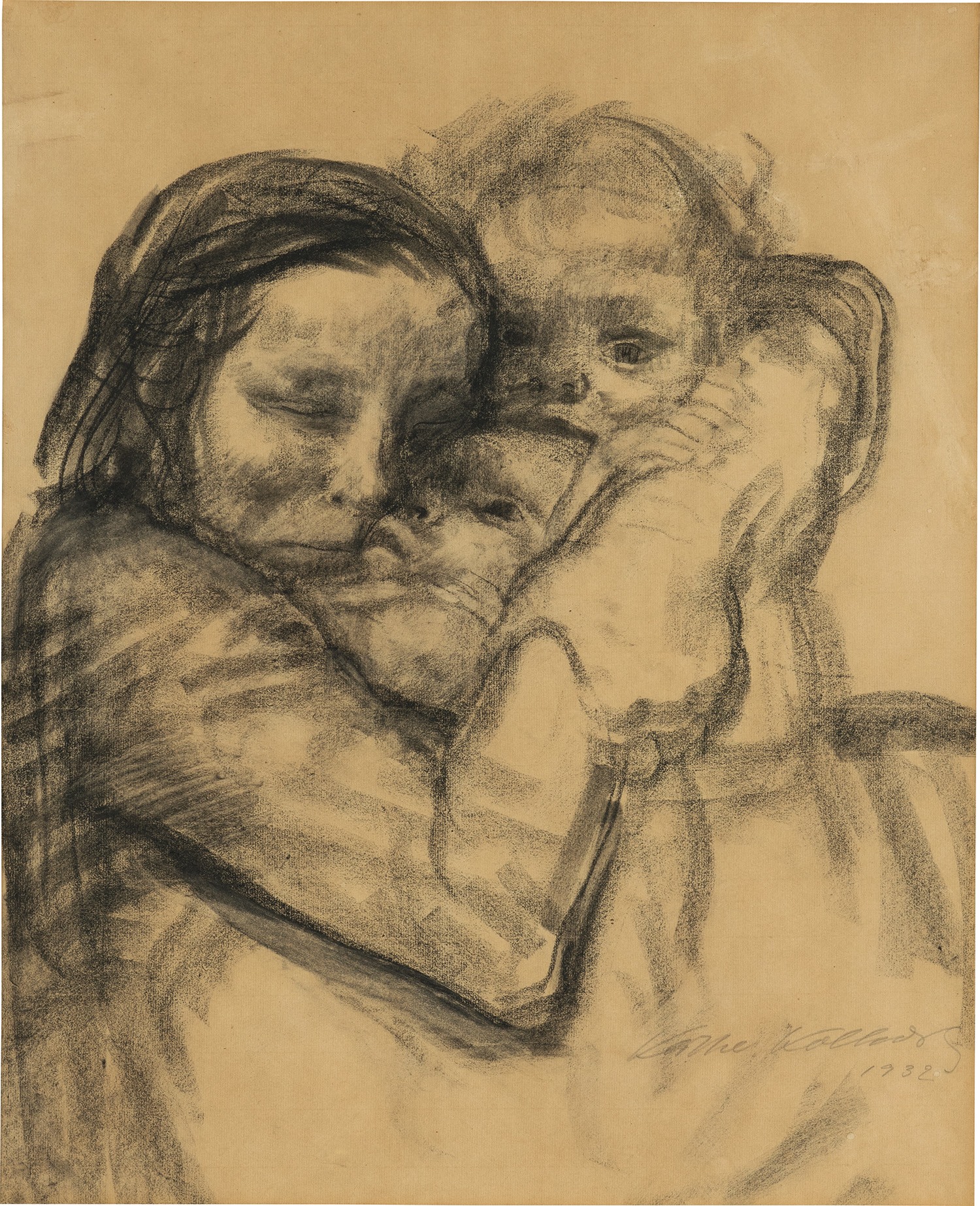
Mutter, zwei Kinder an sich pressend, 1932
They demand your whole humanity. Käthe Kollwitz was born on July 8, 1867, in Königsberg, Prussia, into a family that valued independent thought and social conscience in equal measure. Her father, Karl Schmidt, was a committed social democrat and freethinker who recognized his daughter's artistic gifts early and ensured she received serious training, an unusual commitment in an era when women's education was routinely deprioritized. She studied in Berlin and Munich, immersing herself in the technical traditions of drawing and printmaking while developing the fierce empathy that would come to define her entire body of work.
Her marriage in 1891 to physician Karl Kollwitz brought her to a working class district of Berlin, where she witnessed poverty, illness, and the physical toll of industrial labor at close range. That daily proximity to human suffering did not harden her. It became the wellspring of everything she made. Her breakthrough arrived with a suite of prints completed between 1893 and 1897 inspired by Gerhart Hauptmann's play The Weavers, depicting the doomed 1844 Silesian weavers' uprising.
Käthe Kollwitz
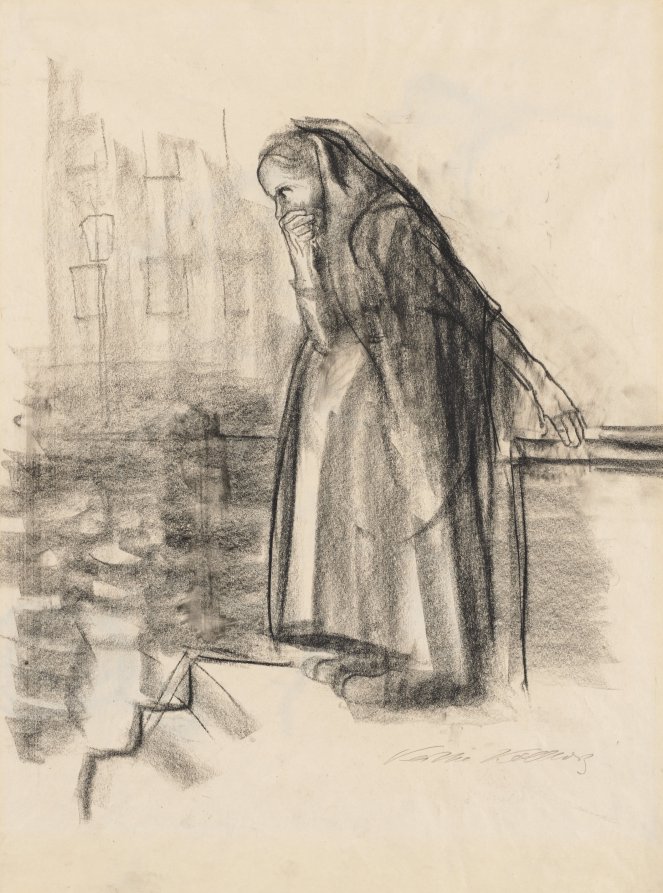
Pregnant Woman Contemplating Suicide (recto), 1921
The cycle announced her not as a political illustrator but as a major artist in full command of the expressive possibilities of etching and lithography. Kaiser Wilhelm II reportedly blocked her nomination for a gold medal at the 1898 Great Berlin Art Exhibition, unwilling to honor work so openly sympathetic to the laboring poor, yet the controversy only amplified her reputation. She followed The Weavers with the Peasants' War cycle, completed in 1908, which many scholars consider one of the great printmaking achievements in European art history. These seven prints, rendered with extraordinary technical sophistication and emotional intelligence, established her as a central figure of German Expressionism without her ever needing to align herself with any single school or movement.
“I do not want to die until I have faithfully made the most of my talent and cultivated the seed that was placed in me.”
Käthe Kollwitz, diary
The death of her son Peter in October 1914, just weeks into the First World War, transformed her practice with an intimacy and directness that remains overwhelming to encounter today. She spent nearly two decades on a memorial sculpture for Peter, finally completing The Grieving Parents in 1932, figures of sculpted stone that kneel permanently at the Vladslo German war cemetery in Belgium where he is buried. Meanwhile, her graphic work of the 1920s reached new intensity. The 1921 lithograph Help Russia, created in response to famine devastating the Soviet Union, shows the human figure reduced to its most essential form, a gesture of outstretched need.
Käthe Kollwitz
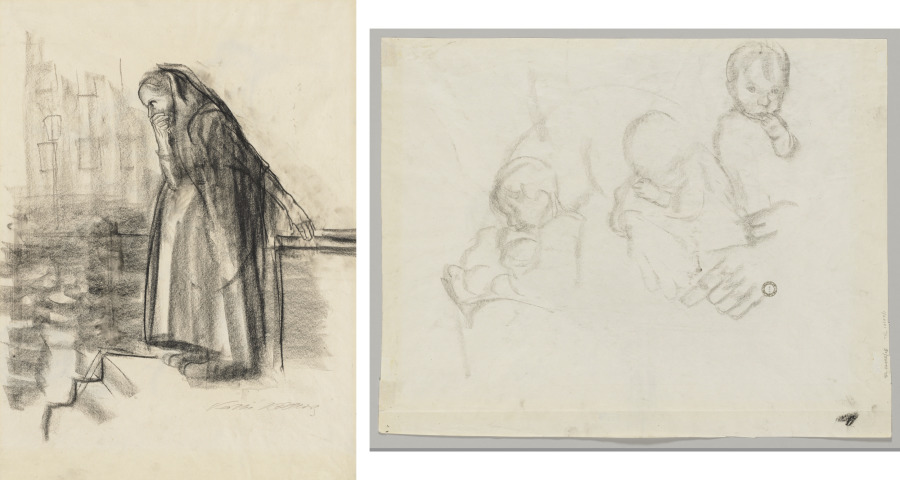
Pregnant Woman Contemplating Suicide (recto) Three Studies of a Child (verso), 1921
The 1925 woodcut series Proletariat, from which No. 1 Out of Work appears in The Collection's holdings, demonstrates her mastery of the woodcut medium's stark contrasts to convey economic devastation with almost architectural force. She was not documenting suffering from a distance. She was translating it into a visual language anyone could read.
“Where do all the women who have watched so carefully over the lives of their beloved ones get the heroism to send them to face the cannon?”
Käthe Kollwitz, diary, August 1914
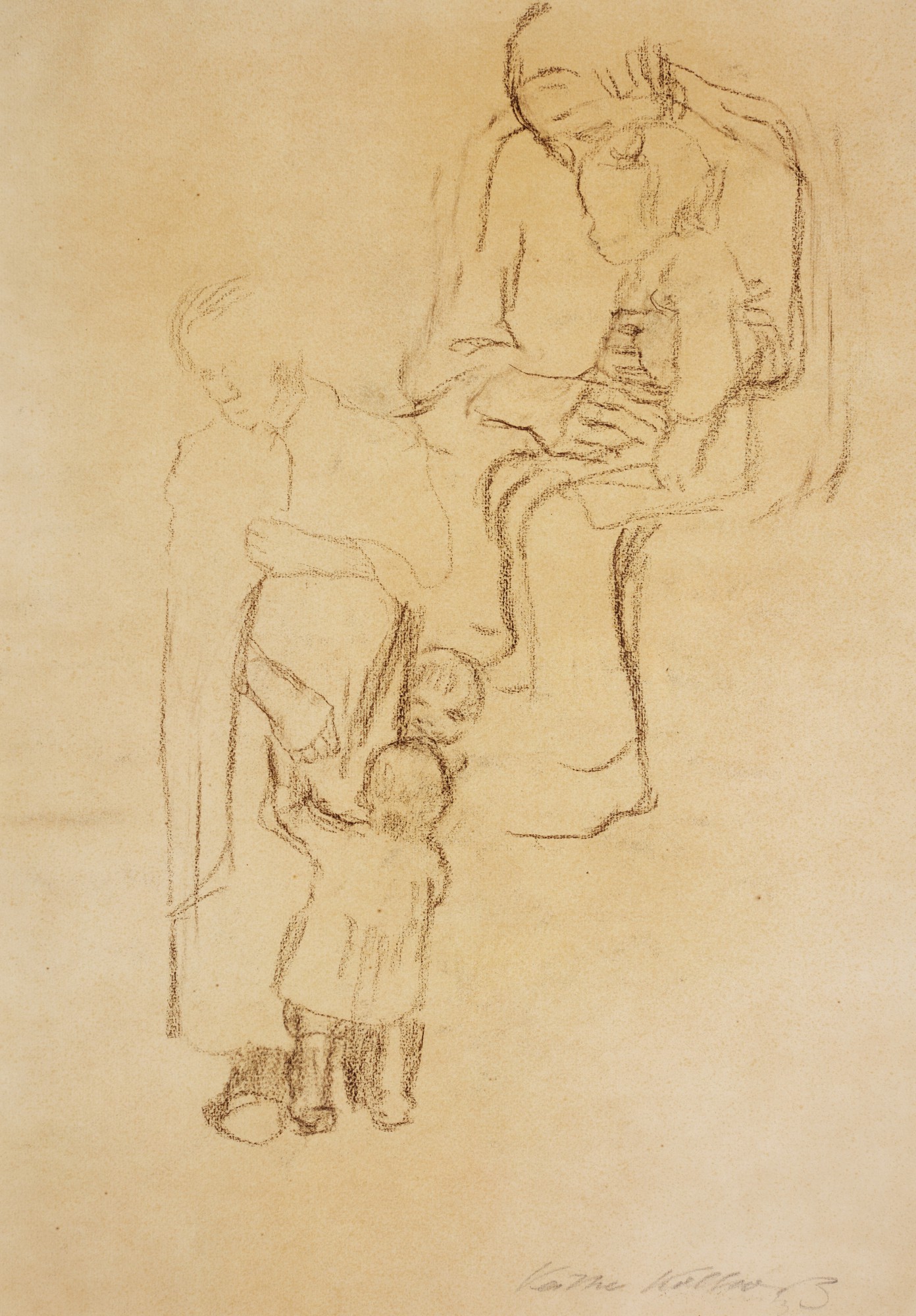
For collectors, Kollwitz occupies a position of remarkable distinction. Her prints are held in virtually every major museum collection in the world, from the Museum of Modern Art in New York to the British Museum in London, yet the works that come to market carry singular weight because they connect directly to one of the most consequential graphic traditions in modern art. Works on paper, including her charcoals and chalk drawings, offer collectors access to the most intimate register of her practice, the space where her hand moved closest to her thinking. Pieces like Mutter, zwei Kinder an sich pressend from 1932, which captures a mother pulling two children into her body with desperate tenderness, and the haunting Frauen mit Kindern from 1909 in brown chalk, demonstrate how her drawing functioned as both preparatory study and finished thought simultaneously.
Käthe Kollwitz
Frauen mit Kindern (Women with Children), 1909
The subject of the mother and child, which she returned to throughout her career, is never sentimental in her hands. It is always a statement about vulnerability, protection, and the cost of love in an uncertain world. Collectors drawn to works of sustained moral seriousness and technical mastery find in Kollwitz a rare alignment of those qualities. Kollwitz belongs to a broader tradition of socially committed European graphic art that includes Francisco Goya, whose Disasters of War prints she admired deeply, and her near contemporary Ernst Barlach, the sculptor and printmaker who shared her concern for human dignity and her willingness to confront political authority.
The Belgian artist Frans Masereel, who developed the wordless woodcut novel as a form, worked in a parallel tradition of graphic storytelling about working class life. Among later artists, the American social realist tradition that includes artists like Ben Shahn acknowledged a clear debt to her example. Yet Kollwitz remains distinct from all of them, not least because of the self portrait practice she sustained across four decades. Her self portraits, including the extraordinary 1915 lithograph and the bronze conceived between 1926 and 1936 and cast between 1937 and 1939, constitute a sustained act of witness, an artist recording her own face as it absorbed time, grief, and the weight of history.
Kollwitz died on April 22, 1945, just weeks before the end of the Second World War, having lived to see her city of Berlin bombed and her grandson Peter, named for his uncle, killed in the conflict. She left behind a body of work that has never required rehabilitation or rediscovery because it never fell from view. Its permanence comes not from institutional protection but from the depth of its feeling and the clarity of its craft. As the world continues to grapple with questions of inequality, displacement, and the human cost of political violence, her images arrive in the present tense with undiminished authority.
To collect Kollwitz is to participate in a long conversation about what art can do when it commits entirely to the truth of human experience. It is one of the most meaningful commitments a collector can make.
Explore books about Käthe Kollwitz
Käthe Kollwitz: Woman, Artist, Revolutionary
Elizabeth Prelinger
The Diaries and Letters of Käthe Kollwitz
Käthe Kollwitz, translated by Richard and Clara Winston
Käthe Kollwitz
Hilton Kramer
Käthe Kollwitz: Graphics, Posters, Drawings
August Klipstein
Käthe Kollwitz: An Interpreted Biography
Mina Harker
Käthe Kollwitz: The Schönlanks Collection
Galerie St. Etienne
The Complete Woodcuts of Käthe Kollwitz
Friedrich Ahlers-Hestermann
Käthe Kollwitz: Origins and Consequences
Martha Kearns