
Kozo: Where Skin Meets Sacred Canvas
Artist Spotlight · The Collection Editorial
Something rare is happening in contemporary art right now, and collectors who pay attention to the edges of the art world are taking notice. Kozo, the American artist whose micro realistic tattooing practice has earned him a global following surpassing one million devotees, is expanding his universe in ways that feel both inevitable and genuinely surprising. His 2026 body of work, a suite of mixed media pieces that carry tattoo ink directly into paper and canvas, signals an artist at full creative velocity, translating the intimacy of skin into the permanence of fine art objects. Works such as "Escapism," "The Great Beyond," and "The Drip" represent a bold declaration that the boundary between tattoo culture and the gallery wall has not simply blurred but dissolved entirely.
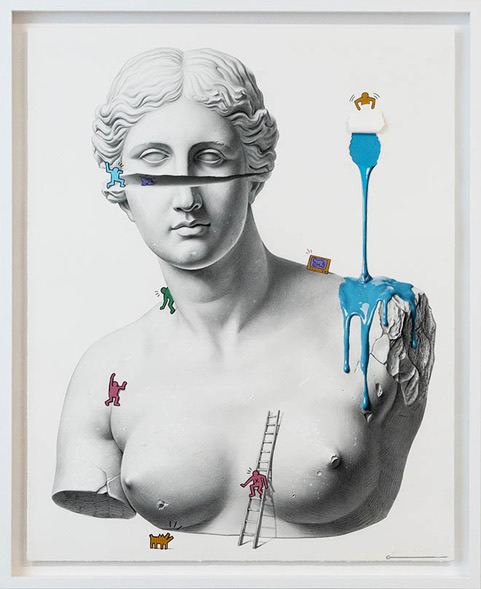
Kozo
Work in Progress, 2026
Kozo grew up steeped in the visual languages that would eventually define his practice. His American upbringing placed him at a crossroads of cultures, and from an early age he demonstrated an appetite for image making that ranged widely across traditions. The influence of Japanese aesthetics, with their reverence for precision, negative space, and the spiritual weight of line, runs through his work like a quiet current. That sensibility, combined with a genuine love for Western classical art and the irreverent vitality of modern pop culture, gave Kozo a visual vocabulary that belonged entirely to him.
He began his artistic journey young, experimenting across mediums and refusing to settle into any single discipline. The tattoo machine became his primary instrument, but Kozo always understood it as a tool with possibilities far beyond its conventional application. He developed a signature technique that is as conceptually rigorous as it is technically astonishing: he integrates the needle of a coil tattoo machine directly into his artworks on canvas, paper, and marble, so that the physical act of tattooing leaves its mark on the artwork itself. This is not illustration or imitation.
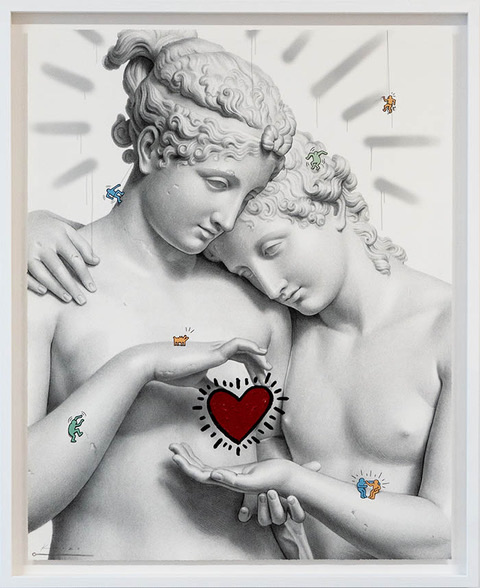
Kozo
Love, Forever, 2026
The works are literally tattooed, carrying the same micro realistic precision and the same commitment of mark that he brings to human skin. The result is a body of work that feels alive, charged with the intention and irreversibility that defines great art in any medium. His 2026 mixed media works reward close looking. "Work in Progress," executed in mixed media on paper with sculptural elements, suggests an artist meditating on process itself, on the work that is never finished, always becoming.
"Love, Forever" and "Amore" carry that theme of endurance into the emotional register, exploring what it means to make a permanent declaration in a world of fleeting images. "Heavy Lifting" on canvas has the weight its title promises, a piece that feels earned rather than announced. "Fragmented Memory" and "The Reveal" speak to the psychological terrain Kozo navigates with particular grace: the way identity is assembled from partial images, recovered impressions, and the details we choose to mark on ourselves and on the world. Each work bears his signature touch in the most literal sense possible, tattooed into the surface, making authenticity a physical fact rather than a provenance question.
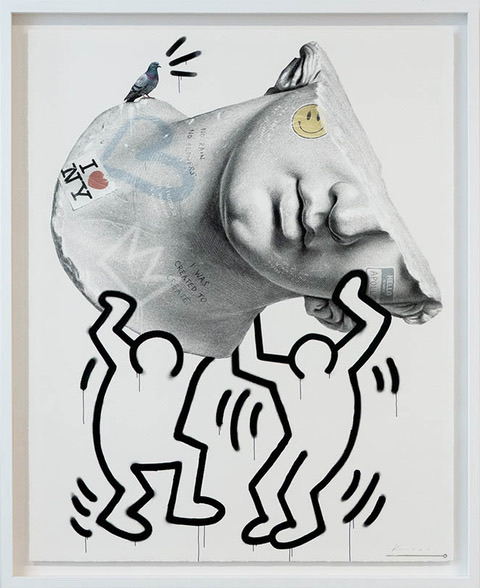
Kozo
Heavy Lifting, 2026
For collectors, Kozo represents an opportunity that sits at a genuinely fertile intersection. The tattoo art world has produced figures of enormous cultural influence, but very few have made the leap to fine art objects with the conceptual coherence that Kozo brings. His mixed media works on paper are particularly compelling as entry points: intimate in scale, extraordinary in their detail, and carrying the kind of material specificity that gives serious collections their character. The use of tattoo ink as an artistic medium creates works that behave differently from conventional paintings, with a quality of absorption and luminosity that rewards study over time.
Collectors drawn to artists working in conceptual craft, material practice, and the space where spiritual inquiry meets technical mastery will find in Kozo a deeply resonant voice. The art historical context for what Kozo is doing is richer than it might first appear. His command of micro realism connects him to the tradition of trompe l'oeil and the great Northern European masters of detailed observation. His embrace of pop culture iconography places him in conversation with artists who understood that high and low visual culture share the same nervous system.
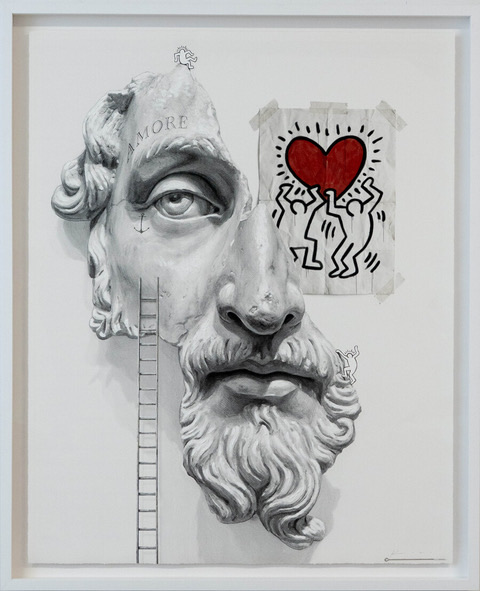
Kozo
Amore, 2026
His Japanese aesthetic influences link him to a lineage of artists for whom craft and spirituality are not separate concerns but a single practice. The tags that follow his work, conceptual art, contemplative art, Zen Buddhism, material practice, handmade paper, are not marketing categories but genuine descriptions of a practice that takes all of these traditions seriously. He is also a printmaker and an artist who works in artist books, which speaks to a belief that art should live in many forms and reach many hands. What makes Kozo matter in this particular cultural moment is his insistence on permanence and intention in an age of disposable imagery.
We live surrounded by images that cost nothing to produce and nothing to discard. Kozo's practice runs against that current with enormous force. Every work he makes carries the marks of a slow, deliberate, irreversible commitment. Whether on skin or stone or paper, the act of tattooing is a vow, a declaration that this image is worth keeping forever.
That philosophy, rooted in something close to the contemplative traditions his work references, gives his art a gravity that collectors and viewers feel immediately even when they cannot immediately name it. As his fine art practice continues to develop and his 2026 works find their way into collections, Kozo is making a case that the most radical thing an artist can do right now is insist that permanence still matters.