Katsushika Hokusai

Hokusai: The Wave That Moves Everything
Artist Spotlight · The Collection Editorial
“From the age of six I had a mania for drawing the shapes of things. When I was fifty I had published a universe of designs.”
Postscript to One Hundred Views of Mount Fuji, 1834
There is a moment, standing before a first edition impression of Under the Wave off Kanagawa, when the scale of what Katsushika Hokusai achieved becomes almost vertiginous. The wave rears and curls, its foam claws reaching toward a serene, indifferent Mount Fuji in the distance, and the three small fishing boats beneath it seem less like vessels in peril than brushstrokes in an argument about the nature of time itself. This print, created around 1831 as part of the celebrated series Thirty six Views of Mount Fuji, has become arguably the most reproduced artwork in human history. Yet its presence on the walls of the Metropolitan Museum of Art, the Art Institute of Chicago, the British Museum, and the Bibliothèque nationale de France speaks not merely to its ubiquity but to its absolute mastery.
![Katsushika Hokusai — Kanagawa oki nami ura (Under the well of the Great Wave off Kanagawa) [“Great Wave”]](https://rtwaymdozgnhgluydsys.supabase.co/storage/v1/object/public/artwork-images/auction-lots/japanese-and-korean-art-24346-nyr-lot84.jpg)
Katsushika Hokusai
Kanagawa oki nami ura (Under the well of the Great Wave off Kanagawa) [“Great Wave”]
Every major survey of Japanese art that has passed through Western institutions in recent decades has returned to Hokusai as its gravitational center, and the appetite among collectors for works from across his staggering output shows no sign of relenting. Katsushika Hokusai was born in 1760 in the Honjo district of Edo, the city we now know as Tokyo. The details of his earliest years are somewhat obscure, as was common for those of modest birth in Tokugawa period Japan, but it is believed he was the son of an artisan, possibly a maker of mirrors for the shogunate. He entered the workshop of the ukiyo e master Katsukawa Shunsho around 1778, where he trained in the tradition of depicting kabuki actors and the floating world of entertainment districts that defined so much of the Edo period popular imagination.
This apprenticeship gave him technical foundations of extraordinary rigor, but Hokusai was constitutionally unsuited to remaining within a single tradition. After the death of Shunsho in 1793, he began to wander freely through styles and influences, studying Dutch and Chinese painting, Western perspective, and the full range of classical Japanese imagery. This restlessness was not uncertainty. It was appetite.
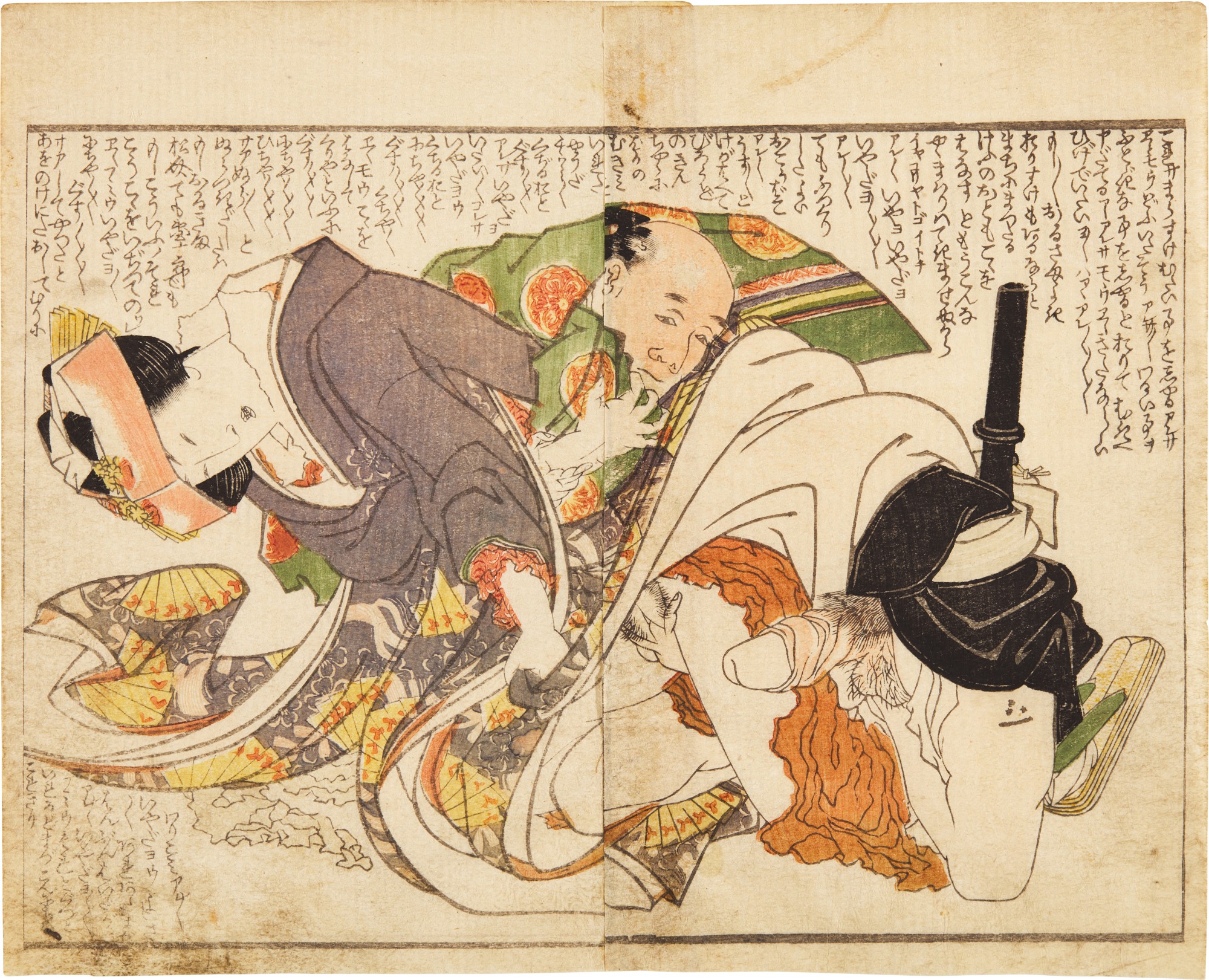
Katsushika Hokusai
Three shunga woodblock-printed book plates | Edo period, 19th century
Over the course of a career spanning nearly seven decades, Hokusai worked under at least thirty different names, a practice that was common among Japanese artists of the period but that Hokusai took to unusual extremes. Each name marked a new phase, a shedding of the previous self in favor of something more refined or more ambitious. He worked as an illustrator of popular fiction, producing thousands of book illustrations in the genre known as kibyoshi and gokan. He created the multivolume Hokusai Manga, a collection of sketches that ran to fifteen volumes from 1814 onward, depicting everything from birds and fish to wrestlers, ghosts, and geometric studies.
“All I have produced before the age of seventy is not worth taking into account.”
Postscript to One Hundred Views of Mount Fuji, 1834
These were not cartoons in any diminished sense. They were encyclopedic acts of visual thinking, and they would later astonish European artists who encountered them in the second half of the nineteenth century. The period of Hokusai's greatest achievement as a printmaker came relatively late in his long life. He was in his early seventies when he began the Thirty six Views of Mount Fuji, a series that ultimately expanded to forty six prints and that redefined what landscape printing could accomplish.
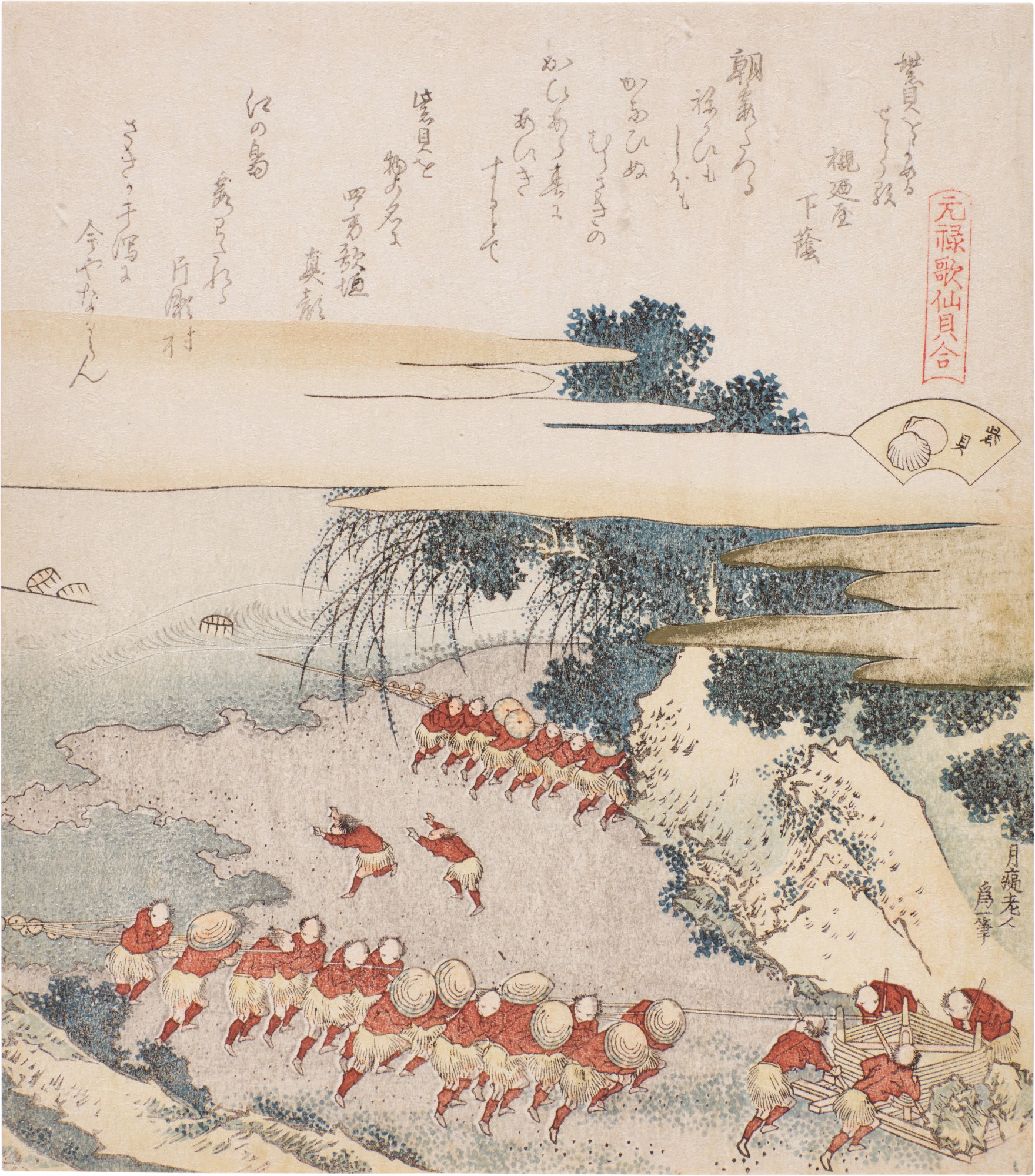
Katsushika Hokusai
The Purple Shell (Murasaki-gai) | Edo period, 19th century
The series introduced the bold Prussian blue pigment that had become available in Japan through Dutch trade, and Hokusai used it with a structural confidence that changed the visual language of the medium. Under the Wave off Kanagawa is the series' most famous work, but the moody grandeur of Rainstorm Beneath the Summit, which appears on The Collection as Sudden Rain beneath the Summit, and the quiet geometric poetry of Clear Day with a Southern Breeze show that the achievement was not a single fortunate moment but a sustained vision operating at full power. Works from this period available on The Collection, including multiple impressions of the Great Wave in various states and the beautifully composed Shichirigahama Beach, Sagami Province, offer collectors a direct encounter with this vision. Hokusai's shunga, the explicitly erotic woodblock prints that were a respected and lucrative part of ukiyo e production, deserve serious consideration alongside his landscapes.
The illustrated book Kinoe no Komatsu, first published around 1814 and represented on The Collection by three plates from a later re carved edition, is widely regarded as among the finest examples of the genre ever produced. The compositions are intimate and psychologically rich, combining technical virtuosity with a humanity that distinguishes them from mere provocation. Collectors of Japanese prints who overlook the shunga tradition miss a significant dimension of Hokusai's range and of Edo period visual culture more broadly. Major auction houses including Christie's and Sotheby's have seen consistent demand for quality Hokusai prints across all categories, with fine impressions of the Thirty six Views series achieving prices well into the hundreds of thousands of dollars at recent sales.
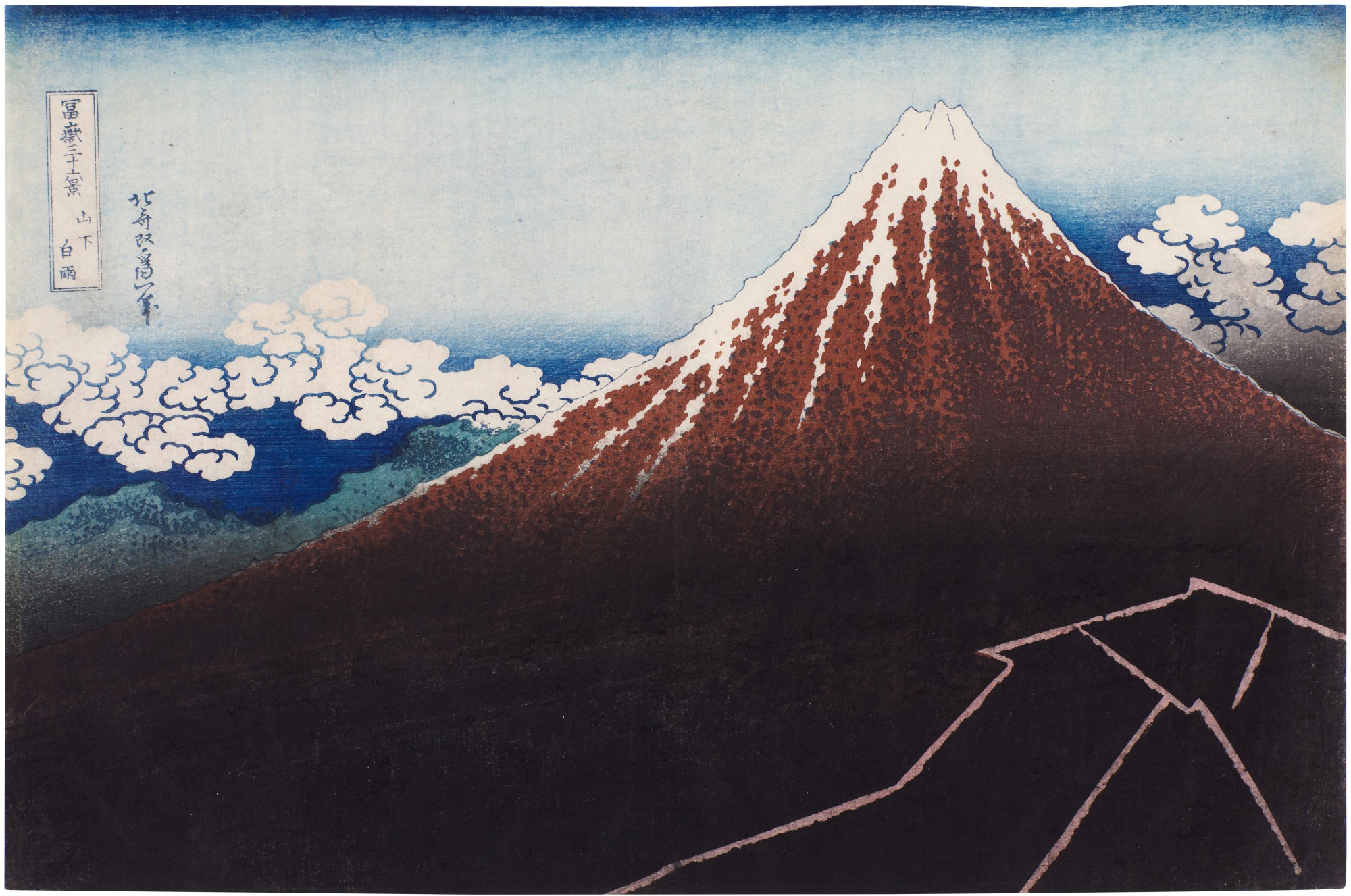
Katsushika Hokusai
Sudden Rain beneath the Summit (Sanka haku-u) | Edo period, 19th century
Works from the Tokaido series, including the Horaiji Temple in Spring and Yahagi Bridge at Okazaki on the Tokaido available on The Collection, offer collectors a more accessible entry into the market while retaining genuine historical and aesthetic weight. To understand Hokusai fully, it helps to place him within the broader constellation of ukiyo e masters and the artists he influenced. His great contemporary Utagawa Hiroshige pursued a similar ambition in landscape printing, and the two are often discussed together, though Hiroshige's sensibility was more lyrical and atmospheric where Hokusai's was structural and almost confrontational. Earlier masters including Kitagawa Utamaro and Torii Kiyonaga defined the figure centered tradition from which Hokusai partly departed.
In the West, the phenomenon known as Japonisme, the deep influence of Japanese prints on European art in the late nineteenth century, is traceable in large part to Hokusai. Edgar Degas collected his prints. Claude Monet arranged his home at Giverny with Japanese woodblocks on nearly every wall. Vincent van Gogh copied Japanese prints directly and wrote about them with reverence in his letters to his brother Theo.
Hokusai died in 1849 at the age of eighty eight, reportedly lamenting that he had not been given ten more years, or even five, to become a truly great artist. It is perhaps the most extraordinary artistic understatement in recorded history. He left behind an output estimated at over thirty thousand works, encompassing prints, paintings, illustrated books, and drawings. What makes him matter today is not simply the scale of that achievement but its quality of attention, the sense that every subject, whether a crashing wave or an amorous couple or a wooden bridge over a provincial river, was worthy of the most rigorous and joyful visual intelligence a human being could bring to bear.
For collectors, engaging with Hokusai is engaging with one of the great minds in the history of art, a mind that was still urgently, hungrily at work almost until its last breath.
Explore books about Katsushika Hokusai
Hokusai: A Life
Christopher Harding
Hokusai
Matthi Forrer
The Great Wave: The Influence of Japanese Woodcuts on Western Art
Hilary Beck

Hokusai and His Age
Edo Tokyo Museum

The Art of Hokusai
James A. Michener
Hokusai: Prints and Drawings
British Museum Press
Katsushika Hokusai: 1760-1849
Metropolitan Museum of Art