Julie Mehretu
Julie Mehretu Maps the World Anew
Artist Spotlight · The Collection Editorial
“I want the work to be a place where you can feel the weight of history and also the possibility of something else.”
Julie Mehretu, interview with Bomb Magazine
In 2023, Julie Mehretu unveiled "The Wine Dark Sea," a monumental ink and acrylic canvas that confirmed what the art world has known for two decades: she is one of the most consequential painters alive. The work, luminous and vertiginous in equal measure, pulses with the energy of a civilization in perpetual motion, its layered marks accruing meaning the way history accrues trauma and beauty simultaneously. Mehretu has long been the artist critics reach for when they want to describe the feeling of living inside information overload, inside geopolitical rupture, inside the thrilling and terrifying now. That she achieves this through painting, through the oldest and most intimate of mediums, makes her achievement all the more remarkable.
Julie Mehretu
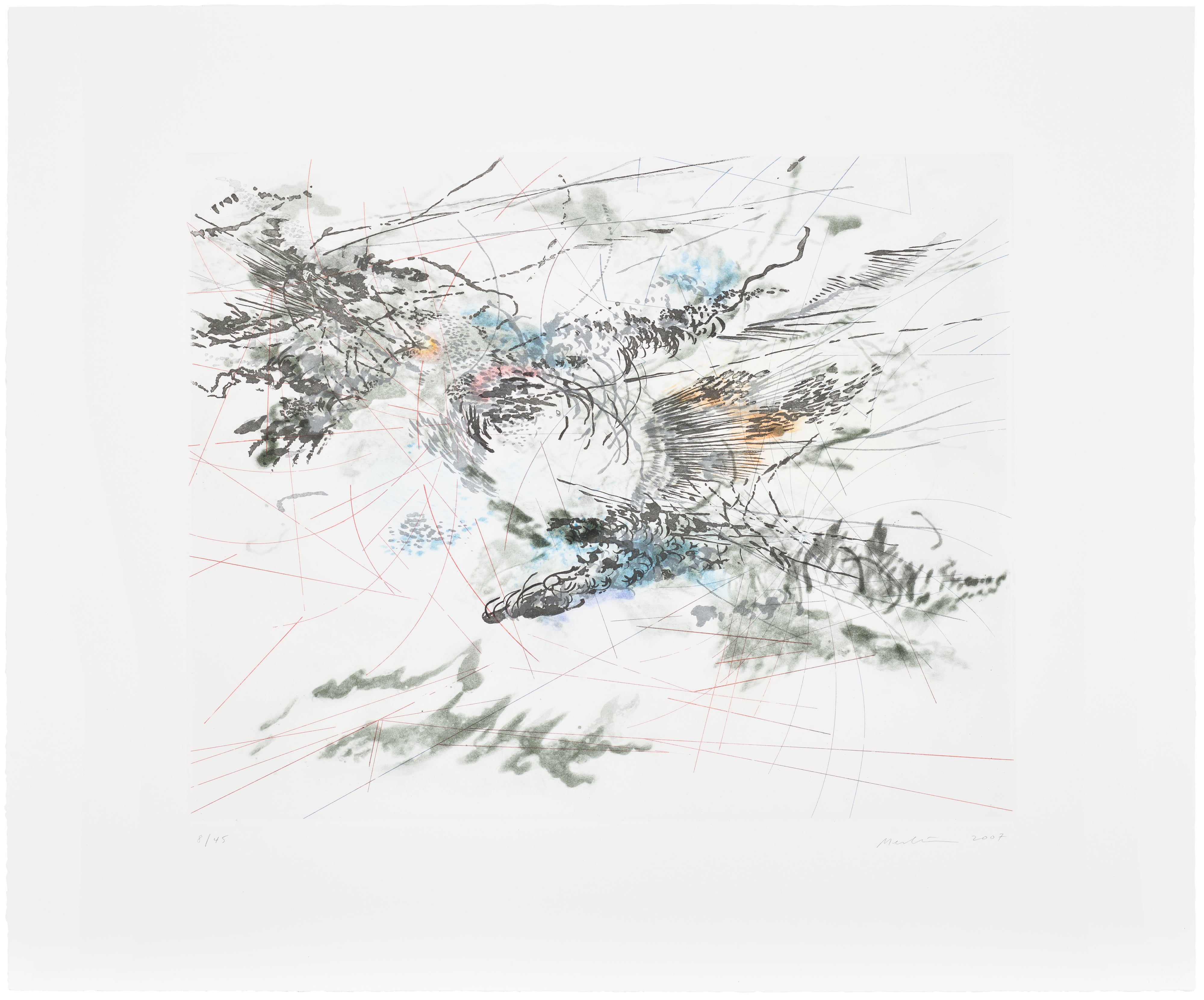
Sapphic Strophe 3, 2011
Julie Mehretu was born in 1970 in Addis Ababa, Ethiopia, the daughter of an Ethiopian father who was an economics professor and an American mother who taught Montessori. The family relocated to East Lansing, Michigan, when Mehretu was a child, and it is that experience of displacement, of holding two worlds inside oneself at once, that would quietly animate everything she would later make. Growing up between cultures, between continents, between systems of meaning, gave her an instinctive sensitivity to the layered and the contested. East Lansing was a long way from Addis Ababa, and the distance between them became a kind of generative creative space.
She studied at Kalamazoo College before earning her Master of Fine Arts from the Rhode Island School of Design in 1997. Her time at RISD sharpened her formal vocabulary and introduced her to the rigorous traditions of printmaking alongside painting, a dual fluency that would define her practice for years to come. She deepened her formation through the prestigious CORE Program residency at the Glassell School of Art in Houston, which brought her into contact with a serious and ambitious peer group and allowed her the time and space to develop the visual language that would make her name. By the late 1990s and early 2000s, working out of New York, she was building something entirely her own.
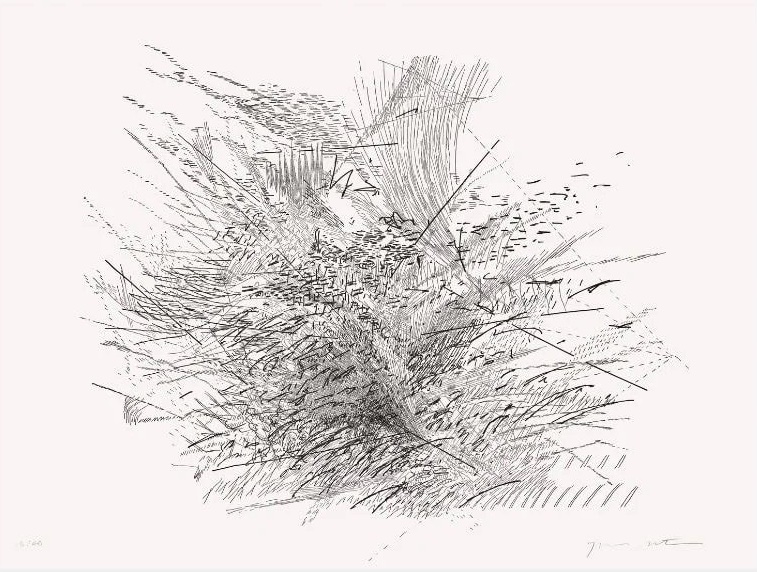
Julie Mehretu
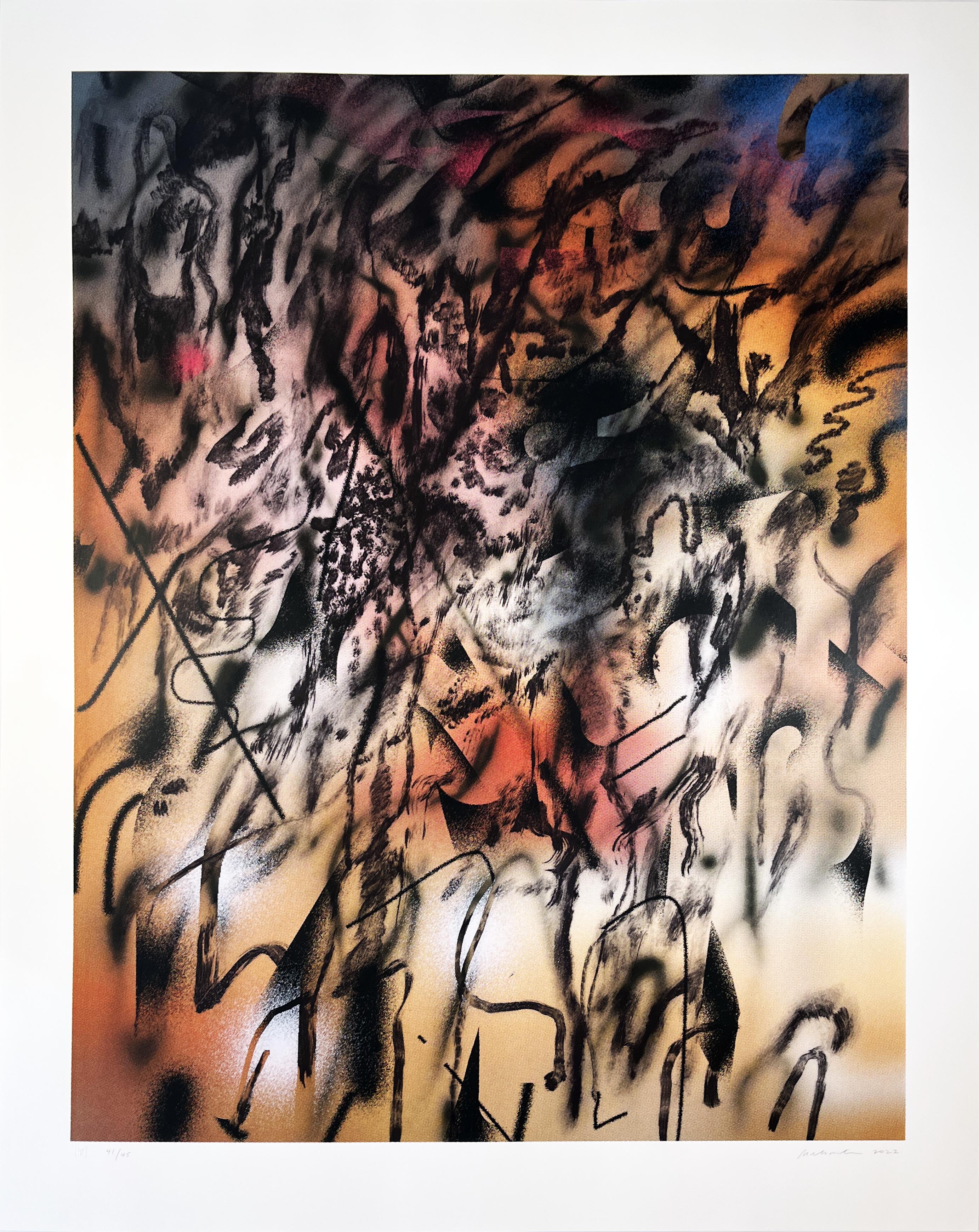
Corner of Lake and Minnehaha, 2022
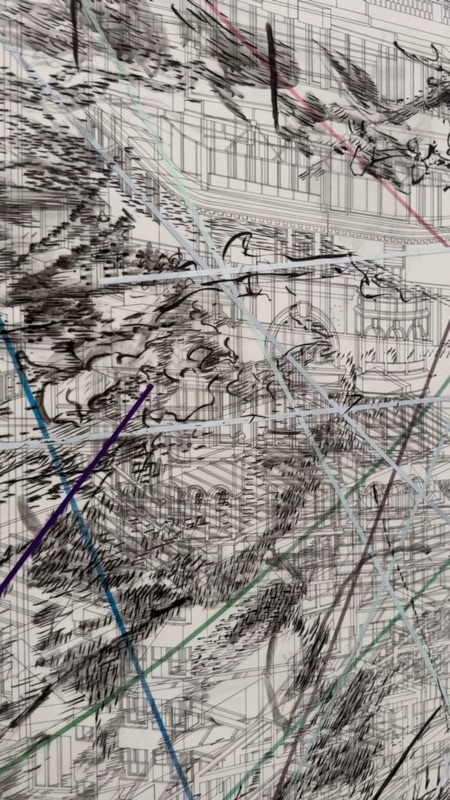
Mehretu's breakthrough came with works that collapsed the distinction between map and painting, between architectural drawing and gestural abstraction. She would begin a canvas by layering printed or hand drawn source material beneath translucent grounds: aerial views of cities, stadium plans, colonial era maps, military diagrams, the infrastructure of power rendered in meticulous graphite and ink. Over these foundations she would unleash cascading marks, calligraphic bursts, smoke like smears, velocity lines that suggested crowds or weather or the movement of capital. The effect was simultaneously precise and wild, controlled and erupting.
“Painting is a language that allows me to think through things I cannot think through in any other way.”
Julie Mehretu, interview with The Guardian
"Stadia I," completed in 2004, stands as one of the defining works of this period, its arena plan becoming an arena for something far more volatile than sport, a meditation on mass gathering, on collective force, on who gets to occupy public space. Her large scale canvases earned her a MacArthur Fellowship in 2005, colloquially known as the genius grant, a recognition that placed her among the most significant thinkers working in any discipline in America. Major museums collected her work with urgency. The Museum of Modern Art in New York, the Walker Art Center in Minneapolis, the San Francisco Museum of Modern Art, and the Guggenheim all hold significant examples of her painting.
Julie Mehretu
Untitled
In 2009 she was commissioned to create a monumental mural for the Goldman Sachs headquarters in New York, a work spanning over twenty meters that brought her practice into one of the most visible architectural contexts imaginable. The commission was not without debate, but the painting itself, titled "Mural," was undeniable: a world in formation, beautiful and unresolved. Mehretu's prints deserve particular attention from collectors, and they represent one of the most rewarding entry points into her practice. Works such as "Sapphic Strophe 3" from 2011, a relief print from a letterpress plate on Italian mould made Revere Paper, and "Corner of Lake and Minnehaha" from 2022, a seventeen run screenprint on Coventry Rag, demonstrate the full complexity of her vision at an intimate scale.
These are not secondary works or reproductions of paintings. They are independent investigations, each one resolving the tensions between architecture and gesture, between the fixed and the fluid, with extraordinary technical refinement. The screenprint series around "Corner of Lake and Minnehaha" is particularly compelling, with color variants including the luminous blue edition offering collectors the experience of watching a single vision breathe differently across iterations. In the collecting market, Mehretu occupies a position of genuine blue chip stability paired with continued critical momentum, a combination that is increasingly rare.
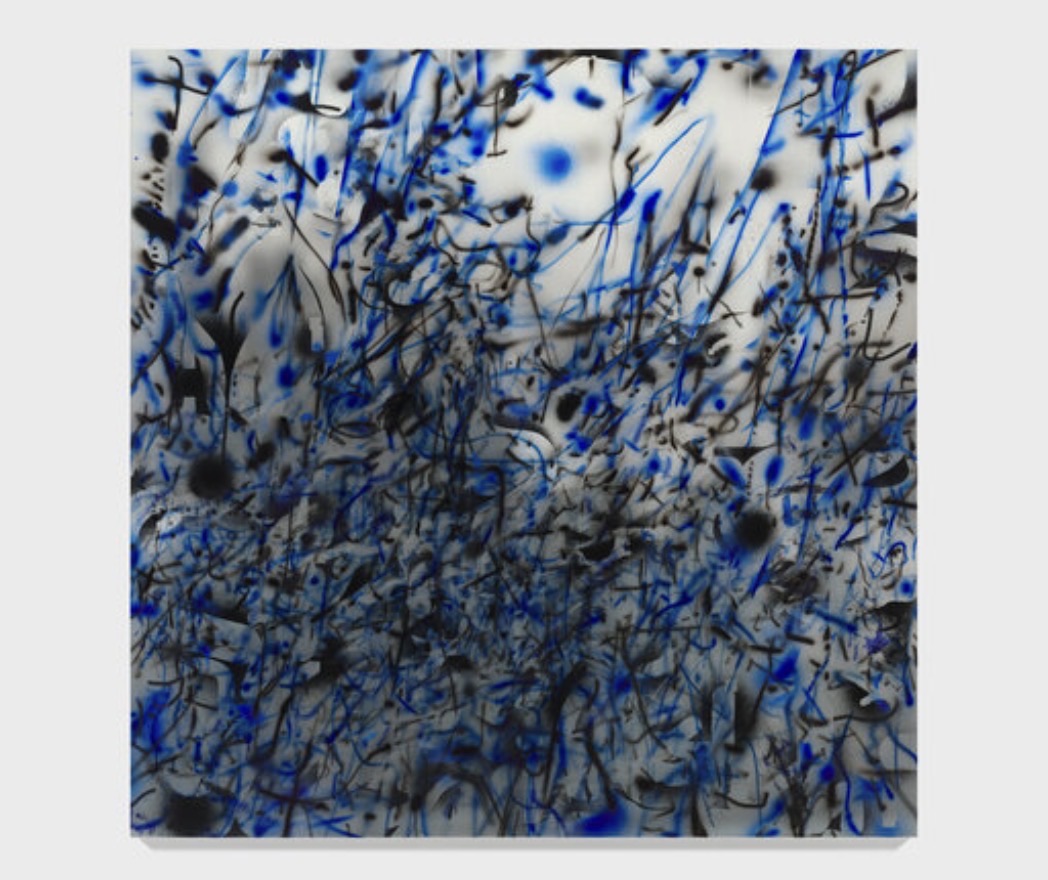
Julie Mehretu
The Wine-Dark-Sea, 2023
Her auction records reflect sustained institutional and private demand, with major canvases achieving prices in the millions at Christie's, Sotheby's, and Phillips. Collectors who came to her work in the early 2000s have watched their acquisitions grow not only in monetary value but in cultural resonance, as the themes she explored then have only become more urgent. For those approaching her work now, works on paper, prints, and smaller canvases offer meaningful access to a practice whose large scale paintings increasingly reside in institutions. Condition, provenance, and the specificity of the edition matter greatly in the print market, and works published through respected print studios command particular confidence.
To place Mehretu in art historical context is to understand how she synthesizes and transcends her influences. She draws on the gestural energy of the Abstract Expressionists, particularly Franz Kline and Willem de Kooning, while rejecting their studied indifference to political content. She shares with Cy Twombly a love of mark as language, of the line as bearer of historical weight. Her engagement with space and infrastructure resonates with Gordon Matta Clark and the tradition of institutional critique.
Yet Mehretu's Africanness, her diasporic subjectivity, her gender, her politics, and her generation make her something new, an artist for whom the global and the personal are genuinely inseparable rather than theoretically linked. Julie Mehretu matters today because the questions her work poses have not been answered and show no sign of being answered soon. What does it mean to live inside systems too large and too fast to perceive clearly? How do we map the forces that shape us?
Where is home when home is also a historical wound and a future aspiration? Her canvases do not resolve these questions. They hold them open with tremendous beauty and seriousness, inviting the viewer to stand inside the complexity rather than flee from it. That is the rarest and most generous thing a painting can do.